Adult Tricycle Accessories: 10 Must-Haves for Safer, More Comfortable Rides
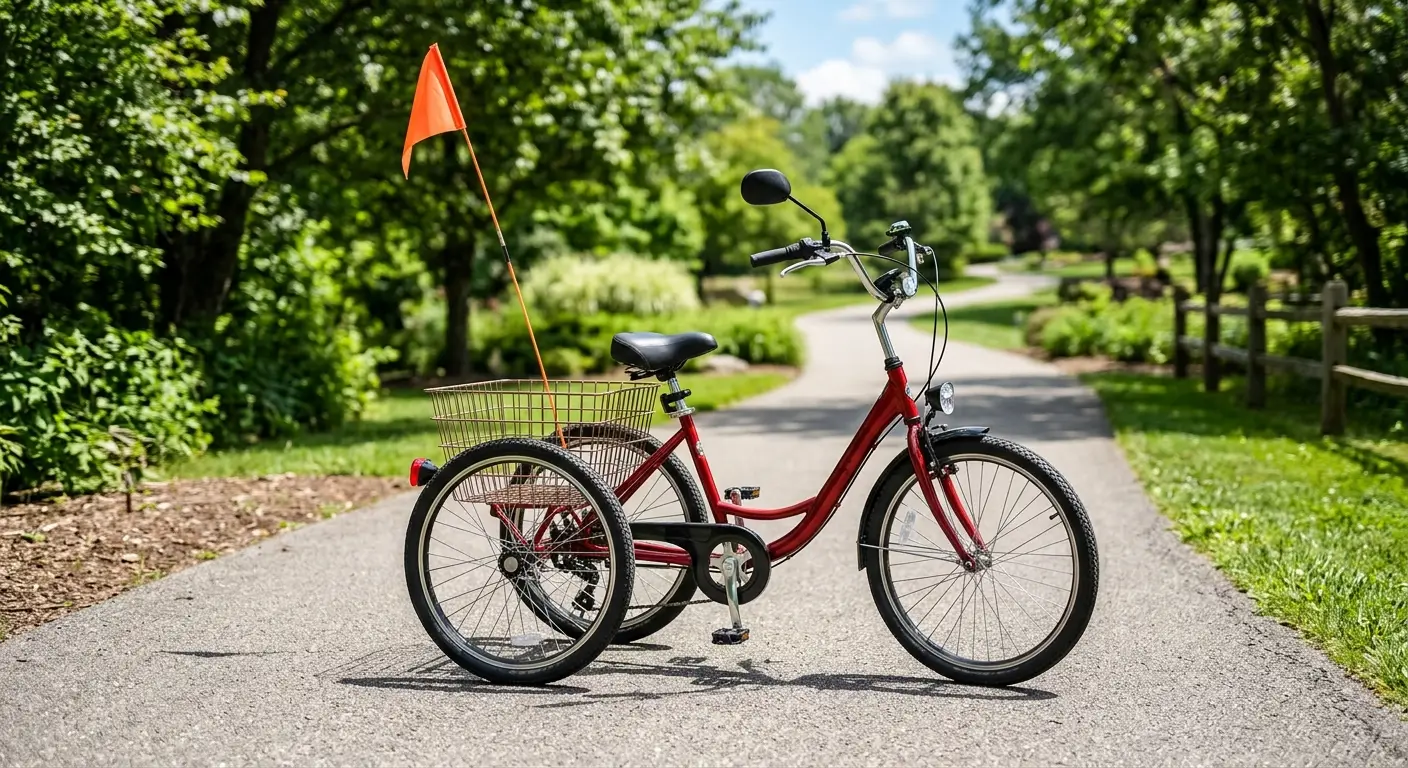
A tricycle already solves the biggest worry for many riders: it stays upright when you stop. But the right adult tricycle accessories decide whether you ride once a week or every day. Cargo space, visibility, and comfort are what turn a trike into a real mode of transport and a reliable way to stay active.
Think of the bike itself as the engine and the add-ons as the tools that make it useful. Some accessories fix problems you will notice in the first week, such as a sore seat or nowhere to put groceries. Others protect you from problems you hope never to meet, such as a driver who does not see you at dusk.
This guide ranks the most useful trike accessories for adults, explains who needs each one, and shows how to choose without wasting money. If you are still choosing the trike itself, start with our best adult tricycle reviews and come back here to build your kit.
Quick Answer: What Are the Best Adult Tricycle Accessories?
Top pick: a rear cargo basket. Budget pick: a rearview mirror plus reflectors. Upgrade pick: a high-visibility kit with a safety flag and front and rear lights. Add a certified helmet and a padded seat, and you cover safety, comfort, and carrying capacity for most riders.
Why Adult Tricycle Accessories Matter More on a Trike
A trike has a wider footprint than a bicycle, so drivers judge your position differently. It also leans less in turns, so extra weight placed badly can change how it handles. That is why accessories on a tricycle are about more than convenience.
Regular riding also supports your health goals. The CDC guidance for adults 65 and older calls for aerobic activity, muscle-strengthening activity, and balance activities each week. Trike riding counts toward the aerobic part, and the leg work involved helps with the strengthening side. Comfortable, well-equipped gear makes it far easier to keep going.
If you are new to three-wheel riding, read our guide to riding a tricycle first. It covers turning, starting, and braking, which affect how you load and place every accessory below.
Comparison Table: Adult Tricycle Accessories at a Glance
Prices below are general ranges only. Check current listings before you buy [VERIFY].
| Accessory | Key spec to check | Best for | Price range |
|---|---|---|---|
| Rear cargo basket | Weight rating, mounting fit | Errands, shopping | Low to mid [VERIFY] |
| Seat cushion | Gel or foam, cover type | Longer rides, sore sit bones | Low [VERIFY] |
| Rearview mirror | Mount type, glass vs. plastic | Riders with neck stiffness | Low [VERIFY] |
| Lights and reflectors | Front and rear, flashing mode | Dawn, dusk, shaded paths | Low to mid [VERIFY] |
| Safety flag | Height, bright color | Road and shared-lane riding | Low [VERIFY] |
| Helmet | CPSC label, fit system | Every rider | Low to mid [VERIFY] |
| Cup and phone holder | Clamp size, grip security | Daily commuters | Low [VERIFY] |
| Weather cover | Fit to your frame, vented | Outdoor storage | Low to mid [VERIFY] |
| Lock and cable | Length, lock type | Public parking | Low to mid [VERIFY] |
| Grips and mitts | Diameter, padding | Hand numbness, arthritis comfort | Low [VERIFY] |
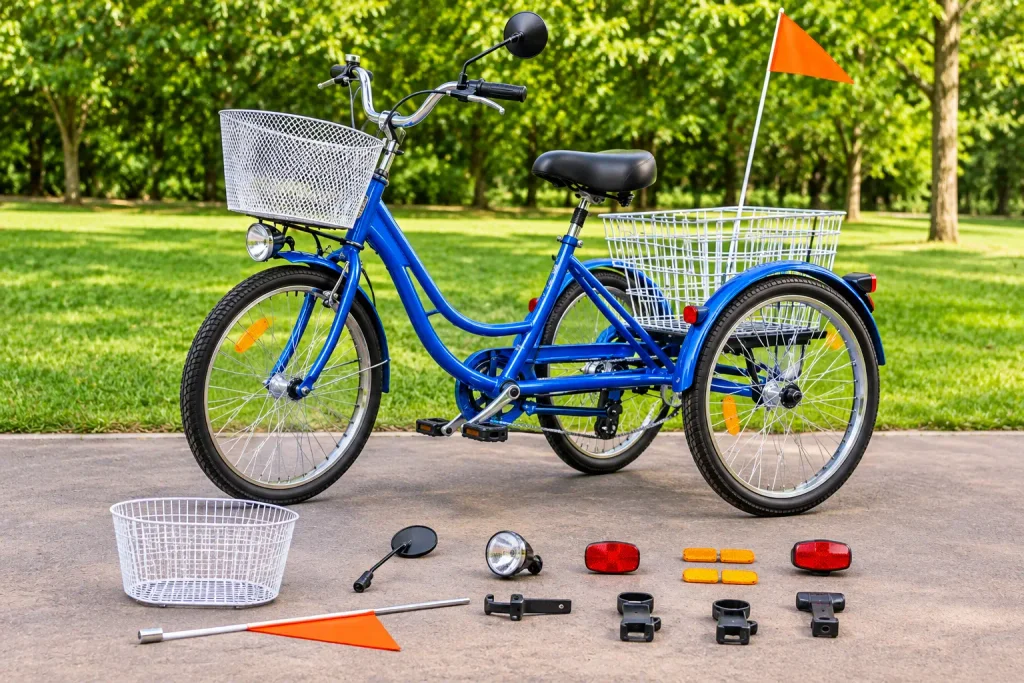
The 10 Best Adult Tricycle Accessories
1. Rear Cargo Basket
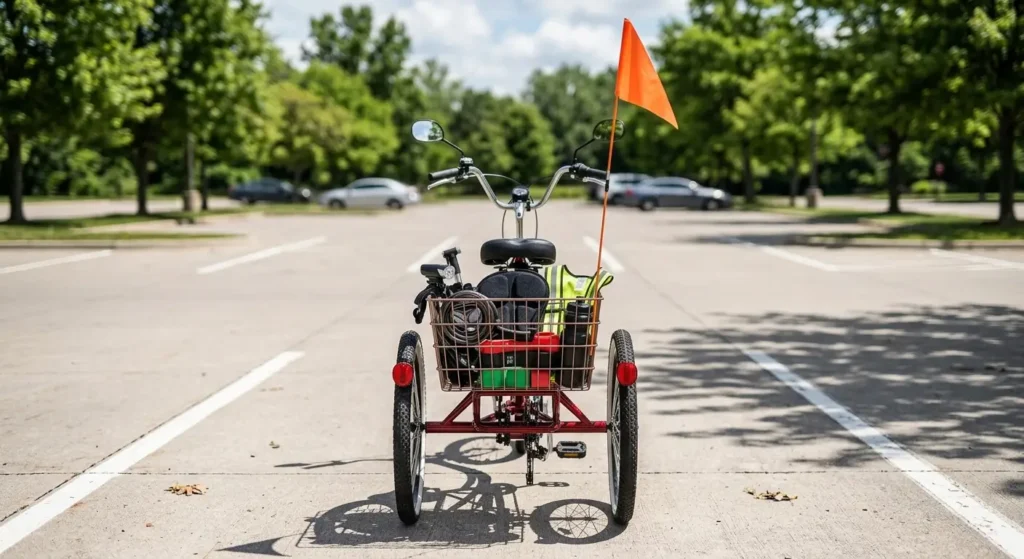
A basket is usually the first item to buy for an adult tricycle. It turns a pleasant ride into a trip to the market, the library, or the garden center.
Who it’s for: anyone running errands or carrying a water bottle, jacket, and groceries.
Key features: look for a stated weight rating, a sturdy frame, and a design that sits low and centered between or behind the rear wheels. Many large rear baskets are rated somewhere in the range of 25-50 lb (11-23 kg) [VERIFY with the manufacturer’s page for your exact model]. Basket dimensions vary widely, so measure your available space in inches (cm) before ordering.
Pros:
- Large capacity for the money
- Keeps weight off your back and shoulders
- Works with most trike frames
Cons:
- Overloading can affect handling
- Some baskets rattle if not tightened properly
Coach’s Tip: Pack heavy items on the bottom and in the center of the basket. A low center of gravity keeps the trike steadier in turns, which is the moment a trike feels least like a bike.
2. Padded Seat or Seat Cushion
Comfort is a safety issue. A rider who dreads the seat rides less, and less riding means fewer of the activity benefits described by the National Institute on Aging [VERIFY URL]. NIA lists endurance, strength, balance, and flexibility as the four pillars of exercise for older adults.
Who it’s for: riders on stock saddles, longer rides, or anyone with sensitive sit bones.
Key features: gel or high-density foam, a non-slip bottom, and a cover that sheds rain. A cushion should add comfort without raising your seat so much that your feet struggle to reach the pedals.
Pros: inexpensive, easy to install, easy to swap.
Cons: a thick cushion can change your leg extension, and a cheap one can slide.
3. Rearview Mirror
On a trike, you cannot easily glance over your shoulder without drifting. A mirror lets you check traffic while keeping your eyes mostly forward.
Who it’s for: riders with neck stiffness, shoulder limits, or a busy route.
Key features: a mount that clamps firmly to the handlebar or an end bar, glass rather than polished plastic if you can, and an angle you can adjust without tools. If you want a trike with a recumbent setup, see our guide to 3-wheel recumbent bikes, where mirrors are even more important because your head sits lower.
Pros: better awareness, small and light.
Cons: vibration can blur the image, and a loose mount drifts out of position.
4. Lights and Reflectors
Lights are the single most important piece of safety gear for dawn and dusk riding. Yet many riders think they are more visible than they are.
A study in Accident Analysis & Prevention found that bicyclists overestimated how visible they were at night and underestimated the value of reflective markings at the ankles and knees. It also reported that flashing lights were linked to higher conspicuity than steady ones. That said, researchers note that the effect of conspicuity aids on actual crash risk is still being studied, so treat lights as a smart layer of protection, not a guarantee.
Who it’s for: everyone, including riders who only plan to ride in daylight. Weather and shade change that quickly.
Key features: a white front light, a red rear light with a flashing mode, side reflectors, and USB-rechargeable batteries so you can top them up indoors.
Pros: cheap insurance, easy to fit.
Cons: batteries die, and mounts need occasional tightening.
Common Mistake: Relying on a single small rear light and calling it done. Add reflective ankle bands or pedal reflectors, because moving reflective points help drivers recognize a human shape [VERIFY with a second source if you want to expand this claim].
5. Safety Flag
A tall, brightly colored flag lifts a visual cue above the roofline of parked cars. On a wide tricycle, this is useful in parking lots, driveways, and shared lanes.
Who it’s for: riders on streets with cars or in parking-heavy areas.
Key features: a rigid or flexible pole around 5 ft (1.5 m) high [VERIFY typical heights], a bright color, and a secure mount at the rear.
Pros: inexpensive, high visibility above vehicles.
Cons: it can whip in wind and be caught by low branches.
6. Helmet
A helmet is not an accessory so much as the baseline. A Cochrane systematic review found that helmets were associated with a 63-88% reduction in the risk of head, brain, and severe brain injury for bicyclists of all ages. The review is older, and it covers bicycles rather than trikes specifically, but the protective principle is the same.
Who it’s for: every rider, every ride.
Key features: a CPSC certification label inside, a dial-fit system, and adjustable straps. Fit it level on your head, about two fingers above the eyebrows.
Pros: strong evidence of benefit.
Cons: needs replacing after a significant impact, and a poor fit reduces its value.
Not sure about shoes? Our commuter bike shoes guide covers footwear that grips the pedal and keeps your feet planted.
7. Cup and Phone Holder
Small, but it keeps your hands on the grips. Holding a phone or bottle while steering a trike is a real risk.
Who it’s for: commuters, riders who use navigation, and anyone who needs a drink on a hot day.
Key features: a clamp that fits your handlebar diameter, a rubber insert so bottles do not rattle, and a case that keeps the phone dry.
Pros: frees your hands, tidy cockpit.
Cons: overloaded handlebars can feel front-heavy.
8. Weather Cover
A trike is bulky, so many owners leave it outside or in a shed. A properly fitted cover keeps rain, sun, and dust off the seat, cables, and electronics.
Who it’s for: riders without garage space.
Key features: a cut sized to three-wheel frames (not a standard bike cover), vents to stop condensation, and tie-down straps.
Pros: protects the finish and seat.
Cons: a poorly fitted cover traps moisture.
9. Lock and Cable
A trike is harder to carry off than a bike, but it is not impossible to move. A cable lock threaded through the frame and a wheel is a sensible deterrent.
Who it’s for: anyone who parks in public.
Key features: a thick, flexible cable long enough to reach a fixed post, plus a key or combination you will actually remember.
Pros: peace of mind.
Cons: adds weight, and cheaper cables can be cut quickly.
10. Ergonomic Grips and Padded Mitts
If your hands go numb, you may be gripping too tightly or resting too much weight on the bars. Wider, softer grips distribute pressure.
Who it’s for: riders with sensitive hands, wrist discomfort, or arthritis [check with a doctor or physical therapist about persistent hand pain].
Pros: comfort, inexpensive.
Cons: wrong diameter or poor installation can twist or slip.
How to Choose Adult Tricycle Accessories: A Buyer’s Checklist
Before you buy, run through this list:
- Fit. Check your handlebar and frame diameter in inches (cm). Many accessory clamps cover a range of sizes, but not all.
- Weight rating. Never exceed the manufacturer’s stated limit for the basket or rack [VERIFY for your model].
- Space. Make sure accessories do not block pedals, brake levers, or mounting steps.
- Budget. Prioritize safety (helmet, lights, mirror), then comfort, then cargo, then convenience.
- Warranty and returns. Cheap accessories often fail first at the mount, so choose sellers with easy returns.
- Weather. If you ride in rain, look for sealed lights and water-resistant covers.
Coach’s Tip: Install one accessory at a time and take a five-minute test ride after each. That way you know exactly which change affected the handling.
How We Picked These Adult Tricycle Accessories
We ranked each item on four criteria: safety value, practical use for adult riders, ease of installation, and general availability. We did not run lab tests, and we do not list brand-specific specs here because they change often. For exact weight limits, dimensions, and prices, always confirm on the manufacturer’s page [VERIFY].
We also leaned on the health research that matters most for riders in this age group. The CDC’s older-adult guidance and NIA’s exercise guidance both emphasize that regular movement, balance, and strength all matter, and that some activity is better than none.
Starter Kit vs. Full Kit of Adult Tricycle Accessories
Here is an easy way to scale your setup:
- Easier version (starter): helmet, rear light, and a rear reflector. Under half an hour to install.
- Standard version: add a mirror, a basket, and a seat cushion.
- Harder version (full): add a flag, phone holder, cover, and lock.
If weather keeps you indoors, a pedal exerciser can keep your legs moving between rides. Our guide to stationary bikes for older adults covers a more complete option. And if you are weighing a trike against two-wheeled options, see our bicycles for older adults roundup.
Setup and Maintenance Tips for Adult Tricycle Accessories
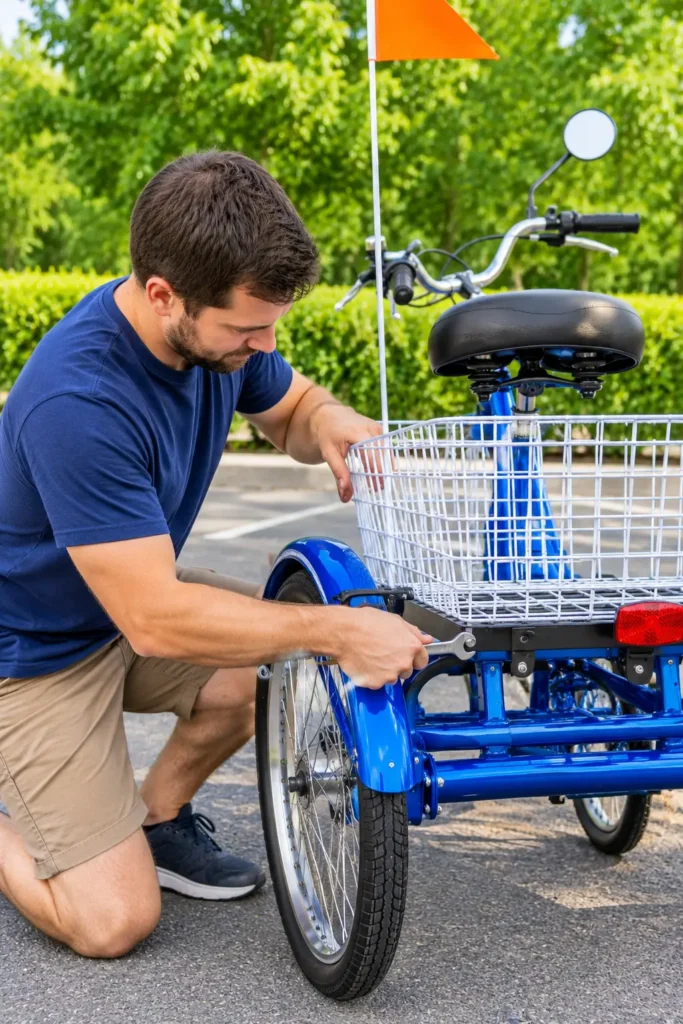
- Tighten twice. Re-check bolts after your first week. Vibration loosens clamps.
- Balance the load. Spread weight evenly and low. Avoid hanging heavy bags from the handlebars.
- Clean the lights. Wipe lenses every few rides, and charge batteries on a schedule.
- Check tire pressure. Follow the number printed on the tire sidewall [VERIFY for your tires].
- Inspect the flag and mounts. Replace any that crack or fade.
- Ride a quiet loop first. Practice turns with your new load before you hit the street.
Common Mistake: Overloading the basket and then taking a sharp turn at speed. Slow down before the turn, not in it.
Who Should Be Careful
If you have dizziness, balance problems, joint pain, heart or lung conditions, or you have not exercised in a long time, check with a doctor or physical therapist before starting a riding routine. NIA advises older adults to talk to a doctor before beginning a new exercise program if they have health conditions or are not used to energetic activity [VERIFY].
Frequently Asked Questions
What accessories does an adult tricycle need? At minimum, a helmet, lights or reflectors, and a way to carry items, such as a basket. A mirror is highly useful, and a flag helps on shared roads. Add comfort items like a cushion as you ride more.
What is the best basket for an adult tricycle? The best basket is one sized to your frame, with a clearly stated weight rating and a low, centered mounting position. Measure your available space in inches (cm) and confirm the limit with the maker [VERIFY].
Do adult tricycles need a flag? Not legally in most places [VERIFY local rules], but a flag adds visibility, especially in parking lots and near driveways. It is a low-cost layer of protection rather than a replacement for lights.
Can you put a mirror on an adult trike? Yes. Most mirrors clamp to the handlebar or bar end. Choose a stable mount, adjust it before you ride, and re-check it after the first few trips.
How do I make an adult tricycle more comfortable? Start with a padded seat or cushion, then adjust seat height so your leg is slightly bent at the bottom of the pedal stroke. Ergonomic grips can ease hand pressure.
Are lights required on an adult tricycle? Rules vary by state and city, so check your local laws [VERIFY]. Regardless of the law, lights and reflectors are a smart way to be seen at dawn, dusk, and in shade.
Conclusion: Build Your Adult Tricycle Accessories Kit in the Right Order
The best adult tricycle accessories are the ones you will actually use. Start with a helmet, lights, and a basket. Then add a mirror, cushion, and flag as your riding grows. Keep each addition simple, test it, and ride within your comfort zone.
Strong adult tricycle accessories do not need to cost much, but they do need to fit your trike and your route. Pick safety first, comfort second, and convenience third, and you will get more out of every ride.
