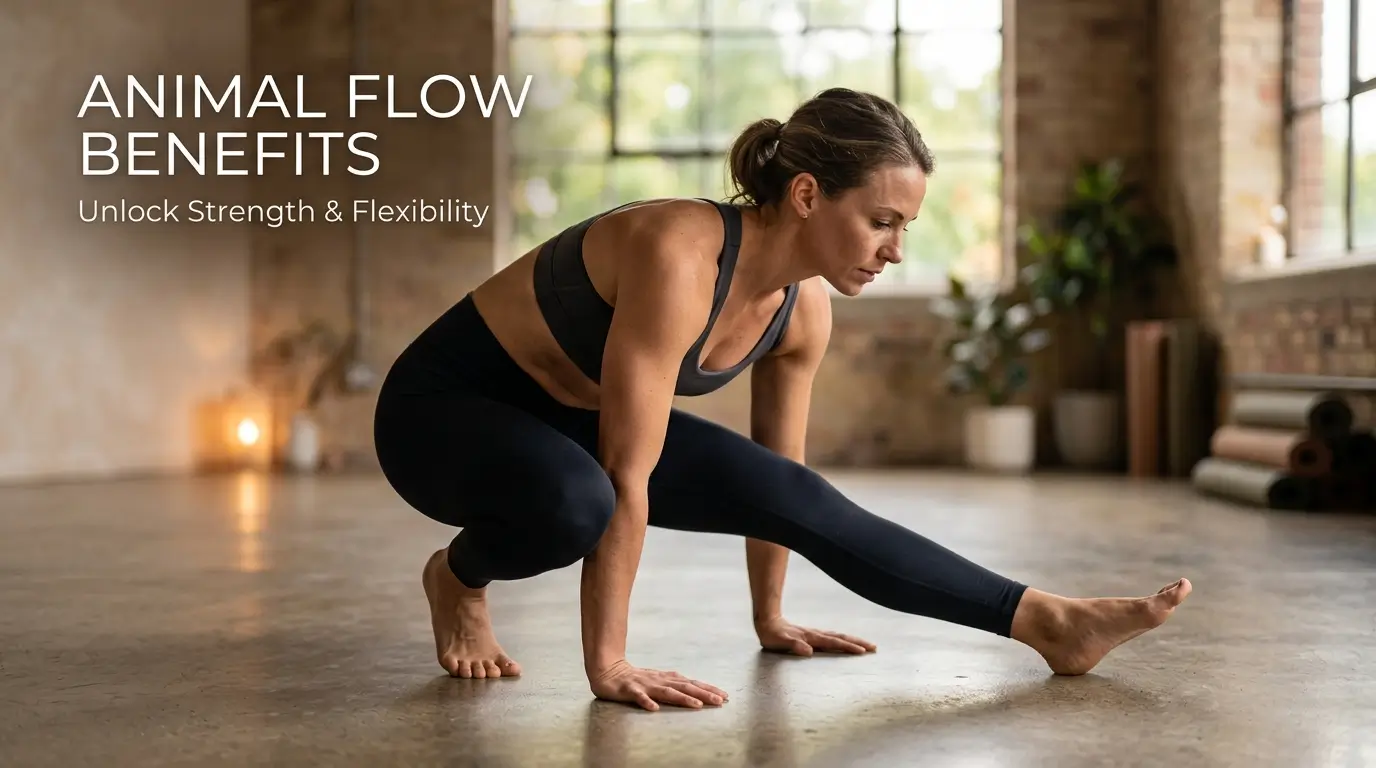
Most workouts train you to move up and down or back and forth. Animal Flow asks you to crawl, reach, rotate, and flow across the floor instead. The Animal Flow benefits go well beyond a fun change of pace, because the system builds strength, mobility, and body control at the same time.
I coach people who feel stiff, bored with their routine, or tired of machines. Animal Flow works well for them because it needs no equipment and very little space. It also teaches you to feel your body move. In this guide, you will learn what the system is, which muscles it works, how to do the basic moves, and how to start safely.
Quick Answer: The main Animal Flow benefits include better mobility, stronger shoulders and core, improved balance, and moderate-intensity cardio. Research on quadrupedal movement training suggests it may improve movement quality and fitness in healthy adults. It needs no equipment, so beginners can start at home.
What Is Animal Flow?
Animal Flow is a bodyweight system created by fitness coach Mike Fitch. It belongs to a style called quadrupedal movement training, or QMT. In plain terms, you move on all fours, linking animal-inspired positions into smooth sequences.
The system is built from six parts: wrist mobilizations, activations, form-specific stretches, traveling forms, switches and transitions, and flows. Think of them as a warm-up, a skill block, and a finishing sequence. Each part trains a different quality, so you get a full session in about 20 to 40 minutes.
Moreover, the moves are named after animals for a reason. A “Beast” position looks like a crouching cat with the knees hovering above the floor. A “Crab Reach” has you facing the ceiling with your hips lifted. These shapes load the body in ways that machines and standard gym lifts rarely do.
Muscles Worked in Animal Flow
Because you carry your own body weight on your hands and feet, nearly every muscle joins in. The load is not heavy in pounds, but the positions are demanding. As a result, you build control as well as strength.
Primary muscles:
- Shoulders and upper back: the deltoids, rotator cuff, and serratus anterior keep your shoulder blades steady while you hold and travel on your hands.
- Core: the abs, obliques, and deep trunk muscles stop your spine from sagging or twisting.
- Hips and glutes: these muscles drive crawling, stepping, and the reaching shapes.
Secondary muscles:
- Forearms and wrists: gripping the floor and bearing weight challenge these small but important areas.
- Quads and hamstrings: they work every time you lower, lift, or step through.
- Chest and triceps: as in a push-up, they support you in the lowered and held positions.
In short, Animal Flow trains your shoulders, core, and hips as one connected unit. If you enjoy simple bodyweight work, you may also like our calisthenics exercises list, which pairs nicely with this style.
The Top Animal Flow Benefits
Research on this style is still young, and most studies are small and use healthy young adults. Therefore, treat the findings below as promising rather than guaranteed. Here are the Animal Flow benefits that coaches and researchers talk about most.
1. Better Mobility and Range of Motion
Animal Flow moves your joints through big, controlled ranges. Your wrists, shoulders, spine, and hips all get a turn. Unlike static stretching, you build strength in those end ranges, which is where most people feel weak.
In one 8-week trial of 42 active college-age adults, researchers measured active range of motion before and after training. The Buxton et al. study in the Journal of Strength and Conditioning Research compared a QMT group with a control group. The QMT group showed larger improvements in Functional Movement Screen scores, a test of basic movement quality. These Animal Flow benefits for mobility may help you feel less stiff during daily tasks.
2. Stronger Core and Trunk Stability
Every crawl and hold asks your core to keep the spine steady while your arms and legs move. This is different from crunches. You learn to brace and breathe at the same time. Many of my clients feel their abs working within the first session, even though they never lie on their backs.
If core strength is your main goal, see our guide on how to flex your abs for a good companion skill.
Coach’s Tip: Keep your ribs “stacked” over your hips in every hold. If you feel your lower back arching, tuck your tailbone slightly and exhale. The effort should sit in your abs, not your lower back.
3. Upper Body Strength and Endurance
Holding yourself up on your hands is a real shoulder workout. The same study above also tracked handgrip strength and push-up endurance, along with balance and range of motion. Exact result sizes for each test should be checked in the full paper [VERIFY]. In practice, my clients notice that holds that felt shaky in week one feel steady by week four.
Animal Flow also reinforces the pressing muscles used in push-ups. For more on that, read our article on push-ups for biceps.
4. Improved Balance and Coordination
You change your base of support constantly in Animal Flow. One hand lifts, one leg sweeps through, and your body must adjust. This teaches balance in a way that standing exercises cannot match. The Y-Balance Test, which measures dynamic balance, was one of the measures used in the research above.
Coordination improves too. Linking moves into a flow trains your brain to plan, sequence, and adapt. In turn, better body awareness may carry over to sports and daily activity.
5. Better Joint Control and Shoulder Awareness
A 2016 study reported that four weeks of QMT improved markers of cognition and joint repositioning sense in young adults [VERIFY: confirm journal, authors, and URL before citing]. Joint repositioning sense is your ability to feel where a joint is without looking. In everyday terms, it is body awareness. Better awareness may help you move with fewer awkward strains.
6. Moderate-Intensity Cardio
Animal Flow can raise your heart rate more than you might expect. A study in Frontiers in Sports and Active Living compared a beginner Animal Flow class with treadmill walking. The authors concluded that the class met the American College of Sports Medicine’s criteria for moderate-intensity physical activity. That is useful, because adults are advised to get regular moderate activity each week. The CDC adult activity guidelines [VERIFY URL] recommend at least 150 minutes of moderate-intensity activity weekly, plus muscle-strengthening on two or more days.
The same article compared energy use with heart rate-matched walking. Check the paper for the exact calorie numbers before quoting them [VERIFY]. Either way, Animal Flow can count toward your weekly activity.
7. A Workout You Will Actually Keep Doing
This one gets overlooked. The best program is the one you repeat. Many people find Animal Flow more playful than lifting or running. It feels like exploring movement rather than grinding through sets. Consistency, therefore, becomes easier.
8. Low Equipment, Low Space, Low Cost
You need a mat and about 6 by 6 feet of floor, or roughly 72 by 72 inches (183 by 183 cm). That is the size of a small bedroom corner. If you live in a small place, our list of the best apartment workout equipment can help you add extras later.
These Animal Flow benefits stack up because one short session trains mobility, strength, and cardio together. However, they do not replace heavy lifting if your goal is maximal muscle size. Be honest about that goal when you plan your week.
How to Do the Basic Animal Flow Moves
Start with three simple moves. Learn them slowly before you link them. Use a mat that is about 0.5 inches (1.3 cm) thick so your wrists and knees stay comfortable.
Beast Position (Hold)
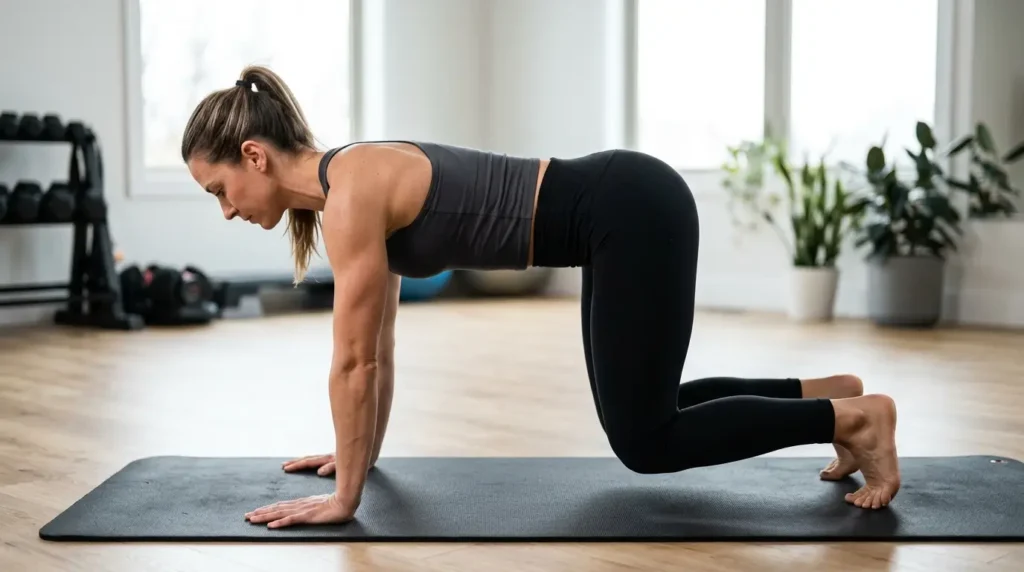
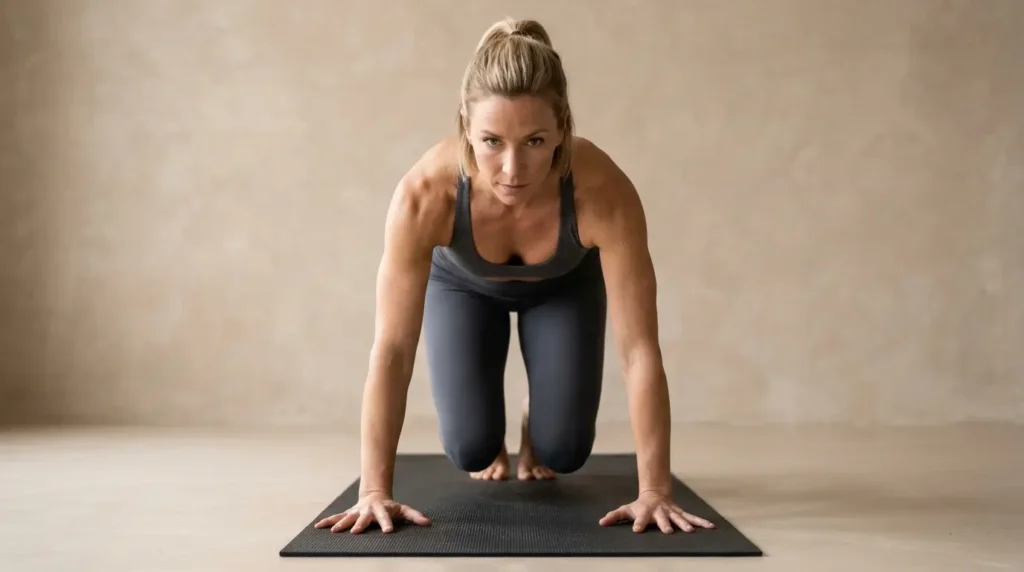
- Start on hands and knees, hands under shoulders and knees under hips.
- Spread your fingers wide and press the floor away.
- Tuck your toes, then lift your knees about 2 inches (5 cm) off the floor.
- Keep your back flat, your ribs down, and your gaze about a foot ahead of your hands.
- Breathe steadily for 5 to 10 seconds, then lower.
What it should feel like: a working burn in your shoulders, abs, and quads, not pinching in your wrists.
Crab Reach
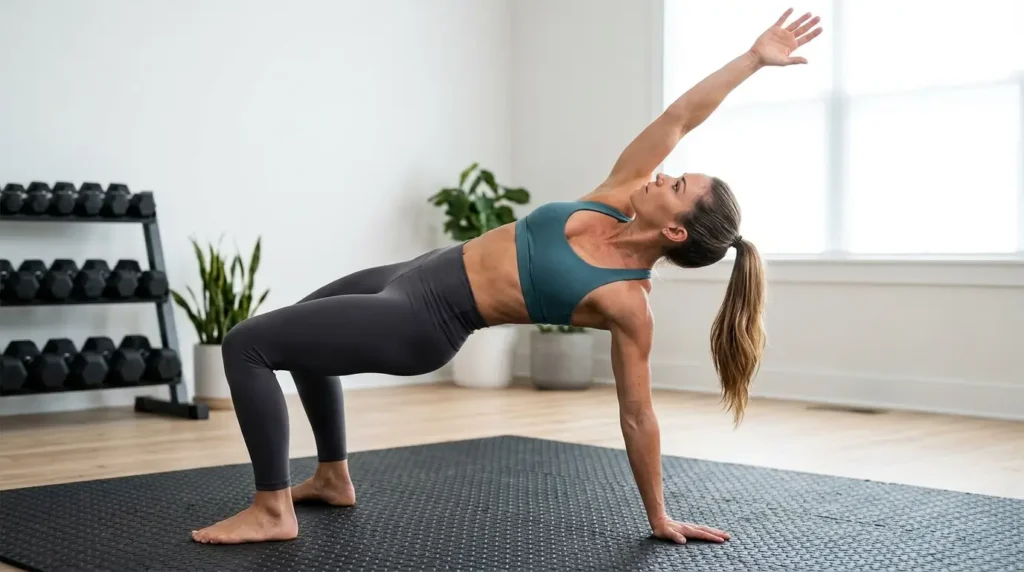
- Sit with knees bent and hands behind you, fingers pointing toward your feet.
- Lift your hips until your body forms a “tabletop” shape.
- Reach one arm over your head while rotating your chest toward the ceiling.
- Return to center with control, then switch sides.
- Move slowly, about 3 seconds per reach.
Cues: push the floor away, squeeze your glutes, and keep your neck relaxed.
Front Kickthrough
- Start in Beast position.
- Lift one hand and sweep the opposite leg underneath your body.
- Rotate your hips as you step through and open your chest.
- Reverse the movement and return to Beast.
- Repeat on the other side.
Cues: step lightly, keep your standing hand firm, and let your hips lead the turn.
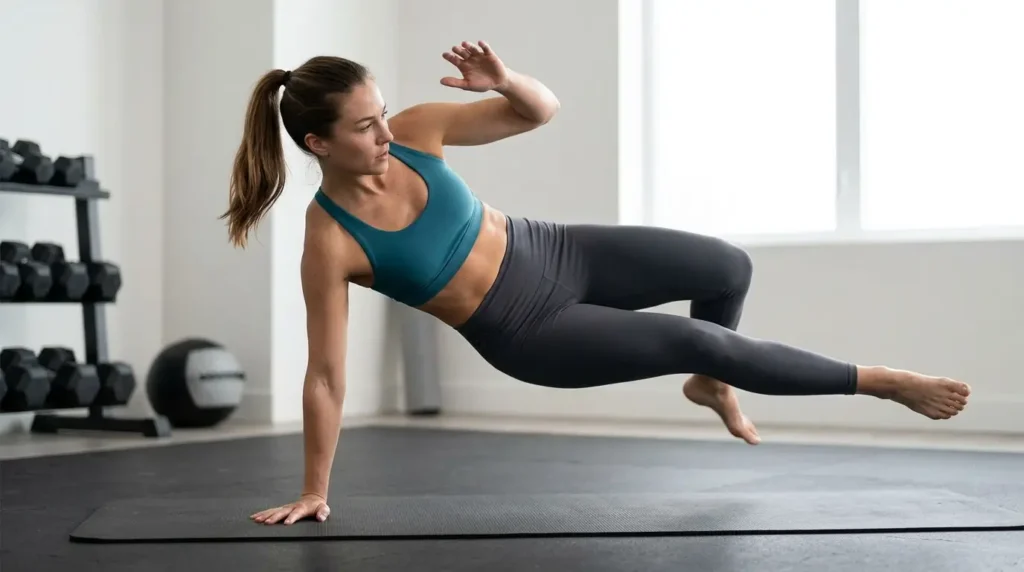
Common Mistake: Collapsing into the shoulders. When your shoulder blades sag toward your ears, your joints take the load instead of your muscles. Fix: push the floor away until your upper back feels slightly rounded and broad, and stop the set when you can no longer hold that shape.
Sets, Reps, and Time by Goal
Animal Flow uses bodyweight, so we adjust time and reps rather than pounds. Use this table as a starting point.
| Goal | Sets | Reps or Time | Tempo | Rest |
|---|---|---|---|---|
| Mobility | 2-3 | 6-8 slow reps per side | 3 seconds per rep | 30 seconds |
| Strength | 3-4 | 20-30 second holds | Slow and controlled | 60 seconds |
| Endurance | 3-5 | 40-60 seconds of flowing | Steady, smooth | 30-45 seconds |
Start with the mobility row for your first two weeks. Next, add holds. Finally, build toward flows once the basic moves feel smooth.
Easier and Harder Versions
Every exercise should meet you where you are. Here are simple ways to scale the three moves above.
Easier (regressions):
- Beast: keep the knees on the floor and lift only the hands for one second at a time.
- Crab Reach: reach with a smaller range, or keep both hips low.
- Front Kickthrough: step through without rotating your chest, or practice from a high-plank position with wider feet.
Harder (progressions):
- Beast: hold for 30 to 45 seconds, or add slow crawls forward and back.
- Crab Reach: hold the lifted hips for 2 seconds at the top, then reach.
- Front Kickthrough: speed up the flow slightly, or chain it into a Crab Reach.
Make one change at a time. If you struggle to keep your form, go back a level.
Alternatives If You Want Similar Benefits
Animal Flow is not the only option. If you want a different tool, try one of these.
- No equipment: bear crawls, inchworms, and cat-cow stretches deliver similar shoulder and core work.
- Dumbbell: renegade rows and single-arm carries build core stability with light weights of about 10 to 20 lb (4.5 to 9 kg).
- Cable: Pallof presses train the same anti-rotation core control.
- Machine: If you prefer a guided path, a lower-back or ab machine works the trunk, though it is less functional.
For lower-body control without moving, our isometric leg exercises are another good option. Similarly, anyone training for a throwing sport can find useful core ideas in our baseball core workout.
Who Should Be Careful
Animal Flow loads the wrists, shoulders, and hips. For that reason, a few groups should take extra care.
- People with wrist pain, shoulder injuries, or carpal tunnel symptoms should start with fist or forearm variations.
- Anyone with hip or lower-back pain should keep ranges small until pain-free.
- Pregnant or postpartum exercisers should check with their doctor first.
- Older adults and people with medical conditions should get clearance before starting.
If anything pinches or feels sharp, stop. Pain is a signal, not a challenge. Always check with a doctor or physical therapist before starting if you have pain, an injury, or a medical condition.
Sample 20-Minute Animal Flow Workout
Try this beginner session two to three times per week. Move slowly and focus on clean positions.
| Block | Exercise | Sets | Reps / Time | Rest |
|---|---|---|---|---|
| Warm-up | Wrist circles and rocking | 1 | 60 seconds | None |
| Warm-up | Cat-cow | 1 | 8 reps | None |
| Skill | Beast hold | 3 | 20 seconds | 45 seconds |
| Skill | Crab Reach | 3 | 6 per side | 45 seconds |
| Skill | Front Kickthrough | 3 | 5 per side | 45 seconds |
| Finisher | Beast-to-Crab flow | 3 | 40 seconds | 30 seconds |
| Cool-down | Child’s pose and hip stretch | 1 | 60 seconds each | None |
For a bigger lower-body and shoulder day, you can pair this with our leg and shoulder workout.
How to Get the Most Animal Flow Benefits
A few habits will help you collect the full Animal Flow benefits sooner.
- Train 2-3 times weekly. Short, frequent practice beats one long session.
- Move slowly first. Speed hides weak spots in your form.
- Breathe through every move. Holding your breath tightens your neck and shoulders.
- Warm up your wrists. They are the most overlooked joint in this system.
- Track one small win. For example, add 5 seconds to your Beast hold each week.
- Rest between hard days. Your shoulders and wrists need time to adapt.
Additionally, give yourself four to six weeks before judging results. Skill moves take time. Finally, remember that these benefits come from steady practice, not perfection.
FAQ
Is Animal Flow a good workout?
Yes, it can be. It trains mobility, strength, balance, and cardio in one session. Early research on quadrupedal movement training suggests benefits for movement quality in healthy adults. It works best alongside other training if you want maximum muscle size.
Is Animal Flow good for beginners?
Yes. Beginner classes teach basic positions first and build slowly. Start with Beast, Crab Reach, and simple transitions. Use the easier versions above and stop if anything hurts. Beginners often feel results in coordination within a few weeks.
How often should I do Animal Flow?
Two to three sessions per week is a solid start. Rest at least one day between sessions while your wrists and shoulders adapt. As you gain skill, you can add short daily warm-ups of 5 to 10 minutes.
Does Animal Flow build muscle?
It can build strength and some muscle, especially in beginners, because your shoulders and core work hard. However, bodyweight loading has limits. If your main goal is large muscle gains, add resistance training such as weighted lifts.
Is Animal Flow cardio?
Partly. A study in healthy adults reported that a beginner Animal Flow class met the ACSM’s criteria for moderate-intensity activity. How hard it feels depends on your pace and fitness level. Faster flows raise your heart rate more.
Can Animal Flow help mobility?
It may. The moves take your wrists, shoulders, spine, and hips through large ranges under control. A trial of QMT in active adults reported larger improvements in functional movement scores than a control group. Individual results will vary.
Conclusion
The Animal Flow benefits are easy to appreciate once you try a session. You get mobility, core strength, balance, and moderate-intensity cardio in one short routine, with no equipment and little space. Research is still growing and mostly involves healthy young adults, so keep your expectations realistic.
Start with Beast, Crab Reach, and the Front Kickthrough. Practice two or three times per week, move slowly, and scale each move to your level. Over a month or two, you should notice smoother, more confident movement.
