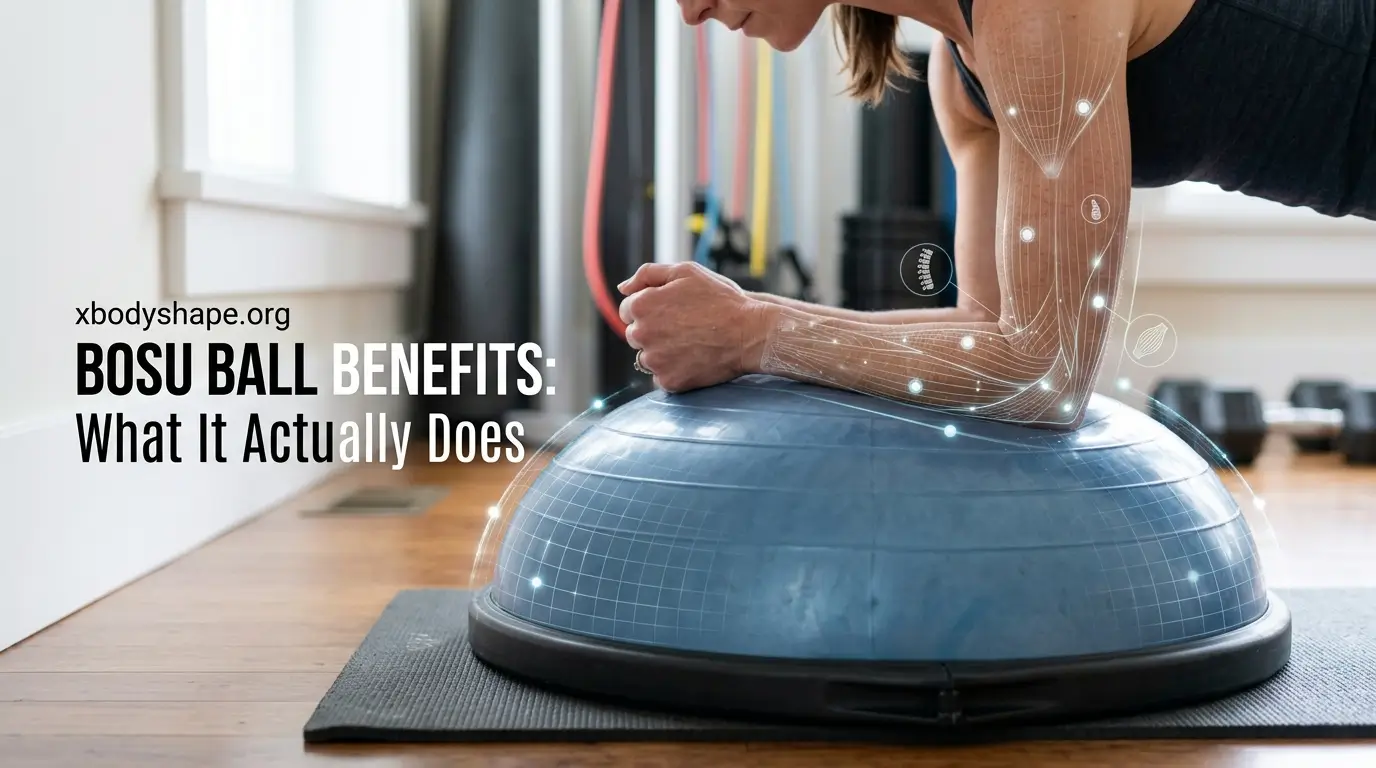
BOSU ball benefits are real, but they are not the ones most gym ads promise. The dome-shaped trainer is great at making simple moves feel harder because it wobbles under your feet or hands. That challenge targets balance and control more than raw muscle growth.
In this guide, I’ll explain what a BOSU ball actually does, what research says about it, and how to use it well. I’ll also cover form, sets and reps, safety, and a short sample routine. Think of it as a coach’s honest answer to a common gym question: is a BOSU ball worth your time?
Quick Answer: BOSU ball benefits include more balance challenge, higher demand on your core and stabilizing muscles, and a fun way to progress simple exercises. However, research on unstable surfaces shows lower force and power output. It does not build more strength than stable training, so use it as a tool, not a replacement.
BOSU Ball Benefits: What the Research Says
Let’s separate what is supported from what is hype. In short, the BOSU is best at one thing: adding instability. How you use that wobble decides whether it helps you.
It Raises the Demand on Balance and Stabilizing Muscles
This is the clearest of all BOSU ball benefits. A clinical commentary in the International Journal of Sports Physical Therapy notes that trunk muscle activation is relatively greater during unstable resistance exercises, which suggests the stabilizing muscles work harder. The same paper says these exercises can also train coordination and other motor control skills.
A review in Sports Health adds that balance training without resistance [VERIFY year] has been shown to improve balance and functional performance. That is where a BOSU shines. Standing on one leg on the dome, for example, asks your ankles, hips, and core to react quickly.
It Lowers How Much Force and Power You Can Produce
Here is the trade-off. The same commentary explains that criticism of unstable training comes from impaired force, power, and movement velocity compared with stable surfaces. Simply put, you can’t lift as much on a wobbly surface.
A study of push-ups points the same way. In a 2022 study of 51 participants, power and speed in push-ups dropped as instability rose, including hands-on and feet-on BOSU conditions. For that reason, a BOSU is a poor choice for heavy or explosive lifts.
Strength Gains Are About the Same, Not Better
You might hope the extra challenge builds more muscle. The evidence says no. In an eight-week study of 30 men with lifting experience, adding unstable surfaces such as the BOSU to push-up training did not improve strength or endurance more than floor push-ups.
On the other hand, instability did not hurt either. A seven-week study of untrained men found that a circuit using BOSU and TRX devices was as effective as a stable circuit for 1RM strength, power, velocity, and jumping. So BOSU ball benefits include variety without a strength penalty, at least for beginners.
Where the BOSU Fits Best
Based on the research above, the BOSU fits these roles:
- Balance and ankle control: single-leg stands and light bodyweight moves.
- Core stability work: planks and slow, controlled bodyweight exercises.
- Variety: a fresh way to progress familiar moves.
- Rehab-style progressions: the IJSPT commentary describes a path from balance work to instability training and then to higher-load traditional lifting. If you are recovering from an injury, a physical therapist should guide this.
Adults should also do muscle-strengthening activity on two or more days a week, according to the CDC adult activity guidelines. A BOSU session can count when it is part of a broader plan.
BOSU Ball Benefits at a Glance
Use this table to separate popular claims from what the evidence supports.
| Common Claim | What Research Suggests | Coach’s Verdict |
|---|---|---|
| Improves balance | Balance training improves balance and function | Supported |
| Works the core harder | Trunk muscle activation is higher on unstable surfaces | Supported |
| Builds more muscle | No greater strength gains than stable push-ups in one trial | Not supported |
| Boosts power | Power and speed drop on unstable surfaces | Not supported |
| Good for heavy lifting | Force output falls | Skip |
| Adds variety | Similar strength gains to stable training in beginners | Supported |
How to Get the Real BOSU Ball Benefits: Step-by-Step Exercises
Start with these three. They match the research: light loads, slow reps, and a focus on balance and control.
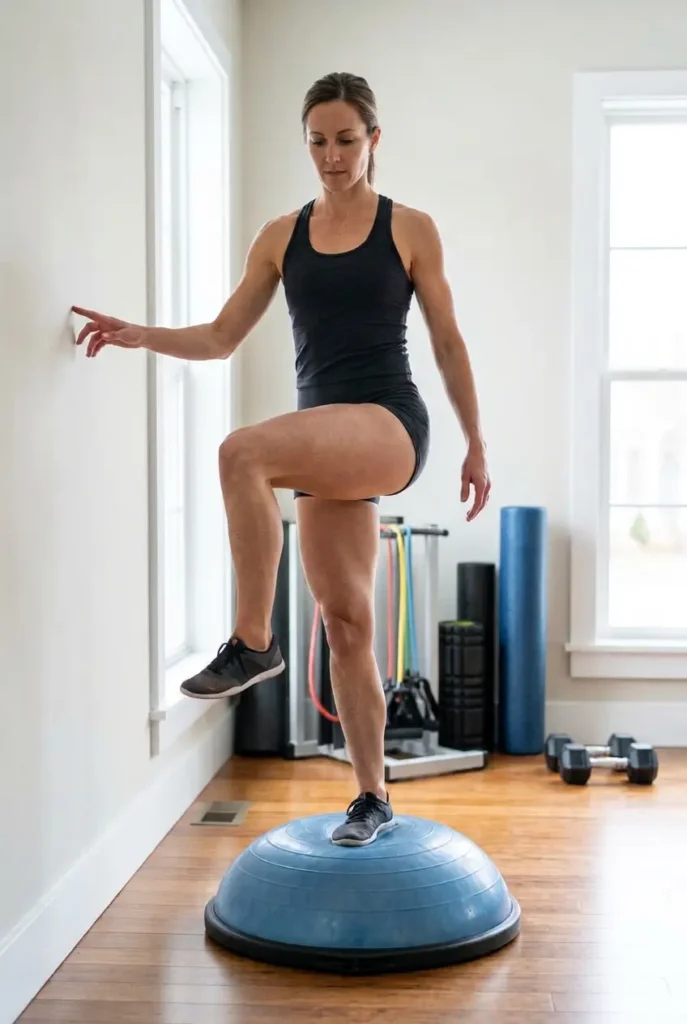
1. Single-Leg Balance (Dome Up)
- Place the BOSU on a non-slip floor near a wall or sturdy chair.
- Step onto the center of the dome with one foot. Keep your knee slightly soft.
- Lift the other foot off the floor and balance for 20-30 seconds.
- Keep your chest tall, shoulders relaxed, and eyes fixed on a spot ahead of you.
- Switch legs.
What it should feel like: small, quick adjustments in your ankle and hip. Your standing leg will shake a little, which is normal.
Coach’s Tip: Squeeze your glute on the standing leg and think “tall spine.” This keeps your hip steady and lets your ankle do less frantic work. If you wobble too much, hold the wall with two fingers.
2. BOSU Bodyweight Squat (Dome Up)
- Stand on the dome with your feet hip-width apart, about 8-12 inches (20-30 cm).
- Keep your weight in your midfoot and brace your abs.
- Sit your hips back and down over 3 seconds, as if sitting in a chair.
- Stop when your thighs are near parallel, or earlier if your balance slips.
- Press through your whole foot to stand.
What it should feel like: your glutes and thighs working, with your core and ankles constantly adjusting. Because the surface moves, you will naturally go slower than on the floor.
Load guidance: Start with bodyweight only. After you can do 3 sets of 12 steady reps, you may hold a light dumbbell of 5-10 lb (2-5 kg) at your chest. Keep the load light, because research shows force output drops on unstable surfaces.
3. BOSU Push-Up (Hands on Dome or Flat Side Up)
- Place your hands on the dome (easier on joints) or flip it flat side up with your hands on the platform’s edges.
- Step your feet back into a straight line from head to heels.
- Squeeze your glutes and brace your abs.
- Lower your chest over 2-3 seconds, keeping your elbows at about 45 degrees.
- Press up smoothly.
What it should feel like: extra work in the shoulders and core to keep the surface steady, plus the usual chest and triceps effort. If you want more arm-focused ideas, see our post on push-ups and your biceps.
Common Mistake: Doing fast, heavy, or jumpy moves on the BOSU because it “feels athletic.” Research shows power and speed fall on unstable surfaces, and the wobble raises your fall risk. Instead, keep reps slow and use light loads.
Sets, Reps, and Weight for BOSU Ball Benefits by Goal
Because the BOSU limits how much load you can handle, it favors slow tempo and moderate reps. This table shows a smart setup.
| Goal | Exercise Type | Sets | Reps / Time | Rest | Tempo |
|---|---|---|---|---|---|
| Balance | Single-leg stance, slow step-ups | 2-3 | 20-40 sec per side | 30-45 sec | Slow and steady |
| Core stability | Plank, bodyweight moves | 2-3 | 20-45 sec holds | 45-60 sec | Controlled |
| Muscle (light) | Squats, push-ups | 3 | 10-15 | 60 sec | 3 sec down / 1 sec up |
| Endurance | Bodyweight circuits | 2-3 | 15-20 | 30-45 sec | 2 sec / 1 sec |
Practical notes
- For real strength gains, do your heavy lifts on a stable floor, bench, or machine. Use the BOSU as a finisher or a warm-up.
- Train it 2-3 days a week. Short sessions of 10-15 minutes work well.
- Progress slowly. First add time or reps. Then add light weight, 2-5 lb (1-2 kg) at a time.
Common Mistakes and Fixes
Because the BOSU moves, small errors show up fast. Here are the ones I’d watch for.
- Going too heavy. Heavy loads on a wobbly surface raise your fall risk and cut force. Fix: use bodyweight or a light dumbbell.
- Gripping the surface with your toes. This tightens your foot and calf. Fix: spread your toes and press your whole foot down.
- Rushing. Fast reps skip the stability benefit. Fix: slow every rep to 3 seconds down and 1-2 seconds up.
- Holding your breath. This raises tension and wrecks balance. Fix: breathe out as you stand or press.
- Using it for everything. Doing every exercise on the BOSU limits strength gains. Fix: keep your main lifts on stable ground.
- Forgetting a spot to hold. Without something to grab, one slip can lead to a fall. Fix: place the BOSU beside a wall, rack, or chair.
- Skipping core awareness. If your abs aren’t engaged, your low back takes over. Our tips on how to flex your abs can help you learn to brace.
Easier and Harder Versions
Everyone starts in a different place. Use this ladder to match your level.
Easier versions (regressions)
- Flat-floor first: Practice the move on the floor to learn the pattern.
- Hold a support: Lightly touch a wall or chair.
- Smaller range: Squat only a quarter or half of the way down.
- Hands on dome push-up with knees down: Lower the demand while you build control.
- Shorter holds: Start with 10-15 seconds.
Harder versions (progressions)
- Close your eyes briefly: Only do this next to a wall and with a spotter nearby.
- Flat side up: The dome-down version is less forgiving, so add it only when you are steady.
- Add a light dumbbell: 5-10 lb (2-5 kg), at chest height.
- Slow tempo: Take 4-5 seconds to lower each rep.
- Add isometric pauses: Hold the bottom of a squat for 3 seconds. For more ideas, see our list of isometric leg exercises.
Who Should Be Careful
A BOSU is low-impact, but it is still an unstable surface. Falls are the main risk. Take extra care, or ask a professional first, if any of these apply:
- You have current ankle, knee, hip, or back pain.
- You have had a recent sprain, injury, or surgery.
- You have balance problems, dizziness, or a history of falls.
- You are an older adult or new to exercise.
- You are pregnant or postpartum.
- You have a medical condition such as arthritis or high blood pressure.
Check with a doctor or physical therapist before starting if any of these apply. Also stop any move that causes sharp pain, a pinching feeling in the joint, or tingling. A muscle burn is normal, but joint pain is a signal to stop.
Safety setup matters too. Put the trainer on a flat, non-slip surface with a few feet of clear space around it. Wear flat, grippy shoes or go barefoot only if the surface is secure. Keep a wall, rack, or sturdy chair within reach.
Sample Workout Using BOSU Ball Benefits
This 20-minute routine fits a home gym. Warm up first with 3-5 minutes of marching in place and easy hip circles.
| Order | Exercise | Sets | Reps / Time | Rest |
|---|---|---|---|---|
| 1 | Single-leg balance (dome up) | 2 | 20-30 sec per leg | 30 sec |
| 2 | BOSU bodyweight squat | 3 | 10-12 | 60 sec |
| 3 | BOSU push-up (hands on dome) | 3 | 8-12 | 60 sec |
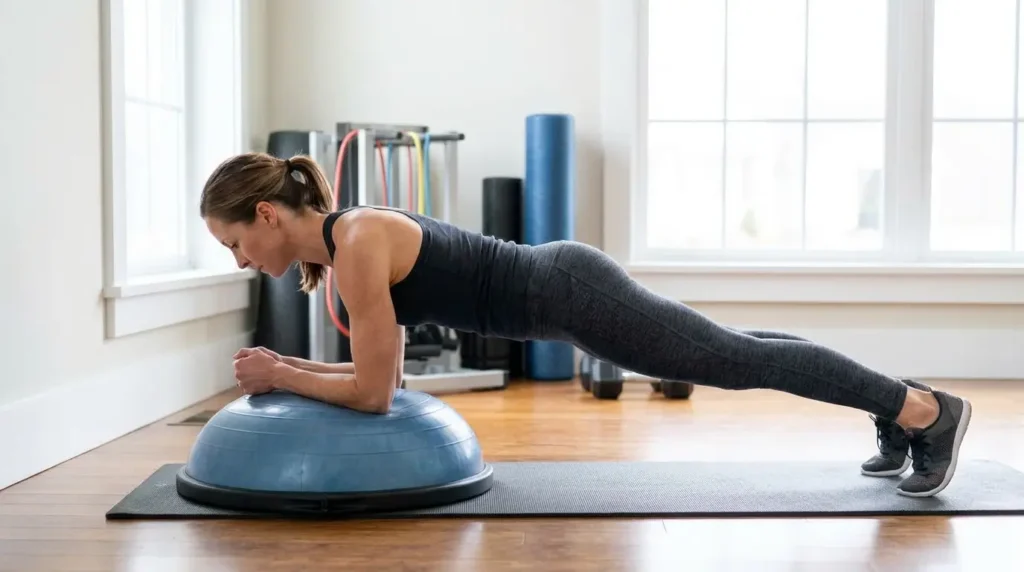
| 4 | Forearm plank on the dome | 2 | 20-40 sec | 45 sec |
| 5 | Slow step-up and step-down | 2 | 8-10 per leg | 45 sec |
Weekly plan: Do this routine on Tuesday and Friday. On other days, lift on stable surfaces, such as our leg and shoulder workout. This split gives you the BOSU ball benefits for balance and control without giving up heavier strength work.
Progression: Each week, add 5 seconds to your holds or one rep to each set. After three weeks, try one harder variation from the list above.
Related Tips: Other Ways to Train Balance and Core
A BOSU is not the only option. Depending on your space and goals, another tool may fit better.
- Bodyweight moves. Single-leg stands, lunges, and planks need no gear. Our calisthenics exercises list has more ideas.
- Balance pad or wobble board. These are smaller and easier to store than a BOSU.
- Stability ball. It works well for core exercises, though it behaves differently than a BOSU.
- Chair-based work. Our beginner guide to a Pilates chair workout offers a steadier way to train balance and control.
- Rotational core training. For athletes, a baseball core workout shows how to train rotation on stable ground.
If you are setting up a small home gym, our best apartment workout equipment guide shows compact tools that pair well with a BOSU. Before you buy, check the manufacturer’s page for size, weight capacity, and pump requirements [VERIFY], because models differ.
FAQ
Is a BOSU ball good for core strength?
It can help. Research shows trunk muscle activation is higher on unstable surfaces, so planks and slow bodyweight moves challenge your core. However, it doesn’t replace stable-ground core training. Combine both for the best results, and keep your reps slow and controlled.
Does a BOSU ball build muscle?
Not better than stable training. In one eight-week study, push-ups on a BOSU did not improve strength or endurance more than floor push-ups. You can build muscle with it, but heavy lifting on stable surfaces is more effective for size and strength.
Is a BOSU ball good for balance?
Yes, that is one of its best uses. Balance training has been shown to improve balance and functional performance. Single-leg stands and slow, light moves on the dome train your ankles, hips, and core to react. Start near a wall for safety.
Can older adults use a BOSU ball?
Possibly, with care. Balance training can be helpful, but falls are a concern. Start with support nearby, such as a wall or sturdy chair, and keep moves simple. A doctor or physical therapist can tell you whether a BOSU suits your balance and joints.
Should the dome be up or down?
Dome up is easier for most people and works well for squats, balance work, and hands-on push-ups. Flat side up is more challenging and less forgiving. Begin with the dome up, and only try flat side up after you feel steady.
Are BOSU ball squats better than regular squats?
They are different. BOSU squats challenge balance and stabilizing muscles, but you must use lighter loads. Regular squats on stable ground allow heavier weight and more force. Many lifters use BOSU squats for balance practice, then do their main squats on the floor.
Conclusion
BOSU ball benefits are real but specific. The trainer adds a balance challenge, raises the demand on your core and stabilizing muscles, and gives simple moves a fresh twist. It will not build more strength than stable training, and it lowers the load and power you can use.
Your next step is simple. Pick two or three light BOSU moves, set up near a wall, and run the sample routine twice a week. Keep your heavy lifting on stable ground, and add difficulty slowly. Used that way, BOSU ball benefits can support your balance and control without adding unnecessary risk.
