
As a beginner lifter, you may want to get some muscles safely. For example, to build your upper trap, shrugs are an excellent choice for exercise. Dumbbell shrugs vs. barbell shrugs Which one is the best?
Of course, it confuDumbbell Shrugs vs Barbell Shrugs: Which One Is the Best Choice?
Dumbbell shrugs vs barbell shrugs is one of the oldest debates in the gym, and both sides have a point. Each lift trains the upper traps, the muscles that give your neck and shoulders that thick, powerful look. However, the tool you pick changes how the movement feels, how much weight you can move, and how kind it is to your hands and joints.
A good coach would tell you this: the best shrug is the one you can load gradually and perform with clean form. In this guide, you will see how the two options compare on range of motion, load, grip, setup, safety, and cost. By the end, you will know which one fits your goals and your gym.
Quick Answer: Barbell shrugs are best when you want to lift the heaviest weight and track progress easily. Dumbbell shrugs are best when you want a freer range of motion, a more natural arm position, and easier setup at home. Most lifters build traps well with either, so pick the one you can do with clean form.
Dumbbell Shrugs vs Barbell Shrugs: Side-by-Side Comparison
Before we dig into the details, this table shows how the two lifts stack up. Use it as a quick reference, then read the sections below for the reasoning.
| Factor | Barbell shrugs | Dumbbell shrugs |
|---|---|---|
| Range of motion | Good, but the bar can touch your thighs | Often longer, since arms hang at your sides |
| Maximum load | Highest | Limited by your dumbbell set |
| Arm position | Fixed, palms facing you | Free, neutral grip possible |
| Grip demand | High at heavy weights | High at heavy weights, split across two hands |
| Setup | Bar, plates, ideally a rack | Pick up and go |
| Space needed | More | Less |
| Side-to-side balance | Both arms share one bar | Each side works on its own |
| Tracking progress | Easy, small plate jumps | Bigger weight jumps; add reps first |
| Best for | Strength-focused lifters with a rack | Beginners, home gyms, tight spaces |
Dumbbell Shrugs vs Barbell Shrugs: Which One Is the Best Choice?
Dumbbell shrugs vs barbell shrugs is one of the oldest debates in the gym, and both sides have a point. Each lift trains the upper traps, the muscles that give your neck and shoulders that thick, powerful look. However, the tool you pick changes how the movement feels, how much weight you can move, and how kind it is to your hands and joints.
A good coach would tell you this: the best shrug is the one you can load gradually and perform with clean form. In this guide, you will see how the two options compare on range of motion, load, grip, setup, safety, and cost. By the end, you will know which one fits your goals and your gym.
Quick Answer: Barbell shrugs are best when you want to lift the heaviest weight and track progress easily. Dumbbell shrugs are best when you want a freer range of motion, a more natural arm position, and easier setup at home. Most lifters build traps well with either, so pick the one you can do with clean form.
Dumbbell Shrugs vs Barbell Shrugs: Side-by-Side Comparison
Before we dig into the details, this table shows how the two lifts stack up. Use it as a quick reference, then read the sections below for the reasoning.
| Factor | Barbell shrugs | Dumbbell shrugs |
|---|---|---|
| Range of motion | Good, but the bar can touch your thighs | Often longer, since arms hang at your sides |
| Maximum load | Highest | Limited by your dumbbell set |
| Arm position | Fixed, palms facing you | Free, neutral grip possible |
| Grip demand | High at heavy weights | High at heavy weights, split across two hands |
| Setup | Bar, plates, ideally a rack | Pick up and go |
| Space needed | More | Less |
| Side-to-side balance | Both arms share one bar | Each side works on its own |
| Tracking progress | Easy, small plate jumps | Bigger weight jumps; add reps first |
| Best for | Strength-focused lifters with a rack | Beginners, home gyms, tight spaces |
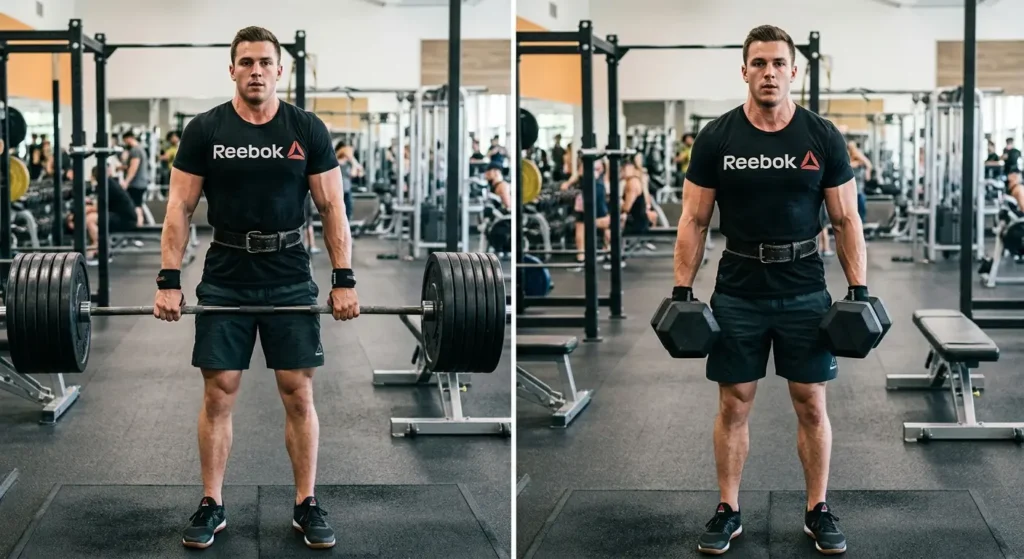
Muscles Worked by Both Shrugs
Both lifts target the upper trapezius, the large muscle that raises your shoulder blades toward your ears. Supporting muscles include the levator scapulae, the rhomboids, and the middle trapezius. Meanwhile, your forearms, grip muscles, and core work to hold the weight and keep you steady.
Research gives a useful clue about the shrug pattern itself. In a surface EMG study of 30 healthy people doing 10 exercises, the one-sided shoulder shrug produced the greatest upper trapezius activity. That study did not compare barbells with dumbbells, so it does not crown a winner here. Still, it shows that shrugging is an effective way to train this muscle.
Key Differences Between Dumbbell Shrugs vs Barbell Shrugs
Range of Motion
Dumbbells hang beside your body, so your arms follow a natural path and your shoulders can drop lower at the bottom. A barbell sits in front of your thighs, so the bar can bump your legs and shorten the movement slightly. For that reason, many lifters feel a longer stretch with dumbbells.
Does that extra range build more muscle? Not necessarily. A systematic review of range of motion found that research on the upper body is limited and conflicting, so strong conclusions are not possible yet. Therefore, aim for a full, controlled shrug with whichever tool you use.
Loading Potential
Barbells win on raw load. Because both hands share one bar, you can stack plates and lift more total weight than most dumbbell racks allow. A standard Olympic barbell weighs 45 lb (20 kg) [VERIFY for your bar], so even the empty bar is a solid starting point for many lifters.
Heavier is not always better for size, though. A meta-analysis of low- versus high-load training reported greater one-rep-max strength gains with heavier loads, while muscle-size changes were similar between conditions. In other words, heavy barbell shrugs may help strength, but lighter dumbbell shrugs can still grow your traps when sets finish close to failure.
Progress tracking also differs. With a barbell, you can add 5 lb (2.3 kg) in small plate jumps. With dumbbells, the jump between pairs is often bigger, so add reps or a pause before you add weight.
Arm Path and Joint Comfort
Barbell shrugs lock your hands in one position, usually with palms facing you. That is simple and stable, yet some lifters find their wrists or shoulders prefer another angle. Dumbbells allow a neutral grip, with palms facing your sides, which many people find friendlier.
Small changes in arm position can matter. One study on shrug variations in people with a specific shoulder-blade movement pattern found that different shrug styles changed which shoulder muscles worked hardest. For most lifters, the practical lesson is simple: choose the arm position that feels smooth and pain-free.
Grip and Forearm Demand
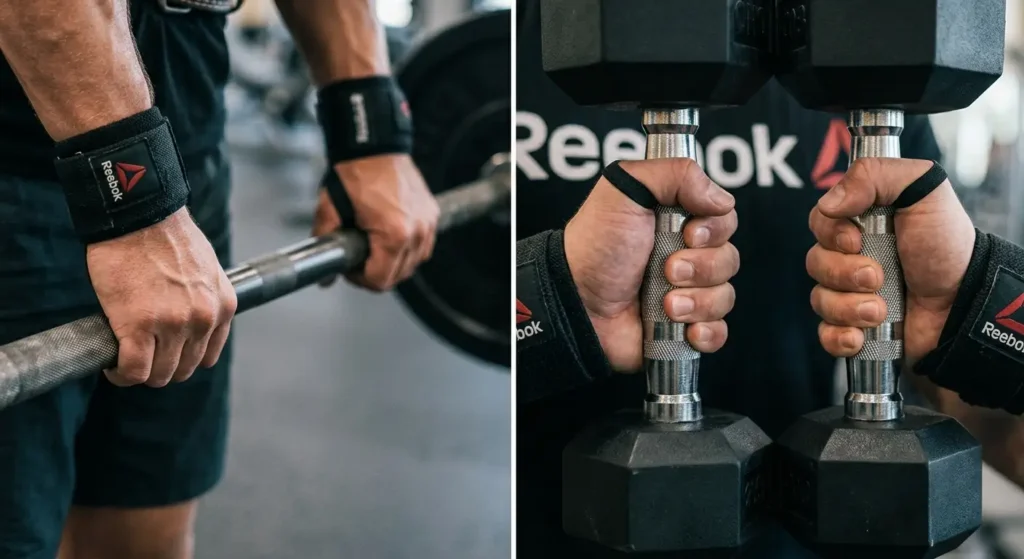
Heavy shrugs often end because your hands give out before your traps do. A loaded barbell can overwhelm your grip quickly. Dumbbells split the load between two hands, but at heavy weights they also challenge your grip.
Straps solve the problem for both tools. Use them only on your heaviest sets, so your grip keeps improving on lighter work.
Coach’s Tip: Do your warm-up sets without straps and your top sets with them. Then train grip separately with farmer’s carries or dead hangs. That way, your traps get full loading and your hands still get stronger.
Setup, Space, and Safety
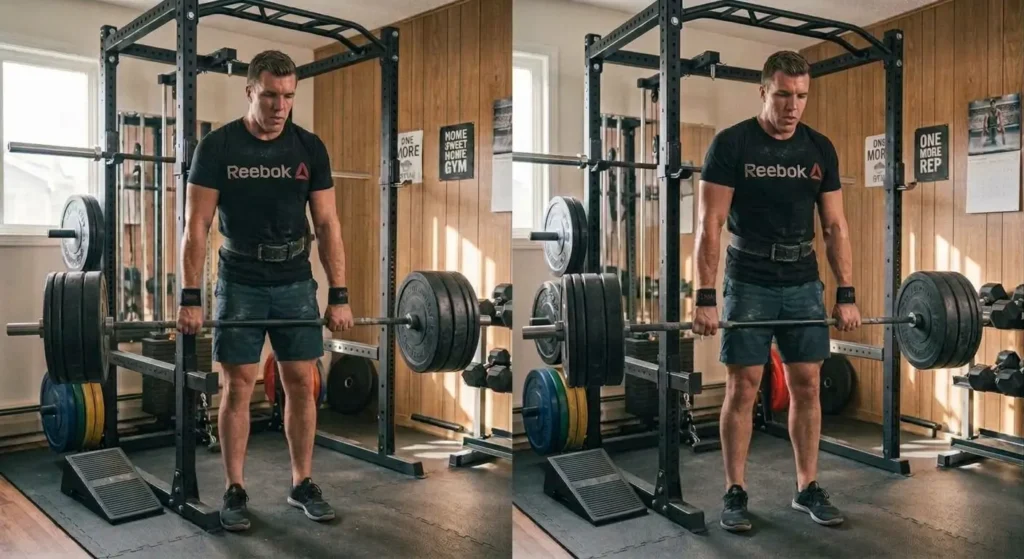
Barbell shrugs need a bar, plates, and ideally a rack. A squat rack with a pull-up bar lets you set the bar at mid-thigh height, so you skip a deadlift before every set. If you are unsure which bar to buy, our guide to Olympic versus standard barbells explains the difference.
An Olympic barbell is about 86 in (218 cm) long [VERIFY], so give yourself roughly 8 ft (2.4 m) of width. Dumbbells need far less room, and you can lower them to the floor if a rep goes wrong. Consequently, they are easier to store and a bit more forgiving when you train alone.
Balance and Symmetry
Dumbbells train each side on its own, so your stronger arm cannot take over. If one shoulder rises higher or one hand slips first, you get useful feedback. Barbells can hide these gaps because both arms share one bar.
To keep your shoulders balanced, pair shrugs with pulling work. For example, add seated bent-over rear delt raises later in the same session.
How to Do Barbell Shrugs
Start light and treat the first few sessions as practice. The movement should feel like a strong burn across the tops of your shoulders and the base of your neck.
- Set the bar on a rack at mid-thigh height. Stand with your feet hip-width apart.
- Grip the bar just outside your thighs with an overhand grip. Keep your chest tall and your ribs down.
- Lift the bar off the rack and step back. Let your arms hang straight, with the bar resting near your upper thighs.
- Exhale and shrug your shoulders straight up toward your ears. Do not roll them.
- Pause for one to two seconds at the top, then squeeze.
- Lower the bar slowly over two to three seconds until you feel a gentle stretch.
Cue to remember: think “shoulders to ears,” not “chin forward.” Keep your elbows soft and your head neutral throughout.
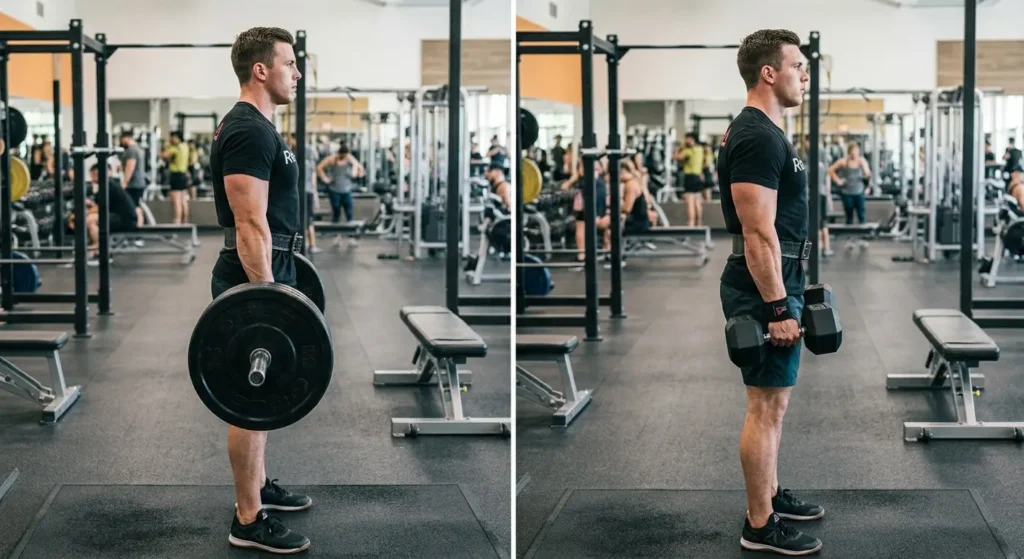
How to Do Dumbbell Shrugs
Dumbbell shrugs use the same pattern, but your hands stay at your sides. This makes the lift easy to learn at home.
- Pick up two dumbbells and stand tall, feet hip-width apart. Hold them at your sides with palms facing in.
- Brace your core and keep your chest up. Let your shoulders hang naturally.
- Shrug both shoulders straight up. Keep your arms straight, and do not bend the elbows to help.
- Hold the top for one to two seconds.
- Lower for two to three seconds until your shoulders drop fully.
If your dumbbells feel heavy, rest them against your thighs for a moment between reps. Meanwhile, keep your gaze forward so your neck stays relaxed. If you train at home, hex dumbbells stay put when you set them down and are easy to grab.
Sets, Reps, and Weight by Goal
Use this table as a starting point. These ranges are common coaching guidelines, not strict rules, so adjust them to how you feel.
| Goal | Sets | Reps | Rest | Tempo |
|---|---|---|---|---|
| Strength | 3-5 | 4-6 | 2-3 minutes | 1 s up, 1 s pause, 2 s down |
| Muscle size | 3-4 | 8-12 | 60-90 seconds | 1 s up, 2 s pause, 3 s down |
| Endurance | 2-3 | 15-20 | 45-60 seconds | Smooth and steady |
For starting weights, many beginner men do well with 30-40 lb (14-18 kg) per hand for dumbbells, or the empty 45 lb (20 kg) bar. Many beginner women do well with 15-25 lb (7-11 kg) per hand, or a lighter training bar [VERIFY bar weight]. Choose a load that lets you finish every rep with good form and about two reps left in the tank.
When to Choose Barbell Shrugs
Barbell shrugs make sense when your goal is to move heavy weight and track it easily. Consider them if:
- You have a power rack with safety pins and enough floor space.
- You want to chase strength numbers over time.
- You already deadlift or row heavy, and your grip is solid.
- You like adding small plate jumps each week.
They also suit lifters who train alone with a rack, since the safety pins add security. Finally, many strength athletes like how stable a fixed bar feels.
When to Choose Dumbbell Shrugs
Dumbbell shrugs fit best when comfort, simplicity, and space matter most. Consider them if:
- You are a beginner learning the shrug pattern.
- You train at home with limited space. Our list of apartment workout equipment can help you plan.
- Barbell shrugs bother your wrists or the front of your shoulders.
- You want to spot and fix side-to-side differences.
In addition, dumbbells are easy to use for single-arm variations, so they offer more variety.
Easier and Harder Versions
Easier (regression):
- Use lighter dumbbells and remove the pause.
- Sit on a bench to take your legs out of the movement.
- Do half the reps and focus on a smooth lowering phase.
Harder (progression):
- Add a three-second pause at the top.
- Slow the lowering phase to four seconds.
- Try single-arm dumbbell shrugs for extra control.
- Move to a trap bar for heavier loading with a neutral grip.
Common Mistakes and Fixes
Common Mistake: Rolling the shoulders in a circle. It looks impressive but adds stress to the joint without adding much to the traps. Fix it by moving straight up and straight down, with a pause at the top.
Other mistakes show up often. First, lifters use too much weight, so the reps become short, jerky bounces. Lower the load until each rep is smooth. Second, they push the head forward at the top, which strains the neck. Keep your chin level and your eyes on one spot.
Third, many lifters bend the elbows to “help” the weight up. Instead, keep your arms long and let the shoulders do the work. Finally, skipping the lowering phase wastes the best part of the rep, so take at least two seconds to come down.
Who Should Be Careful
People with neck or shoulder pain, a recent injury, numbness in the arms, or frequent dizziness should check with a doctor or physical therapist before adding heavy shrugs. Beginners can start with light dumbbells to learn the movement first. If a rep causes sharp pain rather than muscle burn, stop and reassess.
Sample Workout With Shrugs
Here is a simple pull-and-shoulder session of about 45 minutes. Warm up first with five minutes of easy cardio and two light sets of 10-12 shrugs.
| Exercise | Sets | Reps | Rest |
|---|---|---|---|
| Barbell or dumbbell row | 3 | 8-10 | 90 seconds |
| Seated bent-over rear delt raise | 3 | 12-15 | 60 seconds |
| Barbell shrug (heavy) | 4 | 6-8 | 90-120 seconds |
| Dumbbell shrug (lighter, slow) | 2 | 12-15 | 60 seconds |
| Curl of your choice | 3 | 10-12 | 60 seconds |
For the curl slot, our comparison of barbell versus cable curls can help you decide. If you prefer to combine days, you can place shrugs inside a leg and shoulder workout. Aim to train each major muscle group on two or more days a week, in line with the CDC adult activity guidelines.
Cost Comparison
Prices vary by brand and region, so treat these as rough ranges and check current listings [VERIFY all].
| Item | Typical price range | Notes |
|---|---|---|
| Fixed dumbbell pair (mid-weight) | $60-$200 [VERIFY] | Cheapest way to start |
| Adjustable dumbbell set | $200-$500 [VERIFY] | Saves space; weight jumps vary |
| Olympic barbell | $150-$400 [VERIFY] | Needs plates |
| Weight plates | About $1-$2 per lb [VERIFY] | Cost adds up with heavy loads |
| Squat rack | $200-$600 [VERIFY] | Strongly recommended for heavy shrugs |
In short, dumbbells cost less to start and take less room. Barbells cost more once you add plates and a rack, but they may last longer if your loads keep growing.
FAQ
Are dumbbell shrugs better than barbell shrugs?
Neither is clearly better for everyone. Barbell shrugs let you load heavier and track progress easily, while dumbbell shrugs offer a freer arm position and simpler setup. Head-to-head research on shrugs is limited, so choose the version you can perform with controlled form and progress steadily over time.
Can you build traps with dumbbells only?
Yes. Dumbbells can load your upper traps well when you progress the weight, add reps, or slow the tempo. If your dumbbells max out, try pausing for two seconds at the top, using a slower lowering phase, or adding sets. Heavier adjustable or hex dumbbells also help at home.
How many reps should I do for traps?
For most lifters, 8-15 reps per set works well for muscle size, while 4-6 heavier reps can suit strength goals. Research suggests heavier and lighter loads can produce similar muscle growth when sets finish near failure. Stop each set when form breaks down.
Should I use straps on shrugs?
Straps are useful when grip fails before your traps do, especially with heavy barbell shrugs. Use them for your top sets, and train grip separately with carries or hangs. If you only train traps with lighter weights, you may not need straps at all.
Do shrugs hurt your neck?
Shrugs should feel like a burn across the tops of your shoulders, not a pinch in the neck. Neck tension can come from jutting the chin forward, rolling the shoulders, or lifting too heavy. Lower the weight and keep your head neutral. If pain continues, stop and check with a doctor or physical therapist.
How often should I train traps?
Most lifters do well with trap work two days a week, which also lines up with the CDC advice to do muscle-strengthening activity on two or more days weekly. Shrugs can go at the end of pull or shoulder days. Leave at least one rest day between hard trap sessions if you feel sore.
Conclusion: The Best Choice in Dumbbell Shrugs vs Barbell Shrugs
So, which wins in the dumbbell shrugs vs barbell shrugs debate? For most beginners and home gym lifters, dumbbell shrugs are the better starting point because they are simple, comfortable, and easy to set up. For lifters who own a rack and want to chase heavier numbers, barbell shrugs are a strong choice.
The smartest plan may be to use both. Do heavy barbell shrugs for 6-8 reps, then finish with slower dumbbell shrugs for 12-15 reps. Whichever you pick, focus on a full range, a pause at the top, and steady progress week after week.
