
The Olympic barbell vs standard barbell debate is one of the first big choices you face when you build a home gym. The two bars look alike from across the room, but they are built for very different jobs. One is made for heavy, long-term strength work. The other fits light training and small budgets.
This guide breaks down the real differences in sleeve size, weight capacity, rotation, plates, racks, and price. You will also get a coach’s view on which bar fits your goals, plus a beginner workout you can start this week.
Quick Answer
For most people, an Olympic barbell is the better choice. Its 2-inch (5 cm) sleeves, higher weight capacity, rotating sleeves, and wide plate and rack compatibility let you keep progressing for years. A standard barbell only makes sense for light lifting, small budgets, or very tight spaces.
Olympic Barbell vs Standard Barbell: Side-by-Side Comparison
| Feature | Olympic Barbell | Standard Barbell |
|---|---|---|
| Sleeve diameter | 2 in (5 cm) | About 1 in (2.5 cm) |
| Plate hole size | 2 in (5 cm) | 1 in (2.5 cm) |
| Typical length | Men’s bar about 7.2 ft (2.2 m); women’s bar about 6.6 ft (2 m) | Often 5–7 ft (152–213 cm) [VERIFY] |
| Typical bar weight | 45 lb (20 kg) men’s; 33 lb (15 kg) women’s | Often 15–25 lb (7–11 kg) [VERIFY] |
| Shaft diameter | About 1.1 in (28 mm) men’s; about 1 in (25 mm) women’s | About 1 in (25 mm) |
| Weight capacity | Often 500–1,500 lb (227–680 kg), varies by bar [VERIFY] | Often 200–300 lb (91–136 kg) [VERIFY] |
| Sleeve rotation | Yes (bushings or bearings) | Often fixed or limited |
| Best for | Squats, deadlifts, presses, Olympic lifts | Light lifting, curls, beginners on a tight budget |
| Rack compatibility | Most power racks and benches | Limited |
Specs vary by brand and model. Always check the manufacturer’s listing before you buy.
Key Differences Between Olympic and Standard Barbells
1. Sleeve and Plate Size
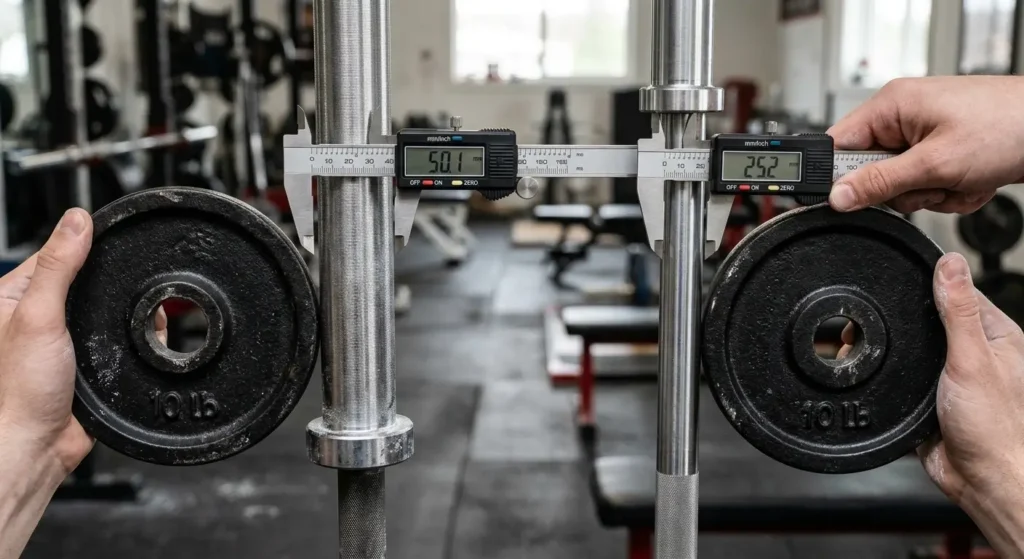
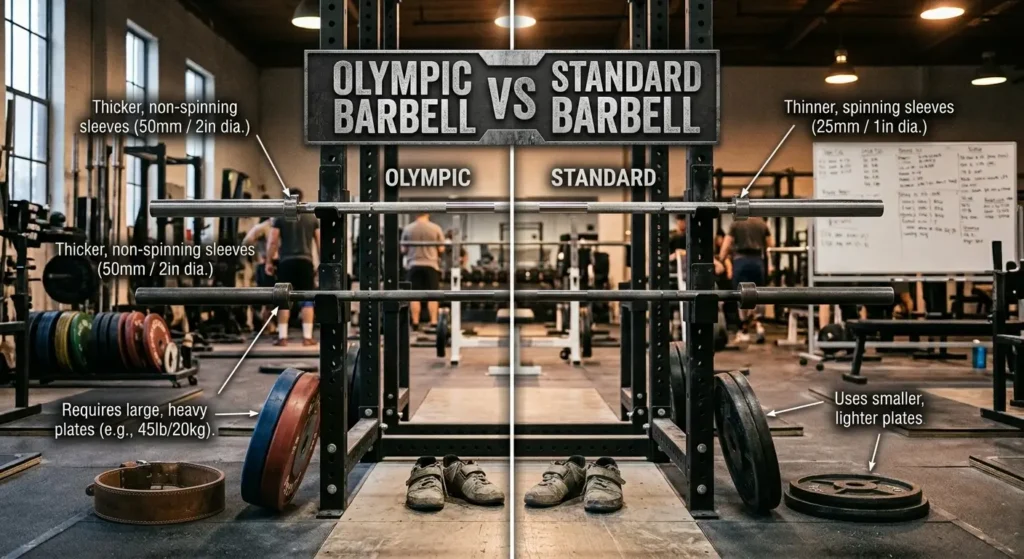
The sleeve is the end of the bar where you load plates. An Olympic sleeve is 2 inches (5 cm) wide, and Olympic plates have a matching 2-inch hole. A standard sleeve is about 1 inch (2.5 cm), and standard plates have a 1-inch hole.
This one difference drives almost everything else. Plates do not swap between the two systems. A 2-inch plate will not fit on a 1-inch sleeve, and a 1-inch plate will wobble on a 2-inch sleeve.
Olympic sleeves are also longer, so they hold more plates. That matters once your lifts get heavier.
2. Weight Capacity
Weight capacity is the biggest safety difference. Olympic bars use thicker steel with higher tensile strength, so they can take heavy loads without bending for good. Many are rated for several hundred pounds or more, often in the 500–1,500 lb (227–680 kg) range [VERIFY].
Standard bars are usually rated much lower, often around 200–300 lb (91–136 kg) [VERIFY]. A cheap standard bar can bend permanently if you load it past its limit.
Capacity matters because strength training works through progression. The American College of Sports Medicine says healthy adults should do progressive resistance training to improve muscle function, size, and physical performance, according to its 2026 position stand. A bar that tops out early forces you to buy a second one. nih
For beginners, the ACSM progression guidelines suggest training 2–3 days a week and adding roughly 2–10% to the load once you can complete your target reps. Even small jumps add up over a year. sportgeneeskunde
Coach’s Tip: Pick a bar rated for at least double the heaviest load you expect to lift in the next two years. It is a simple rule of thumb that protects your investment. The rating covers the bar only, so check your bench and rack limits too.
3. Bar Length and Weight
A men’s Olympic bar is about 7.2 feet (2.2 m) long and weighs 45 lb (20 kg). A women’s Olympic bar is about 6.6 feet (2 m) long and weighs 33 lb (15 kg). Standard bars vary a lot by brand, so check each listing [VERIFY].
You need to know the empty bar weight to count your total load. A 45 lb (20 kg) bar with a 25 lb (11 kg) plate on each side totals 95 lb (43 kg). With a lighter standard bar, your math changes.
Specialty bars differ too. If you plan to add one later, read about how much a trap bar weighs and how much a curl bar weighs before you buy.
4. Shaft Diameter and Grip
Shaft diameter changes how the bar feels in your hands. A men’s Olympic shaft is about 1.1 inches (28 mm). A women’s Olympic shaft is about 1 inch (25 mm), which suits smaller hands. Standard shafts are usually about 1 inch (25 mm).
Brands also build bars for specific lifts. Rogue’s Hybrid Power Bar, for example, lists a 28.5 mm (1.12 in) shaft and 200,000 PSI tensile strength on the manufacturer’s product page. roguefitness
Grip is personal. If the bar slips or your hands feel cramped, try a different diameter before you blame your technique.
5. Knurling
Knurling is the rough, diamond-shaped pattern on the shaft. It helps you hold the bar when your hands get sweaty. Olympic bars usually have clear, well-placed knurl patterns and marks that help you set your grip evenly.
Standard bars often have simpler knurling, or none in some spots. That can feel smooth and comfortable on light sets. It can also mean the bar slides during heavier pulls.
Aggressive knurling grips well but can scrape your back during squats or your thighs during deadlifts. Milder knurling is kinder to skin but needs chalk when loads climb.
6. Sleeve Rotation
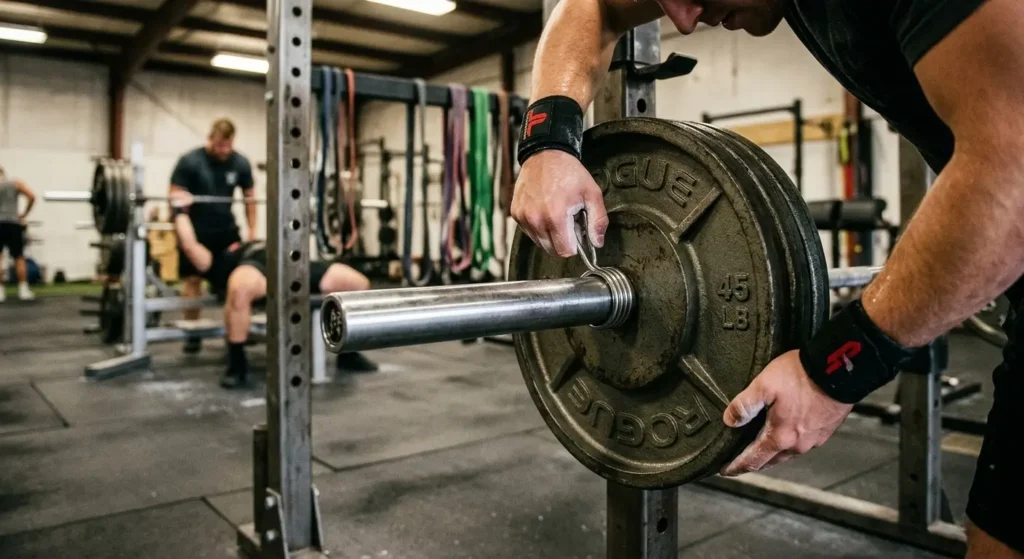
On most Olympic bars, the sleeves spin on bushings or bearings. This lets the plates turn while your hands hold the shaft steady. It reduces twisting stress on your wrists during fast lifts like cleans, snatches, and curls.
Many standard bars have fixed sleeves or very basic rotation. The plates and bar move as one piece. For slow lifts like the bench press, you may not notice. For dynamic lifts, you will.
Common Mistake: Skipping collars because “the plates feel tight enough.” Plates can slide off if the bar tilts, even for a second. Always use collars on every set, on any bar.
7. Whip and Tensile Strength
Whip is the bar’s spring. When you lift heavy, the shaft bends slightly and snaps back. Weightlifters like some whip for fast lifts. Powerlifters often want a stiffer bar for squats and bench presses.
Tensile strength, measured in PSI, shows how much stress the steel can handle before it deforms. Higher numbers usually mean a stiffer, more durable bar. Quality Olympic bars publish this number. Many budget standard bars do not [VERIFY].
If a bar doesn’t list its tensile strength or capacity, treat that as a warning sign.
8. Rack, Bench, and Plate Compatibility
Most power racks, squat stands, and benches are built for 7-foot Olympic bars. The uprights, hooks, and safety arms are spaced for that length. A shorter standard bar may not reach the hooks properly, which makes it unsafe in a rack.
Plates matter too. Olympic plates come as steel, iron, or rubber bumper plates. Standard plates are often vinyl-coated or cast iron. If you plan to buy a rack later, check our squat rack with pull-up bar reviews so your bar and rack match.
Adapter sleeves let you use 1-inch plates on a 2-inch bar. They are fine for light work, but they add wobble and are not ideal for heavy lifting.
When to Choose an Olympic Barbell
In the Olympic barbell vs standard barbell choice, pick the Olympic bar if you plan to train for more than a few months.. It is the better fit for most home gym owners and gym beginners who want room to grow.
An Olympic bar makes sense if:
- You want to squat, deadlift, bench press, and overhead press with heavier loads over time.
- You plan to buy a rack or bench with standard 7-foot dimensions.
- You want to use bumper plates for deadlifts or Olympic lifts.
- You want one bar that you won’t outgrow.
Lifting heavier is not the only reason. Mayo Clinic notes that strength training helps adults keep and build muscle mass and supports balance and physical function. Read their full strength training guide if you are new to lifting. A bar that lets you add weight safely supports that long-term process. mayoclinic
Research also supports using heavier loads when your goal is raw strength. A 2017 meta-analysis in the Journal of Strength and Conditioning Research found that heavier training produced greater gains in one-rep max strength than lighter training. An Olympic bar gives you the capacity to follow that path. nih
Olympic bars also suit lifters who want to learn barbell variations. Check out barbell curl vs cable curl if you are deciding how a bar fits into your arm training.
When to Choose a Standard Barbell
A standard barbell is a reasonable choice in a few cases. It is not a bad tool. It is a limited one.
A standard bar fits if:
- Your budget is very tight and you just need something to start.
- You only plan to lift light, such as curls, light presses, or rehab work.
- You already own a set of 1-inch plates and don’t want to replace them.
- You have very little space and don’t plan to buy a rack.
If space is the main issue, see our guide to apartment workout equipment. Dumbbells or adjustable weights may suit you better than any barbell. For help choosing dumbbells, read hex vs round dumbbells.
A standard barbell is also fine as a learning tool. You can practice the hip hinge, the squat pattern, and the press with a light bar before you move to heavier loads.
Be honest about where you are headed. Many people who start with a standard bar end up buying an Olympic bar and a new set of plates within a year. That double purchase often costs more than buying the Olympic setup once.
Cost Comparison: Olympic Barbell vs Standard Barbell
Standard gear costs less at the start. Olympic gear usually costs less over time. Prices change often, so treat these as rough ranges and check current listings [VERIFY].
| Item | Standard Setup | Olympic Setup |
|---|---|---|
| Barbell only | About $25–$80 [VERIFY] | About $120–$600+, depending on quality [VERIFY] |
| Plates (per lb) | About $0.80–$1.50 [VERIFY] | About $1.20–$2.50 [VERIFY] |
| Collars | Often included or very cheap | About $10–$40 [VERIFY] |
| Rack and bench compatibility | Limited | Wide |
| Long-term value | Often outgrown | Holds up for years |
Here is how to think about the money. A standard setup costs less on day one but caps your progress. An Olympic setup costs more up front but removes that cap.
Resale value follows the same pattern. Olympic bars and plates tend to hold value better because more people want them [VERIFY]. Standard gear is harder to resell.
If you can afford one Olympic bar today, buy it. If you can’t, buy a standard bar for light training and save for the upgrade.
Safety and Setup Tips for Any Barbell
Barbell training is safe for most healthy adults when you use good form and sensible loads. Mayo Clinic advises warming up first, using proper technique, and stopping any exercise that causes pain. If you have joint pain, a heart condition, or any health concern, check with a doctor or physical therapist before you start. mayoclinic
A few habits make every session safer:
- Set the rack hooks so the bar sits just below shoulder height.
- Set the safety arms just below your lowest rep position.
- Use collars on every set.
- Load the plates evenly, one on each side.
- Keep the bar close to your body.
If you lift alone, use a rack with safeties for squats and bench presses. A bar without safeties is a risk, whatever type it is.
A Simple Beginner Workout You Can Do With Either Bar
You don’t need a complicated plan. The CDC says adults need muscle-strengthening activity at least two days a week, working all major muscle groups, as listed in the CDC adult activity guidelines. This full-body workout hits that target in about 40–50 minutes. cdc
| Exercise | Sets | Reps | Rest |
|---|---|---|---|
| Barbell back squat | 3 | 8 | 90 sec |
| Barbell bench press | 3 | 8 | 90 sec |
| Romanian deadlift | 3 | 10 | 90 sec |
| Barbell bent-over row | 3 | 10 | 90 sec |
| Standing overhead press | 3 | 8 | 90 sec |
For beginners, ACSM guidelines suggest loads in the 8–12 repetition range. Choose a weight that leaves you with about 2 reps in reserve on the last set. Use a smooth tempo: about 2 seconds down, a short pause, then lift under control. sportgeneeskunde
Quick Form Cues
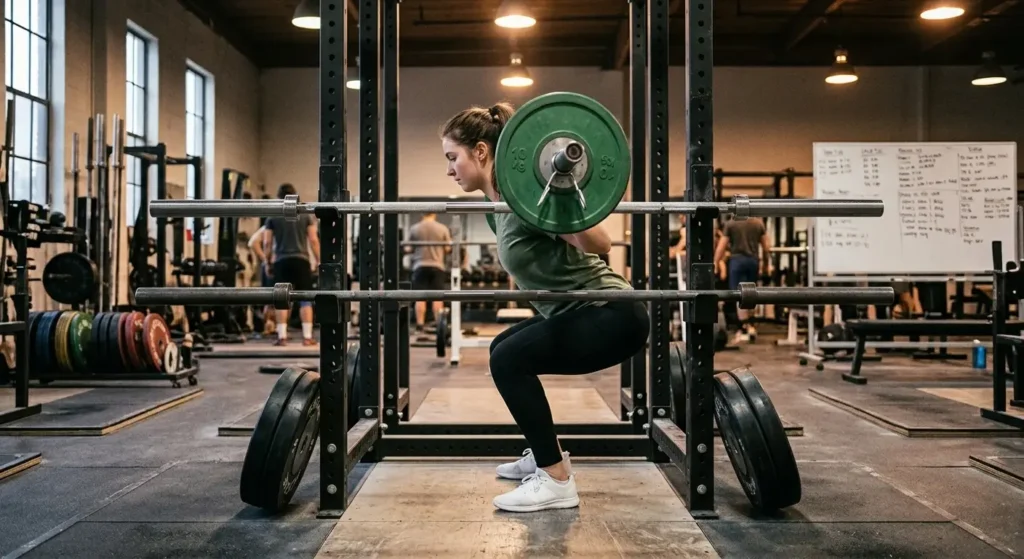
- Squat: Feet shoulder-width apart, chest tall, knees track over toes. It should feel like your thighs and glutes are doing the work.
- Bench press: Shoulder blades pinched, feet planted, bar lowers to mid-chest. Your chest and triceps should feel the load.
- Romanian deadlift: Soft knees, push hips back, bar slides along thighs. You should feel a stretch in your hamstrings.
- Row: Hinge forward, flat back, pull the bar to your lower ribs.
- Overhead press: Ribs down, glutes tight, press the bar straight up past your face.
Easier and Harder Versions
Easier (regression): Use an empty bar or a light standard bar for all lifts. If the squat feels hard, try a goblet squat with a dumbbell. If the bench feels unstable, use dumbbells or push-ups first.
Harder (progression): When you hit the top of your rep range on every set, add about 5 lb (2.3 kg) to the bar. After a few weeks, move to 4 sets, or slow the lowering phase to 3 seconds.
Weekly Schedule
Train 2–3 non-consecutive days a week, such as Monday, Wednesday, and Friday. Leave a day of rest between sessions so your muscles can recover. Wondering about training more often? Read can I do squats every day first.
If you later want to add accessory work, such as shrugs, compare dumbbell shrugs vs barbell shrugs to pick the better tool for your setup. If you want specialty bars, our list of the best Swiss barbells is a good next step.
Frequently Asked Questions
Can you use standard plates on an Olympic bar?
Not directly. Standard plates have a 1-inch (2.5 cm) hole, while Olympic sleeves are 2 inches (5 cm). Adapter sleeves can bridge the gap for light loads. They add wobble, so avoid them for heavy lifting. Buying Olympic plates is the safer long-term option.
Is an Olympic barbell worth it for beginners?
For most beginners, yes. It costs more upfront, but it supports heavier loads, fits standard racks, and uses common plates. You won’t outgrow it as your strength improves. If your budget is very tight, a standard bar can work for light training first.
How much does an Olympic barbell weigh?
A standard men’s Olympic barbell weighs 45 lb (20 kg), and a women’s Olympic bar weighs 33 lb (15 kg). Training bars and specialty bars can weigh less or more. Always check the manufacturer’s listing, since weights vary by brand and model.
What is the difference between Olympic and standard weight plates?
Olympic plates have a 2-inch (5 cm) center hole and fit Olympic bars. Standard plates have a 1-inch (2.5 cm) hole and fit standard bars. Olympic plates come in more styles, such as bumper plates, and generally cost more per pound. The two types are not interchangeable.
Can I convert a standard barbell to Olympic?
No. The sleeve size is built into the bar, so you can’t change it. You can use adapter sleeves to run standard plates on an Olympic bar, but not the other way around. If you want Olympic compatibility, buy an Olympic bar.
Is a standard barbell good for a home gym?
It can work for light training, curls, and small spaces. It is limited by lower weight capacity and poor rack compatibility. If you plan to squat, deadlift, or bench heavy, an Olympic barbell is usually the better home gym choice.
Final Verdict: Olympic Barbell vs Standard Barbell, Which One Is Best?
So, in the Olympic barbell vs standard barbell debate, which one is best? For most lifters, the Olympic barbell wins. It handles heavier loads, rotates smoothly, fits standard racks, and uses common plates. It is the bar you can train with for years.
A standard barbell still has a place if your budget is tight, your space is small, or your goals are light. Just be realistic about how quickly you may outgrow it.
If you can only buy one bar, buy an Olympic bar. Pick one with a clear weight rating, add collars, and set up a rack with safeties. Then start with an empty bar, learn good form, and add weight slowly.
