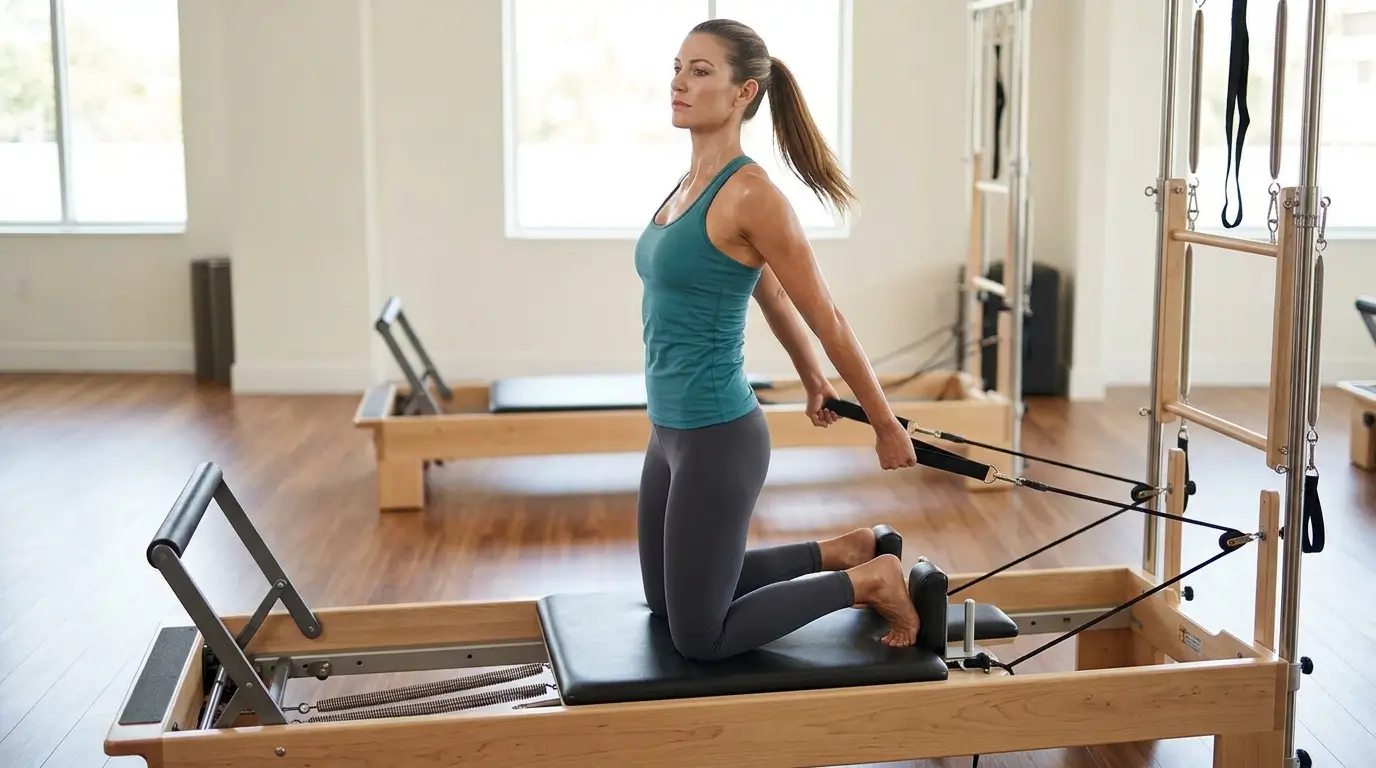
Reformer chest expansion looks simple. You kneel tall on the carriage, press the straps behind you, and turn your head while your ribs and spine stay still. However, this small movement asks your back, shoulders, triceps, and core to work together. In this guide, you’ll learn how to do reformer chest expansion with clear form cues, spring settings, sets and reps, and easier and harder options.
Despite the name, the exercise does not train your pecs like a bench press does. Instead, it opens the front of your chest by strengthening the muscles behind you. For that reason, it is a favorite in posture-focused Pilates sessions.
Quick Answer: To do reformer chest expansion, kneel tall on the carriage facing the back of the reformer, hold the straps, and press your straight arms behind you while your torso stays still. Turn your head right, left, and center, then return slowly. Use a light spring and do 5–8 smooth reps. Stop if you feel shoulder or neck pain.
Reformer Chest Expansion Muscles Worked
Chest expansion mostly trains the back of your body. Meanwhile, your trunk and legs work hard to keep you upright on a moving surface.
| Role | Muscles | What they do |
|---|---|---|
| Primary | Triceps brachii | Keep your elbows straight |
| Primary | Latissimus dorsi, teres major, posterior deltoid | Pull your straight arms behind your body |
| Primary | Lower and middle trapezius, rhomboids | Keep your shoulder blades down and steady |
| Secondary | Transversus abdominis, obliques | Hold your ribs and spine still |
| Secondary | Erector spinae, glutes, quadriceps | Keep you tall in the kneeling position |
| Secondary | Deep neck rotators | Turn your head with control |
Research on this exact exercise is limited, so this list comes from movement analysis, not chest expansion studies. Still, related research supports the “shoulders down” cue. One laboratory study found that scapular depression produced moderate lower trapezius activity with minimal upper trapezius activity. That is the same cue you’ll use here to avoid shrugging.
Benefits of Reformer Chest Expansion
Here is what the exercise may offer, along with what the evidence can and cannot say.
Posture Awareness and Upper Back Strength
Pilates in general has been studied for posture. A systematic review of nine studies with 643 participants concluded that Pilates had a positive impact on spinal deformity and posture. Another review described Pilates as a possible complementary option but stated that more detailed studies are needed. Neither tested chest expansion alone, so treat it as one useful tool, not a cure.
Shoulder Mobility, With Realistic Expectations
Standing or kneeling tall can make overhead and backward arm movements easier. A systematic review found that reducing thoracic kyphosis facilitated greater shoulder range of motion, but this came from single-session studies with unclear long-term relevance. The same review also concluded that thoracic kyphosis may not be an important contributor to shoulder pain. Therefore, don’t expect chest expansion to fix shoulder pain on its own.
Spring Resistance for Strength
Reformer springs provide elastic resistance, much like bands. The 2026 ACSM overview found that elastic band resistance training improved strength and muscle size compared with no exercise. It also recommended training with all major muscle groups on at least two days per week, which matches the CDC’s muscle-strengthening guideline. Chest expansion works well as one piece of that routine.
Coordination and Body Awareness
Beyond strength, the exercise teaches you to move your arms without letting your ribs flare or your back arch. That skill carries over to other Pilates work, including our Pilates chair workout for beginners.
How to Do Reformer Chest Expansion: Step-by-Step Form
Reformer layouts vary by brand, so check your manual for spring names and strap options.
Setup
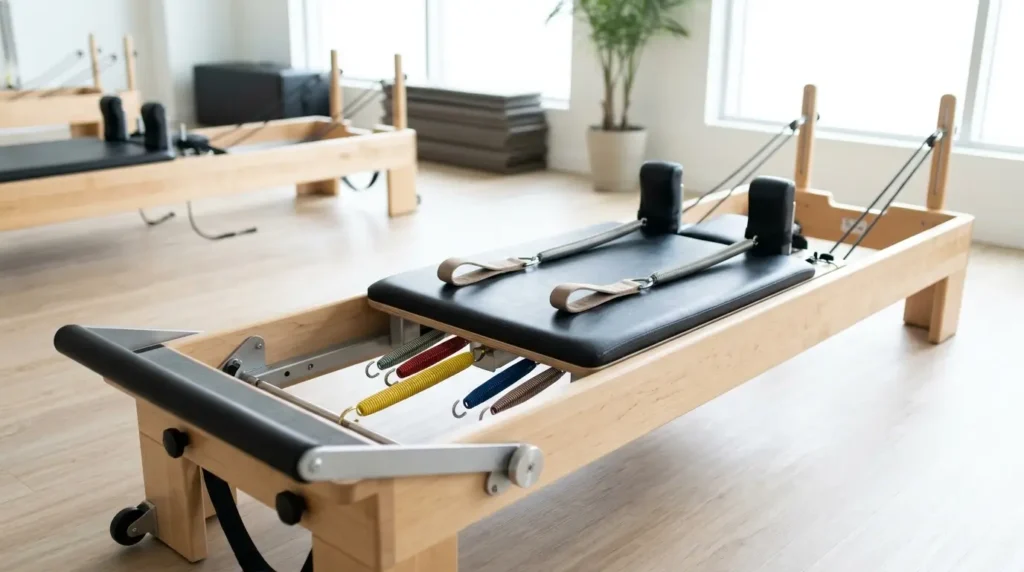
- Footbar: Lower it so you can kneel without bumping it.
- Springs: Start with one light spring. On many Balanced Body-style machines, that is one red spring, but colors differ by brand [VERIFY against your machine].
- Knees: Place a pad or folded towel under your knees if the carriage feels hard.
- Straps: Take the straps off their hooks or posts.
The Movement
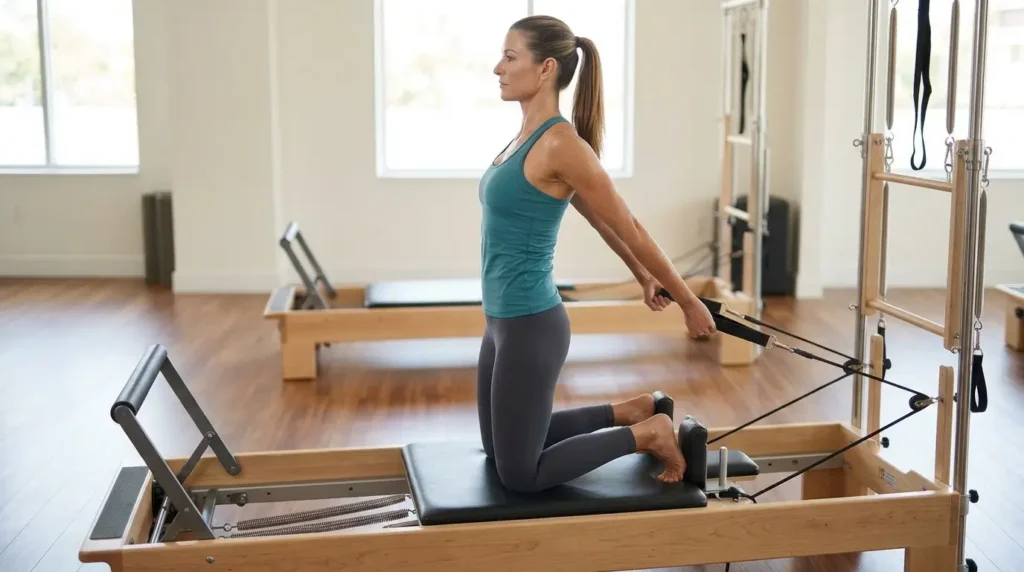
- Kneel tall. Face the back of the reformer, away from the footbar. Place your knees about hip-width apart (roughly 8–12 inches, or 20–30 cm) with your hips stacked over your knees.
- Take the straps. Hold them with a closed fist, palms facing your thighs, and arms straight beside you with light tension.
- Set your torso. Lengthen your spine, draw your lower ribs in, and slide your shoulder blades down your back.
- Press back. Exhale and press your straight arms behind you, stopping just behind your hips. Your torso should not lean forward or arch backward.
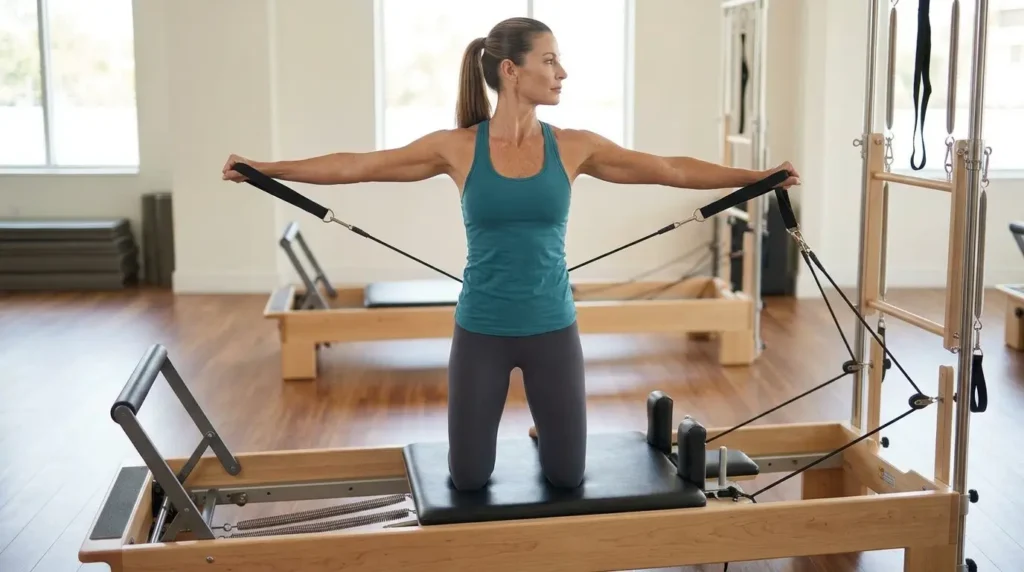
- Turn your head. Keep your arms pressed back. Slowly turn your head right, return to center, turn left, and return to center.
- Return with control. Inhale and let your arms travel forward over about three counts, resisting the spring the whole way.
- Repeat. Complete 5–8 reps, then hook the straps back on their posts.
What It Should Feel Like
You should feel your triceps and the area around your shoulder blades working. Your chest and the front of your shoulders should feel open, and your abdominals should feel lightly engaged. If you feel pinching at the front of your shoulder or strain in your lower back, shorten the range.
Coach’s Tip: Imagine a string lifting the crown of your head and a weight pulling your shoulder blades toward your back pockets. This cue keeps your neck long and prevents shrugging.
Sets, Reps, and Spring Settings by Goal
Spring colors and tensions differ between reformer brands, so use these as relative guides. Move to a heavier setting only when your form stays perfect through every rep.
| Goal | Spring load | Sets × reps | Tempo | Rest |
|---|---|---|---|---|
| Learning the movement | Lightest | 1–2 × 5–6 | Slow, 3-count return | 30–45 sec |
| Posture and control | Light | 2 × 6–8 | 2 counts back, 3 counts return | 30–45 sec |
| Strength and endurance | Light to medium | 2–3 × 8–12 | 2 counts back, 1 count pause, 3 counts return | 45–60 sec |
| Warm-up for upper body | Light | 1 × 5 | Smooth and easy | None |
Changing spring settings changes muscle demand. For instance, a study of the reformer long stretch exercise found that changing the spring constant affected the electromyographic activity of several trunk muscles. Likewise, spring tension also altered muscle activation in a reformer core stabilization study. Both studies used other exercises, but they show why small spring changes matter.
Common Mistakes and How to Fix Them
| Mistake | Why it matters | Fix |
|---|---|---|
| Arching the lower back | Shifts work from your upper back to your spine | Draw your lower ribs in and keep your hips stacked over your knees |
| Shrugging toward your ears | Overworks the upper trapezius | Slide your shoulder blades down and lengthen your neck |
| Throwing your arms far back | Strains the front of the shoulders | Stop just behind your hips |
| Rushing the return | Lets the spring do the work | Count three slow beats forward |
| Jutting your chin during head turns | Strains your neck | Think of a small, smooth rotation around a long spine |
| Holding your breath | Creates tension | Exhale as you press, inhale as you return |
Common Mistake: Leaning back at the hips as your arms press behind you. This turns the exercise into a lower-back bend. Instead, imagine your body sliding up a wall behind you.
Reformer Chest Expansion Variations: Easier to Harder
Easier Versions (Regressions)
- Seated version: Sit cross-legged on the carriage if tall kneeling feels unstable.
- Smaller range: Press your arms back only halfway at first.
- No head turn: Skip the rotation until your arm press feels smooth.
- Lighter spring: Use the lightest setting and focus on a slow return.
Harder Versions (Progressions)
- Slower tempo: Take 4–5 counts to return.
- Add a pause: Hold the end position for 2 seconds before turning your head.
- Reverse chest expansion: Face the front of the reformer instead. Instructors often suggest a slightly lighter spring for this version, because the stability demand changes.
- Medium spring: Move up one spring level only when you can keep your torso perfectly still.
Alternatives: No Equipment, Dumbbell, Cable, Machine, and Band
You can train the same muscles without a reformer. These options mimic the arm-behind-the-body pattern.
| Option | Exercise | Starting guidance |
|---|---|---|
| No equipment | Tall-kneeling arm sweeps, or prone “T” and “Y” lifts on the floor | 2 sets of 8–10 reps, with a 2-second squeeze |
| Dumbbell | Seated bent-over rear delt raise | 3–8 lb (1.4–3.6 kg) per hand, 2–3 sets of 10–12 reps |
| Cable | Straight-arm pushdown or face pull | 10–20 lb (4.5–9 kg), 2–3 sets of 10–12 reps |
| Machine | Reverse pec deck | 20–40 lb (9–18 kg), 2–3 sets of 10–12 reps |
| Resistance band | Kneeling band pull-apart | Light band, 2–3 sets of 10–15 reps |
If you train at home, our list of the best apartment workout equipment includes compact tools for these moves. A Bowflex-style home gym can also stand in for cables. For the no-equipment option, browse our calisthenics exercises list.
Additionally, if you want to understand the muscles that overlap with this exercise, our guide to which muscles pull-ups work covers the lats and upper back in detail.
Who Should Be Careful
Reformer chest expansion is gentle, but it is not right for everyone at every moment. Check with a doctor or physical therapist first if any of these apply:
- You have shoulder pain, a past shoulder injury, or instability.
- You have neck pain, dizziness with head turns, or a cervical spine condition.
- You have osteoporosis or low bone density.
- You are pregnant or postpartum.
- You have knee pain that makes kneeling uncomfortable.
- You are recovering from surgery.
Furthermore, stop if you feel sharp pain, numbness, or tingling. A certified Pilates instructor can adjust the setup for your body.
Sample Workout Using Reformer Chest Expansion
This 20–25 minute routine pairs chest expansion with moves that balance your upper body. Mayo Clinic suggests a few minutes of brisk walking or another aerobic activity before strength work, so begin with an easy warm-up.
| Order | Exercise | Sets × reps | Notes |
|---|---|---|---|
| 1 | Warm-up: cat-cow and shoulder rolls | 1 × 8 each | Easy pace |
| 2 | Reformer chest expansion | 2 × 6–8 | Light spring, 3-count return |
| 3 | Reverse chest expansion | 1 × 6 | Slightly lighter spring |
| 4 | Kneeling arm circles | 1 × 5 each direction | Keep ribs quiet |
| 5 | Rowing-style strap pulls | 2 × 8 | Light to medium spring |
| 6 | Push-ups or incline push-ups | 2 × 6–10 | Balances the pulling work; see push-ups for biceps |
| 7 | Doorway chest stretch | 2 × 20–30 sec | No pain |
Do this routine two or three days per week. Mayo Clinic advises a full rest day between working the same muscle group, so avoid hard sessions on consecutive days.
FAQ
What muscles does reformer chest expansion work?
It mainly works your triceps, lats, rear shoulders, and the muscles around your shoulder blades. Your abs, back extensors, glutes, and thighs stabilize you while you kneel. Your chest muscles mostly stretch instead of contract, which is why it opens the front of the body.
What springs should I use for chest expansion?
Start with one light spring. Many instructors use a single light spring, but colors and tensions vary by brand, so check your manual. Choose the lightest setting that lets you keep your ribs still and shoulders down. Increase only when your form stays smooth for every rep.
Is chest expansion good for posture?
It may help by strengthening the upper back and training your shoulders to stay down while your spine stays tall. Research on Pilates and posture is encouraging but limited, and no study has tested this exact move alone. Combine it with regular movement and varied strength training.
How many reps should I do?
Most people do 5–8 slow reps per set, with 1–3 sets. Beginners can start with one set of 5 reps. Quality matters more than count, so stop when your lower back arches or your shoulders creep upward.
Can beginners do chest expansion?
Yes, with a light spring and a smaller range. Beginners can sit cross-legged on the carriage or skip the head turn at first. Learn the tall-kneeling position and a slow return before adding more spring tension or extra sets.
Is chest expansion safe during pregnancy?
Many Pilates programs include it, but you should ask your doctor and a prenatal-trained instructor first. Pregnancy changes balance, joint stability, and comfort in kneeling positions. Your instructor may adjust the setup, spring, and range based on your stage and health.
Final Thoughts on Reformer Chest Expansion
Reformer chest expansion is a small exercise with big skill demands. You kneel tall, press back with straight arms, turn your head, and return slowly while your ribs and spine stay quiet. Used regularly with light springs and good form, it can strengthen your upper back and support better posture habits.
Start with one light spring and a short range. Then progress with slower tempo, a pause, or the reverse version. If you feel pain at your shoulder, neck, or lower back, stop and ask a qualified instructor or healthcare professional for guidance.
