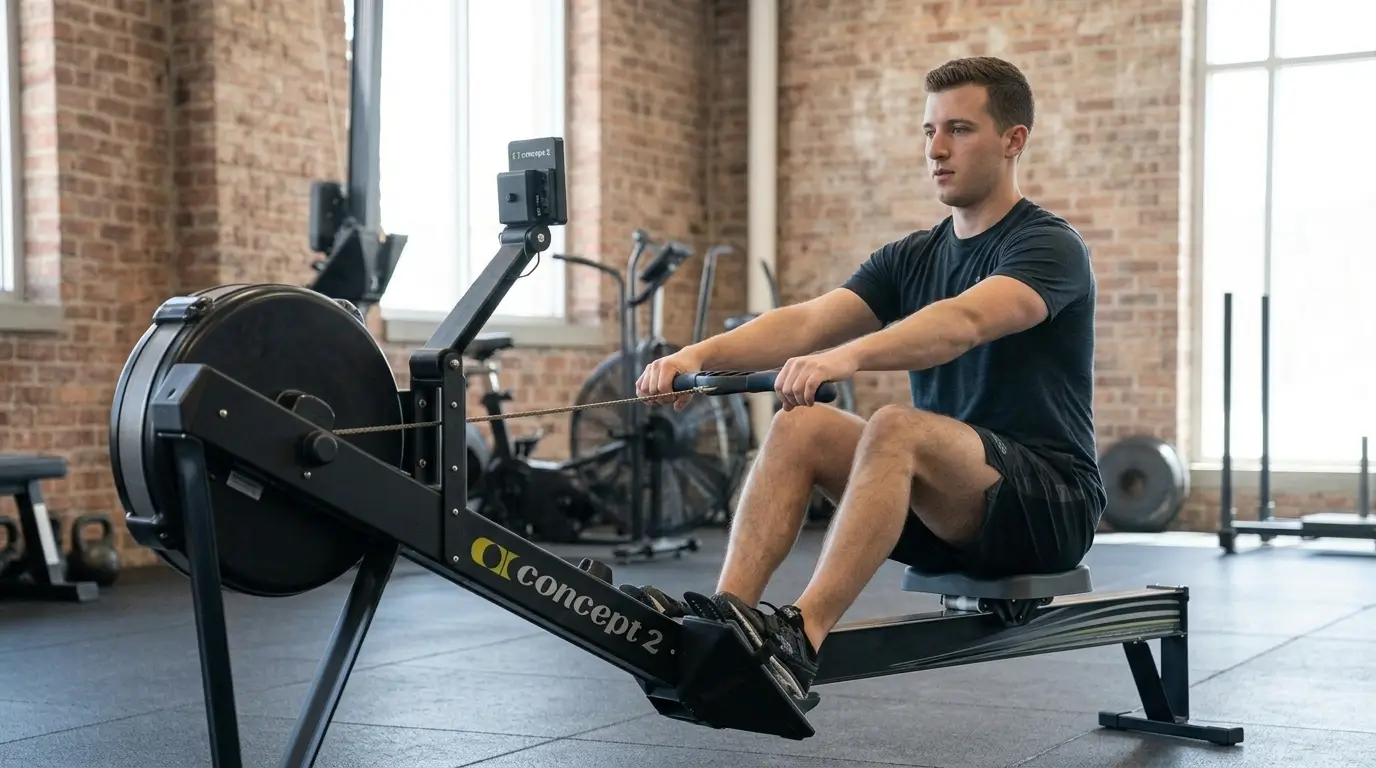
A 30-minute rowing workout is one of the simplest ways to train your heart, legs, back, and core in one session. You sit down, strap in, and repeat one smooth stroke. Best of all, it puts no pounding on your knees and requires no complicated setup.
Still, many people jump on the machine, yank with their arms, and quit after ten minutes with a tired lower back. The fix is a clear plan and a few form basics. Once those click, rowing feels powerful, not awkward.
In this guide, you will get a complete 30-minute rowing workout with a warm-up, interval blocks, and a cool-down. In addition, you will find form cues, a weekly schedule, and easier and harder versions, so you can start where you are.
Quick Answer: The 30 Minute Rowing Workout at a Glance
Quick Answer: A 30 minute rowing workout works best as 4 minutes of warm-up, 22 minutes of steady rowing and intervals, and 4 minutes of cool-down. Use any rowing machine with the damper around 3-5. Row at a pace that lets you speak in short sentences, two to three times a week.
Who Should Try a 30 Minute Rowing Workout
This 30-minute rowing workout suits a wide range of people. You do not need rowing experience, only a machine and some patience while you learn the stroke.
Who It Fits
- Gym beginners who want low-impact cardio that also trains the back and legs
- Home gym owners who want a plan, not just random rowing
- Runners and cyclists who want cross-training that does not pound the joints
- Busy adults who want a short, structured session
The CDC physical activity guidelines say adults need at least 150 minutes of moderate-intensity activity a week. They also call for muscle-strengthening work on two or more days. As a result, three sessions of this plan give you up to 90 minutes toward that goal, and the harder intervals may count toward your vigorous minutes, too.
Safety First
Please check with your doctor or physical therapist before starting if you have back pain, a heart or lung condition, or a recent injury. The same goes if you are pregnant, postpartum, returning after a long break, or rowing mainly for weight loss. Above all, stop any session that causes sharp pain, dizziness, or chest discomfort.
What a 30 Minute Rowing Workout Does for Your Body
A rowing stroke links your legs, hips, trunk, and arms in one chain. In a Journal of Strength and Conditioning Research study of well-trained rowers, the most involved muscles were the leg and shoulder girdle extensors and the arm flexors. In plain terms, you push with your legs, brace your trunk, and finish with your back and arms.
Muscles Worked
- Primary: quadriceps, glutes, hamstrings, calves, lats, and the erector spinae along your spine
- Secondary: abs, obliques, mid-back (rhomboids), biceps, forearms, and rear shoulders
In addition, trunk motion matters. A 2025 study on trunk swing used rowing ergometers to test how much the trunk adds to rowing performance. That is why this plan teaches you to hinge from the hips instead of hunching.
Key Benefits
- Cardio fitness: First, steady blocks build your aerobic base. Then, intervals challenge your heart and lungs.
- Low impact: Because your feet stay on the footplate, there is no landing force.
- Time efficiency: Also, one machine trains most major muscle groups.
- Scalable effort: Meanwhile, you control the pace, resistance, and interval length.
- Calorie burn: The Harvard Health calorie chart lists 30-minute burns by body weight. However, exact numbers vary with effort, so use it as a guide [VERIFY the rowing rows before quoting figures].
Equipment You Need for a 30 Minute Rowing Workout
You need very little to get started. Here is the short list:
- A rowing machine: Air, magnetic, water, or hybrid all work. If you are still choosing, our Concept2 rower review and the water rower or Concept2 comparison explain the differences.
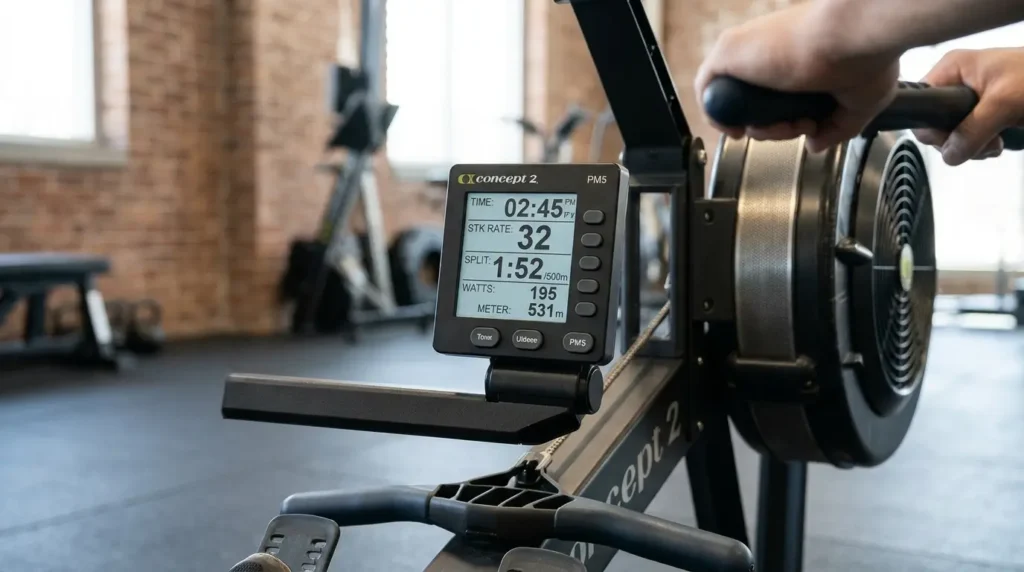
- A clock or monitor: Most machines show time, stroke rate, and split time per 500 meters (about 0.31 miles).
- Water and a small towel: Rowing makes you sweat faster than most people expect.
- Snug athletic shoes: These keep your feet planted.
- Floor space: Many full-size rowers are about 7-8 feet (213-244 cm) long [VERIFY for your model]. If space is tight, see our apartment workout equipment ideas.
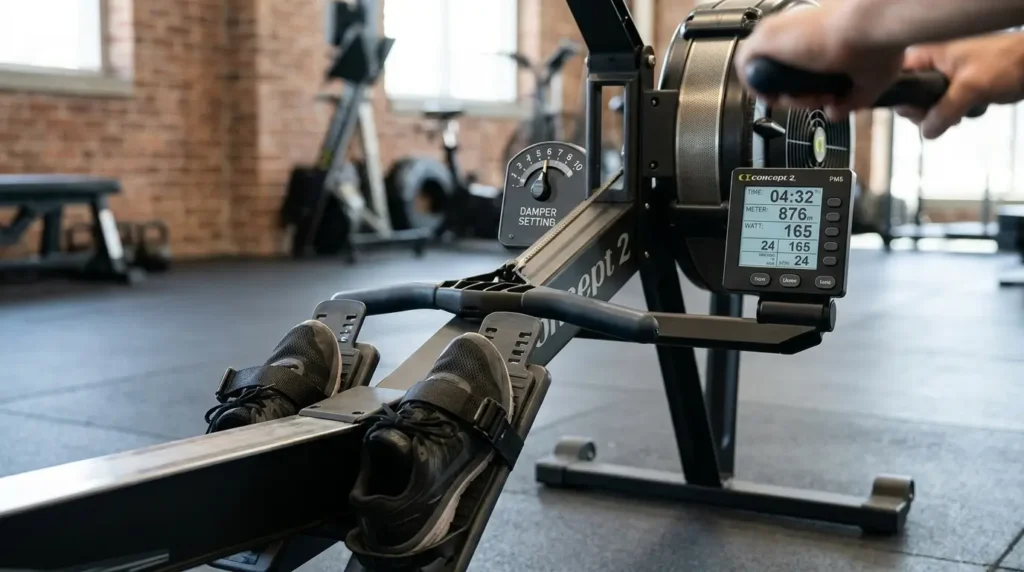
Quick Machine Setup
- First, slide your feet in and tighten the straps across the widest part of each foot, near the ball.
- Next, set the damper to 3-5 on a 1-10 scale. Higher is not better; instead, it just feels like rowing through mud.
- Finally, sit tall, grip the handle lightly, and check that your shins are close to vertical at the front of the stroke.
Warm-Up: First 4 Minutes of Your Rowing Session
A good warm-up makes the rest of the 30-minute rowing workout smoother. If your hips feel stiff, spend a minute before you sit down on easy hip hinges and bodyweight squats. Then row.
- 0:00-1:00: Arms only, then arms and body. Use 14-16 strokes per minute (spm) at effort 2.
- 1:00-2:00: Quarter slide, then half slide. Use 16-18 spm at effort 3.
- 2:00-4:00: Full slide, with 3 short “pickups” of 5 firm strokes. Use 18-20 spm at effort 3-4.
Effort scale: A 1 is sitting still. A 5 lets you talk in full sentences. In contrast, a 7-8 lets you say only a few words, and a 10 is all-out.
The 30 Minute Rowing Workout Plan (Minute by Minute)
This is the full session. For the first two weeks, beginners can use the easier version below.
Reading the Plan
- Warm-up (0:00-4:00): 1 set, continuous, 14-20 spm, effort 2-4.
- Steady base (4:00-10:00): 1 set, continuous, 20-22 spm, effort 5.
- Intervals (10:00-22:00): 6 sets of 1 minute hard, then 1 minute easy. Row the hard minute at 24-28 spm and effort 7-8. Then recover at 18 spm and effort 3.
- Steady finish (22:00-26:00): 1 set, continuous, 22 spm, effort 5-6.
- Cool-down (26:00-30:00): 1 set, continuous, 16-18 spm, effort 2-3.
Why the Stroke Rate Changes
In a Sports Biomechanics study of 24 high-level rowers, higher stroke rates produced technique closer to racing and greater muscle activation. Meanwhile, lower rates were suggested as a way to work on earlier trunk extension. Therefore, this plan mixes both: calm, controlled rowing for technique, and quicker strokes for the hard minutes.
For most beginners, 30 minutes covers roughly 2.5-3.5 miles (4-5.5 km). However, do not chase distance at first. Instead, focus on smooth strokes and even effort.
How to Row: Step-by-Step Form Cues
Good form is the difference between a great session and a sore back. On the way back, think “legs, body, arms.” Then, on the way forward, reverse it: “arms, body, legs.”
Step 1: The Catch
This is the front of the stroke. Your shins should be near vertical, your arms straight, and your shoulders relaxed. Meanwhile, lean slightly forward from the hips with your chest tall.
Step 2: The Drive
Start by pushing through your heels. Next, once your legs are almost straight, swing your body back to about a 1 o’clock lean. Finally, pull the handle to your lower ribs.
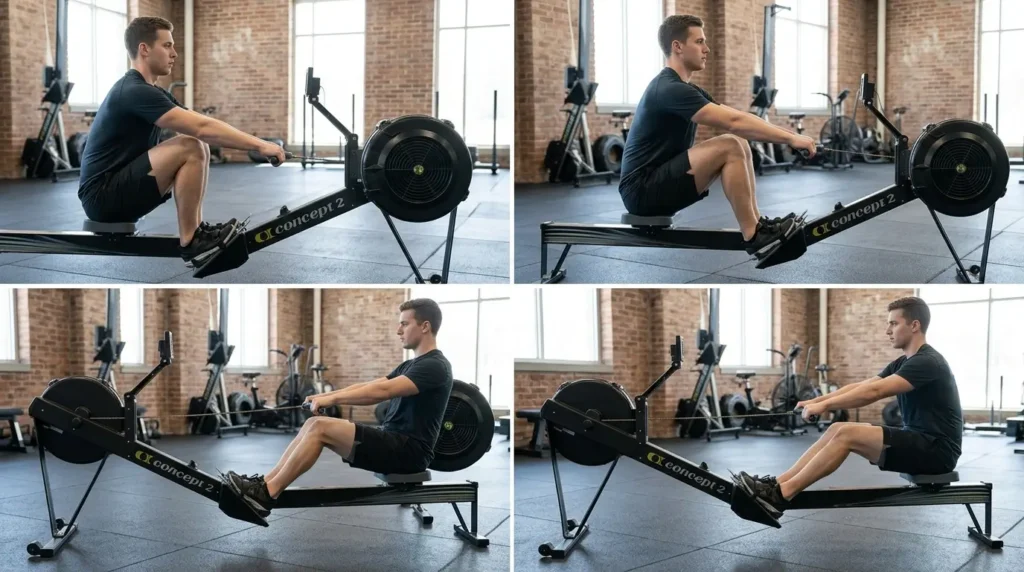
Step 3: The Finish
At this point, your legs are flat, and your core is braced. Your elbows pass your body, and your wrists stay flat. As a result, you should feel strong, not slumped.
Step 4: The Recovery
Now reverse the order. Arms go forward first, then your hips hinge over, and only then do your knees bend. Overall, take about twice as long on the recovery as on the drive.
What It Should Feel Like
Your legs should do most of the work, so your core should feel braced, and your grip should stay light. However, if your forearms burn first, you are over-pulling with your arms.
Coach’s Tip: Count “one” on the drive and “two-three” on the recovery. This 1:2 rhythm keeps your stroke smooth. Also, it gives your lower back a break between pulls.
Common Mistake: Opening the back early. Many beginners lean back before the legs finish pushing, so the stroke becomes a back-and-arms pull. To fix it, pause for a split second with straight arms at the start of the drive until you feel your legs engage.
Other Common Mistakes and Fixes
- Rounded back at the catch: To fix this, sit taller and hinge from the hips. Also, shorten your slide until it feels solid.
- Shooting the slide: If your seat moves before your shoulders, you lose power. Instead, push with the legs first.
- Death grip: Hold the handle with your fingers, not your fists. As a result, your forearms will tire later.
- Rushing the recovery: Slow down so you can reset at the front. Otherwise, the next drive starts off balance.
- Damper too high: Drop it to 3-4. Then focus on clean strokes.
Weekly Schedule and Progression Plan
Overall, aim for two or three rowing days per week. Also, space them out so your legs and back recover. On the other days, add strength work, such as the moves in our calisthenics exercises list, or rest.
Sample Week
- Monday: 30-minute rowing workout
- Tuesday: Strength training (full body)
- Wednesday: Rest or easy walk
- Thursday30-minutete rowing workout
- Friday: Mobility or rest
- Saturday: Strength training or a sport you enjoy
- Sunday: Optional easy row or full rest
If you also run, see how to plan running after leg day so your sessions do not collide.
Four-Week Progression
Change the interval block (10:00-22:00) like this:
- Week 1: No intervals. Instead, row steady at 20-22 spm, effort 4-5.
- Week 2: 6 rounds of 30 seconds hard and 90 seconds easy.
- Week 3: 6 rounds of 1 minute hard and 1 minute easy (the main plan).
- Week 4: 8 rounds of 45 seconds hard and 45 seconds easy.
For best results, add only one change at a time. However, if your form falls apart, repeat the week.
Beginner and Advanced Versions of the 30 Minute Rowing Workout
Easier Version (Regression)
- First, skip intervals and row at 20-22 spm for the full middle section.
- Then, use a half slide for the first week.
- Also, set the damper at 3.
- Alternatively, split the session into two 15-minute rows with 2 minutes of rest.
As a result, you can practice a 30-minute rowing workout with less strain while your technique settles.
Harder Version (Progression)
- Pyramid: Replace the main block with 1-2-3-2-1 minutes hard, with 1 minute easy between each.
- Power strokes: Every 2 minutes, add 10 strokes at effort 8 and a stroke rate of 24 spm.
- Negative split: Row the second half 3-5 seconds faster per 500 meters than the first half.
- Longer hard blocks: Try 4 rounds of 3 minutes at effort 7 with 90 seconds easy.
Instead of raising the damper, build power with a stronger leg drive. For example, if you want to compare gear, our NordicTrack RW200 comparison and ProForm 440R review show how resistance types feel different.
Cool-Down and Stretches
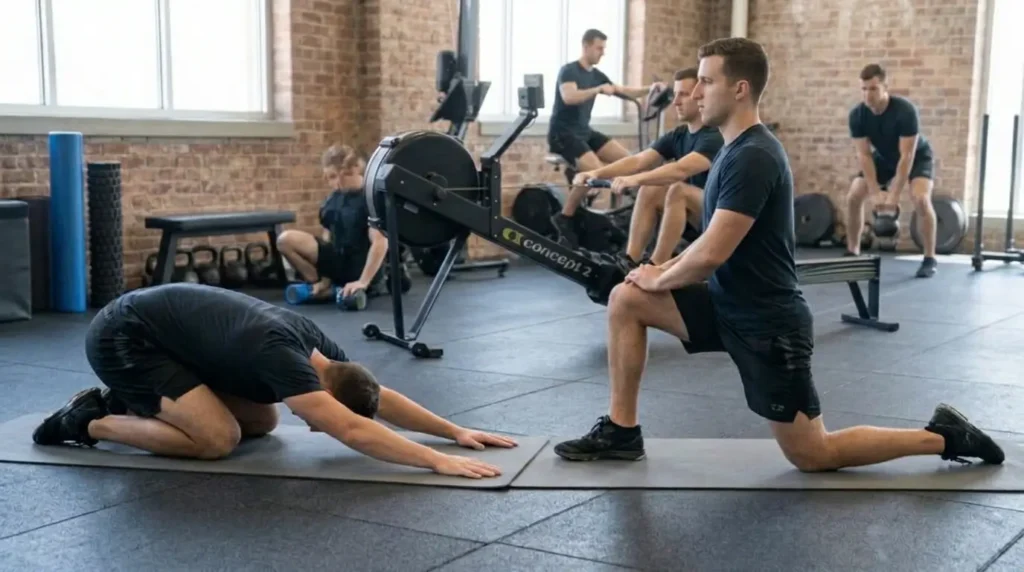
Finally, row easy for the last 4 minutes of your session. After that, step off and stretch for 3-5 minutes. Hold each stretch for 20-30 seconds and breathe slowly.
- Hamstring stretch: Sit with one leg extended and reach toward your toes.
- Hip flexor stretch: Kneel on one knee and gently push your hips forward.
- Child’s pose: Sit back toward your heels with your arms extended to ease your back and lats.
- Chest opener: Clasp your hands behind you and lift slightly.
Tips for Better Results
- Track one number. First, log your average split or total distance each week. That way, progress is easier to see than to feel.
- Be consistent. Overall, two steady sessions a week beat one heroic session followed by soreness.
- Fuel and hydrate. Drink water before and after. Also, eat a light snack if you train on an empty stomach and feel weak.
- Mix in other cardio. For example, our rowing machine vs elliptical guide covers the trade-offs. In addition, walking and easy jogging help; see our slow jogging comparison.
- Be realistic about weight loss. Exercise is only one piece, alongside food and sleep. For instance, our article on the elliptical and belly fat explains why. Above all, talk with your doctor before starting a weight-loss plan.
- Film your stroke. Finally, a short side-view video shows rounded backs and early arm pulls better than a mirror.
FAQ
Is a 30-minute rowing workout enough to get fit?
Yes, for most beginners. Half an hour of structured rowing, done two or three times a week, can build cardio fitness and work your legs, back, and core. However, add strength training on other days, since the CDC also recommends muscle-strengthening activity on two or more days a week.
How many calories does a 30-minute rowing workout burn?
It depends on your body weight and effort. Heavier people and harder efforts burn more. Therefore, the Harvard Health calorie chart, which lists 30-minute estimates by weight, is a better guide than a single number. Also, treat any machine’s calorie readout as a rough estimate.
How often should I do a 30-minute rowing workout?
Most beginners do well with two or three sessions a week, with at least one rest or light day in between. Then, as your technique and stamina improve, you can add a third session or lengthen the hard intervals. Meanwhile, listen to your lower back and legs, and rest if form slips.
What damper setting should I use?
Start between 3 and 5 on a 1-10 scale. The damper controls airflow, not weight. As a result, a lower setting feels like a light boat, while a higher one feels heavy. Most people row best around 4, and it is easier on the back.
Will rowing hurt my lower back?
Rowing is low impact, but poor form can irritate your back. To avoid that, hinge from the hips, keep your chest tall, and push with your legs first. Stop if you feel sharp pain. Also, if you have a history of back problems, check with a doctor or physical therapist before starting.
Can I row every day?
Some experienced people do, but it is not necessary and not ideal for beginners. Daily rowing repeats the same movement and can stress your lower back and hands. Instead, two or three rows per week, plus walking and strength days, is a safer pattern to build on.
Conclusion: Make the 30 Minute Rowing Workout a Habit
A 30-minute rowing workout gives you a full-body session in a short window. First, you warm up and build a steady base. Then you push through six intervals and cool down. Along the way, learn the catch, drive, finish, and recovery, and keep your damper modest.
Start with the easier version, add one change per week, and keep two or three rowing days on your calendar. Within a month, the stroke will feel smooth, and your sessions will feel stronger.
Good luck. Grab the handle and row.
