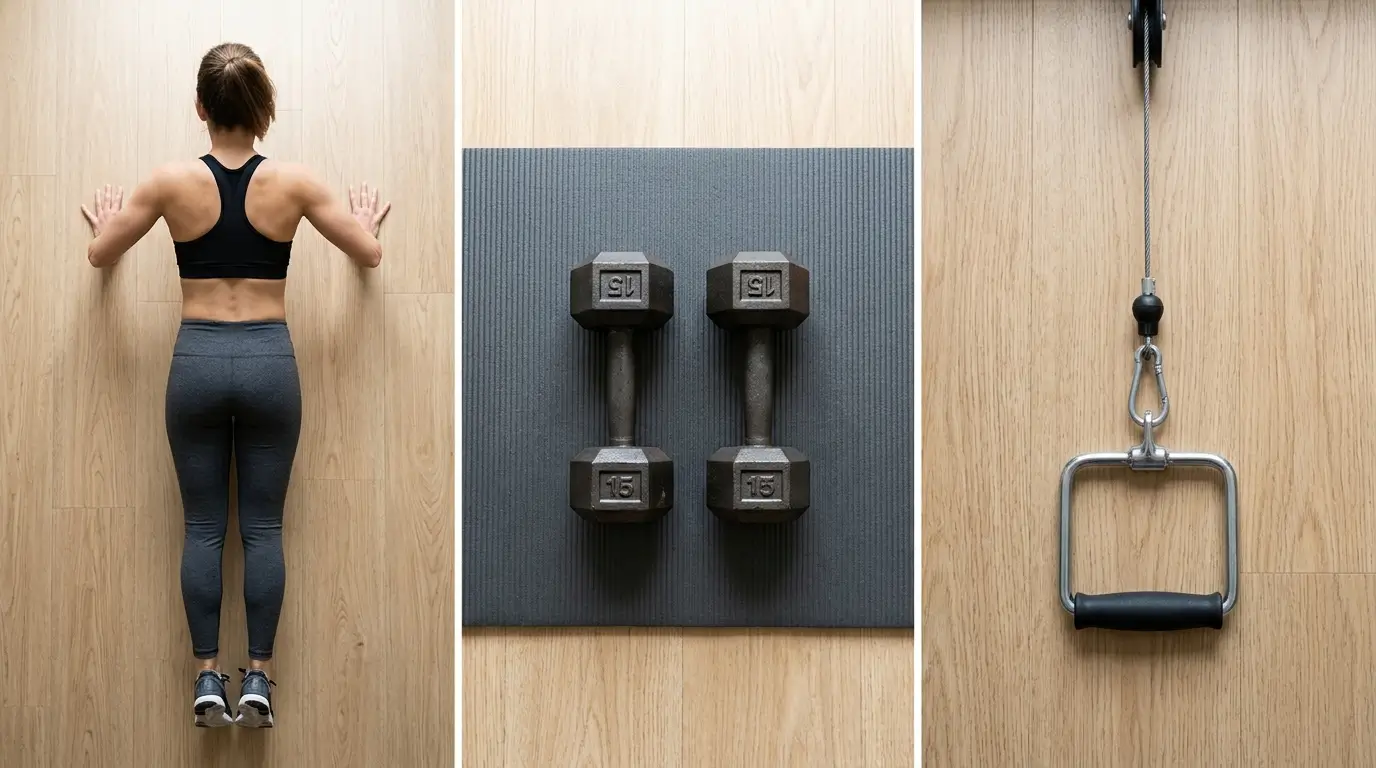
The best bench press alternatives let you train your chest, front shoulders, and triceps without a barbell, a spotter, or even a bench. Maybe the rack is busy at your gym. Maybe your shoulders ache under a heavy bar, or you train at home with a pair of dumbbells and a little floor space.
Whatever your reason, you have solid options. In this guide, I’ll walk you through bench press alternatives for three setups: no equipment, dumbbells, and cables. I’ll also cover machines, form cues, sets and reps, and a full sample workout.
Think like a coach here. Your goal is steady progress, not one perfect lift. Pick the version that fits your gear and your body, then add reps or weight over time.
Quick Answer: The best bench press alternatives are the push-up (no equipment), the dumbbell floor press (dumbbells), and the standing cable chest press (cable). All three train your chest, shoulders, and triceps. In one randomized trial of trained lifters, band push-ups and the bench press produced similar strength gains.
Muscles Worked by Bench Press Alternatives
Most bench press alternatives are horizontal pushing moves. Your hands travel away from your chest in a straight line, so the same muscles do the work. That is why a good substitute can feel very familiar.
Primary muscles
- Pectoralis major (chest): This is the main driver. The upper fibers work harder on incline angles, while the lower fibers work harder on decline angles.
- Anterior deltoid (front shoulder): It helps push your arm forward and up.
- Triceps brachii (back of the arm): It straightens your elbow at the top of each rep.
Secondary muscles
- Serratus anterior: It keeps your shoulder blade snug against your ribs.
- Rotator cuff: It steadies the shoulder joint, especially in dumbbell and cable work.
- Biceps and forearms: They help you control the weight.
- Core and glutes: They keep your body rigid during push-ups and standing cable presses.
Researchers who compared push-ups and bench presses at matched loads concluded the two moves can be used interchangeably for strength training [VERIFY authors and year]. The catch is simple: the load must be hard enough. Easy reps will not do much, no matter which exercise you pick.
Benefits of Bench Press Alternatives
Switching your pressing move is not a downgrade. In fact, a smart rotation often keeps training fresh and easier to stick with. Here is what you gain.
- No spotter needed. You can stop a set safely on the floor, in a push-up position, or by simply letting go of a cable handle. Therefore, you can train close to your limit with less worry.
- Each arm works on its own. With dumbbells and single-arm cables, a stronger side can’t take over. As a result, you notice weak spots quickly.
- More freedom of movement. Your hands are not locked to one bar path. Many lifters find this feels better on the shoulders and wrists, although comfort varies from person to person.
- Home-friendly. A mat, a pair of dumbbells, and a band cover most of what you need. Our guide to apartment workout equipment shows compact gear that fits small spaces.
- Easy to progress. You can add reps, slow the tempo, raise your feet, or pick up heavier dumbbells.
Besides these perks, there is the bigger picture. Adults should do muscle-strengthening activity on two or more days a week, and that work should include the chest, according to the CDC adult activity guidelines. Any of the moves below can help you meet that target.
How to Do the 3 Core Bench Press Alternatives (Step by Step)
Start with these three. They cover no-equipment, dumbbell, and cable setups, and every other move in this article builds on them.
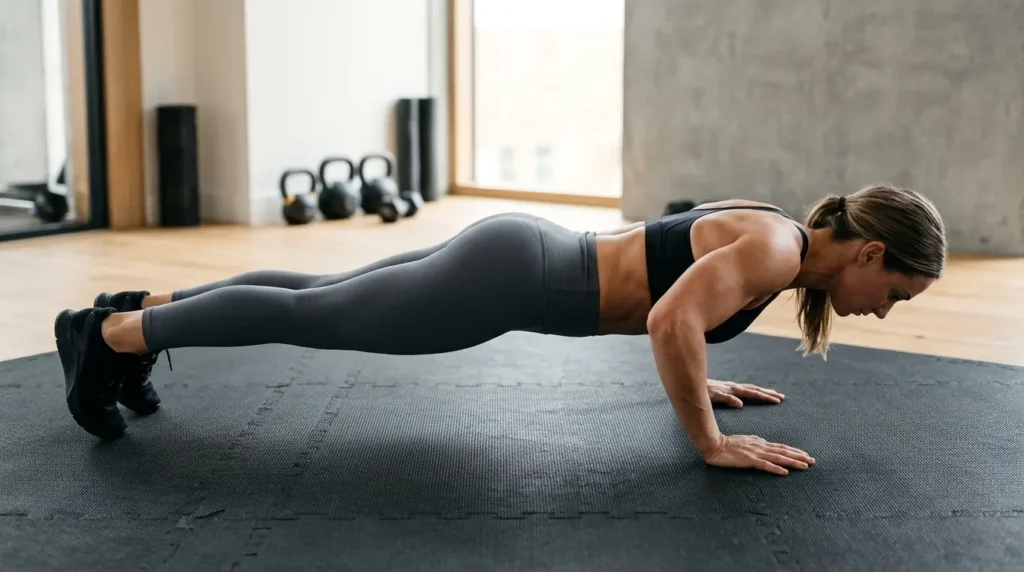
1. The Push-Up (No Equipment)
- Place your hands on the floor slightly wider than your shoulders, about 1.5 times shoulder width.
- Step your feet back until your body forms a straight line from head to heels.
- Squeeze your glutes and brace your abs, as if someone might poke your stomach.
- Lower your chest toward the floor over about 2-3 seconds. Keep your elbows at roughly a 45-degree angle to your body, not flared straight out.
- Touch lightly or stop an inch (2.5 cm) above the floor.
- Press the floor away until your arms are straight, then spread your shoulder blades slightly at the top.
What it should feel like: a stretch across the chest on the way down and a strong push through the chest and triceps on the way up. Your lower back should feel quiet.
Coach’s Tip: Pretend you are trying to “bend the floor” by twisting your hands outward, with no actual movement. This cue switches on your shoulder muscles and takes pressure off your elbows. It also keeps your shoulder blades from drifting forward.
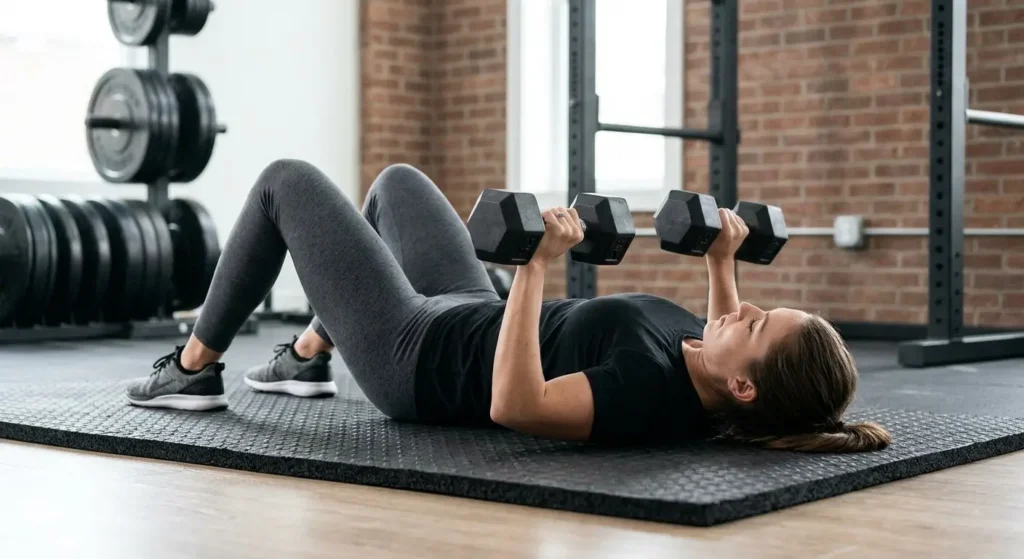
2. The Dumbbell Floor Press (Dumbbell)
- Lie on your back with knees bent and feet flat. Hold a dumbbell in each hand, resting on your thighs.
- Roll back while bringing the dumbbells to chest level, then press them straight above your shoulders.
- Lower the weights slowly until your upper arms lightly touch the floor, about 2-3 seconds.
- Pause for one beat. Don’t bounce or relax your shoulders.
- Drive the dumbbells up and slightly together until your arms are straight.
What it should feel like: a deep chest and triceps push, with a short stop at the bottom. The floor limits your range, so your triceps often work harder than they do on a regular bench.
Starting weight: Most beginners do well with 15-25 lb (7-11 kg) per hand. Intermediate lifters often press 30-50 lb (14-23 kg) per hand. Pick a weight that lets you finish your target reps with 1-3 reps left in the tank.
3. The Standing Cable Chest Press (Cable)
- Set both pulleys at about shoulder height and attach a single handle to each.
- Grab the handles and step forward into a split stance, one foot ahead of the other. Lean slightly forward.
- Start with your hands near your chest and elbows bent behind you.
- Press both handles forward until your arms are nearly straight. Bring your hands together in front of your chest.
- Return slowly over 2-3 seconds, feeling a gentle stretch in your chest.
What it should feel like: constant tension from start to finish. Unlike free weights, the cable does not “go slack” at the top, so your chest keeps working.
Starting weight: Try 10-20 lb (5-9 kg) on each side of the stack. Add small jumps once you can finish all reps with smooth form.
Common Mistake: Letting your shoulders shrug up toward your ears during presses. This turns a chest move into a neck-and-shoulder strain. Instead, keep your shoulders down and back, then think about pushing your hands apart as you press.
Sets, Reps, and Weight for Bench Press Alternatives by Goal
Your goal decides your plan. Heavier loads tend to build the most max strength. In a meta-analysis of 21 studies, 1RM strength gains were greater with high-load training, while isometric strength gains were similar between conditions. For that reason, strength days should use harder variations and fewer reps.
| Goal | Sets | Reps | Effort | Rest | Tempo (down / up) |
|---|---|---|---|---|---|
| Strength | 3-5 | 3-6 | 1-2 reps left | 2-3 min | 2 sec / fast |
| Muscle size | 3-4 | 8-12 | 1-3 reps left | 60-90 sec | 3 sec / 1 sec |
| Endurance | 2-3 | 15-25 | 2-4 reps left | 30-60 sec | 2 sec / 1 sec |
How to make it work in practice
- No-equipment strength days: Use harder variations such as decline or archer push-ups, or wear a weighted backpack. If your push-ups are too easy, move up before you add more reps.
- Dumbbell days: Pick weights that make your last 2 reps slow but clean.
- Cable days: Use the slow lowering phase to build control. Stop a set if your form breaks.
Train your chest about twice per week with at least 48 hours between sessions. Add one rep per set each week, then raise the weight when you reach the top of your rep range. This is called progressive overload, and it is how your body keeps adapting.
Common Mistakes and Fixes
Even simple moves go wrong when you rush. Here are the errors I see most often, along with quick fixes.
- Flared elbows. Elbows pointed out at 90 degrees stress the front of the shoulder. Fix: tuck them to about 45 degrees and lead with your chest.
- Sagging hips in push-ups. A drooping low back makes the move harder and less effective. Fix: squeeze your glutes and shorten the set.
- Bouncing at the bottom. Dropping the weight fast uses momentum instead of muscle. Fix: lower for 2-3 seconds and pause briefly.
- Half reps. Short reps leave results on the table. Fix: use a lighter weight and move through a full, comfortable range.
- Too much weight too soon. Heavy dumbbells can pull your shoulders forward. Fix: drop 10-20% of the load and rebuild.
- Flat shoulder blades. When your shoulder blades slide forward, your front shoulders take over. Fix: keep your chest proud and your shoulder blades gently pulled back on dumbbell presses.
- Skipping pulling work. If you only push, your posture may suffer over time. Fix: pair every pressing day with rows or pull-ups. This guide to the muscles pull-ups work shows how back work balances your chest training.
Variations: Easier to Harder
Every lifter starts at a different spot. Use this ladder to find yours and move up when you can do 3 clean sets at the top of your rep range.
Easier versions (regressions)
- Wall push-up: Stand about an arm’s length from a wall and press away.
- Incline push-up: Put your hands on a counter or box 24-30 inches (61-76 cm) high. The higher your hands, the easier the move.
- Knee push-up: Keep a straight line from your knees to your head.
- Light dumbbell floor press: Start with 8-12 lb (4-5 kg) per hand to learn the path.
- Cable press with a split stance and lighter stack: Learn the motion with 5-10 lb (2-5 kg) per side.
Harder versions (progressions)
- Decline push-up: Put your feet on a bench or box about 12-18 inches (30-46 cm) high.
- Archer push-up: Shift most of your weight to one arm while the other arm stays straighter.
- Tempo push-up: Lower for 4 seconds, pause 1 second, then press up fast.
- Weighted push-up: Add a loaded backpack or a weight vest.
- Single-arm dumbbell press: Press one dumbbell at a time to challenge your core.
- Single-arm cable press: Keep your torso still as the cable tries to twist you.
If you also train with a barbell, it helps to know your gear. Our breakdown of Olympic vs. standard barbells explains bar weight and sleeve size so you can load the bar correctly.
More Bench Press Alternatives: No Equipment, Dumbbell, Cable, and Machine
Once you have mastered the core three, add these. Each one targets the chest a little differently.
No-Equipment Bench Press Alternatives
You can build a lot of upper body strength with bodyweight alone. Our calisthenics exercises list offers more ideas once you outgrow these.
- Standard push-up: 3 sets of 8-15 reps, rest 60-90 seconds. The classic. It trains the chest, shoulders, and triceps while challenging your core.
- Decline push-up: 3 sets of 6-12 reps, rest 90 seconds. Your feet are raised, which shifts more load onto the upper chest and front shoulders.
- Close-grip (diamond) push-up: 3 sets of 6-12 reps, rest 90 seconds. Your hands sit closer together, so your triceps work harder. If you want arm gains too, read about push-ups and your biceps.
- Archer push-up: 3 sets of 4-8 reps per side. This is a great bridge toward one-arm push-ups.
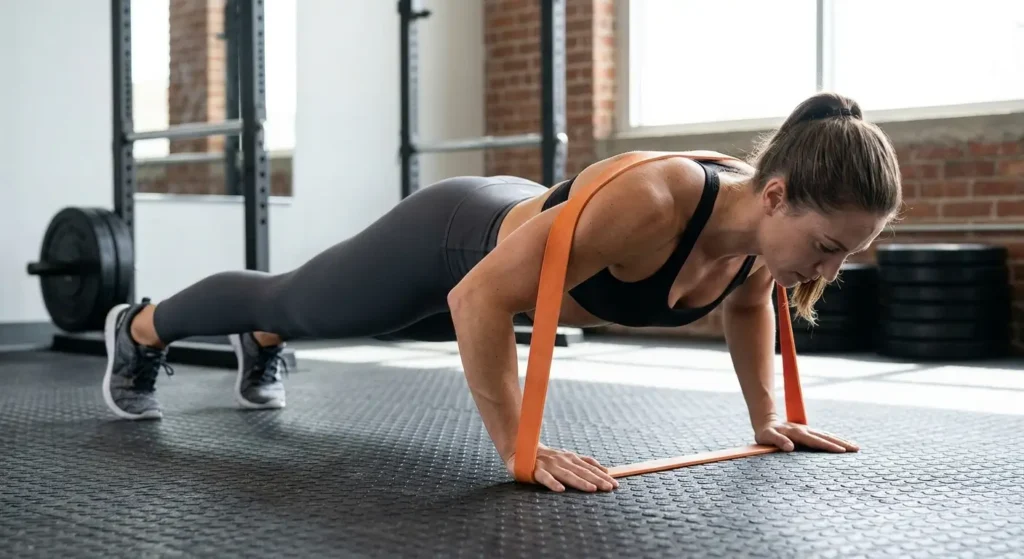
- Band-resisted push-up: 3 sets of 8-12 reps, rest 90 seconds. Loop a resistance band across your upper back and under your hands. In the trial mentioned earlier, trained lifters who did 6-rep-max band push-ups gained strength similar to a bench press group over five weeks.
Dumbbell Bench Press Alternatives
Dumbbells are the most flexible choice for home gym owners. If you are still shopping, compare hex vs. round dumbbells so your set does not roll away mid-workout.
- Dumbbell floor press: 3 sets of 6-12 reps, rest 90 seconds. Best when you have no bench or want a shorter range of motion.
- Flat dumbbell bench press: 3 sets of 8-12 reps, rest 90 seconds. If you have a bench, this is the closest match to the barbell lift, with more freedom for your wrists and shoulders.
- Incline dumbbell press: 3 sets of 8-12 reps. Set the bench at 30 degrees to hit the upper chest.
- Dumbbell squeeze press: 3 sets of 10-15 reps. Press the dumbbells together the whole time. You will feel a strong inner-chest squeeze with light weights.
- Dumbbell fly: 2-3 sets of 10-15 reps, light weight. This is an isolation move, so use it after your main press rather than in place of it.
- Single-arm dumbbell press: 3 sets of 8-10 reps per side. Brace your core to avoid tipping sideways.
Coach’s Tip: On any dumbbell press, imagine bending the handles toward each other at the top without moving your hands. This light “squeeze” keeps tension on the chest and makes lighter weights feel harder.
Cable Bench Press Alternatives
Cables offer steady resistance through the whole rep. Many gyms have them, and some all-in-one trainers copy the feel at home. If you are weighing a home setup, our best Bowflex home gym overview explains how those machines handle pressing moves.
- Standing cable chest press: 3 sets of 10-15 reps, rest 60-90 seconds. Great for beginners because the posture supports your balance.
- High-to-low cable fly: 3 sets of 12-15 reps. Pulleys set high, arms sweep down and in. It hits the lower chest.
- Low-to-high cable fly: 3 sets of 12-15 reps. Pulleys set low, arms sweep up and in. It targets the upper chest.
- Single-arm cable press: 3 sets of 10-12 reps per side. Resist the urge to twist your torso.
Machine Bench Press Alternatives
- Seated chest press machine: 3 sets of 8-12 reps, rest 90 seconds. The seat and handles guide your path, so it is a safe pick if you train alone. Our review of the Hammer Strength chest press covers what to look for in a good machine.
- Smith machine press: 3 sets of 8-12 reps. One study of experienced and inexperienced lifters found greater medial deltoid activity during the free-weight bench press than the Smith machine version. For that reason, use the Smith machine as a backup rather than your main move.
Who Should Be Careful
Pressing moves load your shoulders, elbows, and wrists. Take extra care, or ask a professional first, if any of these apply to you:
- You have current shoulder, elbow, or wrist pain, or a past shoulder injury.
- You are recovering from surgery.
- You are pregnant or postpartum.
- You have high blood pressure, heart disease, or another medical condition.
- You are older and new to strength training.
Check with a doctor or physical therapist before starting if you have pain, an injury, or a medical condition. Also stop any rep that causes sharp pain, tingling, or joint pinching. Muscle burn is normal, but joint pain is a signal to back off.
Sample Workout Using Bench Press Alternatives
Here is a 45-minute upper-body session. It works whether you train at home or in a gym. Warm up first with 5 minutes of easy movement, arm circles, and 1-2 light sets of push-ups.
| Order | Exercise | Sets | Reps | Rest |
|---|---|---|---|---|
| 1 | Dumbbell floor press (or flat dumbbell press) | 4 | 8-10 | 90 sec |
| 2 | Push-up (tempo: 3 sec down) | 3 | 8-15 | 60-90 sec |
| 3 | Standing cable chest press | 3 | 10-12 | 60-90 sec |
| 4 | Low-to-high cable fly (or dumbbell fly) | 2-3 | 12-15 | 60 sec |
| 5 | Close-grip push-up (triceps finisher) | 2 | AMRAP* | 60 sec |
*AMRAP means “as many reps as possible” with good form. Stop 1-2 reps before your form fails.
Weekly plan: Do this session on Monday and again on Thursday. On the other days, train your back, legs, and shoulders. Our leg and shoulder workout is a good fit for your midweek day.
Progression: Each week, add one rep to each set. After you hit the top of your rep range on every set, increase the dumbbell or cable weight by 5 lb (2 kg) or move to a harder push-up variation.
FAQ
What can I use instead of a bench press?
Push-ups, the dumbbell floor press, dumbbell bench press, standing cable chest press, and machine chest press all work. Pick the one that fits your equipment. Choose a load that feels hard in the last few reps, and aim to add reps or weight each week.
Can push-ups replace the bench press?
Yes, for most people. One study found that trained lifters who did band-resisted push-ups gained strength similar to bench press lifters over five weeks. Push-ups must be hard enough, so add a band, backpack, or foot elevation when they get easy.
Is the dumbbell press as good as the bench press?
For building the chest, shoulders, and triceps, it is an excellent option. You usually lift less total weight with dumbbells. However, they let each arm work separately and give your wrists and shoulders more freedom, which many lifters like.
What is the best bench press alternative for bad shoulders?
There is no single best choice. Many people find the floor press, neutral-grip dumbbell press, or a higher-hand incline push-up more comfortable. Pain, though, needs a professional opinion. See a doctor or physical therapist before training through shoulder pain.
Are cable flys better than the bench press?
They are different tools. Cable flys isolate the chest and keep tension throughout the move, but you cannot load them as heavily. Use them after a main press, such as push-ups or dumbbell presses, rather than as a full replacement.
Can I build my chest without a bench?
Yes. Push-up variations, the dumbbell floor press, band work, and standing cable presses need no bench. Train near your limit with good form, rest enough between sessions, and increase your difficulty over time.
Conclusion
Bench press alternatives give you more than a backup plan. With push-ups, dumbbells, cables, and machines, you can train your chest from many angles, protect your comfort, and keep making progress without a spotter. Start with the three core moves, follow the sets and reps in the table, and add difficulty slowly.
Your next step is simple. Choose one no-equipment move, one dumbbell move, and one cable or machine move, then build the sample workout into your week. Stay consistent for 6-8 weeks, track your reps and weights, and let steady effort do the work.
