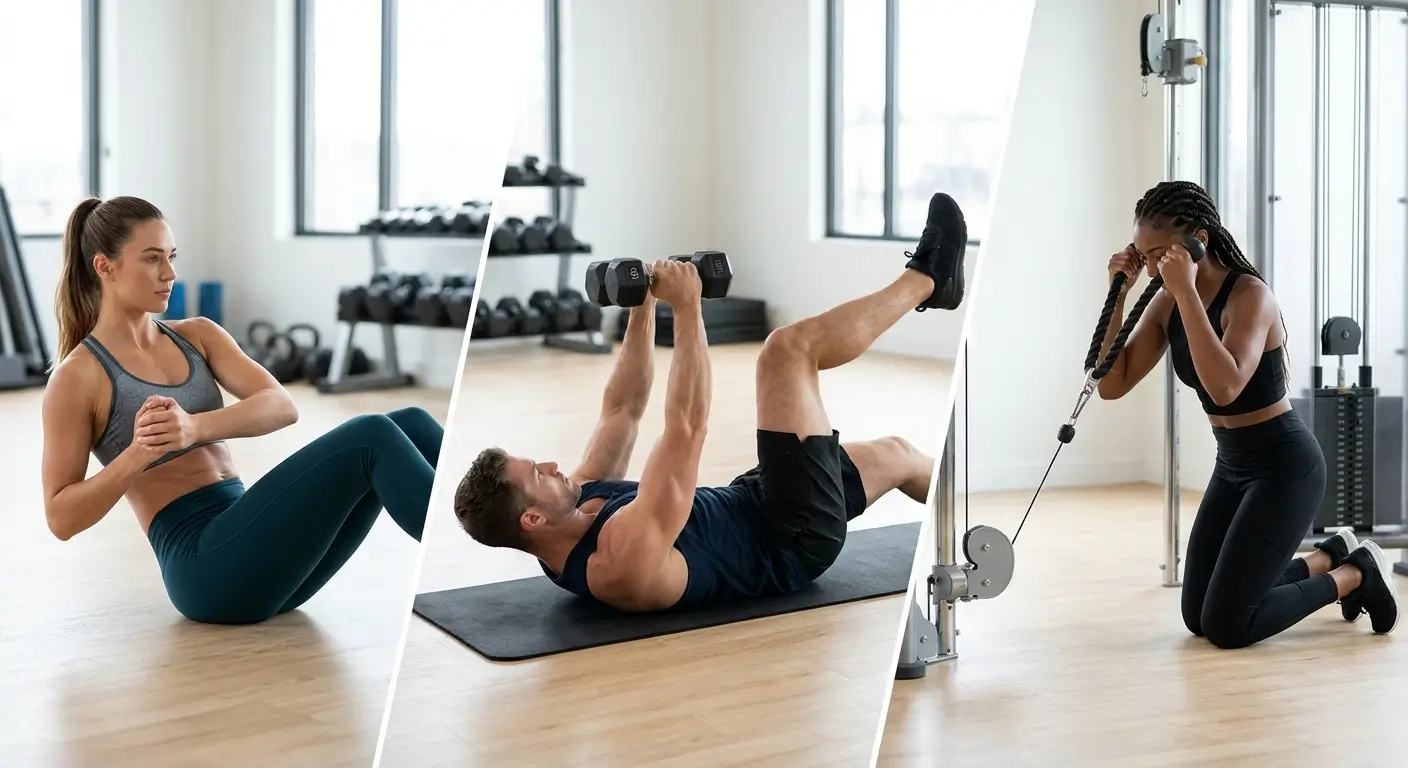
The best bicycle crunch alternatives train your abs and obliques with less neck pulling, less momentum, and more control. Maybe your neck gets tired halfway through a set. Maybe your hip flexors take over, or you simply want your core routine to feel fresh again.
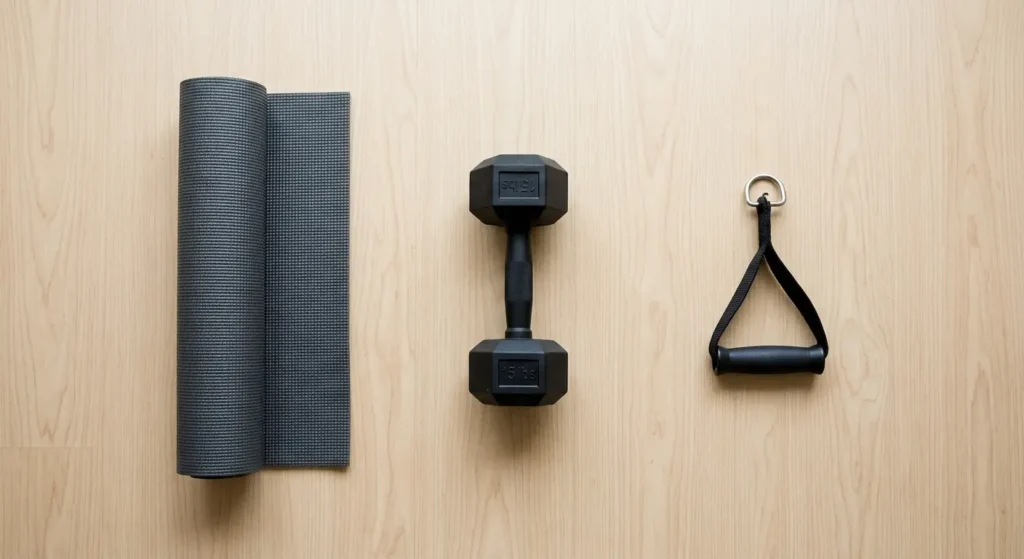
You have plenty of good options. In this guide, I’ll show you bicycle crunch alternatives for three setups: no equipment, dumbbells, and cables. I’ll also cover machines, form cues, sets and reps, and a full sample workout.
Think like a coach here. Strong abs come from smooth reps and steady progress, not from speed. Pick the version that fits your body and your gear, then add difficulty slowly.
Quick Answer: The best bicycle crunch alternatives are the dead bug and reverse crunch (no equipment), the dumbbell Russian twist (dumbbell), and the cable woodchop (cable). All of them train the rectus abdominis and obliques with less neck pull. Pick one from each group and train core two to three days a week.
Muscles Worked by Bicycle Crunch Alternatives
The bicycle crunch mixes spinal flexion (curling forward) with rotation (twisting). Most bicycle crunch alternatives split those two jobs apart. That makes each one easier to control and easier to load.
Primary muscles
- Rectus abdominis: the “six-pack” muscle. It curls your ribcage toward your pelvis.
- External obliques: the outer side muscles. They help you rotate and bend sideways.
- Internal obliques: the deeper side muscles. They work with the external obliques on the opposite side.
Secondary muscles
- Transverse abdominis: a deep muscle that acts like a natural weight belt.
- Hip flexors: they lift your knees and often work hard in leg-driven moves.
- Erector spinae and glutes: they hold your spine steady in anti-rotation and plank moves.
- Shoulders and lats: they help in rollouts and hanging work.
Research shows that different ab exercises hit different regions. In one study of 25 healthy adults, the reverse curl produced the most lower rectus activity [VERIFY authors: Willett et al., 2001], and the V-sit and reverse curl produced the most external oblique activity. So mixing moves is smarter than relying on a single exercise.
Benefits of Bicycle Crunch Alternatives
The bicycle crunch is a good move. In an ACE-commissioned EMG study of 13 ab exercises, it ranked first for rectus abdominis activity and second for obliques. Still, no single exercise fits every body or every goal.
Here is what you gain from using bicycle crunch alternatives.
- Less neck strain. Many people pull on their head during bicycle crunches. Moves like dead bugs and reverse crunches keep your hands off your head altogether.
- Better control. Slow, planned reps make it harder to “cheat” with momentum.
- Easy loading. Dumbbells and cables let you add resistance, which supports progressive overload.
- Rotation and anti-rotation. Cable work trains you to twist and also to resist twisting. Athletes in sports like baseball use both, as shown in our baseball core workout.
- Variety. Changing exercises every 4-6 weeks keeps training interesting.
Core work also fits the bigger picture. Adults need muscle-strengthening activity on at least two days a week, and those sessions should include the abdomen, according to the CDC adult activity guidelines. Any move below helps you meet that goal.
How to Do the 3 Core Bicycle Crunch Alternatives (Step by Step)
Start with these three. Together they cover no-equipment, dumbbell, and cable setups.
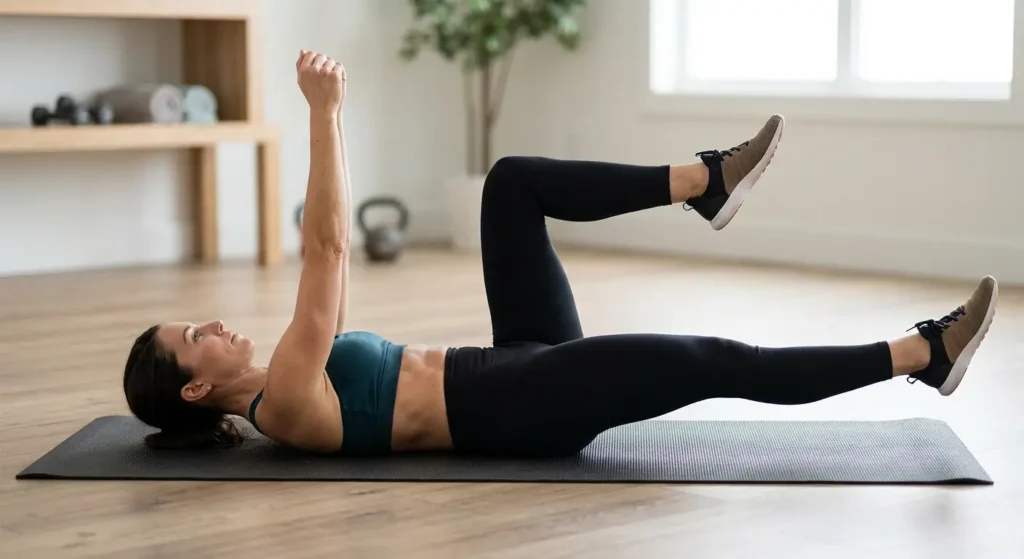
1. The Dead Bug (No Equipment)
- Lie on your back with arms straight up toward the ceiling and knees bent at 90 degrees over your hips.
- Press your lower back gently into the floor and brace your abs, as if you were about to cough.
- Slowly lower your right arm overhead and straighten your left leg toward the floor, over about 3 seconds.
- Stop before your lower back arches off the floor.
- Return to the start and switch sides.
What it should feel like: a deep, steady tension in your midsection. You should not feel it in your neck or low back.
Coach’s Tip: Slide a flat hand under your lower back before you begin. If your back lifts off the floor during a rep, shorten your range. The goal is control, not distance.
2. The Dumbbell Russian Twist (Dumbbell)
- Sit on the floor with knees bent and heels resting on the ground.
- Hold one dumbbell with both hands at chest level.
- Lean back until you feel your abs engage, keeping your chest tall.
- Rotate your ribcage to the right, then to the left. Your hips stay still.
- Touch the dumbbell lightly beside each hip, if your range allows.
What it should feel like: a strong squeeze in the obliques as you twist. Your arms should stay relaxed.
Starting weight: Beginners do well with 8-12 lb (4-5 kg). Intermediate lifters often use 15-25 lb (7-11 kg). Choose a weight that lets you rotate smoothly for the full set.
3. The Cable Woodchop (Cable)
- Set a cable pulley above head height and attach a single handle.
- Stand sideways to the machine with feet shoulder-width apart. Grip the handle with both hands.
- Start with your hands near the upper shoulder closest to the stack.
- Pull the handle down and across your body toward the opposite hip. Rotate through your torso and pivot your back foot.
- Return slowly over 2-3 seconds.
What it should feel like: a diagonal squeeze through your obliques and a stable base through your legs. The cable keeps constant tension on your muscles.
Starting weight: Try 10-20 lb (5-9 kg) on the stack. Raise the load in small steps once your form is smooth.
Common Mistake: Swinging the weight with your arms instead of rotating your torso. When this happens, your obliques are barely working. Instead, keep your arms long and let your ribcage drive the movement.
Sets, Reps, and Weight for Bicycle Crunch Alternatives by Goal
Your goal decides your plan. Because ab muscles respond well to both controlled reps and brief holds, you can mix the two. Start conservatively, then build.
| Goal | Sets | Reps / Time | Effort | Rest | Tempo |
|---|---|---|---|---|---|
| Strength | 3-4 | 6-10 reps (weighted) | 1-2 reps left | 90-120 sec | 3 sec / 1 sec |
| Muscle size | 3-4 | 10-15 reps | 1-3 reps left | 60-90 sec | 2 sec / 2 sec |
| Endurance | 2-3 | 20-30 reps, or 30-60 sec holds | 2-4 reps left | 30-45 sec | 2 sec / 1 sec |
How to apply the table
- Floor moves: Use slow tempo before you add weight. Control matters more than reps.
- Dumbbell moves: Add weight when you can finish all sets with smooth twists.
- Cable moves: Use the lowering phase to build control, and make each rep the same speed.
Train your core 2-3 days a week with at least one rest day between hard sessions. Add one rep per set each week. Then, when you reach the top of your range, add 2-5 lb (1-2 kg) or switch to a harder variation.
Common Mistakes and Fixes
Core exercises look simple, which is exactly why form slips. Here are the errors I see most often.
- Pulling on the neck. Clasped hands tug the head forward. Fix: place fingertips lightly behind your ears, or cross your arms over your chest.
- Rushing reps. Fast reps rely on momentum. Fix: slow the lowering phase to 2-3 seconds.
- Arched lower back. This often happens in dead bugs and leg raises. Fix: shorten your range and keep your ribs pulled down.
- Letting hip flexors take over. Big leg swings turn an ab move into a hip move. Fix: focus on curling your pelvis, as in a reverse crunch.
- Twisting from the hips. In rotation moves, your hips should stay mostly still. Fix: move your ribcage first, then your arms.
- Holding your breath. This raises tension in your neck and face. Fix: exhale as you curl or rotate, and inhale as you return.
- Only training crunch-style moves. Your core also needs stability work, such as planks. See our guide on how to flex your abs for ideas on activation.
Variations: Easier to Harder
Use this ladder to find your level. Move up when you can finish 3 sets with clean form.
Easier versions (regressions)
- Dead bug with arms only: Keep your feet planted and move just your arms.
- Heel taps: Lie on your back with knees bent and reach side to side for your ankles.
- Bent-knee reverse crunch: Keep your knees tucked and lift just your hips an inch (2.5 cm) off the floor.
- Light cable woodchop: Use 5-10 lb (2-5 kg) and a smaller range.
- Seated Russian twist without weight: Keep your heels on the floor.
Harder versions (progressions)
- Weighted dead bug: Hold a light dumbbell, 5-10 lb (2-5 kg), in both hands above your chest.
- Slow-tempo reverse crunch: Lower for 4 seconds and pause at the bottom.
- Feet-up Russian twist: Lift your heels off the floor.
- Single-arm cable press (Pallof style): Press out and hold for 3-5 seconds.
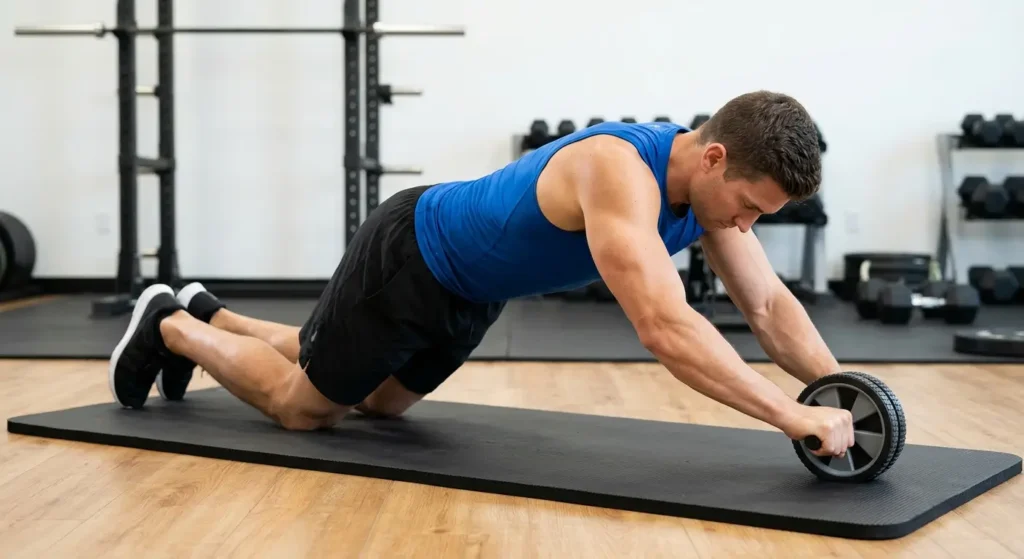
- Ab wheel rollout: Start from your knees, then progress toward longer rollouts.
If you want to build a home setup that covers these moves, our list of the best apartment workout equipment shows compact tools that suit small spaces.
More Bicycle Crunch Alternatives: No Equipment, Dumbbell, Cable, and Machine
Once the core three feel easy, add these. Each one hits your abs a little differently.
No-Equipment Bicycle Crunch Alternatives
You can build a lot of core strength with your body weight alone. For more ideas, see our calisthenics exercises list.
- Dead bug: 3 sets of 8-12 reps per side, rest 45-60 seconds. It teaches you to keep your spine steady while your limbs move.
- Reverse crunch: 3 sets of 10-15 reps, rest 60 seconds. Roll your hips up and curl your knees toward your chest. An EMG study of 21 adults found that a reverse crunch on a 30-degree incline was among the most effective moves for activating the abdominal muscles.
- Heel touches: 3 sets of 15-20 reps per side. A low-neck-strain option for the obliques.
- Side plank: 3 holds of 20-40 seconds per side. It trains the obliques and teaches your trunk to resist sideways bending.
- Standing knee-to-elbow crunch: 3 sets of 12-16 reps per side. A gentle, standing version of the bicycle crunch. It is good for people who dislike lying on the floor.
- Hollow hold: 3 holds of 15-30 seconds. Lie on your back, lift your shoulders and legs slightly, and keep your lower back pressed down.
Dumbbell Bicycle Crunch Alternatives
Dumbbells make it easy to load your core. If you are still choosing a set, read our comparison of hex vs. round dumbbells.
- Dumbbell Russian twist: 3 sets of 10-16 twists, rest 60 seconds. It builds oblique strength with a controlled twist.
- Weighted dead bug: 3 sets of 8-10 reps per side. Hold a light dumbbell in both hands above your chest.
- Dumbbell side bend: 2-3 sets of 10-12 reps per side, using 15-25 lb (7-11 kg). Keep the move small and slow. Use only one dumbbell and stand tall.
- Suitcase carry: 3 walks of 30-40 seconds per side. Hold one heavy dumbbell and walk without leaning. This trains your obliques to resist bending.
- Dumbbell V-sit twist: 2-3 sets of 8-12 twists. This one is advanced. Lift your feet and keep your chest open.
- Dumbbell reverse crunch (squeezed between feet): 3 sets of 8-12 reps with a light dumbbell, about 5-10 lb (2-5 kg). Use only if your form is already solid.
If kettlebells are your tool of choice, check whether kettlebell swings work abs for a hip-driven core option.
Cable Bicycle Crunch Alternatives
Cables give steady tension through the whole rep. Many gyms have them, and all-in-one home gyms can offer a similar feel.
- Cable woodchop (high-to-low): 3 sets of 10-12 reps per side, rest 60 seconds.
- Cable woodchop (low-to-high): 3 sets of 10-12 reps per side. It adds a lift that works the opposite diagonal.
- Pallof press: 3 sets of 10 reps per side with a 2-second hold. Stand sideways, press the handle out, and resist rotation. This is a favorite of mine for teaching bracing.
- Kneeling cable crunch: 3 sets of 10-15 reps, rest 60 seconds. Hold the rope by your head and curl your ribs toward your hips.
- Standing cable oblique crunch: 2-3 sets of 12-15 reps per side. Bend sideways against a low pulley.
Machine and Gear Bicycle Crunch Alternatives
- Hanging knee raise: 3 sets of 8-12 reps, rest 90 seconds. In the same EMG study, the hanging knee-up with straps was among the most effective exercises for abdominal activation. You can do it from a bar or a captain’s chair. A squat rack with a pull-up bar works, and so does the hang itself, as covered in our piece on whether pull-ups work abs.
- Ab wheel rollout: 3 sets of 6-10 reps. A separate EMG study of ab machines found that sliding devices like the Ab Slide and Torso Track were the most effective at activating the abs while limiting low back and hip flexor activity. Start from your knees and roll out only as far as you can control.
- Ab crunch machine: 3 sets of 10-15 reps. It is stable, so it is good for beginners who want to practice a curl.
Who Should Be Careful
Core work is safe for most people when done slowly. However, take extra care, or get advice first, if any of these apply to you:
- You have current low back, neck, or hip pain.
- You have had a recent injury or surgery.
- You are pregnant or postpartum, or you have separation of the abdominal muscles.
- You have a hernia or high blood pressure.
- You are an older adult or new to exercise.
Check with a doctor or physical therapist before starting if any of these apply. Also stop any move that causes sharp pain, tingling, or numbness. Muscle burn is normal, but joint or nerve pain is a signal to back off.
Sample Workout Using Bicycle Crunch Alternatives
This 25-minute session fits a home gym or a commercial gym. Warm up first with 3-5 minutes of easy movement, cat-cow stretches, and a few slow dead bugs.
| Order | Exercise | Sets | Reps / Time | Rest |
|---|---|---|---|---|
| 1 | Dead bug | 3 | 8-10 per side | 45 sec |
| 2 | Reverse crunch | 3 | 10-12 | 60 sec |
| 3 | Dumbbell Russian twist | 3 | 10-14 twists | 60 sec |
| 4 | Cable woodchop (high-to-low) | 3 | 10-12 per side | 60 sec |
| 5 | Side plank | 2 | 20-30 sec per side | 45 sec |
Weekly plan: Do this workout on Monday and Thursday. On other days, train your legs, back, and chest. If you like pairing your core with other muscle groups, try it after our leg and shoulder workout.
Progression: Each week, add one rep to each set. When you reach the top of your rep range, add 2-5 lb (1-2 kg) to the dumbbell or cable, or move to a harder variation.
FAQ
What can I do instead of bicycle crunches?
Try dead bugs, reverse crunches, heel touches, and side planks with no equipment. Add dumbbell Russian twists or cable woodchops when you want resistance. Each move trains the abs and obliques with more control and less neck pull.
Are bicycle crunches good for abs?
Yes. In an ACE-commissioned EMG study, the bicycle maneuver ranked first for rectus abdominis activity and second for the obliques among 13 exercises. Even so, a mix of moves works better than any single exercise, so rotate in alternatives.
What is a good bicycle crunch alternative for lower back pain?
Low-impact moves like dead bugs, bird dogs, and side planks are common starting points. Pain, however, needs a professional opinion. See a doctor or physical therapist before training your core if your back hurts, and stop any move that increases pain.
Which oblique exercise is best without equipment?
The side plank and heel touches are strong picks. The side plank trains your obliques to hold your trunk steady, while heel touches add gentle side-bending. Standing knee-to-elbow crunches also work well if lying down bothers you.
Can I train obliques with dumbbells?
Yes. Dumbbell Russian twists, suitcase carries, and side bends all challenge the obliques. Use a light weight first and move slowly. Keep your hips steady during twists, and avoid jerking the dumbbell with your arms.
Are cable woodchops better than bicycle crunches?
They are different tools. Cable woodchops let you add resistance and train rotation through a bigger range, while bicycle crunches are a quick bodyweight option. Many lifters use both, with woodchops as the main loaded move.
Conclusion
Bicycle crunch alternatives give you more control, more variety, and easy ways to add resistance. With dead bugs, reverse crunches, dumbbell twists, and cable woodchops, you can train every part of your core without relying on one move. Start with the core three, follow the sets and reps in the table, and progress slowly.
Your next step is simple. Pick one no-equipment move, one dumbbell move, and one cable or machine move, then add the sample workout to your week. Stay consistent for 6-8 weeks, track your reps and weights, and let steady practice do the work.
