
Does bench press work your shoulders? Yes. Your front shoulder muscle, the anterior deltoid, is one of the three main movers of the bar, along with your chest and triceps. However, your side and rear shoulder muscles get far less work.
That gap matters if you want balanced, healthy shoulders. In this guide, you will learn how much the bench press trains each part of your shoulder, how grip and bench angle change the picture, and how to press in a shoulder-friendly way. You will also learn what to add so your shoulders keep up with your chest.
Quick Answer
Yes, the bench press works your shoulders, mainly the front deltoid, which helps push the bar alongside your chest and triceps. Your side deltoids get a moderate share, and your rear deltoids get very little. For complete shoulders, pair benching with overhead presses, lateral raises, and rear delt work.
Does Bench Press Work Your Shoulders? What the Research Shows
Shoulder muscles are called deltoids, and each one has three parts: front (anterior), side (lateral or medial), and rear (posterior). The bench press does not train all three parts equally. Researchers measure this with electromyography (EMG), which records the electrical activity of a muscle during a lift.
The front delt is a prime mover
In a study of 28 men, lifters performed a six-rep max bench press with narrow, medium, and wide grips while researchers recorded activity in eight muscles. The authors describe the pectoralis major, anterior deltoid, and triceps as the main muscles of the lift. With a medium grip, front deltoid activity averaged roughly 96% of what the lifters produced in a separate max-effort test for that muscle.
In other words, your front delts work about as hard as your chest during a bench press. That is why heavy benching can leave the front of your shoulders feeling tired, even when you never touch an overhead press.
Side and rear delts play smaller roles
The same study found that the side deltoid reached only about 31% of its max-test activity. Meanwhile, the rear deltoid reached roughly 10%. So the bench press gives your side delts a moderate share and your rear delts very little.
This is a big reason many lifters end up with strong chests and front delts but flat, rounded-looking shoulders. Therefore, if your goal is full, balanced shoulders, the bench press alone will not get you there.
How grip width and bench angle change shoulder work
Grip width changes the picture only a little. In trained lifters in the same study, front deltoid activity did not differ across narrow, medium, and wide grips. Among novices, however, a narrow grip produced about 12% less front delt activity than a medium grip. On the other hand, the narrow grip also cut the six-rep max load by about 7%.
Bench angle matters more. A 2020 study of five bench inclinations reviews earlier work showing that front deltoid activity rose as the bench was tilted upward. That fits what many lifters feel: the steeper the incline, the more the press looks like a shoulder press. [VERIFY: confirm the author list and details of the 2020 study]
One caution applies to all of this. The authors of the grip study note that conclusions about training effects based on EMG should be interpreted with caution. Higher muscle activity is a useful clue, but it does not guarantee more muscle growth.
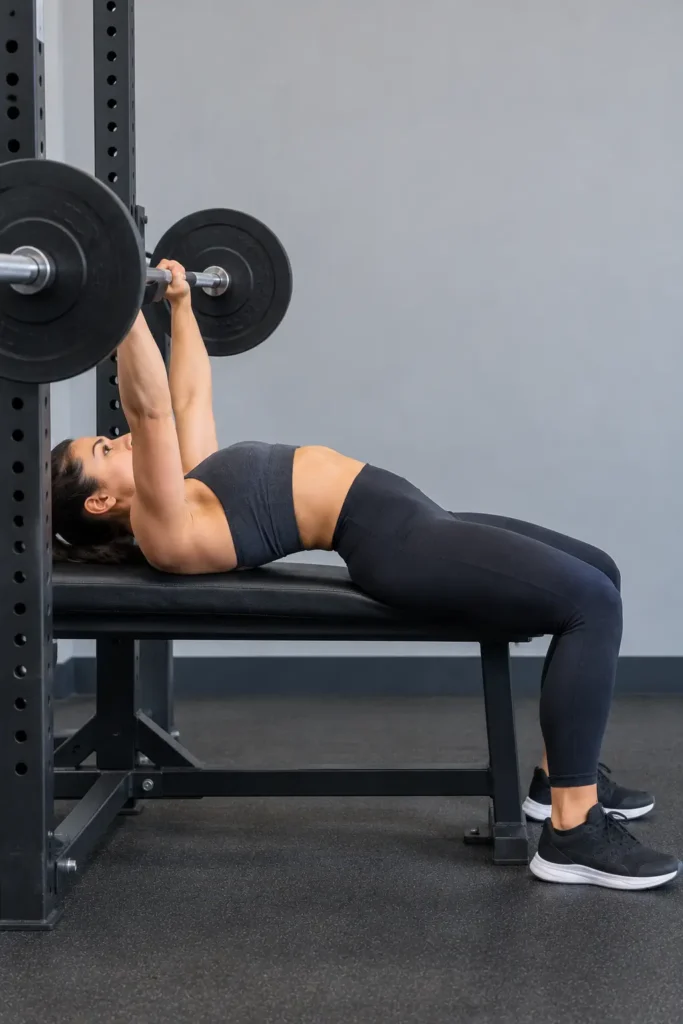
Muscles Worked by the Bench Press
Use this chart to see how hard each muscle works. The numbers come from the medium-grip results in the 28-man study and show activity as a percentage of each muscle’s max-test activity. Treat them as rough guides, because each muscle was tested with a different exercise.
| Muscle | Role in the bench press | Approx. activity (medium grip) |
|---|---|---|
| Pectoralis major (sternal part) | Prime mover | About 98% |
| Anterior (front) deltoid | Prime mover | About 96% |
| Pectoralis major (clavicular part) | Prime mover | About 89% |
| Triceps (long head) | Prime mover, finishes the lockout | About 69% |
| Lateral (side) deltoid | Helper | About 31% |
| Latissimus dorsi | Stabilizer | About 23% |
| Biceps | Stabilizer | About 19% |
| Posterior (rear) deltoid | Minor helper | About 10% |
Notice how the front delt sits near the top of the list, while the side and rear delts sit near the bottom. That pattern is the heart of the answer to the keyword question.
How to Bench Press in a Shoulder-Friendly Way
Good form lets your chest, front delts, and triceps do the work while keeping stress off the joint. These steps and cues work for most lifters.
Setup and form steps
- Set your body. Lie back with your eyes under the bar, feet flat on the floor, and glutes on the bench.
- Pin your shoulder blades. Next, pull them back and down, as if tucking them into your back pockets. A 2024 biomechanics study of ten experienced lifters found that scapula retraction decreased shear forces in the shoulder joint and rotator cuff activity in a computer model.
- Choose your grip. Place your hands about 1.5 times shoulder width or slightly narrower, so your forearms are vertical at the bottom. The widest grip allowed in powerlifting competition is 32 in (81 cm), which is wider than most people need.
- Unrack the bar. Then hold it over your shoulders with locked elbows before you begin.
- Lower with control. Take 2-3 seconds to bring the bar to your lower chest, keeping your elbows at roughly 45-60 degrees from your torso.
- Press up. Drive your feet into the floor and push the bar up and slightly back until your arms are straight.
- Reset. Take a breath at the top and repeat.
The movement should feel like tension across your chest, the front of your shoulders, and the back of your arms. It should not feel like a pinch at the top or front of your shoulder.
Starting weight (coaching guideline): Begin with an empty Olympic bar, which weighs 45 lb (20.4 kg). If you are choosing a bar for a home setup, our guide to an Olympic versus standard barbell explains the difference. Add 5 lb (2.3 kg) per side only when your form stays clean.
Coach’s Tip: Pause the bar on your chest for one second on every rep. That small pause removes the bounce, keeps your shoulders from taking sudden strain, and shows you whether the weight is truly manageable.
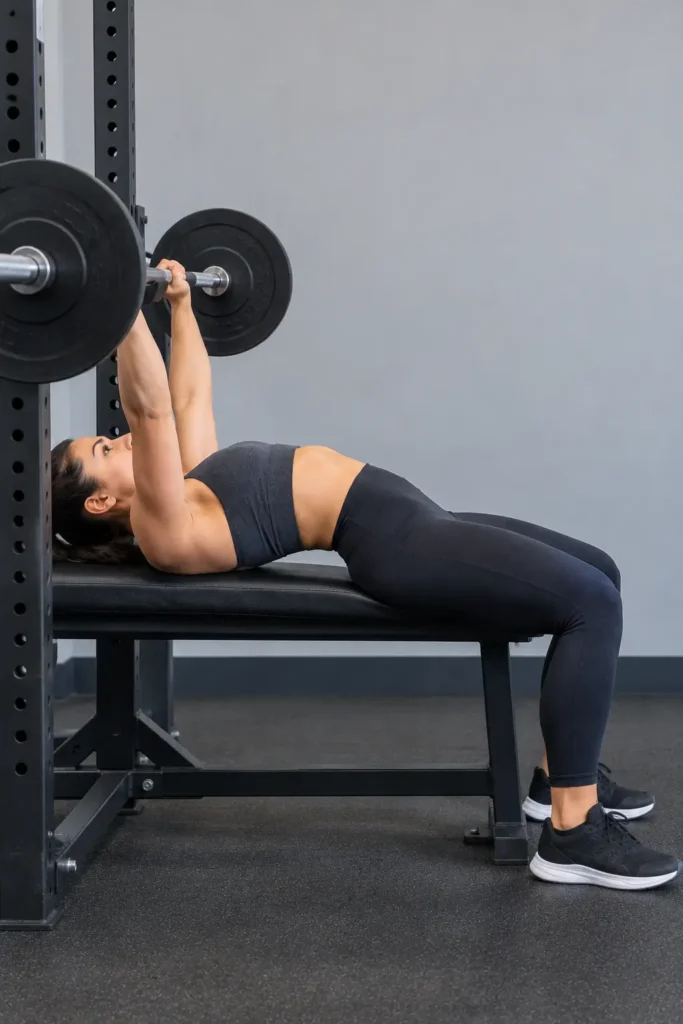
Common Mistake: Flaring the elbows and gripping too wide. Many lifters turn their elbows straight out to the sides at 90 degrees and grab the bar near the rings. As a result, the shoulder joint takes extra strain. Fix: Tuck your elbows to about 45-60 degrees, bring your hands in a little, and keep your shoulder blades pinned throughout.
Sets, reps, and weight by goal
The ACSM position stand recommends that novices train with loads they can lift 8-12 times. It also suggests raising the load by about 2-10% once you can beat your target reps by one or two. The table below puts those ideas into practice. The ranges are coaching guidelines, so adjust them to how you feel.
| Goal | Sets | Reps | Rest | Effort |
|---|---|---|---|---|
| Strength | 3-5 | 3-6 | 2-4 min | Heavy, 1-2 reps left in the tank |
| Muscle size | 3-4 | 6-12 | 90-120 sec | Challenging, 1-3 reps left |
| Endurance | 2-3 | 12-20 | 45-60 sec | Moderate, 3-4 reps left |
| Beginner start | 3 | 8-12 | 90 sec | Easy to moderate |
Easier and harder versions
Easier (regression):
- Incline push-ups with your hands on a bench. For more ideas, see our guide to push-up variations.
- Light dumbbell press with a neutral grip (palms facing each other), which many lifters find kinder to their shoulders.
- Machine chest press with a light stack. Our page on the Hammer Strength chest press covers how the machine works.
Harder (progression):
- Paused bench press with a 2-second hold on your chest.
- Slow lowering phase of 3-4 seconds.
- Incline barbell press, which shifts more work onto your front delts.
Safety Notes: Protect Your Shoulders on the Bench
The bench press is one of the most common lifts linked to shoulder complaints. The 2024 biomechanics study lists distal clavicular osteolysis (irritation at the end of the collarbone), pectoralis major rupture, shoulder instability, and rotator cuff injury among the reported problems. A review in the Strength and Conditioning Journal found that a grip wider than 1.5 times shoulder width may raise the risk of shoulder injury. Keeping the grip at 1.5 times shoulder width or narrower appeared to lower that risk, with only about a 5% difference in one-rep max.
The 2024 study agrees. It found that grips narrower than 1.5 times shoulder width reduced compression at the collarbone joint. On the other hand, it was a model-based study of ten lifters, so treat the results as helpful guidance, not guarantees.
Who should be careful
Talk with a doctor or physical therapist before benching heavy if any of these apply:
- Current shoulder pain. Aching, pinching, or pain when you raise your arm overhead can point to irritation in the shoulder.
- A past dislocation or rotator cuff problem. Heavy barbell work may be a poor fit.
- A new or returning lifter. Your tendons need time to adapt, so start light.
- Rounded shoulders or a hunched posture. If this sounds familiar, see our guide to posture correctors for rounded shoulders.
- A medical condition or an older age with health concerns. Get clearance first.
According to the Cleveland Clinic, shoulder impingement is painful pinching inside the shoulder, and it is almost always an overuse injury. The same source advises you not to ignore pain, tenderness, or trouble moving your shoulder.
Warning signs to stop
Stop the set and rest if you notice any of these:
- Sharp pain at the front or top of the shoulder
- Pinching at the bottom or top of the rep
- Clicking that comes with pain
- Numbness or tingling in the arm
- Pain that wakes you at night
Home lifters should also use safety arms or a spotter. A power rack with adjustable safeties is the safest setup, and our roundup of squat racks with pull-up bars can help you compare options.
Does Bench Press Work Your Shoulders Enough? Add These Moves
So, does bench press work your shoulders enough to skip other shoulder training? For most lifters, no. The front delt gets plenty of work, but the side and rear delts do not. Adding a few targeted moves fills the gap.
Add side and rear delt work
Lateral raises train the side delts, while rear delt raises and band pull-aparts train the back of your shoulders. Because the bench press barely touches the rear delts, a move like the seated bent-over rear delt raise is a smart addition. Aim for 3 sets of 12-15 reps with a light weight, such as 5-10 lb (2.3-4.5 kg) per hand.
Add an overhead press
An overhead press trains the front and side delts through a different path. That variety helps your shoulders build strength at more angles. For a full routine, see our leg and shoulder workout.
Watch your total pressing volume
Your front delts already work hard on every bench session. Consequently, stacking heavy bench, incline, and overhead pressing on back-to-back days can leave them overworked. Space your heavy pressing days, and keep most of your extra shoulder work light.
Train your shoulders often enough
The CDC recommends muscle-strengthening activity on at least two days a week for all major muscle groups. In addition, a 2016 meta-analysis found that training a muscle group twice a week produced better muscle growth than once a week when volume was matched. For most lifters, that means two push sessions a week.
Mix in bodyweight options
If you train at home or travel, bodyweight pressing is a handy backup. Our calisthenics exercises list includes push-ups, pike push-ups, and dips that load your shoulders without a barbell.
Sample Push Workout for Balanced Shoulders
Does bench press work your shoulders well enough for a full push day? Yes, as the first lift. Then you finish the job with the exercises below.
| Exercise | Sets | Reps | Rest |
|---|---|---|---|
| Flat barbell bench press | 3-4 | 6-10 | 2 min |
| Seated dumbbell shoulder press | 3 | 8-12 | 90 sec |
| Dumbbell lateral raise | 3 | 12-15 | 60 sec |
| Seated bent-over rear delt raise | 3 | 12-15 | 60 sec |
| Triceps pushdown | 3 | 10-12 | 60 sec |
Weekly plan: Do this workout twice a week with at least two days between sessions. For example, train on Monday and Thursday, and keep pulling or leg work on the other days.
Simple progression:
- Weeks 1-2: Do 3 sets of 8 reps on the bench with a light weight, and focus on form.
- Weeks 3-4: Add one rep per set, working up to 10-12 reps.
- Week 5: Once you hit your top reps on every set, add 5 lb (2.3 kg) and drop back to 8 reps.
- Repeat. Take an easier week every fourth or fifth week if your shoulders feel beaten up.
Warm up first with arm circles, band pull-aparts, and 2-3 light sets of 10-15 reps before your working weight.
FAQ: Bench Press and Your Shoulders
Does bench press work your shoulders or just your chest?
It works both. Your chest and front deltoids share the job of pushing the bar, and your triceps finish the lockout. The side and rear deltoids help much less. So the bench press builds the front of your shoulders well, but it does not train the whole shoulder.
Which shoulder muscle does the bench press hit most?
The anterior deltoid, or front delt. In research on trained and novice men, its activity during a six-rep max bench press was close to the chest’s. That is why front delts often feel tired after heavy benching, even without overhead work.
Can bench press replace shoulder training?
Not fully. It trains the front delts well, but the side and rear delts get a small share. For balanced shoulders, add lateral raises, rear delt raises, and an overhead press. Together, these moves cover all three parts of the shoulder.
Does a wider grip work your shoulders more?
Not by much. In the 28-man study, trained lifters showed similar front delt activity with narrow, medium, and wide grips. A very wide grip may add shoulder stress, though. Keeping your hands at about 1.5 times shoulder width or narrower is a safer choice.
Is incline bench better for shoulders?
Often, yes. Research summarized in a 2020 study found that front deltoid activity rose as the bench angle increased. A moderate incline shifts more work to the shoulders and upper chest. Start light, because the angle can feel awkward at first.
Why do my shoulders hurt when I bench?
Common causes include a grip that is too wide, flared elbows, loose shoulder blades, or too much pressing volume. Overuse is a frequent factor in shoulder pain. Lower the weight, tighten your form, and see a doctor or physical therapist if pain lingers.
Conclusion: Does Bench Press Work Your Shoulders?
So, does bench press work your shoulders? Yes, mainly the front delts, which work almost as hard as your chest. The side delts get a moderate share, and the rear delts get very little.
For strong, balanced shoulders, keep the bench press as a main lift and surround it with overhead presses, lateral raises, and rear delt work. Pin your shoulder blades, keep your grip at 1.5 times shoulder width or narrower, and tuck your elbows. Above all, stop if you feel sharp or pinching pain.
Check with a doctor or physical therapist before starting if you have shoulder pain, a past injury, or a medical condition.
