
The bench press is a proven chest builder, but no single variation fits every lifter. Your shoulders, your experience, and your equipment all change which press works best. That is why bench press variations for every level matter: they let you train hard, stay safe, and keep progressing.
In this guide, you will learn 12 presses, from the incline push-up to the paused barbell bench. Each move includes form cues, sets, reps, rest times, an easier option, and a harder option. You will also see how to pick the right press and how to build a weekly plan. Along the way, we point to research on grip width, bench angle, and training load, so you know why each choice matters.
Quick Answer: The best bench press variations for every level are the incline push-up and dumbbell floor press for beginners, the flat barbell and incline dumbbell bench press for intermediate lifters, and the paused or close-grip bench press for advanced lifters. Pick one main press and one or two variations, train chest twice weekly, and add weight gradually.
How to Choose Bench Press Variations for Every Level
Before you pick a press, answer three simple questions. How long have you been lifting? What equipment can you use? Does any press bother your shoulders or elbows? Your answers point you to the right level and keep your training honest.
The bench press mainly trains the pectoralis major (chest), the anterior deltoid (front shoulder), and the triceps brachii. Your biceps, lats, and serratus anterior also help control the weight. Small changes to grip width, bench angle, or load shift the emphasis, so each variation has a job.
Grip width is a good example. In a 2021 study of novice and resistance-trained men, the trained group showed lower triceps activity with a wide grip than with a medium grip, and biceps activity rose as the grip widened. However, a 2017 study of competitive bench press athletes found mostly similar muscle activity across grip widths, apart from lower biceps activity with a narrow grip. In other words, the differences are real but modest, so choose the grip that feels strong and pain-free.
Bench angle matters too. A 2020 study of 30 trained adults found the upper chest was most active at a 30° incline, while the middle and lower chest were more active on a flat bench. Angles above 45° raised front-shoulder activity and reduced chest performance. Remember, these studies measure electrical muscle activity, not muscle growth, so treat them as helpful clues rather than guarantees.
Load is the third lever. A meta-analysis of 21 studies found that heavier loads built more one-rep-max strength, while muscle size gains were similar across a wide range of loads. Therefore, you can mix heavy sets of 3–6 reps with lighter sets of 8–15 reps and still make progress.
If you train at home, a bench, dumbbells, and a barbell with a rack cover most of these presses. Our guide to apartment workout equipment can help you choose space-friendly gear.
| Level | Typical experience | Best starting variations | Rep range |
|---|---|---|---|
| Beginner | 0–6 months | Incline push-up, floor press, machine press, flat dumbbell press | 8–15 |
| Intermediate | 6 months–2 years | Flat barbell, incline dumbbell, close-grip, neutral-grip | 5–12 |
| Advanced | 2+ years | Paused, incline barbell, tempo, weighted push-up | 3–10 |
These levels are rough guides. If a move feels too hard or too easy, simply step up or down a level.
Beginner Bench Press Variations: Learn the Pattern
Beginners should focus on smooth reps, steady breathing, and comfortable shoulders. Among the bench press variations for every level, these four presses are the best place to start, so master them before you chase heavy weight.
1. Incline Push-Up
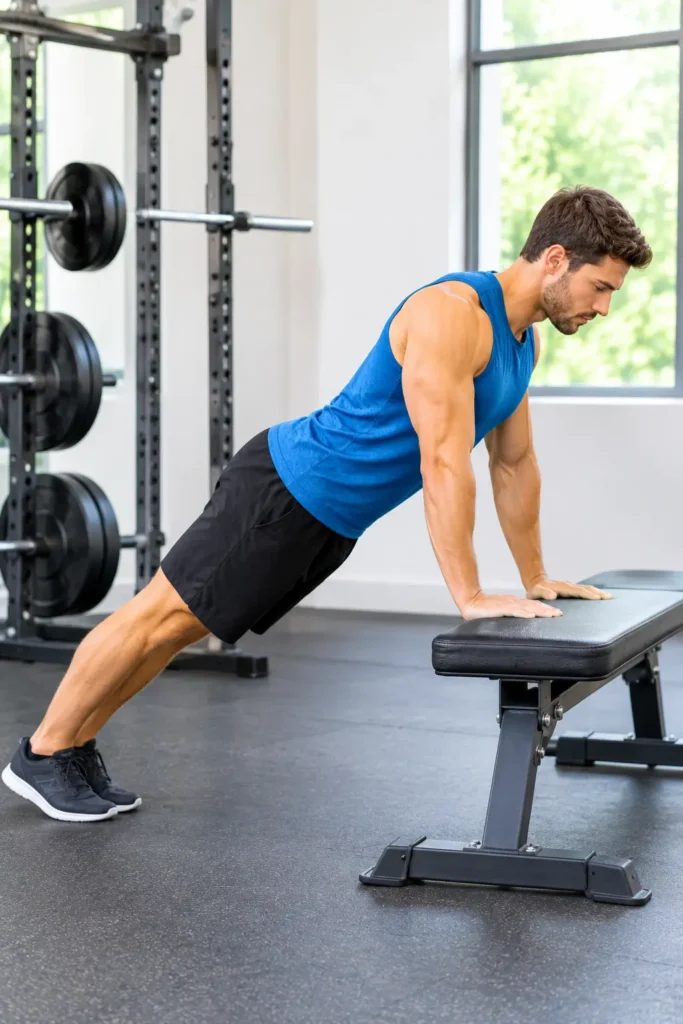
How to do it: Place your hands on a sturdy bench, about hip height, slightly wider than your shoulders. Step your feet back until your body forms a straight line from head to heels. Lower your chest toward the bench over two seconds, then press away. Keep your ribs down and your elbows about 45° from your torso.
Sets and reps: 3 sets of 8–12 reps, resting 60–90 seconds.
Why it works: This move teaches the press pattern with a load you can control. Notably, a study of 20 resistance-trained men found no differences in kinematics or muscle activation between push-ups and the bench press at matched loads, so it is more than a starter move. For more bodyweight options, see our calisthenics exercises list.
Easier: Raise your hands higher, such as on a wall or counter. Harder: Lower the surface until you reach a floor push-up.
2. Dumbbell Floor Press
How to do it: Lie on the floor with your knees bent and a dumbbell in each hand. Press the weights straight up over your chest. Lower until your upper arms lightly touch the floor, pause for one second, and press again. The floor limits your range of motion, which often feels comfortable for beginners.
Sets and reps: 3 sets of 8–12 reps, resting 90 seconds. Start with 10–20 lb (4.5–9 kg) per hand. Hex dumbbells will not roll away between sets, as we explain in our hex vs. round dumbbells guide.
Why it works: You learn to press with control and keep your elbows tucked, because the floor gives instant feedback.
Easier: Use lighter weights and keep the pause. Harder: Lower for three seconds, or try a single-arm version.
3. Machine Chest Press
How to do it: Adjust the seat so the handles sit at mid-chest height. Press your back into the pad, pull your shoulder blades back, and push the handles forward without snapping your elbows straight. Return slowly over two to three seconds. Our guide to the Hammer Strength chest press covers one popular plate-loaded option.
Sets and reps: 3 sets of 10–15 reps, resting 90 seconds. Choose a weight that leaves two reps in reserve.
Why it works: The fixed path lets you push close to your limit without a spotter. As a result, it suits beginners, solo gym-goers, and anyone returning after a break.
Easier: Lower the weight and shorten the range slightly. Harder: Slow the lowering to four seconds, or press one arm at a time.
4. Flat Dumbbell Bench Press
How to do it: Sit on the end of a flat bench with the dumbbells on your thighs. Lie back, kick the weights up one at a time, and plant your feet flat. Pull your shoulder blades together, then lower the dumbbells until your elbows sit just below bench level. Press up and slightly inward, keeping your wrists stacked over your elbows.
Sets and reps: 3 sets of 8–12 reps, resting 90–120 seconds. Pick a weight that leaves two to three reps in reserve.
Why it works: Each arm works on its own, which helps you spot left-right differences. Meanwhile, the longer range of motion is a good step toward the barbell.
Easier: Return to the floor press. Harder: Add a one-second pause at the bottom.
Intermediate Bench Press Variations: Add Load and Angle
Once your reps look the same from set to set, you are ready for more weight and more angles. Next, these four presses add to your bench press variations for every level by building size and strength.
5. Flat Barbell Bench Press
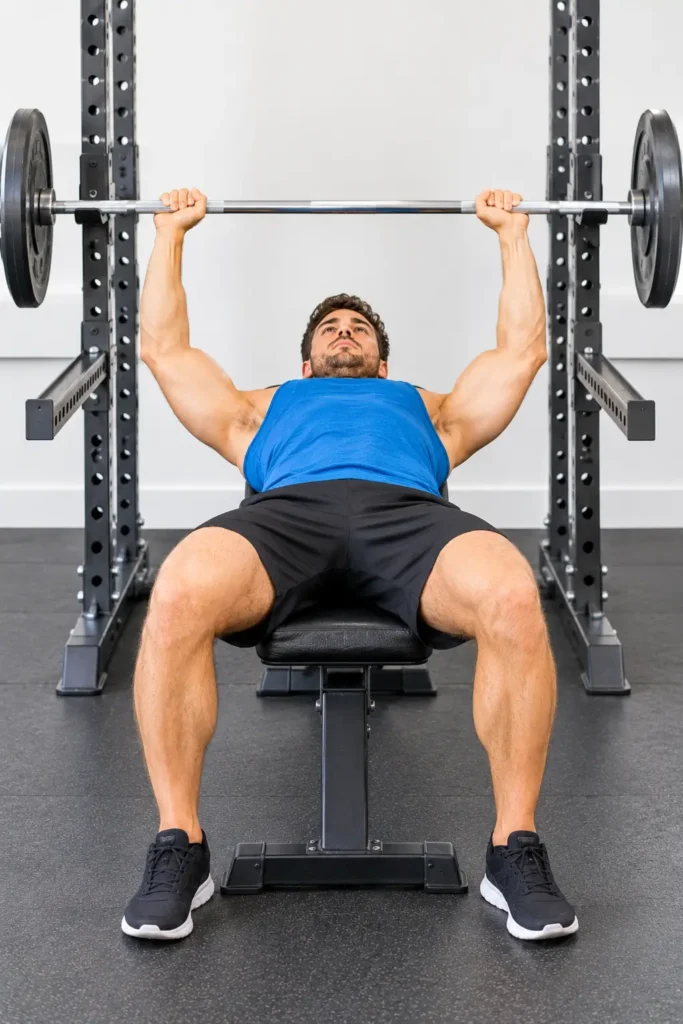
How to do it: Lie with your eyes under the bar, feet flat, and shoulder blades pulled back and down. Grip the bar slightly wider than your shoulders, wrap your thumbs around it, and unrack. Lower the bar to your lower chest, touch lightly, and press up and slightly back toward the rack. A standard Olympic bar weighs 45 lb (20 kg), as covered in our Olympic vs standard barbell comparison.
Sets and reps: For strength, do 4 sets of 5–8 reps with 2–3 minutes of rest. For size, do 3 sets of 8–12 reps. Always use safety bars or a spotter. If you need a rack, see our guide to squat racks with pull-up bars.
Why it works: You can load it in small steps, so it is a strong tool for building upper-body strength.
Easier: Swap to dumbbells. Harder: Add a one- to two-second pause on the chest.
Coach’s Tip: Before you unrack, imagine tucking your shoulder blades into your back pockets. Keep that tension, drive your feet into the floor, and press the bar in a slight arc.
Common Mistake: Bouncing the bar off your chest, lifting your hips off the bench, or flaring your elbows out to 90°. Fix it: Lower under control, keep your glutes down, tuck your elbows to about 45–60°, and reduce the weight until every rep looks the same.
6. Incline Dumbbell Bench Press
How to do it: Set the bench to about 30°. Sit back with the dumbbells on your thighs, lie back, and press them over your upper chest. Lower with your elbows about 45–60° from your torso until you feel a stretch across the chest, then press back up. Avoid cranking the bench steeper than 45°.
Sets and reps: 3 sets of 8–12 reps, resting 90–120 seconds.
Why it works: The 2020 study noted earlier found the upper chest was most active at 30°, while angles above 45° shifted work to the front shoulders. Therefore, a modest incline is usually the better choice.
Easier: Use a 15° incline with lighter weight. Harder: Lower for three seconds and pause briefly at the bottom.

7. Close-Grip Bench Press
How to do it: Set up like a regular bench press, but place your hands about shoulder-width apart, roughly 16–20 in (41–51 cm) for most people. Do not go so narrow that your wrists bend. Tuck your elbows to about 30–45°, lower to your lower chest, and press up.
Sets and reps: 3 sets of 6–10 reps, resting about two minutes. Start with 10–15% less weight than your regular bench.
Why it works: The 2021 grip-width study found the wide grip produced lower triceps activity than the narrow and medium grips in the overall comparison. Consequently, this is a handy way to train your lockout strength.
Easier: Use dumbbells with palms facing each other. Harder: Add a one-second pause on the chest.
8. Neutral-Grip Dumbbell Press
How to do it: Lie on a flat bench or a 30° bench and hold the dumbbells with your palms facing each other. Lower until your elbows are slightly below the bench, keeping your upper arms close to 45° from your body. Press up without letting the weights drift apart.
Sets and reps: 3 sets of 8–12 reps, resting 90–120 seconds.
Why it works: Many lifters find this grip more comfortable on the shoulders and wrists because the elbows stay closer to the body. That comfort helps you train consistently. If a press still causes sharp pain, stop and see a doctor or physical therapist.
Easier: Use a machine with neutral handles. Harder: Press one dumbbell at a time to challenge your core.
Advanced Bench Press Variations: Sharpen Strength and Control
Advanced lifters rarely need more variety; they need more precision. Accordingly, these four presses round out the bench press variations for every level by fixing weak points and keeping progress moving.
9. Paused Bench Press
How to do it: Lower the bar to your chest, hold completely still for one to two seconds, then press without bouncing. Keep your upper back tight during the pause, so you do not relax into the bench.
Sets and reps: 4 sets of 3–6 reps, resting 2–3 minutes. Start about 10% lighter than your normal bench. For example, if you normally lift 200 lb (91 kg), begin near 180 lb (82 kg).
Why it works: The pause removes bounce and builds strength from the bottom position, where many lifters get stuck. It also keeps your form honest.
Easier: Pause for one second. Harder: Pause for three seconds, or stop one inch (2.5 cm) above the chest in a Spoto-style press.
10. Incline Barbell Bench Press
How to do it: Set the bench to 30° and adjust the rack so you can unrack without your shoulders rolling forward. Grip slightly wider than shoulder width, lower the bar to your upper chest, and press up. Keep your head on the bench and your feet planted.
Sets and reps: 3–4 sets of 6–10 reps, resting 2–3 minutes. Expect to lift less than on a flat bench.
Why it works: It adds heavy loading for the upper chest and front shoulders. Because the front shoulders work harder as the angle climbs, keep the bench at or below 45°.
Easier: Use the dumbbell version. Harder: Add a pause, or slow the lowering to three seconds.
11. Tempo Bench Press
How to do it: Lower the bar for a slow three-second count, touch the chest lightly, and press up at a normal speed. Count out loud, or use a phone timer, so every rep matches.
Sets and reps: 3 sets of 6–8 reps, resting about two minutes. Use roughly 70–80% of your usual working weight.
Why it works: Slowing the lowering phase tightens up your bar path and technique. Meanwhile, the muscles also work longer on each rep, so lighter weights feel challenging.
Easier: Lower for two seconds. Harder: Lower for four to five seconds and add a pause.
12. Weighted Push-Up
How to do it: Wear a weighted vest, or loop a resistance band across your upper back and under your palms. Set up like a normal push-up with a straight body line. Lower your chest to within an inch (2.5 cm) of the floor and press up. Avoid balancing a loose plate on your back unless a partner helps.
Sets and reps: 3–4 sets of 6–12 reps, resting 90–120 seconds. Start with a vest of 10–20 lb (4.5–9 kg).
Why it works: An 8-week study of 18 young men found that push-ups matched to 40% of bench press max produced similar muscle growth and strength gains to the bench press. Likewise, a 4-week trial reported that progressive push-up training improved upper-body strength in moderately trained men. Both studies were small, so treat them as encouraging, not final. You can read more about push-ups and the biceps too.
Easier: Remove the vest. Harder: Raise your feet on a 12 in (30 cm) step.
Putting Bench Press Variations for Every Level Into a Weekly Plan
The CDC recommends muscle-strengthening activity on at least two days a week. Pressing twice weekly fits that guideline and gives you enough practice to improve. Use the table below as a template, then adjust it to your schedule.
| Level | Day A | Day B | Rest between sets |
|---|---|---|---|
| Beginner | Machine press 3×10–15; incline push-up 3×8–12 | Flat dumbbell press 3×8–12; floor press 2×10–12 | 60–120 sec |
| Intermediate | Flat barbell 4×5–8; close-grip 3×6–10 | Incline dumbbell 3×8–12; neutral-grip press 3×8–12 | 90 sec–3 min |
| Advanced | Paused bench 4×3–6; tempo bench 3×6–8 | Incline barbell 3–4×6–10; weighted push-up 3×8–12 | 2–3 min |
To progress, use double progression. Stay at one weight until you hit the top of the rep range on every set with clean form. Then add 5 lb (2.3 kg) to the barbell, or take the smallest dumbbell jump available. If your form slips, drop back and build up again.
Always warm up first. Spend five minutes on easy cardio, then do arm circles and two sets of 15 band pull-aparts. Next, perform two lighter ramp-up sets of your first press. Finally, balance your pressing with rows and rear-delt work, such as seated bent-over rear delt raises.
Every six to eight weeks, cut your sets by about one third for a week. This easy week lets your joints and muscles recover, and you will often return stronger.
Safety Tips for Every Bench Press Variation
Smart setup protects your shoulders and keeps your training steady across all bench press variations for every level. Follow these rules on every set:
- Use safeties or a spotter for any barbell or heavy dumbbell press.
- Wrap your thumbs around the bar. A thumbless grip raises the risk of a dropped bar.
- Stop sets before form breaks down, leaving one to three reps in reserve most of the time.
- Warm up your shoulders with light sets before heavier work.
- Stop if you feel sharp pain in your shoulder, elbow, or chest.
Some lifters like elbow sleeves for lifting for warmth and comfort, although sleeves do not fix poor form. If you have shoulder or elbow pain, a past injury, or a heart or blood-pressure condition, check with a doctor or physical therapist before you start heavy pressing.
FAQ: Bench Press Variations
What are the best bench press variations for beginners?
Beginners do well with the incline push-up, dumbbell floor press, machine chest press, and flat dumbbell bench press. These moves are easy to learn, simple to load in small steps, and easier to control than a heavy barbell. Start with 3 sets of 8–12 reps, and stop each set with two reps left.
Does a close-grip bench press work the chest or triceps?
Both. The close-grip bench press hits the chest and front shoulders, but it shifts more work to the triceps. A 2021 study of trained men found higher triceps activity with narrow and medium grips than with a wide grip. Still, the chest works in every grip, so use it as a triceps-focused press.
Is the incline bench press better than the flat bench press?
Neither is better overall. A 2020 study of 30 trained adults found the upper chest was most active at a 30-degree incline, while the middle and lower chest worked harder on a flat bench. Above 45 degrees, the front shoulders worked harder. Use both angles across the week for balanced chest training.
Can push-ups replace the bench press?
Push-ups can replace the bench press for many lifters, especially if you add load or use harder variations. Research in resistance-trained men found similar muscle activation between the two at matched loads. Very strong lifters may find push-ups too light, though, so a weighted vest or barbell press may suit them better.
How often should I bench press each week?
Most lifters do well pressing two times per week. The CDC advises muscle-strengthening activity on at least two days a week, covering all major muscle groups. Beginners can bench twice weekly with a rest day between sessions. Advanced lifters may add a third light or technique-focused day if recovery allows.
How do I bench press safely without a spotter?
Set the safety bars just under your chest-touch point in a power rack, so a failed rep rests on the bars instead of your chest. Wrap your thumb around the bar, and stop sets before form breaks down. If you lack a rack, choose dumbbells, a machine, or push-ups, since they are easier to bail out of.
Final Thoughts on Bench Press Variations for Every Level
The best bench press variations for every level share one rule: match the press to your experience, your equipment, and how your joints feel. Start with push-ups, floor presses, or a machine. Then move to barbell and incline work, and finally sharpen your strength with paused, tempo, and weighted versions.
Pick one main press and one or two variations, train twice a week, and add weight in small steps. Consistency beats variety every time. If pain shows up, back off and ask a professional.
