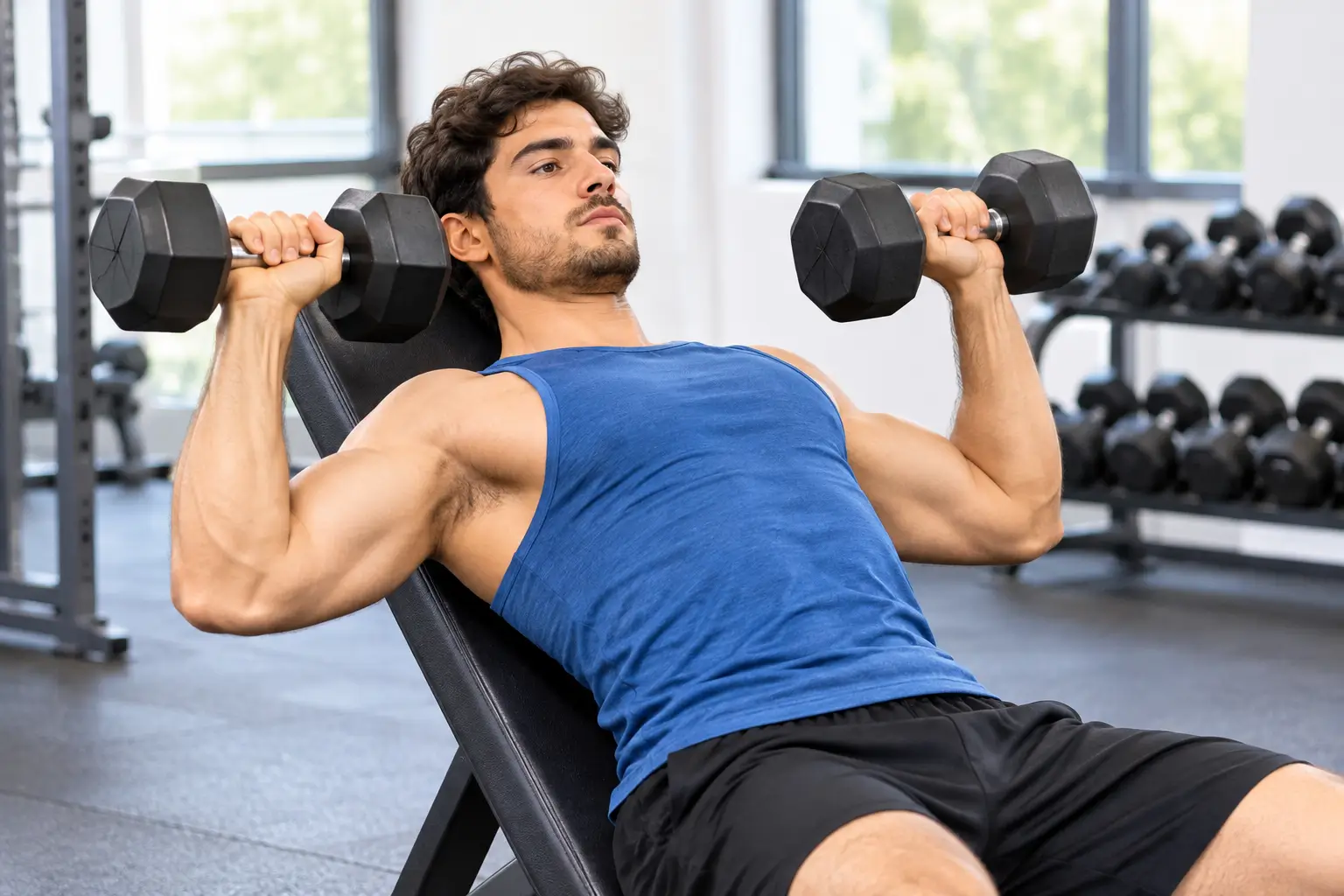
Finding the best exercises to get a bigger chest starts with one idea: your pecs grow when you press and stretch them under challenging, gradually heavier loads. The chest muscle, called the pectoralis major, is a wide fan-shaped muscle, so it responds to several angles and movement types. Because no single move does everything, the strongest plan mixes a few presses, a bodyweight movement, and a fly.
This guide covers 11 options across barbells, dumbbells, bodyweight, cables, machines, and bands. For each one, you’ll get form cues, sets and reps, and an easier and harder version. Afterward, you’ll see how to turn them into a weekly plan.
Quick Answer: The best exercises to get a bigger chest are the bench press, incline dumbbell press, dips, push-ups, and cable crossovers. Together they train the whole pectoralis major from several angles. Aim for at least 10 hard sets per week, add weight or reps over time, and rest a full day between chest sessions.
How Your Chest Grows: What the Research Shows
Before the list, here is what the science says about building chest size. These findings shape every recommendation below.
Volume and Effort Matter Most
Muscle growth responds to total hard work. The 2026 ACSM position stand found that higher volumes of at least 10 sets per muscle group per week enhanced hypertrophy. Likewise, an earlier meta-analysis reported a graded dose-response relationship between weekly sets and muscle size.
The ACSM review also reported that growth did not differ between light and heavy loads. In addition, it concluded that training to total failure is not necessary, and it pointed to stopping with about 2–3 reps in reserve. In practice, most sets of 6–15 reps work well when the last few reps feel hard.
Angles Change Where You Feel the Work
The pectoralis major has an upper (clavicular) portion and a middle-to-lower (sternal) portion. One EMG study found that a 30° incline increased upper-chest activation, while inclines above 45° shifted work to the front shoulder. Meanwhile, a systematic review noted that the sternal portion showed greater activation on a declined bench press. As a result, a mix of flat, low-incline, and dip-style work covers your bases.
Barbells, Bodyweight, Cables, or Machines?
A university thesis comparing chest exercises concluded that the barbell bench press, pec deck, and bent-forward cable crossovers could be used interchangeably to produce the greatest pectoral activation. Push-ups also work when progressed. One thesis found that progressive push-up variations can improve upper-body strength in trained men. Therefore, choose tools you can load progressively and will actually use.
Best Barbell and Dumbbell Exercises to Get a Bigger Chest
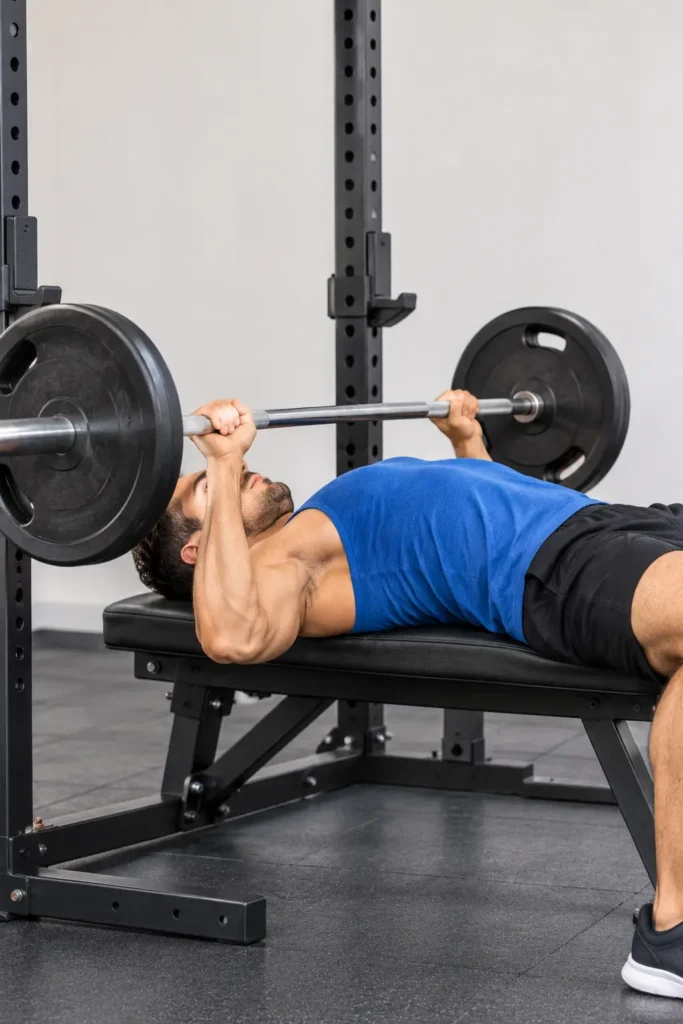
1. Barbell Bench Press
The bench press lets you load your chest heavier than almost any other move. It also trains your triceps and front shoulders at the same time.
- Lie back with your eyes under the bar, feet flat, and shoulder blades pulled down and together.
- Grip the bar about 1.5 times shoulder width, which is roughly 28–32 inches (71–81 cm) between hands for many lifters.
- Lower the bar to mid-chest over about 2 seconds.
- Press up and slightly back until your arms lock out.
Sets and reps: 3–4 sets of 5–8 reps, resting 2–3 minutes. Start with the empty bar; most gyms use a 45 lb (20 kg) Olympic bar, and our guide to Olympic vs. standard barbells explains the difference. Add 5 lb (2.3 kg) once you hit the top of the range on every set.
Easier: Use dumbbells or a machine. Harder: Pause for 1 second on your chest or lower for 3 seconds.
Common Mistake: Bouncing the bar off your ribs and flaring elbows to 90 degrees. Instead, touch lightly and keep elbows at roughly 45–75 degrees.
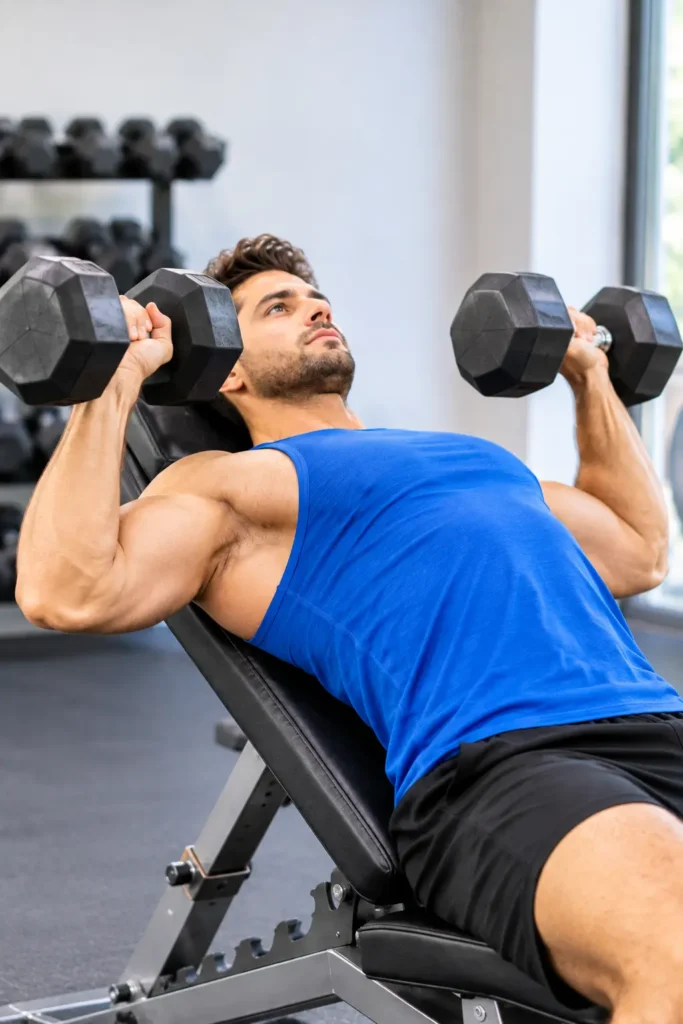
2. Dumbbell Bench Press
Dumbbells let each arm work independently and allow a deeper stretch at the bottom. You will feel a strong stretch across the chest and a squeeze at the top.
- Sit with the dumbbells on your thighs, then lie back and kick them up.
- Lower until your upper arms are about level with the bench.
- Press up and bring the weights together over your chest without clanking them.
Sets and reps: 3 sets of 8–12 reps, resting 90–120 seconds. Choose a weight that leaves 2–3 reps in reserve; many beginners land around 15–30 lb (7–14 kg) per hand. If you are buying, our comparison of hex vs. round dumbbells helps.
Easier: Lighter weights or a neutral grip. Harder: Slow your lowering to 3 seconds.
3. Incline Dumbbell Press (30°)
This move emphasizes the upper chest. In one study of 13 men, regional muscle activation shifted with bench inclination, leading to uneven acute changes in the chest heads.
- Set the bench at about 30°.
- Start with the dumbbells at upper-chest level and palms facing forward or slightly in.
- Press up and slightly together, then lower under control.
Sets and reps: 3 sets of 8–12 reps, resting 90–120 seconds.
Coach’s Tip: Keep the bench at a low incline. If you feel it mostly in your front shoulders, lower the angle a notch.
Easier: Lighter weights. Harder: Add a 1-second pause at the bottom.
Best Bodyweight Exercises to Get a Bigger Chest
4. Push-Up
The push-up is the most accessible of the best exercises to get a bigger chest, because you can do it anywhere. It trains your chest, front shoulders, triceps, and core together. For a closer look at arm involvement, see our article on push-ups for biceps.
- Place your hands slightly wider than shoulders, about 20–24 inches (51–61 cm) apart.
- Form a straight line from head to heels.
- Lower your chest to within 1–2 inches (3–5 cm) of the floor.
- Press back up until your arms are straight.
Sets and reps: 3 sets of 8–20 reps, resting 60–90 seconds. Easier: Incline push-ups with hands on a bench. Harder: Slow your lowering to 4 seconds or add a pause.
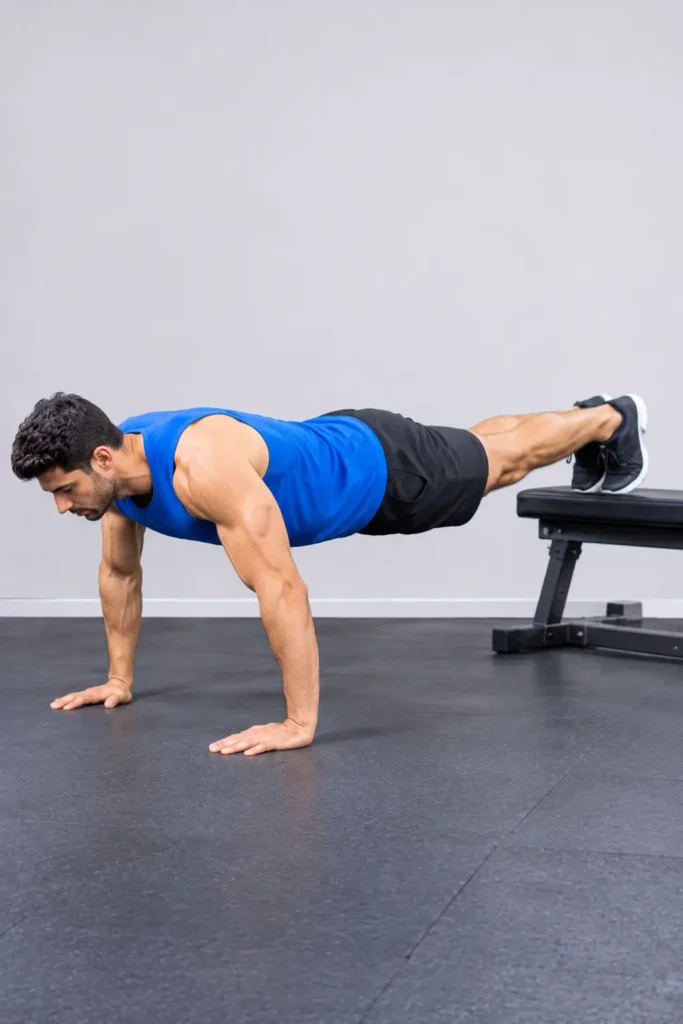
5. Feet-Elevated Push-Up
Raising your feet shifts more bodyweight onto your upper body, which makes the push-up harder as you get stronger. Your upper chest and shoulders will work noticeably harder.
- Place your feet on a bench or step about 12–18 inches (30–46 cm) high.
- Keep your hips level with your shoulders and your abs braced.
- Lower with control, then press up.
Sets and reps: 3 sets of 6–15 reps, resting 90 seconds. Easier: Lower the step height. Harder: Wear a backpack with 5–10 lb (2.3–4.5 kg). For more bodyweight ideas, browse our calisthenics exercises list.
6. Chest Dips
Dips load the lower chest and triceps heavily. They are demanding, so build up to them gradually.
- Grip parallel bars about 20–28 inches (51–71 cm) apart and lift yourself with straight arms.
- Lean your torso forward about 30 degrees and let your elbows flare slightly.
- Lower until your upper arms are roughly parallel to the floor.
- Press up without shrugging.
Sets and reps: 2–3 sets of 6–12 reps, resting 90–120 seconds. Easier: Use a band-assisted dip machine or slow negatives only. Harder: Add a belt with 10–25 lb (4.5–11 kg).
Common Mistake: Dropping too deep with rounded shoulders. Stop where your shoulders feel stable, and skip dips if they cause front-shoulder pain.
Best Cable, Machine, and Band Exercises for Chest Size
7. Cable Crossover
Cables keep tension on your chest through the whole range, especially at the squeezed position. As noted earlier, cable crossovers ranked among the top chest activators in that thesis.
- Set the pulleys at shoulder height or higher.
- Step forward with a slight lean and soft elbows.
- Sweep the handles together in front of your lower chest.
- Squeeze for 1 second, then return slowly.
Sets and reps: 2–3 sets of 12–15 reps, resting 60–90 seconds. Start around 10–15 lb (4.5–7 kg) per side. Easier: Lighter stack and a split stance. Harder: One arm at a time.
8. Pec Deck (Machine Fly)
The pec deck isolates your chest and removes balance demands, so you can push close to your limit safely.
- Set the seat so the handles line up with mid-chest.
- Keep a slight elbow bend and shoulder blades pinned back.
- Bring the handles together, pause, and return until you feel a stretch.
Sets and reps: 2–3 sets of 10–15 reps, resting 60–90 seconds. Easier: Shorten the range slightly. Harder: Pause for 2 seconds at the squeeze.
9. Machine Chest Press
Machines guide the path, which makes them beginner-friendly and useful for hard final sets. Our review of the Hammer Strength chest press covers one popular option.
- Adjust the seat so handles sit at mid-chest.
- Press forward without locking your elbows.
- Return for 2–3 seconds.
Sets and reps: 2–3 sets of 8–12 reps, resting 90 seconds. Easier: Lower the load. Harder: Use a 3-second lowering phase or a 1-second pause.
10. Incline Dumbbell Fly
Flyes stretch the chest under load. Use lighter weights, because your shoulders take more stress here.
- Lie on a 30° bench with dumbbells over your chest and elbows slightly bent.
- Lower in a wide arc until you feel a stretch, not pain.
- Reverse the arc and squeeze at the top.
Sets and reps: 2–3 sets of 10–15 reps, resting 60–90 seconds, with 10–20 lb (4.5–9 kg) per hand to start. Easier: Use cables or the pec deck. Harder: Slow your lowering to 3 seconds.
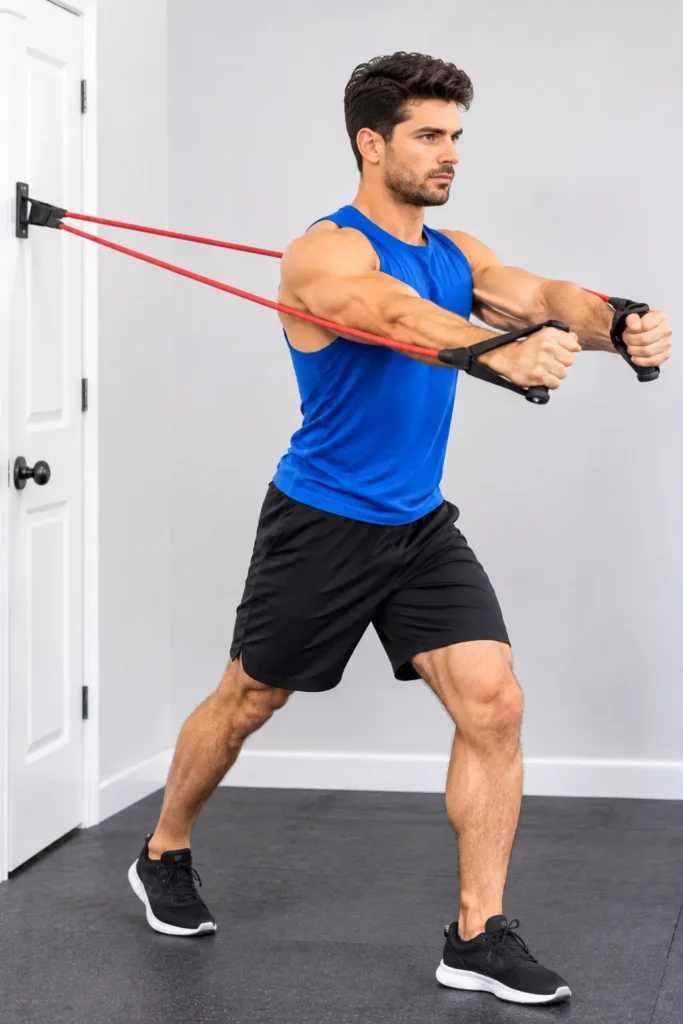
11. Resistance Band Chest Press
Bands are ideal for travel and small spaces. They also pair well with other apartment workout equipment, and a Bowflex-style home gym can replace cables if you have space.
- Anchor the band behind you at chest height.
- Stand in a split stance and press both hands forward until your arms straighten.
- Return slowly rather than snapping back.
Sets and reps: 3 sets of 12–20 reps, resting 60 seconds. Easier: Use a lighter band. Harder: Use a thicker band or add a 2-second pause.
How to Combine the Best Exercises to Get a Bigger Chest Into a Workout
Warm-Up (5–8 Minutes)
Mayo Clinic suggests warming up with brisk walking or another aerobic activity, which may lower injury risk. After that, do 10 band pull-aparts, 10 arm circles, 10 slow push-ups, and 1–2 light ramp-up sets of your first press.
Workout A: Heavy Day
| Exercise | Sets | Reps | Rest |
|---|---|---|---|
| Barbell bench press | 3 | 5–8 | 2–3 min |
| Incline dumbbell press | 3 | 8–12 | 90–120 sec |
| Chest dips | 2 | 6–12 | 90–120 sec |
| Cable crossover | 2 | 12–15 | 60–90 sec |
Workout B: Volume Day
| Exercise | Sets | Reps | Rest |
|---|---|---|---|
| Dumbbell bench press | 3 | 8–12 | 90–120 sec |
| Machine chest press | 2 | 10–12 | 90 sec |
| Feet-elevated push-up | 2 | 10–20 | 90 sec |
| Incline dumbbell fly | 2 | 10–15 | 60–90 sec |
Together, these workouts give you about 19 weekly sets, which fits within the ACSM’s volume findings.
Weekly Schedule
Train chest on Monday (Workout A) and Thursday (Workout B), with back, legs, and rest on other days. Mayo Clinic advises one full rest day between working the same muscle group, and this layout gives you more than that. In addition, the CDC says adults need at least two days of muscle-strengthening activity weekly.
Balance your pressing with pulling. For example, add pull-ups and seated bent-over rear delt raises on your back and shoulder days.
Progression Rule
Use double progression. First, add reps until you reach the top of the range on every set. Then add weight, such as 5 lb (2.3 kg) on the barbell or 2.5–5 lb (1.1–2.3 kg) per dumbbell, and drop back to the bottom of the range.
Beginner and Advanced Versions
Beginner: Do one chest session twice weekly with 5–6 total sets each, such as bench or dumbbell press, push-ups, and a machine fly. Stay with these for 8 weeks before adding sets.
Advanced: Add a third light session with 6–8 sets, slow your lowering to 3–4 seconds, and use pauses. If progress stalls, reduce your sets by about one-third for a week.
Safety Tips and Who Should Be Careful
Use a spotter or safety arms for heavy barbell presses. Never bounce the bar, and stop any set where your form breaks down. Because the ACSM review found that training to failure was not required, leaving a couple of reps in reserve is both effective and safer.
Check with a doctor or physical therapist before starting if you have shoulder pain, a past pectoral or shoulder injury, heart or blood pressure concerns, or recent surgery. People with a chest wall difference should also get medical guidance first; our page on pectus excavatum exercises covers general options. Stop if you feel sharp pain.
FAQ
How often should I train chest?
Two sessions per week suit most people. This spacing gives your muscles time to recover while still reaching enough weekly volume. Mayo Clinic recommends a full rest day between working the same muscle group, so Monday and Thursday works well.
Can push-ups alone build a bigger chest?
Push-ups can build chest strength and size for beginners, especially when you progress to harder variations. Over time, however, you may need added load, such as a weighted backpack or dips, to keep improving. Research on progressive push-up training supports their use.
What is the best exercise for the upper chest?
The incline dumbbell press at about 30° is a top choice. Research found that a 30° incline increased upper-chest activation, while steeper angles shifted work to the shoulders. Feet-elevated push-ups also emphasize the upper chest.
How many sets and reps do I need?
Aim for at least 10 hard sets per week, and many people train around 15–20. Reps from roughly 6–15 work well, since the ACSM found growth was similar across a wide range of loads. Stop sets with about 2–3 reps left.
Are dumbbells or barbells better for chest?
Both work. Barbells let you load heavier and track progress easily. Dumbbells allow a deeper stretch and independent arm work. Because research shows several chest exercises produce high pectoral activation, choose what you can progress consistently and perform comfortably.
Why isn’t my chest growing?
Common reasons include too few weekly sets, no progressive overload, or stopping sets far from hard effort. Check that you are adding reps or weight over time and training chest at least twice a week. Technique matters too, so make sure your chest, not just your shoulders, is doing the work.
Final Thoughts on the Best Exercises to Get a Bigger Chest
The best exercises to get a bigger chest combine heavy presses, an incline angle, bodyweight work, and a fly or cable move. Add up enough hard sets each week, progress steadily, and rest between sessions. Start with the bench press, incline dumbbell press, push-ups, dips, and cable crossovers, then build from there.
Consistency will matter more than any single exercise. Keep a training log, aim for small increases each week, and adjust the plan to your equipment and recovery.
