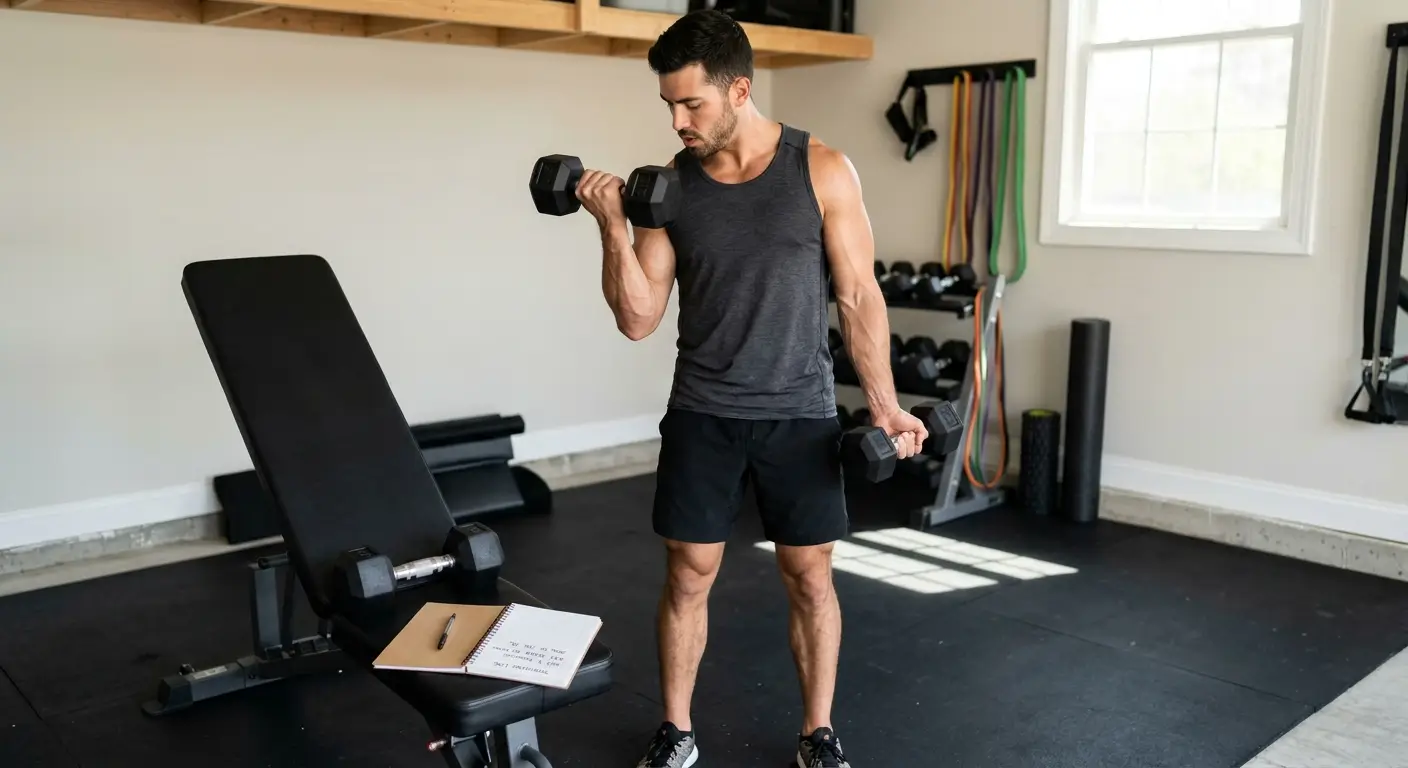
Can I do bicep curls every day? Yes, you can, but it is rarely the smartest way to build bigger or stronger arms. Your biceps are a small muscle group that already works during rows, pull-ups, and chin-ups. As a result, adding daily curls on top makes the total workload climb fast.
That said, the answer is not a flat “no.” Instead, the right plan depends on your training history, how hard you push each set, and how your elbows feel. This guide covers what research says about training frequency, how to run bicep curls every day safely, and a simpler weekly plan that works better for most lifters.
Quick Answer
Yes, you can do bicep curls every day if you keep the volume low, stop sets well short of failure, and stay pain-free. For most people, however, curling two to three times a week may give similar results with less joint stress. Daily curls work best as light, short sessions, not hard daily arm days.
Which Muscles Do Bicep Curls Work?
Bicep curls mainly train the biceps brachii, the two-headed muscle on the front of your upper arm. The brachialis (under the biceps) and the brachioradialis (a forearm muscle) help too. Meanwhile, your forearm flexors grip the weight, and your front shoulder stabilizes the arm.
This matters for the “every day” question. Together, these elbow flexors also work during rows, lat pulldowns, and pull-ups and chin-ups. So your biceps often get indirect work on days when you never touch a curl bar.

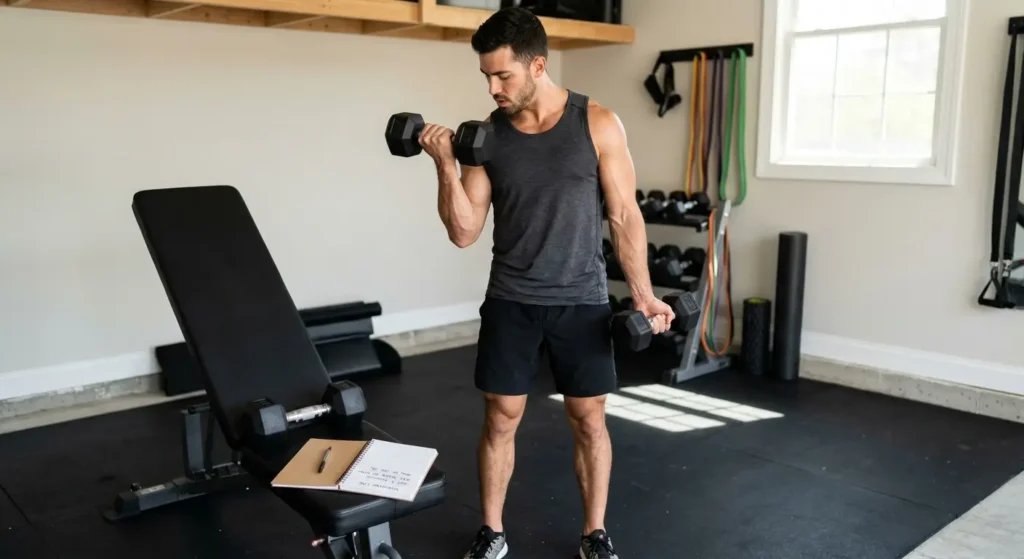
Can You Do Bicep Curls Every Day? What the Evidence Shows
Short answer: research does not show that curling daily is harmful for healthy people. At the same time, it does not show that daily curling is necessary. Most studies compare training frequency across a whole week, so let’s look at what they found.
What studies say about training frequency
A 2016 meta-analysis in Sports Medicine found that training a muscle group twice a week produced better muscle growth than once a week when volume was matched. The authors could not say whether three times a week beats two. That finding suggests a “sweet spot” of two to three weekly sessions per muscle for many people.
On the other hand, a later review in the Journal of Science and Medicine in Sport reached a more flexible conclusion. When total training volume was equal, frequency did not seem to have a pronounced effect on muscle growth. In plain terms, what you do across the whole week matters more than how you slice it up.
However, individual studies on the elbow flexors are mixed, so there is no clear winner:
- Higher frequency looked better in one trial. In a randomized trial of resistance-trained men, whole-body training five days a week produced a larger increase in forearm flexor thickness than a once-per-muscle split. Strength gains were similar in both groups.
- Lower frequency looked better in another. In a 10-week equal-volume study in trained men, only the group training once per week significantly increased elbow flexor thickness.
- Frequency may help strength. A volume-matched study on the thighs reported that both lower- and higher-frequency groups improved. The authors concluded that higher frequency was important for strength gains.
So, what does this mean for you? Overall, spreading your weekly curl volume across several days is fine. However, piling extra volume on top of what you already do is where trouble starts. Likewise, the same logic applies to other muscles, as our guide on squatting every day explains.
What official guidelines recommend
The CDC recommends that adults do muscle-strengthening activity on at least two days a week, working all major muscle groups. That is a minimum, not a ceiling. In addition, the ACSM position stand on resistance training suggests training two to three days a week for novices, three to four for intermediates, and four to five for advanced lifters. These numbers describe whole-program frequency, not how often you should isolate a single small muscle.
Why recovery and tendons still matter
Muscle is only part of the picture. Because tendons adapt more slowly than muscle, the tissue around your elbow and shoulder takes the repeated strain when you curl daily. According to the Cleveland Clinic, biceps tendonitis is an overuse injury, and severe or constant overuse may fray a tendon and lead to a tear.
Therefore, “my muscle feels fine” is not enough. Watch your elbow crease and the front of your shoulder, too. If either area aches during or after curls, the plan needs to change.

Bicep Curl Frequency Compared
This table summarizes common ways to schedule curls. The sets and reps are practical coaching ranges, not research findings, so adjust them to how you feel.
| Approach | Frequency | Weekly sets (curl variations) | Reps and effort | Best for | Main risk |
|---|---|---|---|---|---|
| Once-a-week “arm day” | 1x/week | 8-12 | 8-12 reps, close to failure | Bodybuilders on body-part splits | Long gaps between sessions |
| Recommended: spread out | 2-3x/week | 8-12 total | 8-15 reps, 1-3 reps left in the tank | Most beginners and intermediates | Few, if volume is managed |
| Light daily curls | 5-7x/week | 6-10 total | 12-20 reps, 3-5 reps left in the tank | Lifters who enjoy daily arm work | Tendon irritation if too heavy |
| Hard daily curls | 5-7x/week | 20+ | Near failure every day | Rarely a good idea | Overuse, stalled progress |
How to Do Bicep Curls Every Day Safely
If you still want to curl daily, structure matters more than motivation. Follow these rules, and you cut most of the risk.
The six rules for daily curls
- Keep each session short. To start, do 2 sets of 12-15 reps, which takes about 5 minutes.
- Stay 3-5 reps from failure. Also, if the last rep looks like a grind, the weight is too heavy.
- Use light to moderate weight. Many beginners do well with 5-15 lb (2.3-6.8 kg) per hand.
- Rotate your grip. For example, alternate standard curls, hammer curls, and reverse curls so the load shifts across your elbow flexors.
- Take at least one full rest day. Make it a true off day for your arms, with no curls and no heavy pulling.
- Stop if pain shows up. Sharp, pinching, or lingering pain is a signal to rest, not to push through.
Coach’s Tip: Use the “two-day check.” If your arms still feel tired or sore two days after a session, cut your next session by half. On the other hand, if your reps and weights are creeping up and your elbows feel good, you are recovering well.
How to do a standard dumbbell curl
Good form makes daily work much safer. Follow these steps with a light pair of dumbbells.
- Stand tall. First, place your feet hip-width apart, with a soft bend in your knees and your ribs down.
- Set your grip. Next, hold the dumbbells with palms facing forward and arms nearly straight at your sides.
- Pin your elbows. Then keep your upper arms close to your torso. They should barely move during the rep.
- Curl up for 1-2 seconds. After that, bend your elbows and lift the weights toward your shoulders. Squeeze your biceps at the top.
- Lower for 2-3 seconds. Finally, control the weight all the way down until your arms are almost straight.
- Breathe steadily. Throughout the set, exhale as you curl up, and inhale as you lower.
The movement should feel like tension building along the front of your upper arm, not like a pull at the front of your shoulder. Moreover, a recent study on elbow joint angles found that training at more extended elbow angles produced greater muscle adaptations than training at more flexed angles. For that reason, it helps to start each rep from a nearly straight arm.
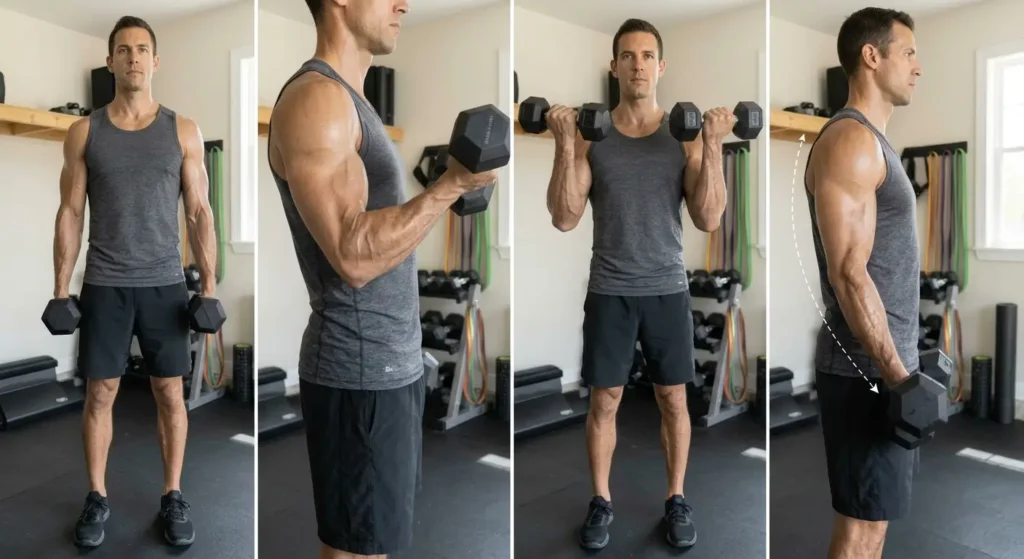
Common Mistake: Swinging the weight. Many lifters lean back and use their hips to heave the dumbbell up. As a result, the load leaves your biceps, and your lower back can take the strain. Fix: Lower the weight by 20-30%, brace your core, and keep your torso still. If you cannot do that, the weight is too heavy.
Easier and harder versions
Easier (regression):
- Seated hammer curl with 3-5 lb (1.4-2.3 kg) dumbbells.
- Resistance band curl with a light band, standing on the middle of the band.
- Half-range curl. Curl only from the midpoint down for a week or two, then extend your range as your elbows adapt.
Harder (progression):
- Add 2.5-5 lb (1.1-2.3 kg) only when you can complete all sets and reps with good form for two weeks in a row.
- Slow the lowering phase to 3-4 seconds.
- Switch to an incline or preacher curl to challenge the muscle at long lengths.
The ACSM position stand mentioned earlier suggests increasing the load by roughly 2-10% once you can beat your target reps by one or two. In practice, however, small jumps are better for your elbows. If you use a barbell or EZ bar, check the curl bar weight before adding plates.
Choosing your tools
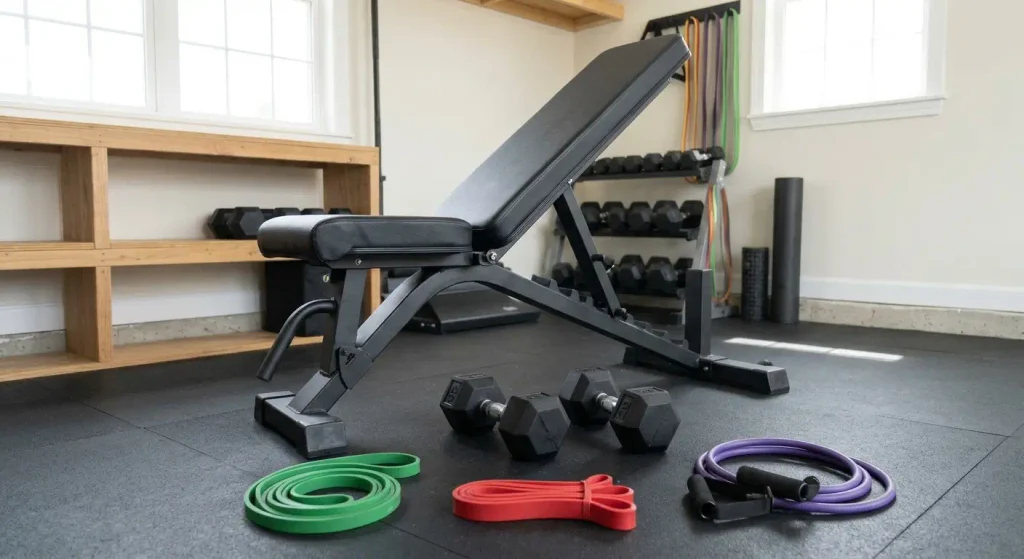
Dumbbells, bars, cables, and bands all work. Because each one changes how the load feels across the range, mixing them helps:
- Dumbbells: Let each arm work on its own and allow a natural wrist turn. If you are choosing equipment for home use, compare hex or round dumbbells.
- Barbell or EZ bar: Let you load heavier but can irritate wrists.
- Cables: Keep tension on the biceps throughout. See how barbell versus cable curls compare.
- Bands: Are light, cheap, and kind to joints, which is ideal for daily sessions.
A Sample Week of Bicep Curls (Two Options)
Pick one plan, not both. Option A is the one I’d choose for most lifters. By contrast, Option B is for people who really want a daily habit.
Option A: Smart frequency (recommended)
| Day | Curl work | Sets x reps | Rest between sets |
|---|---|---|---|
| Monday | Standard dumbbell curl | 3 x 8-12 | 90 sec |
| Tuesday | No curls | – | – |
| Wednesday | Hammer curl | 3 x 10-12 | 90 sec |
| Thursday | No curls | – | – |
| Friday | Incline or cable curl | 3 x 10-15 | 60-90 sec |
| Saturday | Back day or pull-ups (indirect biceps work) | – | – |
| Sunday | Full rest | – | – |
This layout gives you about nine curl sets a week, hits the biceps three times, and leaves recovery days between sessions. Furthermore, hammer curls versus standard curls shift the work toward your brachialis and forearms, which keeps training varied.
Option B: Light daily curls
| Day | Curl type | Sets x reps | Effort |
|---|---|---|---|
| Mon | Standard dumbbell | 2 x 12-15 | Moderate (4 reps left) |
| Tue | Hammer | 2 x 12-15 | Moderate |
| Wed | Band curl | 2 x 15-20 | Easy |
| Thu | Reverse curl | 2 x 12-15 | Moderate |
| Fri | Standard dumbbell | 2 x 12-15 | Moderate |
| Sat | Cable or band curl | 2 x 15-20 | Easy |
| Sun | Rest | – | – |
Notice that Option B still includes a rest day, and no session goes near failure. In addition, if you do heavy back work, drop two of the daily sessions. Your elbows will thank you.
Who Should Be Careful With Daily Curls?
Daily curling is not a good fit for everyone. Be extra cautious, or get advice first, if any of these apply:
- Elbow, wrist, or shoulder pain. Aches at the front of the shoulder or inner elbow can point to tendon irritation.
- New to lifting. Because your tendons need time to adapt, begin with two to three sessions a week.
- Heavy pull days. Rows, deadlifts, and chin-ups already tax your elbow flexors.
- A history of tendon problems or a biceps tear. Talk with a doctor or physical therapist before adding volume.
- A medical condition or medication that affects muscles or joints. Get medical clearance first.
Stop and seek care if you notice a sudden pop, sharp pain, bruising, swelling, or a new bulge in the upper arm. Mild muscle fatigue is normal. However, pain that lingers or worsens is not.
If you want some protection on heavy days, elbow sleeves may add warmth and a feeling of support. Still, they are not a fix for poor form or too much volume.
Smarter Ways to Grow Your Arms
Curling more often is not the only path to bigger arms. In fact, these tips usually pay off more.
1. Train your triceps too. After all, your triceps make up the larger share of your upper arm. A balanced plan builds a more complete look.
2. Use progressive overload. Add a rep or a small amount of weight over time. Indeed, the ACSM position statement lists progression as a key principle of resistance training.
3. Include compound pulls. Rows, lat pulldowns, and chin-ups train your biceps while building your back. If you lack equipment, try push-ups for biceps and other bodyweight options.
4. Build your grip and forearms. Strong forearms help you hold heavier weights and make curls feel more stable. Our guide to grip and forearm work offers more ideas.
5. Warm up first. Before your main sets, do one or two light sets of 10-15 reps. Also add a few easy arm circles.
6. Track your sessions. Write down weights, reps, and how your elbows felt. Because patterns show up quickly, a notebook beats guesswork.
FAQ: Bicep Curls Every Day
Is it OK to do bicep curls every day?
Yes, for most healthy people, as long as the sessions are light and short. For example, keep sets two or three reps short of failure, use moderate weight, and take at least one full rest day each week. If your elbows or shoulders ache, however, scale back and reduce the volume.
Will daily bicep curls make my arms bigger?
Possibly, but daily curling is not required for growth. Research on frequency is mixed, and total weekly volume appears to matter more than the number of sessions. Therefore, many lifters see similar progress with two or three well-planned sessions a week, plus indirect work from rows and pull-ups.
How many days a week should I train biceps?
Two to three days a week is a sound starting point for most lifters. This lines up with the meta-analysis finding that training a muscle at least twice weekly is helpful. Next, spread about 8-12 total sets across those days, and adjust based on recovery and elbow comfort.
Can you overtrain your biceps?
Yes. Doing too many hard sets without enough recovery may lead to stalled progress, lingering soreness, and tendon irritation. Warning signs include elbow pain, shrinking rep counts, and arms that feel tired all day. If you notice these, take a few days off and then return with lower volume.
How many bicep curls a day is too much?
There is no universal number. As a practical limit for daily curling, aim for about 2 sets of 12-15 reps at an easy-to-moderate effort. By contrast, if you are doing 10 or more hard sets in a day, or training to failure repeatedly, you are likely past the point of useful volume.
Do I still need curls if I do pull-ups?
Often, yes, but you may need fewer sets. Pull-ups and rows work your biceps as helpers, though the curl isolates the muscle through a longer range. Consequently, if you do heavy pulling three times a week, one or two light curl sessions may be plenty.
Final Answer: Can I Do Bicep Curls Every Day?
So, can I do bicep curls every day? You can, as long as you keep volume light, stay away from failure, take a rest day, and listen to your elbows. Still, the evidence suggests daily curls are not required. In most cases, two to three focused sessions a week deliver a similar payoff with less wear on your tendons.
For now, start with Option A, track your reps for four to six weeks, and add small upgrades only when your form stays clean. Alternatively, if you love the daily habit, use Option B and keep every set easy. Either way, patience and consistency will take you further than curling more often.
Check with a doctor or physical therapist before starting if you have elbow, shoulder, or tendon pain, an injury, or a medical condition.
