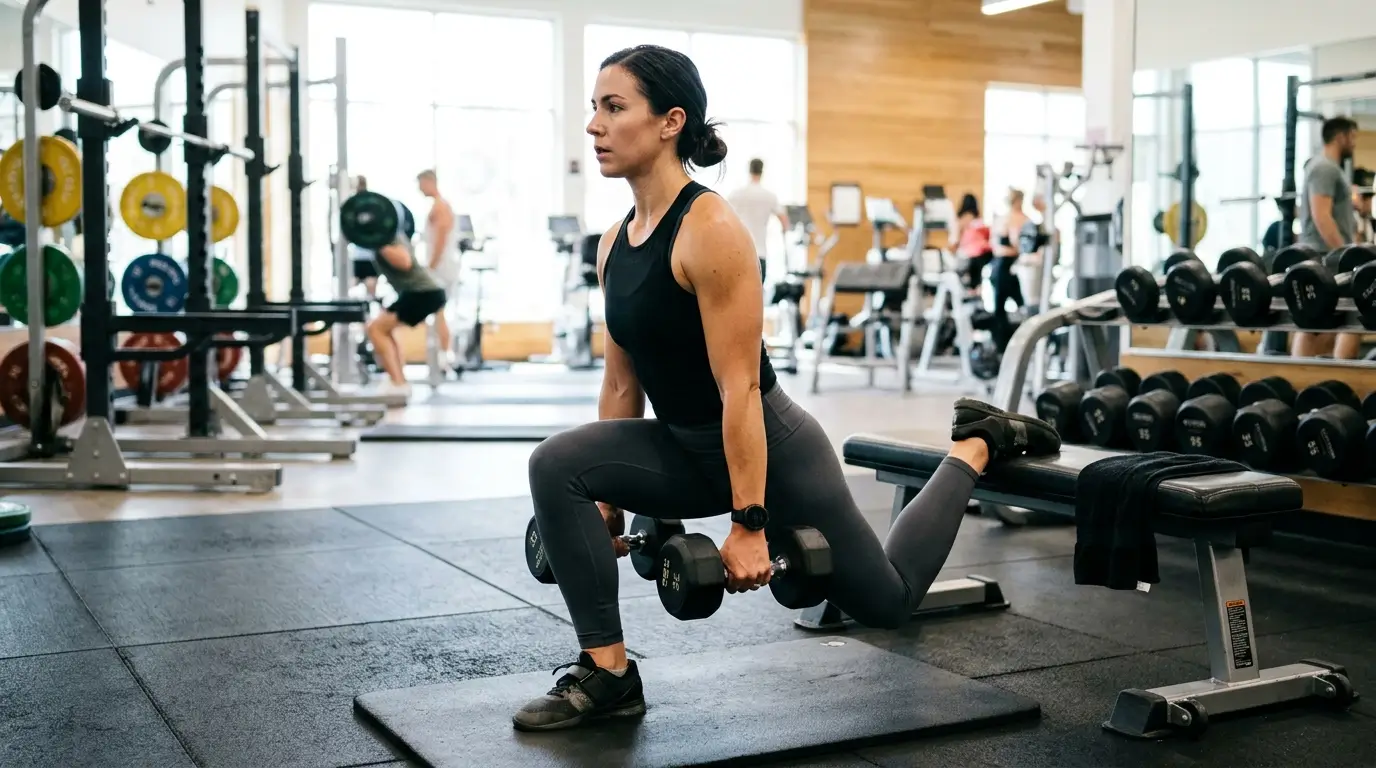
The dumbbell Bulgarian split squat is one of the best single-leg exercises you can do with dumbbells and a bench. You rest your back foot on the bench, lower straight down on your front leg, and drive back up. It looks simple, but it challenges your legs, balance, and focus in ways regular squats don’t.
This guide shows you how to do it step by step, which muscles it works, and how many sets and reps to use. You will also get fixes for common mistakes, easier and harder versions, alternatives, and a sample workout. Whether you train at a commercial gym or in a small home setup, you can start this week.
Quick Answer
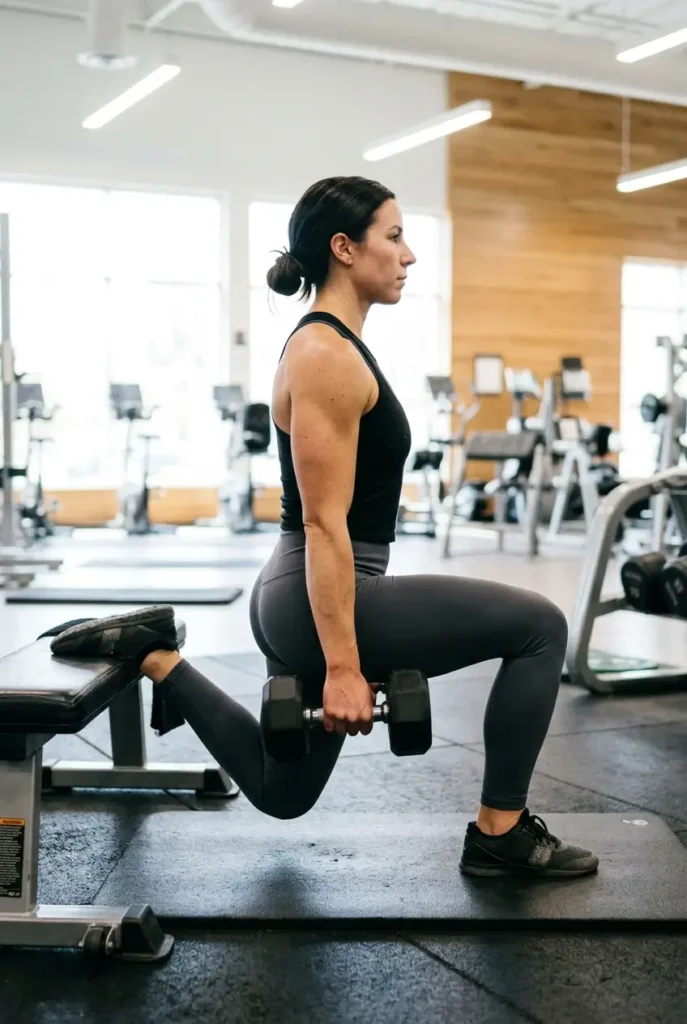
To do a dumbbell Bulgarian split squat, hold a dumbbell in each hand, place your back foot on a bench behind you, and step your front foot about 2–3 feet (61–91 cm) forward. Lower until your front thigh is near parallel, keep your torso tall, then press through your front heel to stand.
Muscles Worked by the Bulgarian Split Squat
This exercise trains your whole lower body, but the work is not spread evenly. Your front leg does most of the job, while your back leg mostly helps with balance. That is why you can get a hard workout with lighter weights than you would use on a barbell squat.
Primary muscles (front leg):
- Gluteus maximus: the big muscle of your butt, which extends your hip as you stand up.
- Quadriceps: the four muscles on the front of your thigh, which straighten your knee.
- Adductor magnus: a large inner-thigh muscle that helps extend the hip.
Secondary muscles:
- Hamstrings: help control the lowering phase and assist hip extension.
- Gluteus medius and minimus: keep your pelvis level and your knee steady.
- Calves (soleus and gastrocnemius): stabilize your ankle.
- Core muscles (obliques, transverse abdominis, erector spinae): keep your torso upright.
- Hip flexors (back leg): get a mild stretch at the bottom.
- Forearms and grip: hold the dumbbells.
Research supports the hip emphasis. A 2025 biomechanics paper on the Bulgarian split squat [VERIFY authors and year] describes it as a unilateral exercise that emphasizes hip extension more than knee extension compared with other squat variations. Likewise, a study comparing the Bulgarian split squat and the back squat found that hip joint demands were greater than knee and ankle demands in both lifts.
Benefits of the Dumbbell Bulgarian Split Squat
Here are the main reasons coaches keep this exercise in their programs.
- It trains one leg at a time. Because each leg works alone, a weaker side cannot hide behind the stronger one. You will notice quickly if one leg feels shakier or tires sooner.
- It builds balance and control. Staying steady on one foot trains your ankle, knee, hip, and core to work together. As a result, the movement may carry over to running, stairs, and sports like soccer or basketball.
- It uses lighter loads. You hold dumbbells at your sides instead of loading a barbell across your back. Consequently, your spine carries less direct load, which many lifters find more comfortable.
- It fits small spaces. All you need is a pair of dumbbells and a sturdy bench, chair, or step. If you are building a small setup, check our list of the best apartment workout equipment.
- It helps you meet strength guidelines. Adults should do muscle-strengthening activity on at least two days a week, according to the CDC physical activity guidelines. Leg work like this counts toward that goal.
Dumbbell Bulgarian Split Squat Form: Step-by-Step
Good form matters more than heavy weight here. Therefore, practice with no weight first, then add dumbbells once the movement feels smooth.
Setup:
- Use a flat bench or sturdy box about 12–18 inches (30–46 cm) high. Knee height is a good starting point.
- Pick dumbbells you can hold comfortably. Most beginners start with 10–15 lb (4.5–7 kg) in each hand, or no weight at all.
- Wear flat, stable shoes. Avoid soft, squishy running shoes, because they make balance harder.
Steps:
- Stand facing away from the bench. Hold a dumbbell in each hand, arms straight at your sides, palms facing your body.
- Place your back foot on the bench. Rest either the top of your shoe (laces down) or your toes on the pad. Pick whichever feels more comfortable.
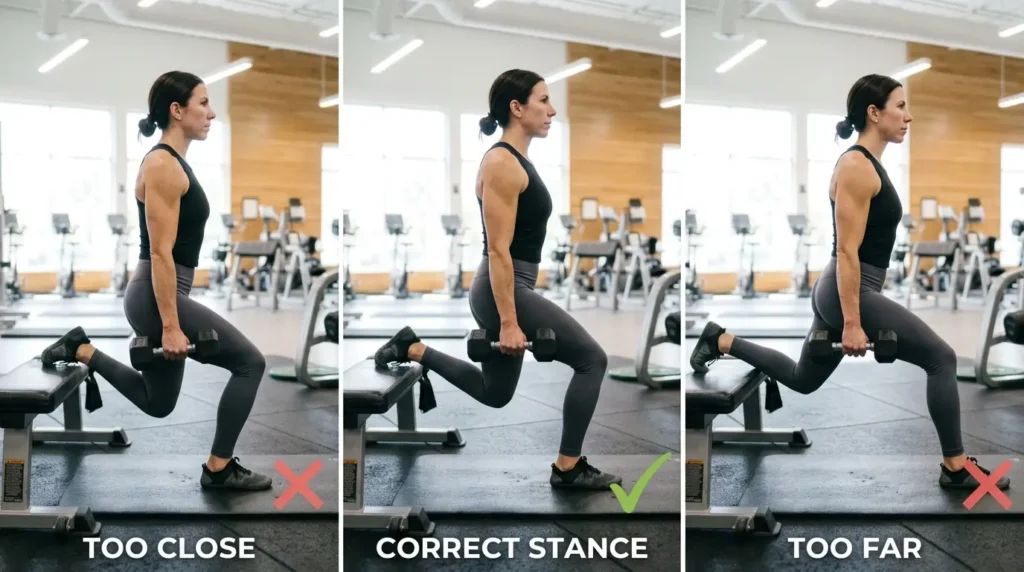
- Set your front foot. Step forward about 2–3 feet (61–91 cm) from the bench. Your front foot should be far enough ahead that your shin stays close to vertical at the bottom.
- Stand tall and brace. Lift your chest, pull your shoulders back, and tighten your abs as if you were about to be nudged.
- Lower with control. Bend both knees and sink straight down for about 3 seconds. Think “down,” not “forward.”
- Reach the bottom. Stop when your front thigh is about parallel to the floor, or slightly higher if you lack mobility. Your back knee should hover an inch or two (3–5 cm) above the floor.
- Drive up. Press through your whole front foot, especially the heel, and stand up in about 1 second.
- Finish all reps on one side, then switch legs and match the reps.
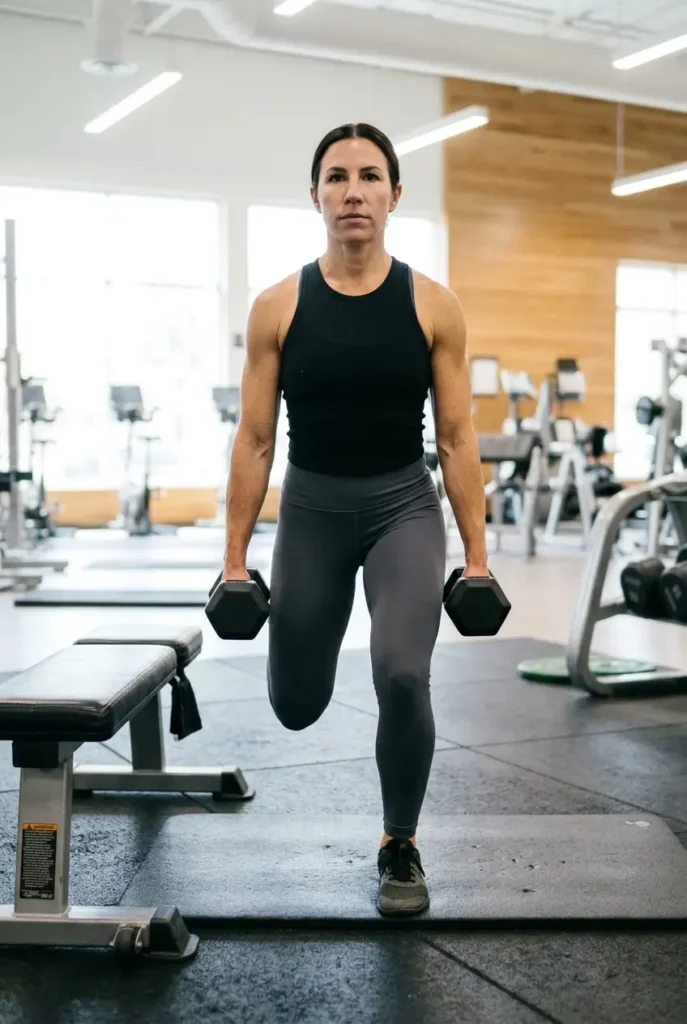
What it should feel like: you should feel the work mostly in your front glute and thigh. A gentle stretch in the back thigh and hip is normal. Sharp pain in a knee or hip is not, so stop and reassess if you feel it.
Coach’s Tip
Before your first working set, do a “test step.” Lower once with no weight, then check your front shin. If your knee is far past your toes and your heel lifts, move your front foot a few inches farther forward. Mark the spot with tape so you can repeat it every session.
Where to Hold the Dumbbells
You have two good options, and each feels a little different:
- Dumbbells at your sides: the most balanced and beginner-friendly option. Your grip may fail before your legs do on heavy sets.
- One dumbbell in goblet position (held at chest): this makes it easier to keep your torso upright. It tends to feel more quad-focused, and it needs only one dumbbell.
Sets, Reps, and Weight for the Dumbbell Bulgarian Split Squat
Your best rep range depends on your goal. The ACSM position stand on resistance training recommends loads in the 8–12 repetition-maximum range for novices, and notes that heavier training generally calls for longer rest periods than hypertrophy work. Use the table below as a starting point, then adjust it to how you feel.
| Goal | Sets | Reps per leg | Weight guidance | Rest between sets |
|---|---|---|---|---|
| Beginner / learning | 2 | 6–8 | Bodyweight or 5–10 lb (2–4.5 kg) each hand | 60–90 sec |
| Strength | 3–5 | 5–8 | Heavy; last 2 reps feel very hard | 2–3 min |
| Muscle size | 3–4 | 8–12 | Moderate; 1–2 reps left in reserve | 1–2 min |
| Endurance | 2–3 | 15–20 | Light; stay smooth | 30–60 sec |
Tempo: a good default is 3 seconds down, a 1-second pause at the bottom, and 1 second up. This builds control and keeps you from bouncing out of the hole.
Choosing weight: pick a load where you can finish every rep with the same form on both legs. If your front knee wobbles or your torso collapses on the last reps, the weight is too heavy. Then, once you complete all sets and reps with good form, add 5 lb (2.3 kg) per hand next time. For a deeper look at progression, the updated ACSM overview of resistance training prescription [VERIFY authors and year] says healthy adults should use progressive resistance training to improve muscle function, size, and physical performance.
Frequency: most people do well with one to two Bulgarian split squat sessions per week. Because the exercise is demanding, you will likely feel it for a day or two. If you wonder how often leg work is too much, read our guide on whether you can do squats every day.
Common Mistakes and How to Fix Them
Most problems come from stance, balance, or ego loading. Fortunately, each one has a simple fix.
| Mistake | Why it matters | Fix |
|---|---|---|
| Front foot too close to bench | Knee travels far forward, heel lifts, quads and knee take over | Step forward 2–4 inches (5–10 cm) |
| Front foot too far forward | You fall into a deep lunge and lose balance; hips and hamstrings get stretched hard | Bring the foot back until your shin is nearly vertical |
| Torso collapses forward | Rounds the back and shifts load to the lower back | Lift your chest, brace, and use lighter dumbbells |
| Front knee caves inward | Puts stress on the knee and shows a weak hip stabilizer | Push the knee toward your little toe |
| Pushing off the back foot | Turns the front leg into a helper | Keep the back foot light, like a kickstand |
| Bouncing out of the bottom | Removes muscle tension and risks the knee | Use a 1-second pause |
| Going too heavy too soon | Form breaks and grip fails first | Cut weight by 20–30% and own each rep |
Common Mistake
Pushing hard with the back leg is the most common error. Your rear foot is there for support, not power. If you feel your back thigh burning more than your front, take a small step closer to the bench and think “all the work happens on the front leg.”
Fine-Tuning Your Torso Angle
You can shift the emphasis with small changes. A slight forward lean of the torso (chest over the front thigh) tends to put more work on the glutes. In contrast, an upright torso tends to emphasize the quads. A biomechanics paper on stance width and trunk lean [VERIFY] reports that both factors change how much the hip and knee are asked to do. So, if you want more glute work, lean slightly and keep your spine long, not rounded.
Variations: From Easier to Harder
You do not need to jump straight to heavy dumbbells. Instead, move up one step at a time.
Easier Versions (Regressions)
- Split squat (both feet on the floor). Skip the bench and take a long stride. Therefore, the balance demand drops a lot.
- Supported Bulgarian split squat. Hold a rack, wall, or sturdy chair with one hand for balance.
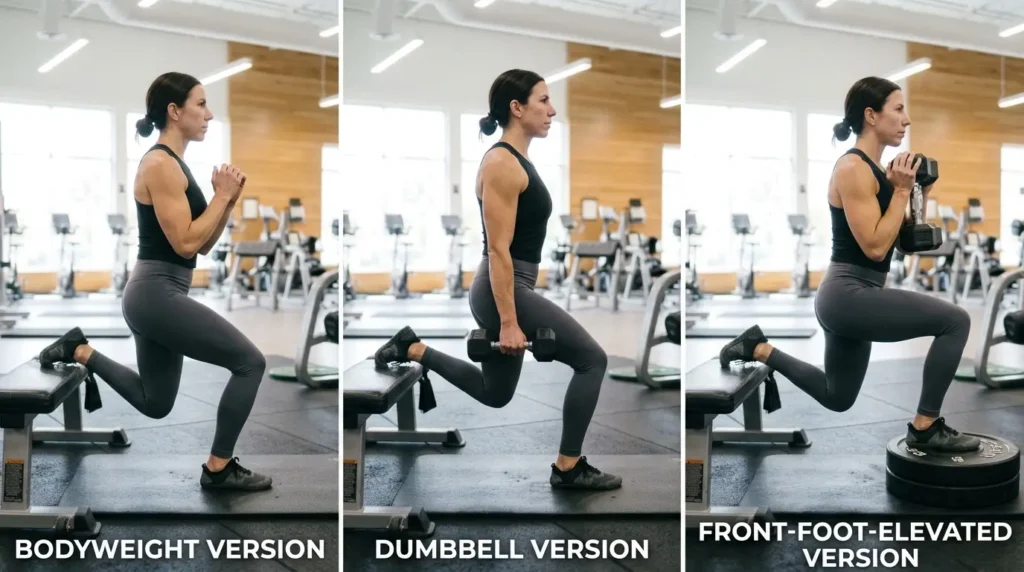
- Bodyweight Bulgarian split squat. Keep your hands on your hips or crossed over your chest.
- Lower back-foot platform. Use a step or low box of about 6–8 inches (15–20 cm) to ease hip stretch.
- Partial range. Lower only halfway at first, then go deeper as comfort grows.
Standard Version
Dumbbells at your sides, back foot on a 12–18 inch (30–46 cm) bench, 3 seconds down, 1 second up.
Harder Versions (Progressions)
- Heavier dumbbells. Add 5 lb (2.3 kg) per hand when you hit the top of your rep range on all sets.
- Pause reps. Hold the bottom position for 2–3 seconds to remove momentum.
- Slow eccentrics. Lower for 4–5 seconds.
- Front-foot elevation. Put your front foot on a 1–2 inch (2.5–5 cm) weight plate to increase depth. This is a hard variation, so use lighter weights.
- Higher rear platform. Raise the back foot a bit more for a bigger stretch.
- Add a rep tempo challenge. Try 5 reps with a 3-second pause on the last rep of each set.
Alternatives to the Bulgarian Split Squat
Some days the bench is taken, your balance is off, or your joints feel unhappy. In that case, swap in one of these.
No equipment:
- Bodyweight split squat or reverse lunge: easy to learn anywhere.
- Stair step-ups: use the bottom or second stair for a low-cost glute exercise.
- Isometric holds: wall sits and split-squat holds are simple. See our list of isometric leg exercises for more ideas.
- Calisthenics options: browse our calisthenics exercises list for bodyweight leg work.
Dumbbells:
- Goblet squat: great for learning squat depth.
- Dumbbell reverse lunge: gentler on the front knee for many people.
- Dumbbell step-up: builds glutes and balance.
- Dumbbell Romanian deadlift: a hip-hinge move that works hamstrings and glutes.
Cable:
- Cable split squat: set the cable low and hold the handle in front of your chest for a steady counterweight.
- Cable pull-through: a hip-dominant option that spares the knees.
Machine:
- Leg press: a seated option with a lot of stability. See our best leg press machines if you are shopping.
- Smith machine split squat: the fixed bar path helps if balance is your limiter.
- Hack squat or similar: our guide to hack squat alternatives explains other ways to load the quads.
If you want a harder quad-focused bodyweight move, you can also try sissy squats after you have built strong knees and good control.
Who Should Be Careful
The dumbbell Bulgarian split squat is safe for many healthy adults when done with good form. Even so, a few groups should be cautious or get approval before starting.
- Current knee, hip, ankle, or back pain. Sharp or pinching pain is a sign to stop.
- Recent injury or surgery. Wait for clearance from your doctor or physical therapist.
- Balance problems or dizziness. Use a support rack and start with the split squat.
- Pregnancy or postpartum. Balance and joint changes can affect safety, so ask your provider first.
- Older adults or people with medical conditions. Start with supported versions and low loads.
- Very tight hip flexors or ankles. Use a lower rear platform and a shorter stride.
If you are unsure, check with a doctor or physical therapist before adding this exercise. Also, always stop a set if form breaks down, even when you have reps left.
Sample Workout Using the Dumbbell Bulgarian Split Squat
Here is a simple lower-body session that takes about 40–50 minutes. Use it once or twice a week with at least one rest day between.
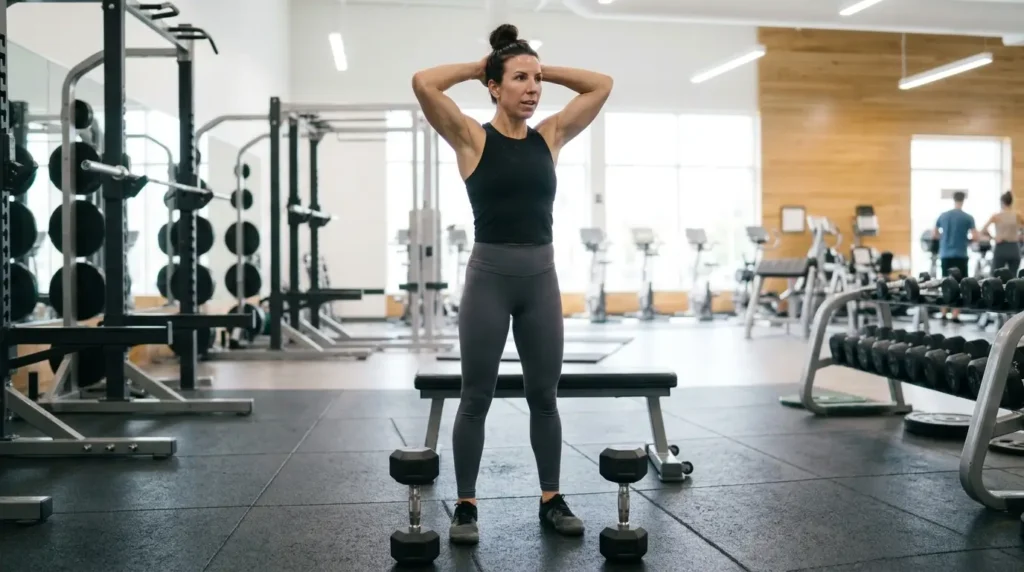
Warm-up (5–8 minutes): easy walking or cycling, then 10 bodyweight squats, 10 hip bridges, 8 leg swings per side, and 5 bodyweight Bulgarian split squats per leg.
| Order | Exercise | Sets | Reps | Rest |
|---|---|---|---|---|
| 1 | Dumbbell Bulgarian split squat | 3 | 8–10 per leg | 90 sec |
| 2 | Dumbbell Romanian deadlift | 3 | 10 | 90 sec |
| 3 | Goblet squat | 2 | 12 | 60 sec |
| 4 | Dumbbell step-up | 2 | 10 per leg | 60 sec |
| 5 | Standing calf raise | 3 | 15 | 45 sec |
| 6 | Plank | 2 | 30–45 sec | 45 sec |
Progression plan (4 weeks):
- Week 1: use a weight that leaves 3 reps in reserve.
- Week 2: add 1 rep per set.
- Week 3: add 5 lb (2.3 kg) per hand and return to lower reps.
- Week 4: repeat week 3 and aim for better control.
Cool-down (3–5 minutes): gentle quad stretch, hip flexor stretch, and hamstring stretch, holding each about 30 seconds.
If you like to pair legs with upper-body work, try this leg and shoulder workout. Also, if you run, plan your hard leg days carefully. Our post on running after leg day explains how to schedule a 3-mile (4.8 km) easy run without wrecking your legs.
Equipment note: if you are buying dumbbells for this move, grip and shape matter. Compare options in our hex dumbbells vs round dumbbells guide.
Frequently Asked Questions
How heavy should dumbbells be for Bulgarian split squats?
Start with bodyweight or 10–15 lb (4.5–7 kg) in each hand. Choose a load that lets you finish every rep with steady balance and the same form on both legs. Add 5 lb (2.3 kg) per hand only after you complete all planned sets and reps cleanly.
Are Bulgarian split squats better than back squats?
Neither is better for everyone. Research suggests the Bulgarian split squat is more hip-focused than other squat types, per a biomechanical comparison. Back squats allow heavier total loads. Many lifters use both, depending on goals, equipment, and comfort.
Why does my front knee hurt during Bulgarian split squats?
A common cause is a front foot that sits too close to the bench, which pushes the knee far forward. Move your foot a few inches ahead, keep your whole foot planted, and reduce the weight. If pain persists or feels sharp, stop and see a doctor or physical therapist.
How high should the bench be?
A bench about 12–18 inches (30–46 cm) high works for most people, often near knee height. If your hip flexors feel tight, try a lower platform of 6–8 inches (15–20 cm). Taller lifters may prefer the higher end. Pick the height that lets you keep your torso tall.
Can I do Bulgarian split squats at home without a bench?
Yes. Use a sturdy chair, couch edge, stair, or low table that will not slide. Check that it is stable before you put weight on it. If you have nothing safe, do regular split squats with both feet on the floor until you can get a bench.
How often should I do Bulgarian split squats?
Most people do well with one to two sessions per week, leaving at least a day or two of recovery in between. Beginners can start with one session. Increase volume slowly, and back off if soreness lingers or your form slips from fatigue.
Final Thoughts
The dumbbell Bulgarian split squat is a simple, effective way to build stronger legs, steadier balance, and better control on each side. Set up your stance carefully, lower with control, and choose a weight you can handle on both legs. Start with the easier versions, progress slowly, and use the sample workout as your roadmap.
Keep the focus on clean reps, steady progress, and consistent training. When you apply the dumbbell Bulgarian split squat: how to do it steps from this guide, your legs will get stronger and your form will improve with every session.
