
Learning how to increase your bench press takes more than adding weight to the bar every week. Your setup, technique, weekly training volume, rest time, and supporting muscles all play a part. When one of these is weak, the bar stalls.
This guide gives you a coach-style plan to fix that. You will learn which muscles do the work, how to set up and press with clean form, and how to choose sets, reps, and rest. You will also get easier and harder variations, accessory exercises, and a full 8-week program.
Quick Answer
To increase your bench press, train it two to three times a week, use a stable setup with shoulder blades pinned back, and add small weight jumps of 2.5–5 lb (1.1–2.3 kg) when reps are clean. Rest 2–3 minutes between hard sets, build your triceps, shoulders, and upper back, and fix your weak point.
Muscles Worked in the Bench Press
The bench press is a team effort. Knowing who is on the team shows you what to strengthen.
Primary muscles:
- Pectoralis major (chest): pushes your arms forward and together.
- Triceps brachii: straighten your elbows, especially near lockout.
- Anterior deltoid (front shoulder): helps drive the bar off your chest.
Secondary and stabilizing muscles:
- Serratus anterior and rotator cuff: keep your shoulder joint steady.
- Lats and upper back: create a stable “shelf” to press from.
- Forearms and biceps: hold and control the bar.
- Legs, glutes, and core: support leg drive and a tight body.
Research agrees that the chest and triceps lead the way. A systematic review of bench press EMG studies found that the triceps brachii and pectoralis major showed similar activity during the lift, both higher than the anterior deltoid [VERIFY authors]. As a result, strong triceps matter almost as much as a strong chest.
Why It Pays to Learn How to Increase Your Bench Press
A stronger bench press is a useful marker of upper-body pushing strength. It carries over to pushing a heavy door, moving furniture, and sports that need strong arms and shoulders. Many lifters also enjoy it because progress is easy to measure.
Strength training also supports general health. Adults should do muscle-strengthening activity at least two days a week, according to the CDC physical activity guidelines. The bench press can be one of several exercises that help you meet that target.
Finally, a focused plan keeps your shoulders healthier. Better technique, balanced pulling work, and smart progression reduce the odds of nagging aches.
How to Increase Your Bench Press: Setup and Form Step-by-Step
Most lifters who stall have a setup problem, not a strength problem. Spend a full minute on your setup before every heavy set. Equipment matters too, so use a sturdy rack with safety bars, such as those in our guide to the best squat racks with pull-up bars.
Step-by-step:
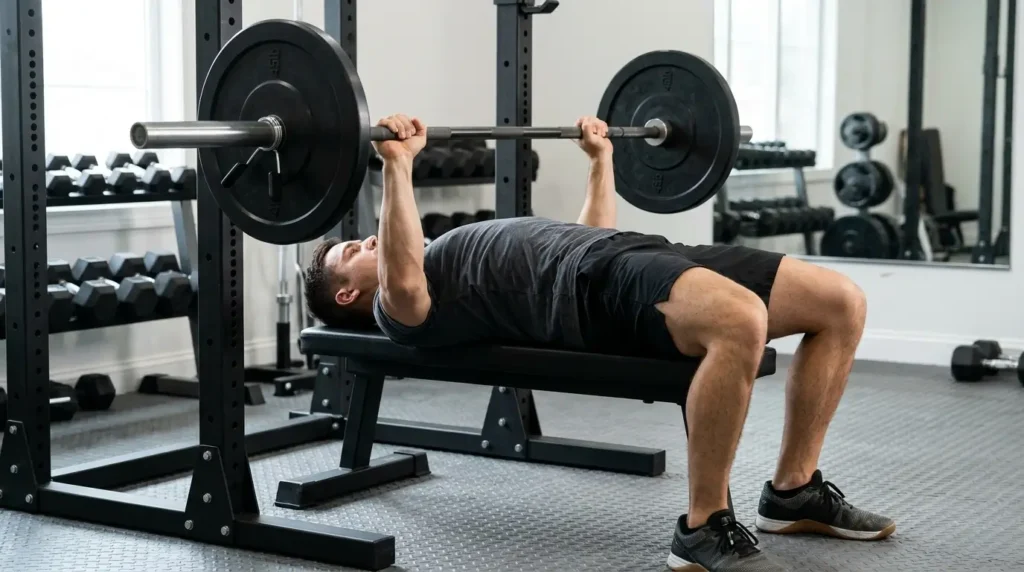
- Lie down with your eyes under the bar. Your head, upper back, and glutes stay on the bench for the whole set.
- Set your grip. Place your hands evenly on the bar with your wrists stacked over your elbows. For most lifters, a good starting point is about 1.5 to 2 times shoulder width. We explain this below.
- Retract and depress your shoulder blades. Pull them together and down, as if tucking them into your back pockets.
- Create a small upper-back arch. Keep your glutes on the bench. This shortens the distance the bar travels and protects your shoulders.
- Plant your feet. Keep them flat on the floor, under or slightly behind your knees. Push the floor away, but do not lift your hips.
- Unrack with straight arms. Let the bar settle over your shoulders. Take a big breath and tighten your core.
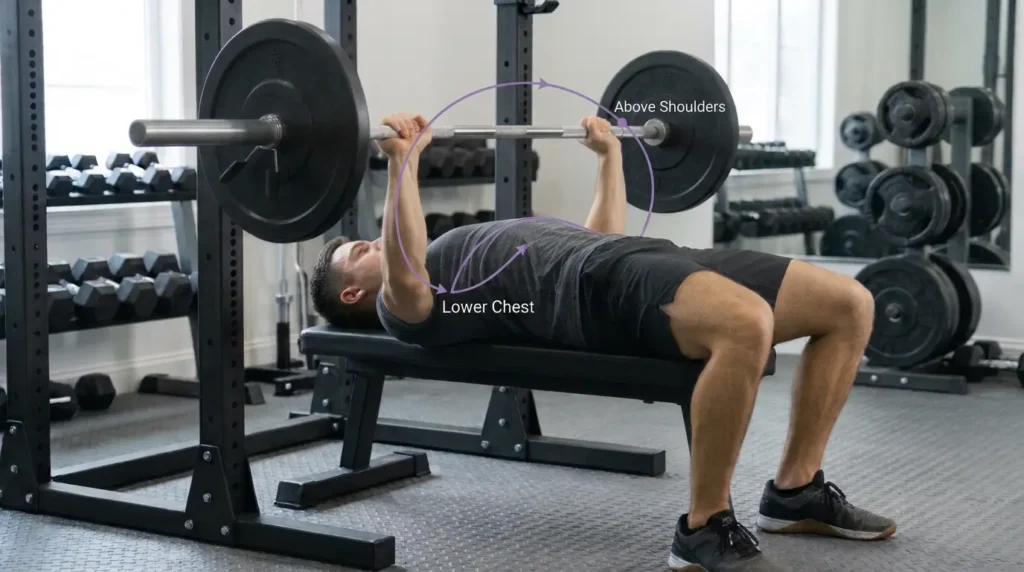
- Lower the bar for about 2 seconds. Aim for your lower chest, near the nipple line, with elbows at about 45–75 degrees from your torso.
- Touch lightly. Do not bounce the bar. Pause briefly if you are training strength.
- Press up and slightly back. Drive through your feet and finish over your shoulders. Breathe out after you pass the hardest point.
Choosing Your Grip Width
Grip width affects which muscles work hardest and how safe the lift feels. A 2023 meta-analysis on bench press EMG concluded that a horizontal-bench press with a grip between 150% and 200% of your biacromial (shoulder-bone) distance produced greater pectoralis major activation in most comparisons. It also advised against going wider than 200% because of injury risk.
For many adults, shoulder-bone width is around 14–16 inches (36–41 cm), so that range works out to about 21–32 inches (53–81 cm) between the hands. Try the narrower half first. Your forearms should look vertical at the bottom of the rep.
Coach’s Tip
Film your set from the side and from the foot of the bench. Check three things: bar touches the same spot every rep, your forearms stay vertical, and your hips stay down. Small fixes in these three areas often add a few pounds without any extra training.
Sets, Reps, and Rest to Increase Your Bench Press
The right plan depends on your goal. The ACSM position stand on resistance training recommends loads of about 8–12 repetitions-to-failure for novices and 2–3 training days per week for untrained lifters. Intermediate and advanced lifters usually progress toward heavier loads with longer rests.
| Goal | Sets | Reps | Rest | Load feel |
|---|---|---|---|---|
| Beginner / learn the lift | 3 | 8–10 | 2 min | 2–3 reps left in the tank |
| Strength | 3–5 | 3–6 | 2–4 min | Heavy; 1–2 reps in reserve |
| Muscle size | 3–4 | 8–12 | 1.5–2.5 min | Moderate; 1–2 reps in reserve |
| Endurance | 2–3 | 15–20 | 45–90 sec | Light; steady tempo |
Rest time matters more than most people think. In one study of resistance-trained men, a 3-minute rest between sets produced greater gains in 1RM bench press than a 1-minute rest over 8 weeks. Therefore, do not rush your heavy sets. Use a timer and rest 2–3 minutes between main sets.
Tempo: a simple default is 2 seconds down, a light touch, and a fast, controlled press up.
Common Bench Press Mistakes That Stall Progress
Most plateaus come from avoidable errors. Fortunately, the fixes are simple.
| Mistake | Why it hurts | Fix |
|---|---|---|
| Loose shoulder blades | Unstable base, more shoulder strain | Pin shoulder blades before unracking |
| Flared elbows (90 degrees) | Stress on shoulders, weaker pressing angle | Tuck to about 45–75 degrees |
| Bouncing the bar | Cheats the first inch and risks the ribs | Touch lightly, pause if needed |
| Hips lifting off the bench | Wastes energy and may cause form fouls | Squeeze glutes, lower the load |
| Wrists bent back | Leaks force and strains the wrist | Stack the bar over your forearm |
| Same weight and reps forever | No overload | Track and add small jumps |
| Skipping rows and rear delt work | Imbalance and weaker base | Match pushing with pulling |
| Training to failure every set | Hard to recover and form breaks | Leave 1–2 reps in reserve |
Common Mistake
Letting the bar drift toward your neck or belly on the way up is one of the most common technique leaks. It makes the lift feel unstable and unfairly hard. Press in a slight arc: down to your lower chest, up and slightly back over your shoulders.
How to Increase Your Bench Press: Variations from Easier to Harder
You do not need to start with a heavy barbell. Move through these steps as you improve.
Easier Versions (Regressions)
- Push-ups. Build body control and shoulder stability. For more bodyweight options, see our calisthenics exercises list.
- Dumbbell bench press. Let each arm work on its own. If you are buying weights, our hex vs .round dumbbells guide can help.
- Machine chest press. A guided path is helpful for beginners or solo training. Our guide to the Hammer Strength chest press explains how this machine works.
- Floor press. Limits shoulder range of motion.
- Empty-bar bench. Practice the setup with a bar that weighs 45 lb (20 kg) on an Olympic bar. Our guide to Olympic vs standard barbells covers the differences.
Standard Version
Barbell flat bench press, as described above.
Harder Versions (Progressions)
- Paused bench press. Hold the bar on your chest for 1–2 seconds, then press. It builds strength off the chest and removes bounce.
- Tempo bench press. Lower for 3–4 seconds, then press.
- Close-grip bench press. Grip just inside shoulder width to put more work on the triceps.
- Spoto press. Stop the bar 1 inch (2.5 cm) above your chest and pause.
- Pin press or board press. Press from a set height to attack a specific sticking point.
Accessory Exercises and Alternatives to Support Your Bench
Accessory work builds weak links. Pick two to four of these after your main bench sets.
Triceps (lockout strength):
- Close-grip bench: 3 sets of 6–10 reps.
- Skull crushers or triceps extensions: 3 sets of 10–12 reps. The right bar helps, so see our best tricep bars list.
- Rope pushdowns: 3 sets of 12–15 reps.
Chest and shoulders (off-the-chest strength):
- Dumbbell incline press: 3 sets of 8–12 reps. The 2023 meta-analysis above suggests the flat barbell bench activates the sternal chest more than the incline version, so use incline as an add-on, not a replacement.
- Overhead press: 3 sets of 6–10 reps.
- Dips: 3 sets of 6–12 reps, with lighter depth if shoulders feel tender.
Upper back and shoulder health (stability):
- Barbell or cable rows: 3 sets of 8–12 reps.
- Face pulls: 3 sets of 12–20 reps.
- Rear delt raises: try our seated bent-over rear delt raise guide.
Cable or machine option: cable chest flies and a chest-press machine both work if you lack a bench or spotter.
Who Should Be Careful
The bench press is safe for many healthy adults when done with good form. Even so, take extra care in these cases.
- Shoulder, elbow, wrist, or chest pain. Do not push through sharp pain.
- Recent injury or surgery. Wait for clearance from your doctor or physical therapist.
- Older adults or people with heart or blood pressure conditions. Check with a doctor first and start light.
- Pregnancy or postpartum. Ask your provider which positions are safe.
- Solo lifters. Always use safety bars or a spotter. Never lift heavy over your face without a safety plan.
Elbow support can feel helpful for some lifters. Our guide to the best elbow sleeves for lifting explains your options, though sleeves do not replace good form or medical care.
Sample 8-Week Plan: How to Increase Your Bench Press Safely
This plan uses three training days a week. It balances heavy work, volume work, and upper-back support.
Weekly Layout
| Day | Focus | Exercises (sets x reps) |
|---|---|---|
| Monday | Heavy bench | Bench press 4×5, overhead press 3×8, barbell row 3×10, rope pushdown 3×12 |
| Wednesday | Lower body / rest | Squats, deadlifts, or walking 0.5 mile (0.8 km) |
| Friday | Volume bench | Paused bench 3×8, dumbbell incline press 3×10, cable row 3×12, face pull 3×15 |
Pair your weekly plan with leg work using our leg and shoulder workout ideas if you want a lower-body day.
8-Week Progression
| Weeks | Heavy day (Monday) | Volume day (Friday) |
|---|---|---|
| 1–3 | Add 5 lb (2.3 kg) each week on 4×5 | Keep weight steady, add 1 rep per set |
| 4 | Deload: 3×5 at about 80% of week 3 | Deload: 2×8 light |
| 5–7 | Add 2.5–5 lb (1.1–2.3 kg) each week | Add 1 rep per set again |
| 8 | Work up to a heavy set of 3 reps | Easy technique work |
Frequency: how often you train matters, but total volume matters too. A meta-analysis on training frequency and strength found that higher frequencies produced greater strength gains, but when volume was equated, the effect of frequency was not significant. In practice, two to three weekly bench sessions are a practical way to fit enough volume without overload. Also, a meta-analysis on training frequency and muscle growth found that training a muscle twice a week produced better growth than once a week when volume was matched.
Progression Rules
- Use double progression. Pick a rep range like 5–8. Add reps each week until you hit the top on all sets, then add weight and start over at the bottom.
- Use small jumps. Microplates let you add 2.5 lb (1.1 kg) or even 1 lb (0.45 kg) at a time. This works better than big jumps that wreck form.
- Leave reps in reserve. Stop 1–2 reps short of failure on most sets.
- Test safely. In week 8, find a 3-rep max instead of a 1-rep max unless you have a spotter and a rack.
- Deload when needed. If your bar speed drops, your joints ache, or you feel run-down, take a lighter week.
Beginner and Advanced Versions
Beginner: train two days a week with full-body sessions. Use 3 sets of 8–10 reps, add 5 lb (2.3 kg) per week, and keep rest at 2 minutes. This lines up with the ACSM guidance for novices.
Advanced: use 3–4 pressing days. Rotate heavy sets of 2–5, paused work, close-grip work, and high-rep triceps. Longer rests of 3–5 minutes suit heavy sets, and the ACSM position stand notes heavier loading for experienced lifters.
Recovery Tips
Sleep, easy movement, and balanced nutrition all support progress. Check with a doctor or registered dietitian for personal nutrition advice. On rest days, light walking or stretching may keep you moving without extra strain.
Frequently Asked Questions
How to Increase Your Bench Press Fast: Is It Possible?
There is no safe shortcut, but you can speed progress by fixing technique, training the bench two to three times a week, and resting properly. Add small jumps of 2.5–5 lb (1.1–2.3 kg) and track every session. Steady, repeatable gains beat risky weight jumps.
How often should I bench press to get stronger?
Two to three times a week works well for most lifters. A frequency meta-analysis found higher frequencies were linked to more strength, mainly because they allow more weekly volume. Leave at least one rest day between hard pressing sessions.
How long should I rest between bench sets?
Rest 2–3 minutes between main sets. A trial in trained men found 3-minute rests produced greater bench strength gains than 1-minute rests. Lighter accessory sets can use 60–90 seconds. Use a timer so you stay consistent.
How to Increase Your Bench Press When You Are Stuck?
First, check technique by filming a set. Next, add pause reps, close-grip work, and upper-back training. Then reduce training fatigue with a deload week, and make smaller weight jumps. If you still stall, track your sleep and weekly volume and consider asking a coach to review your form.
What grip width is best for the bench press?
A grip of about 150–200% of your shoulder-bone distance is a good range, according to a 2023 meta-analysis. Start in the narrower half, keep forearms vertical at the bottom, and avoid going wider than 200%, which may raise injury risk.
Do push-ups help increase my bench press?
Push-ups can help, especially for beginners, because they train pressing strength and shoulder control. The same 2023 review found push-ups reached similar chest activation under the same relative load, but they are hard to load heavier. Use them as support, not a replacement for barbell progression.
Final Thoughts on How to Increase Your Bench Press
Knowing how to increase your bench press comes down to a few habits: set up the same way every time, press with a stable body, rest enough between hard sets, and add weight in small steps. Build your triceps, shoulders, and upper back so every part of the lift can improve.
Use the 8-week plan, track your numbers, and film your sets. With patience and consistent training, increasing your bench press becomes a clear, repeatable process rather than guesswork.
