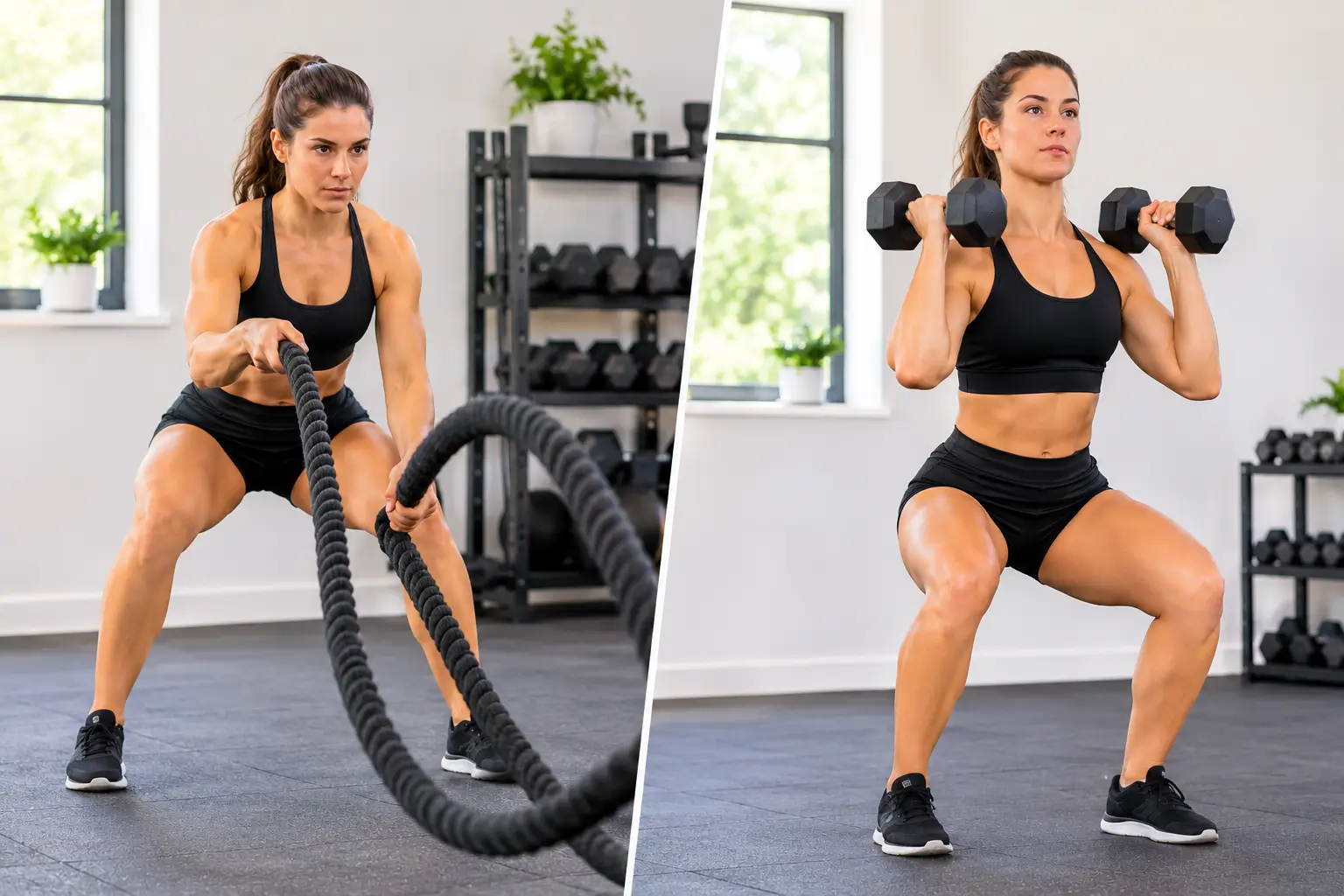
Battle ropes alternatives give you the same heart-pounding, shoulder-burning work without the heavy rope, the anchor point, or the floor space. Ropes are great, yet many home lifters cannot mount one safely, and apartment neighbors may not love the noise. Fortunately, you can copy the effect with bodyweight moves, a pair of dumbbells, or a cable machine.
This guide shows you ten exercises, with form cues, sets, reps, and easier and harder versions. You will also get a sample workout and a short safety section.
Quick Answer: The best battle ropes alternatives are shadow rope waves, mountain climbers, and burpees with no equipment; dumbbell thrusters and renegade rows with weights; and cable woodchops and punches on a cable machine. Pick the option that matches your gear, then train in short, hard intervals.
What Battle Ropes Train (and What a Good Alternative Needs)
Muscles Worked
Battle rope waves are mostly an upper-body exercise, but they also tax your whole body. In one study, researchers measured muscle activity in the anterior deltoid (front shoulder), external oblique, lumbar erector spinae (lower back), and gluteus medius during rope waves, according to a peer-reviewed study in the Journal of Strength and Conditioning Research [VERIFY the link opens the paper].
- Primary: Front and side shoulders, upper back, forearms
- Secondary: Core and obliques, lower back, glutes, quads
Because the rope keeps moving, your grip and shoulders also work for long stretches. As a result, a good alternative should let you move fast for 20–40 seconds while keeping your core braced.
Benefits and What to Copy
A 10-minute rope training session in one study reached a vigorous intensity, with high heart rates and energy expenditure. The study used a rope about 50 feet (15.2 m) long, held in the middle. That finding suggests short, hard intervals are the key feature to copy.
Meanwhile, the CDC says adults need at least 150 minutes of moderate activity or 75 minutes of vigorous activity each week, plus two days of muscle strengthening. Battle ropes alternatives can help you hit both targets. Therefore, choose moves that raise your heart rate, challenge your shoulders, and keep your core working.
Why Look for Battle Ropes Alternatives?
There are several practical reasons to skip the rope. First, ropes need a sturdy anchor point and plenty of room. Second, a long rope can be loud on hard floors. Third, ropes are not always easy to scale for beginners, because the effort depends on how hard you whip.
On the other hand, alternatives let you control the load with simple tools. For example, a dumbbell weight is easy to change by 5 lb (2.3 kg). If you live in a small place, our list of the best apartment workout equipment shows other compact options.
Battle Ropes Alternatives at a Glance
| Exercise | Type | Equipment | Best for |
|---|---|---|---|
| Shadow rope waves | No equipment | None | Mimicking wave rhythm |
| Mountain climbers | No equipment | None | Core and cardio |
| Jumping jack to squat jack | No equipment | None | Low-skill conditioning |
| Burpees | No equipment | None | Full-body intensity |
| Dumbbell thruster | Dumbbell | 2 dumbbells | Legs, shoulders, lungs |
| Alternating dumbbell snatch | Dumbbell | 1 dumbbell | Power and grip |
| Renegade row | Dumbbell | 2 dumbbells | Core and back |
| Cable woodchop | Cable | Cable machine | Obliques and rotation |
| Cable speed punches | Cable | Cable machine | Shoulder endurance |
| Cable face pull | Cable | Cable machine | Upper back and rear delts |
No-Equipment Battle Ropes Alternatives
You do not need any gear to match the pace of a rope workout. These four moves rely on speed, bodyweight, and tight intervals. They are ideal for hotel rooms and small apartments.
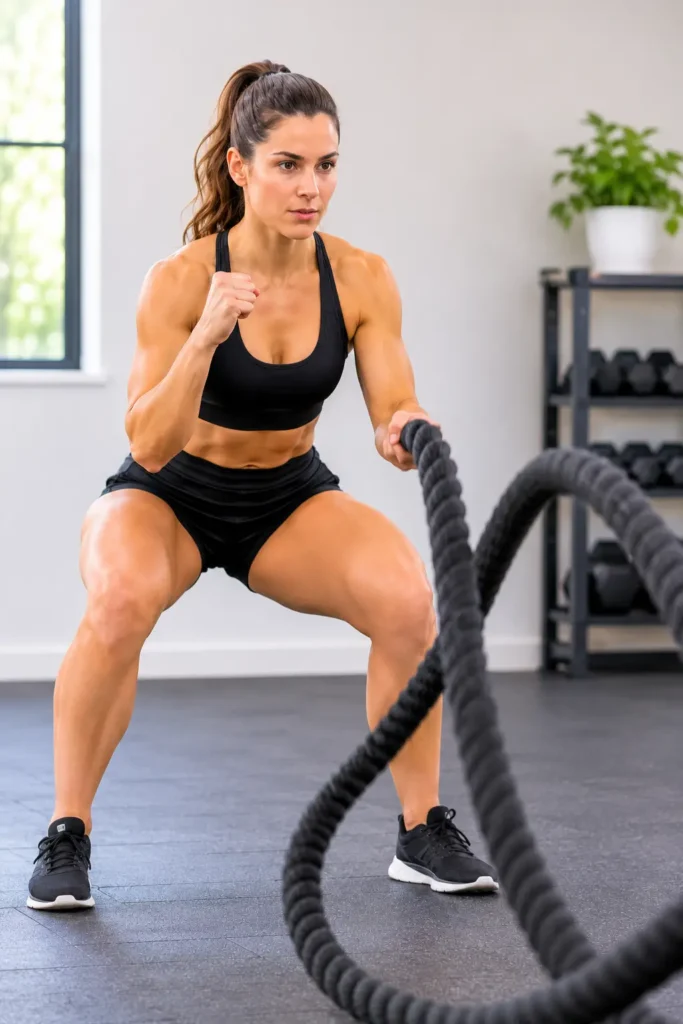
1. Shadow Rope Waves
This move copies the rhythm of rope waves with empty hands. It teaches the tempo and keeps your shoulders working.
- Stand with feet shoulder-width apart in a quarter squat.
- Make fists as if holding rope ends, arms in front.
- Alternate arms up and down in fast, small waves.
- Keep your chest tall and your core tight.
Sets and reps: 4 rounds of 30 seconds, resting 30 seconds. Feel: burning front shoulders and a steady heart rate.
Easier: Use slower waves and a standing posture. Harder: Hold light 3 lb (1.4 kg) weights or add a jump every fourth wave.
2. Mountain Climbers
Mountain climbers keep your shoulders loaded and your core on fire. They also raise your heart rate quickly.
- Start in a high plank, hands under shoulders.
- Drive one knee toward your chest.
- Switch legs fast while keeping hips level.
Sets and reps: 4 rounds of 30 seconds, resting 30 seconds. Easier: Slow the pace or raise your hands on a bench. Harder: Place your feet on sliders or move at a sprint pace.
3. Squat Jacks
Squat jacks combine a squat and a jumping jack. In addition, they spare your wrists, so they suit people who dislike planks.
- Start with feet together and hands at your chest.
- Jump feet wide into a squat.
- Jump back to the start and repeat.
Sets and reps: 4 rounds of 30–40 seconds, resting 30 seconds. Easier: Step out instead of jumping. Harder: Hold a dumbbell at your chest.
4. Burpees
Burpees offer one of the toughest full-body workouts without equipment. Therefore, begin with a small number of reps.
- Squat and place hands on the floor.
- Step or jump your feet back into a plank.
- Lower your chest toward the floor, then press up.
- Jump feet in and finish with a small hop.
Sets and reps: 3–4 rounds of 8–12 reps, resting 45–60 seconds. Easier: Step back and skip the push-up. Harder: Add a tuck jump at the top.
For more bodyweight options, browse our calisthenics exercises list.
Dumbbell Battle Ropes Alternatives
Dumbbells let you add measurable load, which ropes cannot do as easily. Start light, because these moves combine speed and a heavy lift. A beginner can begin with 8–15 lb (3.6–6.8 kg) per hand.
5. Dumbbell Thruster
A thruster blends a front squat and an overhead press. It makes your shoulders, legs, and lungs work together.
- Hold dumbbells at shoulder height, palms facing in.
- Squat until thighs are about parallel.
- Drive up and press the dumbbells overhead.
- Lower them back to your shoulders under control.
Sets and reps: 3–4 sets of 8–12 reps, resting 60–90 seconds. Tempo: Quick up, controlled down. Easier: Use a goblet squat with one dumbbell. Harder: Go heavier or add a pause at the bottom.
Coach’s Tip: Use the legs to drive the press. If your arms do all the work, your shoulders will tire first and your form will slip.
6. Alternating Dumbbell Snatch
This move trains power, grip, and hip drive. Furthermore, it feels like the whip of a rope wave.
- Stand with a dumbbell between your feet.
- Push your hips back and grab the handle.
- Drive your hips forward and pull the dumbbell overhead in one motion.
- Lower under control and switch hands.
Sets and reps: 3 sets of 6–8 reps per arm, resting 60–90 seconds. Easier: Use a high pull to chest height. Harder: Use a heavier weight or switch hands in the air.

7. Renegade Row
The renegade row builds core stability and back strength. Unlike thrusters, it works without jumping, so it is quiet.
- Set up in a plank with hands on dumbbells.
- Widen your feet for balance.
- Row one dumbbell toward your ribs, keeping hips square.
- Lower and repeat on the other side.
Sets and reps: 3 sets of 6–10 reps per side, resting 60 seconds. Easier: Place knees on the floor. Harder: Add a push-up between rows.
Common Mistake: Letting your hips twist as you row. Squeeze your glutes and spread your feet wider so your torso stays level.
For more shoulder work with light weights, see our guide to the seated bent-over rear delt raise.
Cable Battle Ropes Alternatives
A cable machine gives smooth, steady tension, which helps if you want control. Moreover, you can set the weight precisely. These cable battle ropes alternatives also feel gentler on your joints than slams.
8. Cable Woodchop
Rope waves challenge your obliques, and the woodchop trains the same rotation with load.
- Set the cable high and stand sideways to the machine.
- Grab the handle with both hands.
- Rotate and pull down across your body.
- Return slowly and repeat.
Sets and reps: 3 sets of 10–12 reps per side, resting 45–60 seconds. Weight: Start with about 10–20 lb (4.5–9 kg). Easier: Use a lighter stack and a smaller range. Harder: Move faster or switch to a low-to-high chop.
9. Cable Speed Punches
This move targets shoulder endurance and mimics the fast tempo of alternating waves.
- Face away from the machine, handle in each hand, set at chest height.
- Stagger your stance and brace your core.
- Punch forward, alternating arms in a quick rhythm.
Sets and reps: 4 rounds of 20–30 seconds, resting 30 seconds. Easier: Use very light weight and punch slowly. Harder: Add a split-stance lunge.
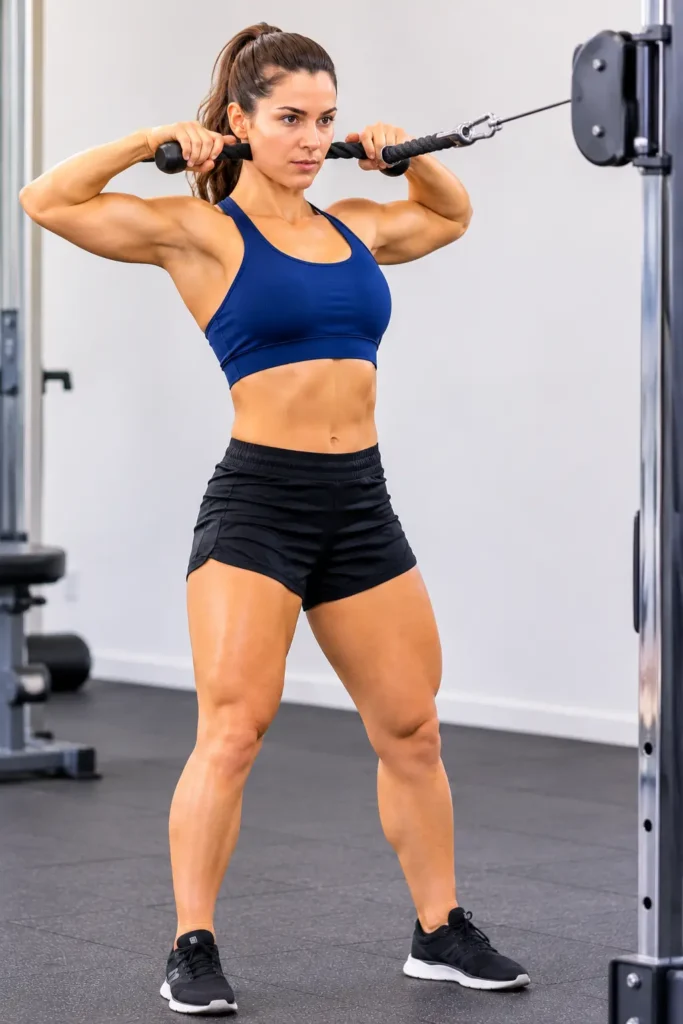
10. Cable Face Pull
The face pull balances all the pushing work. Equally important, it protects your shoulders by training the upper back.
- Set the cable at upper-chest height with a rope attachment.
- Pull toward your face, splitting the rope apart.
- Squeeze your shoulder blades and pause for one second.
Sets and reps: 3 sets of 12–15 reps, resting 45 seconds. Easier: Use a lighter load. Harder: Hold the squeeze for three seconds.
Machine and Cardio-Equipment Options
If you own cardio gear, you can replace rope intervals with machine intervals. For example, a rowing machine works the back, legs, and arms together. Our Concept2 rower review explains what to expect, and the rowing machine vs elliptical comparison helps you choose.
Climbing machines are another choice because they load the upper body hard. In particular, our Maxi Climber vs VersaClimber guide covers two popular options. Use the same 30-second work and 30-second rest structure.
Sets, Reps, and Intensity by Goal
| Goal | Work time | Rest time | Rounds |
|---|---|---|---|
| Conditioning | 20–30 sec | 30–40 sec | 6–10 |
| Power | 10–15 sec | 45–60 sec | 6–8 |
| Muscular endurance | 40–45 sec | 15–20 sec | 4–6 |
| Beginner starter | 20 sec | 40 sec | 4–6 |
Choose one goal per session. Meanwhile, keep every round as fast as you can while holding good form. When the quality drops, stop the set.
Common Mistakes and Fixes
Even simple exercises can go wrong when you rush. Watch for these errors.
- Going too heavy too soon: Start light and add weight only when form stays clean.
- Shrugging the shoulders: Keep your shoulders down and back, away from your ears.
- Holding your breath: Exhale on effort and breathe steadily.
- Skipping the warm-up: Spend five minutes on easy movement first.
- Doing every move at the same pace: Alternate hard and easy rounds.
Progress by changing one thing at a time. According to an ACSM position stand, healthy adults should do progressive resistance training. So add a little time, weight, or speed each week.
Who Should Be Careful
Battle ropes alternatives are demanding, so some people need extra care. Check with a doctor or physical therapist first if you have shoulder, neck, wrist, or back pain, a heart or blood pressure condition, or you are pregnant or returning from injury. Likewise, older adults and complete beginners should start with the easier versions.
Stop any exercise that causes sharp pain, dizziness, or chest discomfort. In those cases, seek medical advice before continuing.
Sample Workout Using Battle Ropes Alternatives
This circuit takes about 25 minutes and needs one pair of dumbbells.
Warm-up (5 minutes): Arm circles, bodyweight squats, and light shadow rope waves.
| Exercise | Work | Rest | Rounds |
|---|---|---|---|
| Shadow rope waves | 30 sec | 30 sec | 3 |
| Dumbbell thruster | 30 sec | 30 sec | 3 |
| Mountain climbers | 30 sec | 30 sec | 3 |
| Renegade row | 30 sec | 30 sec | 3 |
| Burpees | 30 sec | 30 sec | 3 |
Rest 90 seconds between rounds. Finish with a three-minute cool-down walk and gentle shoulder stretches.
Beginner version (regression): Use 20 seconds of work, 40 seconds of rest, and 2 rounds. Swap burpees for squat jacks.
Advanced version (progression): Use 40 seconds of work, 20 seconds of rest, and 4 rounds. Use heavier dumbbells for thrusters and rows.
Add this circuit to your week on two or three non-consecutive days. For leg and shoulder support days, our leg and shoulder workout fits well. Pair it with our guide on whether kettlebell swings work abs if you want another power move.
Frequently Asked Questions
What can I use instead of battle ropes?
Try bodyweight moves like shadow rope waves, mountain climbers, and burpees. You can also use dumbbell thrusters, snatches, and renegade rows. Cable woodchops and speed punches work well at a gym. Choose whichever fits your gear, then train in short, fast intervals.
Can I do battle rope exercises without ropes?
Yes. Shadow rope waves copy the arm rhythm with empty hands. Pair them with squats, planks, and jumps to build a full workout. You will not match the rope’s exact feel, but you can still reach a high heart rate and tire your shoulders.
Are battle ropes worth it?
They can be, especially for short, intense conditioning. One study found that 10 minutes of rope training reached a vigorous intensity. However, they need space and an anchor, so alternatives may suit small homes better. The best tool is the one you will use consistently.
Can dumbbells replace battle ropes?
Largely, yes. Dumbbell thrusters, snatches, and renegade rows work the shoulders, core, and legs with measurable load. They will not copy the wave motion exactly. Still, they build strength and conditioning, and you can raise the weight as you improve.
Are battle ropes bad for shoulders?
They are not harmful for everyone, but the fast overhead and front-raise movements can tire or irritate sore shoulders. Start with short intervals and good form. If you have shoulder pain or past injuries, talk with a doctor or physical therapist before training.
How long should a battle rope-style workout be?
Many people do well with 15–25 minutes, including warm-up and cool-down. Use work intervals of 20–40 seconds with equal or slightly longer rests. Beginners can start with two rounds and add one round each week as fitness improves.
Conclusion: Choosing Your Battle Ropes Alternatives
The best battle ropes alternatives are the ones that fit your space, gear, and fitness level. Bodyweight moves like shadow rope waves and mountain climbers need nothing. Dumbbell thrusters and renegade rows add load, while cable woodchops and speed punches give smooth control.
Start with the easier versions, keep your intervals short, and add a little work each week. Above all, stay consistent and keep your form clean. You will get the same sweaty, shoulder-burning effect without ever mounting a rope.
