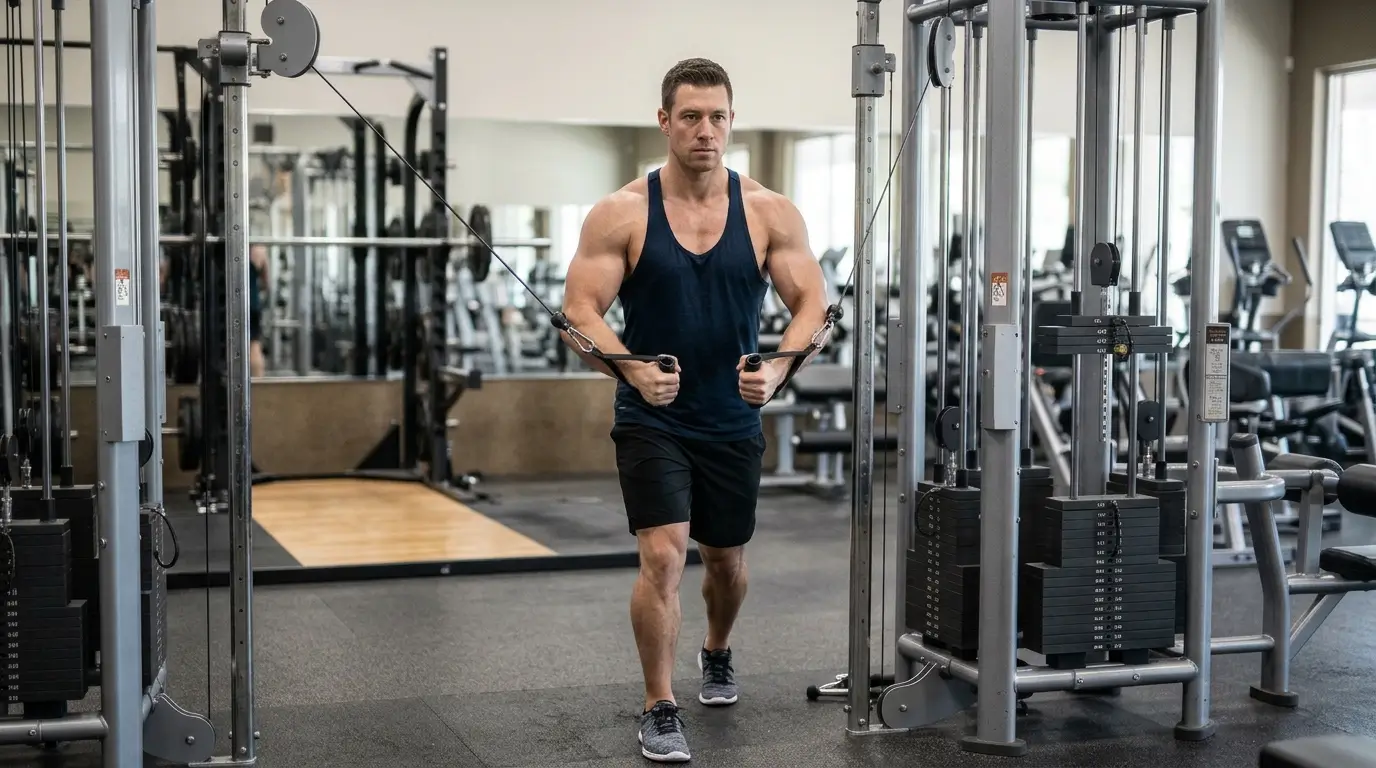
Cable machine benefits go well beyond the classic triceps pushdown. A cable machine uses a weight stack, a steel cable, and pulleys to deliver resistance you can aim from almost any direction. That simple design changes how a lift feels, which muscles work, and how easy it is to train with control. Therefore, this guide explains what a cable machine really does, what research says about it, and where it falls short. You will also get four beginner-friendly moves with easier and harder versions, plus a full-body sample workout. If you have pain or an injury, check with a doctor or physical therapist before you start.
Quick Answer
Cable machine benefits come from a pulley system that gives smooth, adjustable resistance from almost any angle. It lets you train muscles through a full range of motion, work one side at a time, and change weight in seconds. It will not replace heavy squats or deadlifts, but it fills gaps very well.
What a Cable Machine Actually Does
Understanding cable machine benefits starts with the mechanics. First, you need to know how the pulleys turn a falling weight into a pull you can aim anywhere.
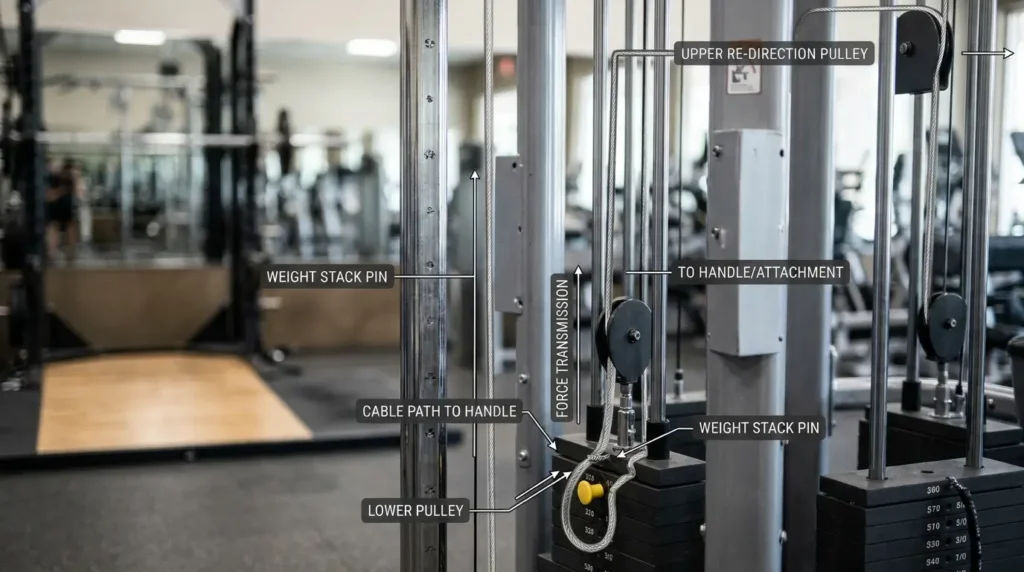
How the Pulley System Works
A weight stack hangs on a cable. The cable runs over one or more pulleys and ends at a handle, rope, or bar. Therefore, when you pull the handle, the pulleys redirect the force. The stack lifts while your hand moves in the direction you choose.
Why the Direction of Pull Matters
Free weights work differently because gravity always pulls straight down. For example, at the top of a dumbbell fly, your arms point at the ceiling and the weight rests on your bones instead of your chest. By contrast, a cable fly set at shoulder height keeps pulling your hands apart through the whole movement. As a result, the muscle stays loaded in positions where a dumbbell would go slack.
Two Things to Know Before You Buy or Use One
Two points are worth keeping in mind:
- Tension is steady, not perfect. The load along the cable stays the same. However, how hard a rep feels still changes with your joint angles. Even so, there are far fewer “dead spots” than in many free-weight moves.
- The number on the stack may not equal the real load. Many machines use a pulley ratio such as 2:1, which makes the resistance at your hand lighter than the stack setting. Therefore, compare numbers only on the same machine [VERIFY pulley ratio with the manufacturer].
Cable Machine Benefits You Can Count On
Here are the seven benefits I would tell a new client to expect. In addition, each one comes with a limit worth knowing.
1. Smooth, Steady Resistance
One of the biggest cable machine benefits is smooth, steady resistance. Because the cable pulls in a fixed line, your muscle works hard at the start, middle, and end of a rep. This suits isolation work such as triceps pushdowns, lateral raises, and rear-delt moves. Also, muscle gets a clear growth signal when you train close to fatigue, and cables make that easy to do with clean form.
2. Adjustable Angles
You can move the pulley from the floor to overhead in seconds. For example, a low pulley works well for curls and pull-throughs, a mid pulley suits rows and presses, and a high pulley fits pulldowns and triceps work. In addition, stepping forward, back, or sideways changes the line of pull again. As a result, one station can replace many separate machines.
3. A Larger, Freer Range of Motion
Another of the cable machine benefits is a freer range of motion. Fixed machines guide you along one path, while cables let your hands, shoulders, and hips find a natural one. One study of 15 young adults found greater range of motion on a cable machine than on standard selectorized machines, along with different muscle activation patterns, according to this Journal of Strength and Conditioning Research study. However, the group was small and young, so treat it as a useful clue and not a rule.
4. Easy One-Side-at-a-Time Training
Single-arm and single-leg cable work lets each side do its own job. Therefore, you can notice quickly if one side is weaker. Moreover, you can close small gaps by matching reps on both sides instead of chasing heavier dumbbells.
5. Fast, Safe Weight Changes
Moving a pin takes about two seconds. As a result, drop sets (lowering the weight and continuing) and supersets (two exercises back to back) become simple. Also, you rarely need a spotter, because you can simply let the handle return. Compared with barbell plates, that means much less setup and cleanup.
6. Core and Rotation Training
Cables resist twisting forces better than most gym tools. For example, woodchops and Pallof presses teach your trunk to stay stable while force tries to turn it. Those skills carry over to swinging, throwing, and carrying. If you play a rotational sport, see our baseball core workout for sport-style ideas.
7. A Gentle Learning Curve
You do not have to balance a barbell, so you can focus on form. In addition, strength training in general may help protect bone strength as you age, according to Mayo Clinic’s strength training guide. Cables are one way to get those benefits with adjustable, controlled loads.
Coach’s Tip: Before you add weight to any cable exercise, do three slow reps with a light load. Count three seconds on the lowering phase. If you cannot control the return, the weight is too heavy.
What the Research Says About Cable Machine Benefits
The research behind cable machine benefits is smaller than the research on barbells and dumbbells. Still, several findings are useful.
Cables vs. Selectorized Machines
First, the study above found that cable machines changed which muscles worked hardest during curls, chest presses, and overhead presses. For example, cable training showed higher activity in some muscles, including the obliques, during presses. It also allowed more range of motion. In short, the machine type changes the exercise, even when the movement looks the same.
Cables vs. Dumbbells
Next, a 2024 study in the International Journal of Strength and Conditioning compared the cable and dumbbell bench press in 12 resistance-trained adults. Chest and front-shoulder activity was similar. However, biceps activity was higher with cables, while triceps activity was higher with dumbbells. As a result, neither tool is “better.” They simply load the body a bit differently.
Volume and Load
Meanwhile, a meta-analysis of weekly resistance training volume found that more weekly sets were linked to more muscle growth. Cables help here because they make it easy to add sets with less balance fatigue. Likewise, a systematic review of low- versus high-load training found similar muscle growth across a range of loads, although heavier loads built more maximal strength. Therefore, moderate-rep cable training can work well for muscle size.
What This Means for You
Overall, cable machine benefits are real when you train hard and consistently. However, for maximum strength in big lifts, you still need heavy free-weight or machine work.
Cable Machine vs Free Weights vs Selectorized Machines
Weighing cable machine benefits against other tools shows why most lifters use more than one.
| Factor | Cable machine | Free weights | Selectorized machine |
|---|---|---|---|
| Direction of resistance | Almost any angle | Straight down (gravity) | Fixed path |
| Balance demand | Moderate | High | Low |
| Best for | Isolation, rotation, single-side work | Heavy compound lifts | Safe, simple muscle training |
| Weak spot | Limited max load for big lifts | Dead spots in some moves | One-size-fits-all path |
| Changing weight | Seconds (pin) | Slower (plates/racks) | Seconds (pin) |
| Space and cost | Larger and pricier | Compact and flexible | Large and pricey |
For example, a barbell curl compared with a cable curl shows how each tool feels different at the top and bottom of the rep. Likewise, a plate-loaded option like the Hammer Strength chest press loads the chest along a fixed path. Therefore, the best programs mix all three.
What a Cable Machine Works: Muscles and Moves
The table below shows which muscles each common cable exercise targets.
| Exercise | Main muscles | Also works | Pulley height |
|---|---|---|---|
| Seated cable row | Lats, rhomboids | Biceps, rear delts | Low |
| Lat pulldown | Lats | Biceps, upper back | High |
| Face pull | Rear delts, upper back | Rotator cuff | Upper chest/face |
| Cable chest fly | Pectoralis major | Front delts | Mid to high |
| Triceps rope pushdown | Triceps brachii | Forearms | High |
| Cable curl | Biceps brachii | Forearms | Low |
| Woodchop | Obliques | Glutes, shoulders | High to low |
| Pallof press | Core (anti-rotation) | Glutes, shoulders | Mid |
| Pull-through | Glutes, hamstrings | Lower back | Low |
For deeper back options, see our guide to back-focused cable exercises.
How to Set Sets, Reps, and Weight
Guideline Targets
Adults should do muscle-strengthening activity on at least two days a week that works all major muscle groups, according to the CDC adult activity guidelines. In addition, the ACSM position stand on resistance training suggests that beginners train two to three days a week using loads around an 8 to 12 repetition maximum. It also recommends raising the load by 2 to 10 percent once you can do one or two extra reps.
| Goal | Sets | Reps | Rest | Tempo | Effort |
|---|---|---|---|---|---|
| Strength (upper body, supported) | 3-5 | 5-8 | 2-3 min | 2 sec up, 1 sec pause, 3 sec down | Hard, 1-2 reps left |
| Muscle size | 2-4 | 8-15 | 60-90 sec | 2 up, 1 pause, 3 down | Last 2 reps are tough |
| Endurance | 2-3 | 15-25 | 30-60 sec | Smooth and steady | Burning but controlled |
How to Choose Your Starting Weight
Follow these steps:
- Pick a light weight and do 10 slow reps.
- If it felt easy, go up one or two pin slots.
- Stop when the final two reps feel hard, but your form stays clean.
Use Double Progression
First, pick a rep range such as 8 to 12. Then, when you reach 12 reps on every set with good form, raise the weight one slot and start again at 8. However, each pin slot is often 5 to 10 lb (2.3 to 4.5 kg) [VERIFY by machine], which can feel like a big jump on small moves. In that case, use micro-weights or slow your tempo instead.
Four Cable Exercises to Learn First
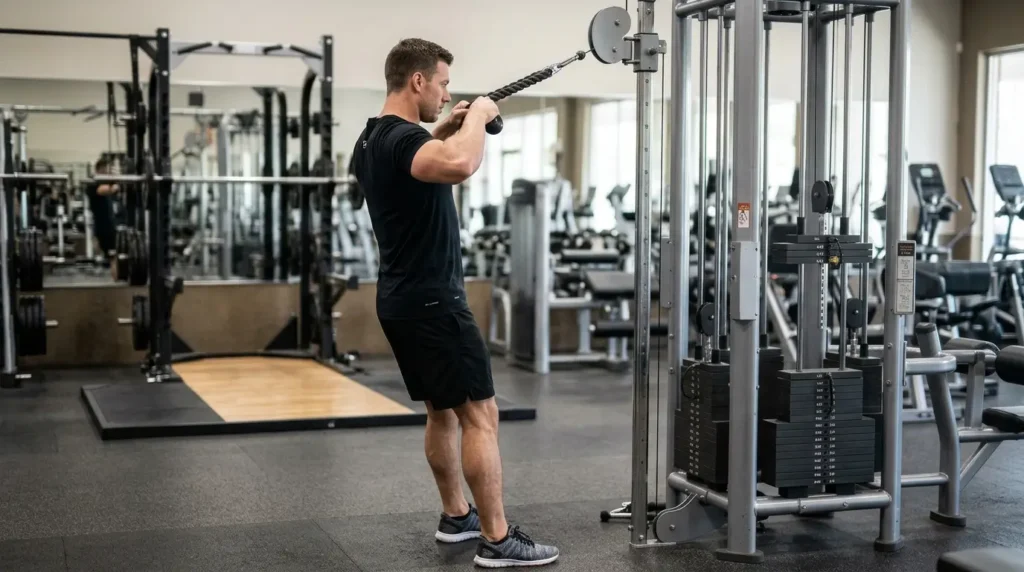
1. Cable Face Pull
Why: It strengthens the rear shoulders and upper back, which many desk-sitters neglect. For a similar target, try rear delt raises.
How to do it:
- Attach a rope to a pulley set near upper-chest or face height.
- Hold the ends with palms facing each other. Step back 12 to 24 in (30 to 61 cm) until the stack lifts slightly.
- Stand tall with knees soft and ribs down.
- Pull the rope toward your face, splitting the ends apart as your elbows travel out and back.
- Pause for one second, then return slowly over three seconds.
Feel: The back of your shoulders and between your shoulder blades. Your neck should stay relaxed.
Start with: about 10 to 30 lb (4.5 to 14 kg) [VERIFY by machine]. Do: 2 to 3 sets of 12 to 15 reps.
Easier: Use a lighter weight and a shorter pull. Harder: Hold the end position for three seconds.
Common Mistake: Leaning back and yanking with your lower back. Instead, lower the weight and keep your ribs stacked over your hips.
2. Standing Cable Chest Fly
Why: It keeps tension on the chest where dumbbells often go slack. Pair it with our list of chest-building exercises. Also, use it among bench press alternatives if a barbell bothers your shoulders.
How to do it:
- Set both pulleys at about shoulder height with single handles.
- Stand in the middle in a split stance with one foot forward.
- Hold a handle in each hand with a small bend in your elbows.
- Bring your hands together in a wide hugging arc in front of your chest.
- Open your arms slowly until you feel a comfortable stretch across your chest.
Feel: A squeeze through the middle of the chest, not a pinch in the front of the shoulder.
Start with: about 10 to 20 lb (4.5 to 9 kg) per side [VERIFY]. Do: 2 to 4 sets of 10 to 15 reps.
Easier: Do one arm at a time or use a shorter range. Harder: Move the pulleys lower and fly upward, or pause one second at the squeeze.
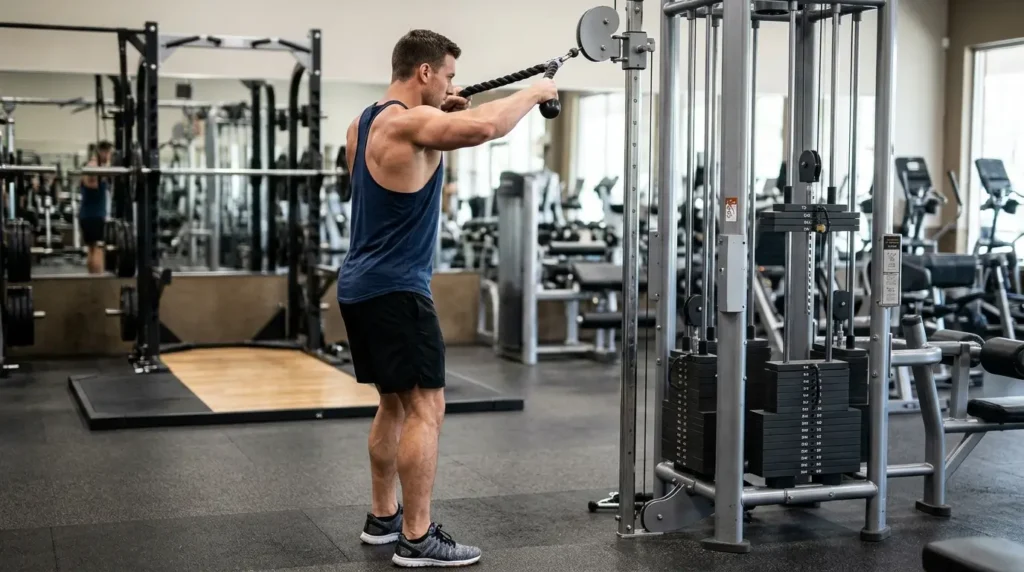
3. Pallof Press
Why: It trains your core to resist twisting, a skill you use when you swing, carry, or throw.
How to do it:
- Set a pulley at chest height with a single handle.
- Stand sideways to the stack, feet about 12 to 18 in (30 to 46 cm) apart.
- Hold the handle at your chest with both hands.
- Press your hands straight out until your arms are long. Do not let your torso rotate.
- Hold for two seconds, then bring your hands back to your chest.
Feel: Your obliques and abs working hard to keep you from turning toward the machine.
Start with: about 10 to 20 lb (4.5 to 9 kg) [VERIFY]. Do: 2 to 3 sets of 8 to 12 reps per side.
Easier: Kneel and shorten the press. Harder: Step further from the stack, or press from a single-leg stance.
4. Cable Pull-Through
Why: It teaches the hip hinge, which trains your glutes and hamstrings with little strain on your back.
How to do it:
- Set a pulley low with a rope attachment.
- Face away from the stack and reach between your legs to hold the rope.
- Walk forward a few steps so the cable has tension. Stand with feet slightly wider than hips.
- Push your hips back with a flat back and soft knees, letting the rope travel behind you.
- Drive your hips forward and squeeze your glutes at the top.
Feel: A stretch in your hamstrings and a strong squeeze in your glutes at the top.
Start with: about 20 to 40 lb (9 to 18 kg) [VERIFY]. Do: 3 sets of 10 to 15 reps.
Easier: Use a very light weight and a shorter hinge. Harder: Add a pause at the bottom or use a staggered stance.
A Full-Body Cable Workout
This routine puts the main cable machine benefits to work in about 40 to 50 minutes.
Warm-Up
First, spend 5 minutes on brisk walking or easy cycling, which may lower your injury risk, as Mayo Clinic advises. Then do one light set of your first exercise.
The Workout
| Order | Exercise | Sets | Reps | Rest |
|---|---|---|---|---|
| 1 | Cable pull-through | 3 | 10-15 | 90 sec |
| 2 | Seated cable row | 3 | 8-12 | 90 sec |
| 3 | Standing cable chest fly | 3 | 10-15 | 60-90 sec |
| 4 | Face pull | 2-3 | 12-15 | 60 sec |
| 5 | Triceps rope pushdown | 2-3 | 10-15 | 60 sec |
| 6 | Pallof press | 2-3 | 8-12 per side | 45-60 sec |
Weekly Plan and Versions
Next, do this workout two or three nonconsecutive days a week, such as Monday, Wednesday, and Friday. In addition, a short walk on off days helps you recover.
Beginner version: Do two sets per exercise, drop the Pallof press, and train twice a week.
Advanced version: Do four sets on the main lifts, add single-arm rows, and finish with a woodchop superset.
Where Cable Machines Fall Short
Even with strong cable machine benefits, there are limits. Honesty matters more than hype, so here they are:
- First, heavy lower-body lifting. Cables cannot match a barbell squat or deadlift for loading the legs and hips.
- Second, weight jumps. Some stacks climb in large steps, which is awkward for small muscles like rear delts.
- Third, machine differences. Pulley ratios and friction vary, so numbers do not transfer between gyms.
- Finally, space and cost. A full functional trainer takes room and a bigger budget. Therefore, many home lifters start smaller. For compact options, compare adjustable dumbbells with a cable station.
Safety Notes
Form and Equipment Checks
Use a stance that lets you resist the pull without leaning or twisting. Also, keep a slight bend in your joints, and never let the handle snap back. In addition, inspect cables and attachments for fraying before each session.
When to See a Professional
Check with a doctor or physical therapist before training if you have joint pain, a recent injury, osteoporosis, balance problems, or a heart or blood pressure condition. Also, stop if you feel sharp pain, dizziness, or chest discomfort.
Setup and Buying Tips
Before you buy, decide which cable machine benefits matter most to you. For example, if you want rotation and single-arm work, a dual-pulley station is a better fit than a single stack. Then use this checklist:
- Space: Measure the footprint plus room to step back, and check your ceiling height.
- Pulley travel: Look for a wide range of height settings.
- Stack size and steps: Confirm total weight and the size of each jump [VERIFY with the manufacturer].
- Attachments: At minimum, get a rope, straight bar, and single handles.
- Warranty and service: Read the manufacturer’s page before buying.
Meanwhile, if you want an all-in-one station, our guide to the best Bowflex home gym compares complete systems.
FAQ
Are cable machines better than free weights?
Neither is better for every goal. Cables give smooth tension and flexible angles, which suit isolation work and rotation. Free weights demand more balance and suit heavy compound lifts like squats and deadlifts. Because muscle growth tracks effort and weekly sets, most lifters do best using both.
Is a cable machine good for beginners?
Yes, in most cases. Pin-select weights make loads easy to adjust, and smooth resistance helps you focus on form instead of balance. Start light, learn two or three movements, and use slow reps. Mayo Clinic also suggests that people new to strength training work with a trainer to learn good technique.
How often should I use a cable machine?
Most adults do well training each muscle group two to three days a week, which fits the ACSM range for beginners and the CDC’s two-day minimum. Leave at least one rest day between hard sessions for the same muscles. Cable work is flexible, so you can train upper body, lower body, or full body.
How much weight should I use on a cable machine?
Choose a weight where the last two reps feel hard, but your form stays clean. ACSM suggests beginners use loads around an 8 to 12 repetition maximum. Once you can do one or two extra reps, add 2 to 10 percent. Remember that stack numbers differ between machines.
Are cable machines safe for joints?
Cable machines are generally low-impact, and you can adjust the angle to find a pain-free path. Still, any exercise can irritate a sore joint. Use light loads, control the lowering phase, and stop if you feel sharp pain. Check with a doctor or physical therapist before training through pain or after an injury.
Is a cable machine worth buying for a home gym?
It can be, if you have the space and budget and want many exercises from one station. A functional trainer replaces a lot of dumbbells and bands for pulling and rotation moves. If your room is small, adjustable dumbbells or resistance bands may offer better value.
Conclusion
In short, the real cable machine benefits are control, variety, and joint-friendly loading, not magic. Use cables for rows, flys, pushdowns, face pulls, and core work. In addition, pair them with squats, deadlifts, or leg presses when you want maximum leg strength. Aim for two to three sessions per week, add load slowly, and let consistent effort do the rest.
Therefore, pick two or three moves from this guide and try them in your next workout. Start light, move slowly, and add weight only when your form stays clean.
