Adjustable vs Fixed Dumbbells: Which Should You Buy?
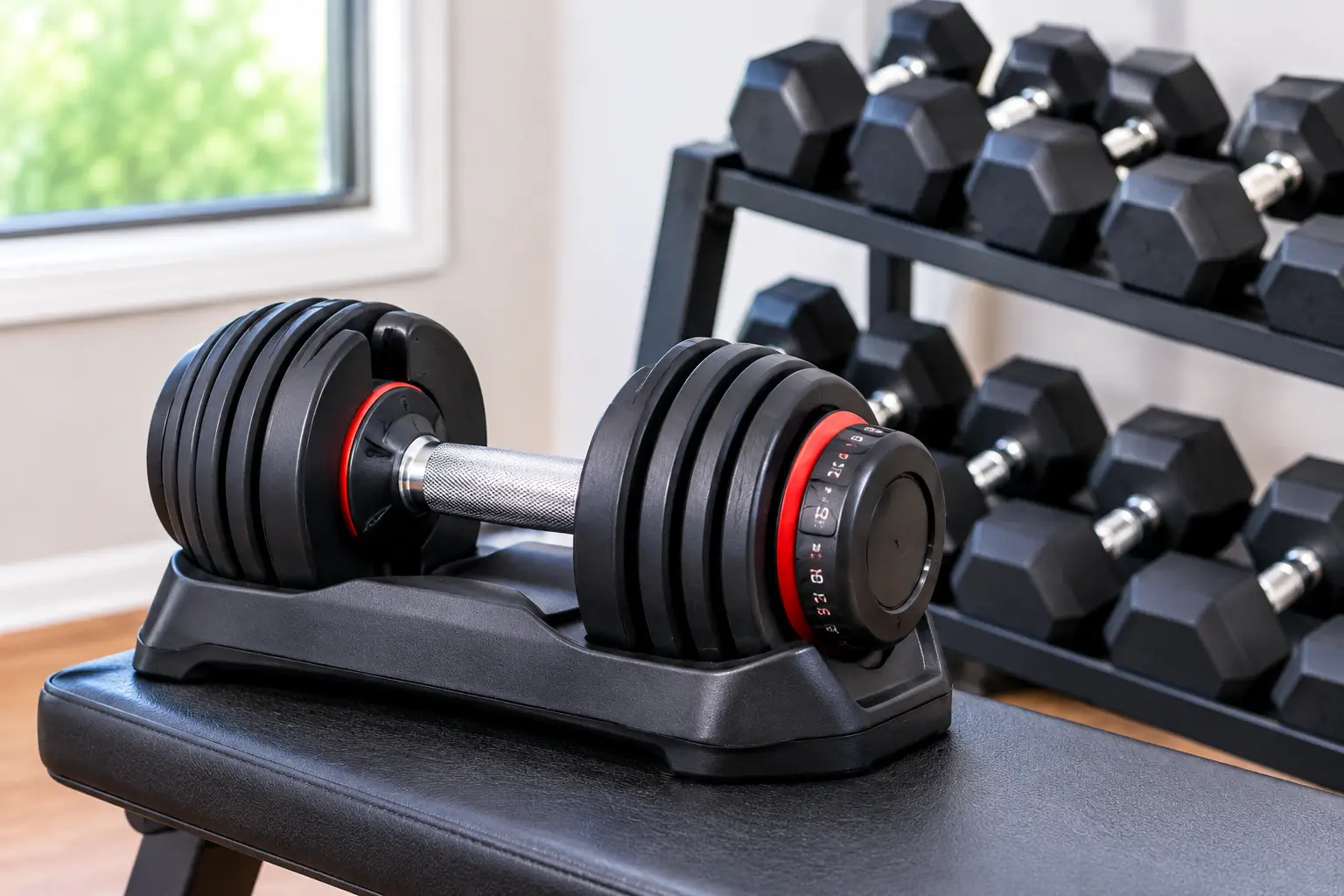
Adjustable vs. fixed dumbbells is the first big equipment choice in almost every home gym. One type replaces an entire rack with a single pair. The other gives you the fast, solid feel of a commercial gym. However, neither wins for everyone, so your space, budget, and training goals decide the answer.
This guide compares adjustable v. fixed dumbbells on space, cost, weight range, speed, feel, and durability. In addition, you will get a buyer’s checklist and a full-body workout that works with either type. By the end, you will know which one fits your home.
Quick Answer: Adjustable vs fixed dumbbells comes down to space and speed. Choose adjustable if space is tight and you want many weights from one purchase. Choose fixed if you want instant changes, a gym feel, and heavier loads. Therefore, most beginners and small-space lifters do best with adjustable sets.
Adjustable vs Fixed Dumbbells: Side-by-Side Comparison
| Factor | Adjustable Dumbbells | Fixed Dumbbells |
|---|---|---|
| Space needed | Very small (one pair plus a tray) | Large (a rack plus many pairs) |
| Upfront cost | Moderate to high, one purchase | Low per pair, high for a full set |
| Typical weight range | About 5–52.5 lb (2.3–23.8 kg) on popular dial models; some reach 80–90 lb (36–41 kg) [VERIFY] | Any weight you buy, often 100+ lb (45+ kg) |
| Weight jumps | Usually 2.5–5 lb (1.1–2.3 kg) | Set by what you buy, often 5 lb (2.3 kg) |
| Switching speed | A few seconds per change | Instant |
| Feel and balance | Longer, can feel bulky | Compact and consistent |
| Durability | Moving parts can wear | Very durable, few failure points |
| Best for | Apartments, beginners, budget builders | Dedicated gym spaces, heavy lifters |
What Is the Difference Between Adjustable and Fixed Dumbbells?
How Fixed Dumbbells Work
Fixed dumbbells have one weight built in. For example, a 20 lb (9 kg) dumbbell stays 20 lb for life. As a result, you buy as many pairs as you need and store them on a rack.
Fixed dumbbells also come in different shapes. Our guide to hex dumbbells vs round dumbbells explains which shape suits which space. Knowing the shapes makes the adjustable vs fixed dumbbells choice much easier.
How Adjustable Dumbbells Work
Adjustable dumbbells let you change the load on one handle. You do this with a dial, a pin, a lever, or by sliding plates on and locking them with collars. Consequently, one pair stands in for many.
Common Adjustable Designs
Three adjustable designs are common:
- Dial or selector systems: You twist a dial, lift the handle from its cradle, and only the chosen plates come with it.
- Pin-select systems: You move a pin to choose how many weights attach to the handle.
- Spin-lock systems: You thread plates onto a bar and tighten collars by hand. These are cheap, but they are slow.
Key Differences Between Adjustable vs Fixed Dumbbells
Space and Storage
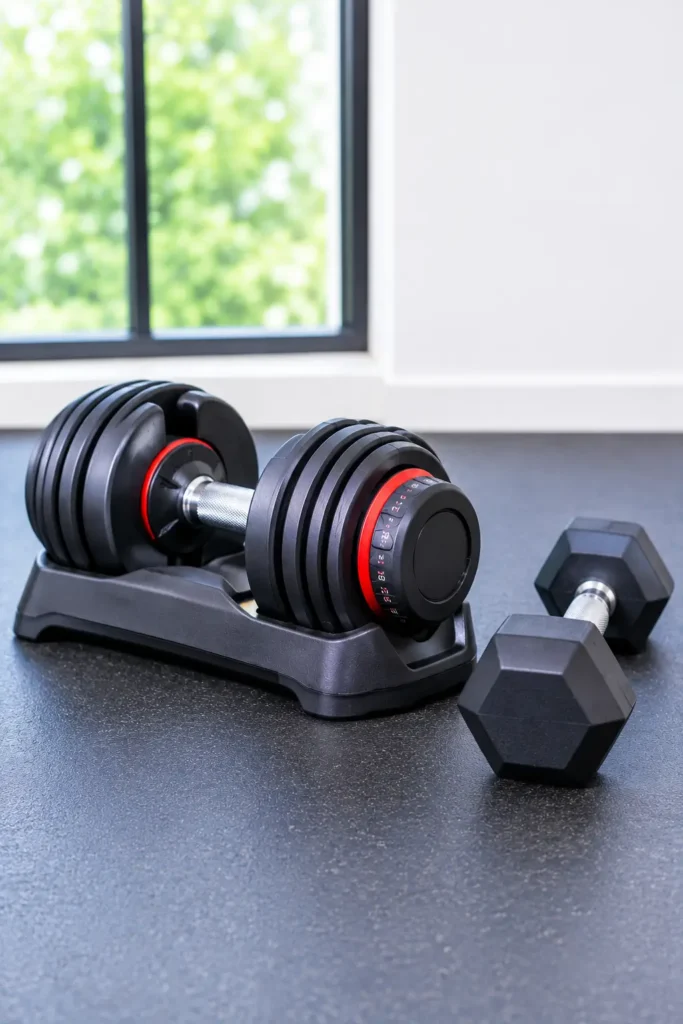
In the adjustable vs fixed dumbbells debate, space is often the deciding factor. A popular dial model measures about 16.9 inches long, 8.3 inches wide, and 9 inches tall (43 × 21.2 × 22.8 cm) per dumbbell, according to the Bowflex SelectTech 552 product page. Even so, that small footprint holds 15 weight settings.
A full fixed set, on the other hand, needs far more room. Nine pairs from 10 to 50 lb (4.5 to 22.7 kg) call for a multi-tier rack. Plan on a wall section roughly the size of a bookshelf.
If you live in a small place, adjustable sets make the most sense. Likewise, our list of the best apartment workout equipment covers other compact gear that pairs well with them.
Winner for space: Adjustable.
Weight Range and Weight Jumps
Weight range is where fixed dumbbells fight back. For instance, many popular dial sets stop at 52.5 lb (23.8 kg) per hand, according to Bowflex’s official page. That is plenty for curls, lateral raises, and rows. Still, a stronger lifter may outgrow it on lunges, Romanian deadlifts, or heavy presses.
Some adjustable systems go higher, including 80 and 90 lb (36 and 41 kg) models [VERIFY on the manufacturer’s page]. Even so, fixed dumbbells have no real limit except your budget and floor space.
Weight jumps matter too. On shoulder raises and curls, a 5 lb (2.3 kg) jump can be a big leap. Our guide to the seated bent-over rear delt raise shows why small increases help on lighter lifts. In addition, many adjustable sets offer 2.5 lb (1.1 kg) steps at the light end, which most fixed sets do not.
So why does range matter at all? A systematic review and meta-analysis in the Journal of Strength and Conditioning Research found greater one-rep-max strength gains with high-load training. However, muscle size changed similarly across load ranges. Similarly, a 2018 paper in Frontiers in Physiology notes that low-load training taken close to failure can grow muscle in a comparable way.
In plain terms, you can build muscle with lighter dumbbells. You simply need enough range to keep each set challenging.
Winner for light-to-moderate training and fine jumps: Adjustable. Winner for heavy lifting: Fixed.
Speed and Workout Flow
Fixed dumbbells are faster. You set down one pair and grab another. Because there is no dial to check, nothing slows you down.
Adjustable dumbbells, in contrast, usually take three to ten seconds per change. That sounds small, yet it adds up during supersets, circuits, and drop sets. As a result, you may lose a minute or two per workout if you change weights on every exercise.
Coach’s Tip: Group exercises that use the same weight. For example, do goblet squats and Romanian deadlifts back to back on one setting. This cuts dial changes and keeps your rest times honest.
Winner for speed: Fixed.
Feel, Balance, and Handle Design
Fixed dumbbells feel like gym dumbbells because they are. The weight sits close to the handle, and the head is compact. Therefore, they work well on exercises where the dumbbell rests against your body, such as hammer curls, floor presses, and goblet squats.
Adjustable dumbbells are longer because they must carry several plates. As a result, some models feel slightly front-heavy at light settings. The extra length can also bump your forearms during chest presses or knock your thighs during lunges.
Handles matter as well. Check the diameter, the grip texture, and whether the handle spins in your hand. Above all, your grip should feel secure, even with sweaty palms.
Winner for feel: Fixed.
Durability and Safety
Fixed dumbbells have no moving parts. Consequently, rubber-coated and cast-iron versions can last for decades with basic care. Dropping them from hip height is still not ideal, but they tolerate more abuse.
Adjustable dumbbells use locks, pins, or dials. Those parts can wear, loosen, or jam. In fact, one independent review lists “not meant to be dropped” as a limit of a popular model [VERIFY against the manual], so always read the instructions for your set.
Safety comes down to the locking mechanism. Before every set, confirm the dial or pin is fully seated on both ends. Then check that the handle lifts out with only the plates you chose. Otherwise, a wrong selection can leave plates behind or shift mid-rep.
Common Mistake: Lifting an adjustable dumbbell before checking that both ends are set to the same weight. An uneven load can twist your wrist or tip the dumbbell mid-rep. Instead, check both dials every time, even when you are rushing.
Winner for durability: Fixed.
Exercise Suitability
Both types handle nearly every dumbbell exercise. Goblet squats, rows, presses, curls, lunges, and carries all work fine.
Where do differences show up? First, heavy single-arm work, like Bulgarian split squats, Romanian deadlifts, and loaded carries, can outgrow a 52.5 lb (23.8 kg) cap. Second, drop sets work better with fixed dumbbells if you have a rack of pairs nearby.
On the other hand, small-step exercises favor adjustable sets. For example, lateral raises, rear delt flyes, and curls benefit from 2.5 lb (1.1 kg) steps. Our comparison of the hammer curl vs bicep curl shows how grip changes the load on your arms. For heavy trap work, see our dumbbell shrugs vs barbell shrugs breakdown.
When to Choose Adjustable Dumbbells
Adjustable dumbbells are the smart pick in several situations. First, you may share a small space such as a bedroom, apartment, or garage corner. Second, you may want many weights without buying a dozen pairs. Third, you may be new to lifting and unsure how heavy you will go.
They also suit people who train alone and like variety. For example, you can go light for shoulders, medium for rows, and heavier for squats, all with one pair. Moreover, if you move often, one pair is far easier to carry than a rack of iron.
For many people, the adjustable vs. fixed dumbbells decision ends here. Beginners can add 2.5 lb (1.1 kg) as they improve. Meanwhile, they avoid paying for pairs they may rarely use.
Choose adjustable if most of these are true:
- Your training space is small, about 50 square feet (4.6 square meters) or less [VERIFY as a rough guide]
- You plan to lift under about 50 lb (22.7 kg) per hand for now
- You want one purchase instead of many
- You prefer neat, compact storage
- You rarely run fast circuits
If you like the idea of a bigger system, our complete overview of the best Bowflex home gym covers other all-in-one options.
When to Choose Fixed Dumbbells
Fixed dumbbells shine when you have room and want a no-fuss gym feel. In particular, they are the best option for lifters who already move heavy weight. They also suit people who run fast circuits, train with a partner, or work out in a garage with a rack.
Fixed sets are also the simple choice for long-term durability. Because nothing can slip or stay behind, you can focus on the lift. In a household with several lifters, grabbing the right pair quickly also saves time and arguments.
When you weigh adjustable vs. fixed dumbbells for a serious training space, fixed often comes out ahead. Choose fixed if most of these are true:
- You already lift more than 50 lb (22.7 kg) per hand on some exercises
- You have a dedicated corner or room with floor space
- You use fast supersets, drop sets, or circuits
- You want a feel close to a commercial gym
- You can afford to buy pairs gradually
A full gym often includes a rack and a bench too. If you are building toward that, our guide to the best squat racks with pull-up bars shows how a rack can anchor your space.
Cost Comparison: Adjustable vs Fixed Dumbbells
Price by Type
Cost makes the adjustable vs fixed dumbbells debate interesting. At first glance, one adjustable pair looks expensive. However, the picture changes once you price a full run of fixed pairs.
| Option | What you get | Typical price range |
|---|---|---|
| Popular dial set (5–52.5 lb / 2.3–23.8 kg pair) | 15 weight settings in one pair | About $350–$500 [VERIFY] |
| Budget spin-lock set | Bar, plates, and collars | About $60–$150 [VERIFY] |
| Premium adjustable (heavier range) | Higher cap, sturdier feel | About $500–$800+ [VERIFY] |
| Single fixed pairs (5–25 lb / 2.3–11.3 kg) | One pair per weight | Low per pair, adds up fast [VERIFY] |
| Full fixed set (10–50 lb / 4.5–22.7 kg) | About nine pairs plus a rack | Often $600–$1,500+ [VERIFY] |
Prices change often, so check the retailer before you buy. In general, a mid-range adjustable pair costs less than a similar range of fixed dumbbells plus a rack. That said, fixed dumbbells can cost less if you only need two or three weights.
Cost per Pound and Warranty
Consider cost per pound as well. Fixed dumbbells usually win on price per pound at heavier weights. In contrast, adjustable sets win on price per usable weight setting, because one pair gives you many options.
Finally, factor in the warranty. The manufacturer’s site lists a two-year parts warranty for one popular dial set [VERIFY current terms]. Fixed dumbbells, however, often carry little or no warranty because little can break [VERIFY].
Cost verdict: Adjustable wins for small, varied setups. Fixed wins for heavy or minimal sets.
How to Choose Between Adjustable vs Fixed Dumbbells: Buyer’s Checklist
Space, Weight, and Growth
Use this checklist before you click “buy.”
- Measure your space. Check floor area, ceiling height for overhead presses, and where a rack or tray will sit.
- Estimate your starting weights. Many beginners start with 10–25 lb (4.5–11.3 kg) per hand on presses and rows. Squats and deadlifts, however, run heavier.
- Plan for growth. Pick a range that covers where you will be in 6–12 months. The ACSM position stand on resistance training concludes that healthy adults should do progressive resistance training. Therefore, your tools should let you add load over time.
- Check weight jumps. Smaller steps help with shoulder and arm work.
Build Quality and Budget
- Inspect the locking system. Look for secure locks and clear weight labels.
- Test the handle. Your hand should wrap comfortably, with a grip that does not slip.
- Read the warranty and manual. Look for drop limits and covered parts.
- Set your budget. Include storage such as a stand or rack.
Also think about how often you will train. The CDC guidelines for adults call for muscle-strengthening activity on at least two days a week. Both dumbbell types meet that easily, so pick the one you will actually use.
How We Compared Them
This comparison uses practical training criteria rather than lab testing. Specifically, we looked at space footprint, weight range, increment size, change speed, handle feel, durability, safety, and long-term cost. In addition, we cite manufacturer pages for specs and peer-reviewed research for training principles only.
Because specs and prices change, recheck every figure marked [VERIFY] on the maker’s site before you buy.
Full-Body Workout for Adjustable vs Fixed Dumbbells
The Workout
This simple routine works with either type, so it is a good way to test your choice. It takes about 40–50 minutes.
| Exercise | Sets | Reps | Rest |
|---|---|---|---|
| Goblet squat | 3 | 8–12 | 90 sec |
| One-arm dumbbell row | 3 | 8–12 per side | 60–90 sec |
| Dumbbell floor press | 3 | 8–12 | 90 sec |
| Dumbbell Romanian deadlift | 3 | 8–12 | 90 sec |
| Dumbbell overhead press | 2–3 | 8–12 | 90 sec |
| Hammer curl | 2 | 10–15 | 60 sec |
| Suitcase carry | 2 | 30–40 sec per side | 60 sec |
Weight guidance: Pick a load that leaves about two reps in reserve on every set. The last reps should feel hard but controlled. Then, when you hit the top of the rep range on every set, add 2.5–5 lb (1.1–2.3 kg).
Form Cues
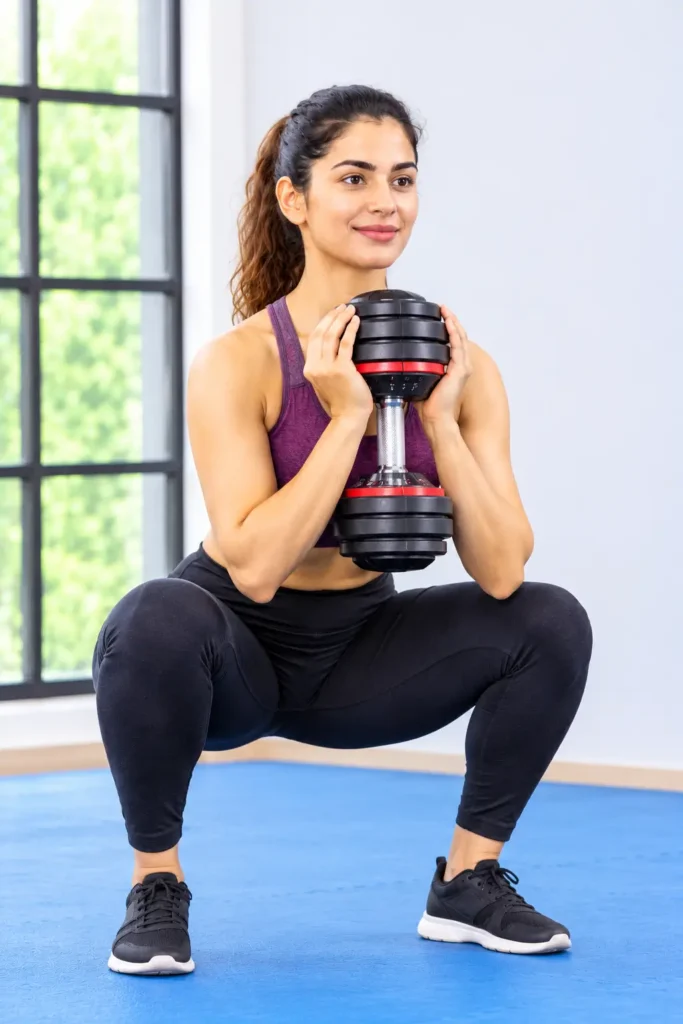
- Goblet squat: Hold the dumbbell at your chest with elbows tucked. Next, sit between your hips, keep your chest tall, and push the floor away. You should feel it in your quads and glutes.
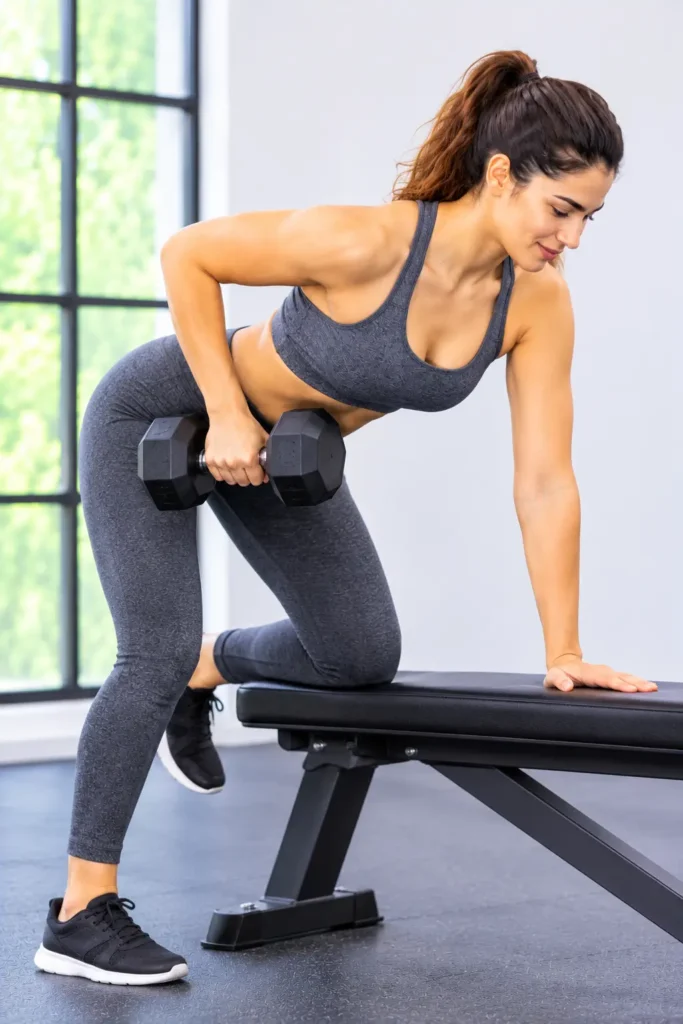
- One-arm row: Brace a hand on a bench. Then pull your elbow toward your hip, and pause briefly at the top. You should feel your lats and mid-back.
- Floor press: Lie on the floor with your upper arms touching the ground at the bottom. After that, press up until your arms are straight. Your chest and triceps do the work.
- Romanian deadlift: Keep your knees, push your hips back, and slide the dumbbells down your legs. You should feel a stretch in your hamstrings.
- Overhead press: Brace your core and press straight up. Do not arch your lower back.
Easier and Harder Versions
Easier version (regression): Do 2 sets with lighter weight. In addition, swap the overhead press for a seated press or lateral raise. Practice the Romanian deadlift hinge with no weight first.
Harder version (progression): Add a set, slow the lowering phase to three seconds, or move to single-leg work like split squats. Furthermore, add a rep or two each week before adding weight.
As you can see, the adjustable vs. fixed dumbbells choice changes very little about the movements themselves. For more ways to use the same pair, see our leg and shoulder workout.
Setup and Care Tips
Good care keeps either type working well.
- Store them off the floor. Use the tray or a rack to prevent rolling and chipping.
- Lower, don’t drop. Set them down under control, even if the brand allows light drops.
- Wipe them down. Sweat can corrode metal and wear grips. Our guide on how to clean rubber dumbbells covers safe cleaning steps.
- Check locks often. For adjustable sets, look for loose plates or sticky dials every few weeks.
- Use a mat. A rubber floor mat protects your floor and cuts noise.
Lastly, if you have an injury, joint pain, or a medical condition, check with a doctor or physical therapist before starting a new lifting routine.
Frequently Asked Questions
Can you build muscle with adjustable vs fixed dumbbells?
Yes, you can build muscle with either type. Research suggests muscle size changes similarly across a wide range of loads when sets end close to failure. However, the real limit is maximum weight. If your adjustable set stops at 52.5 lb (23.8 kg), heavy lower-body work may eventually outgrow it.
How heavy should adjustable dumbbells go?
Most beginners and intermediates do well with a top weight around 50 lb (22.7 kg) per hand. That covers presses, rows, and curls for a long time. However, if you already lunge or deadlift heavier, look at sets reaching 80–90 lb (36–41 kg) [VERIFY].
Are adjustable dumbbells safe to use?
They are safe when used as directed. First, confirm that both ends are set to the same weight and fully locked. Then read the manual for drop limits, and never use a damaged dial or pin. In contrast, fixed dumbbells are simpler because nothing can come loose.
Do adjustable dumbbells break easily?
Well-built sets last for years. Still, they have more parts that can wear out than fixed dumbbells. For example, dropping them, ignoring a loose lock, or storing them somewhere damp can shorten their life. Therefore, check the warranty and follow the care steps in the manual.
Is it cheaper to buy fixed or adjustable dumbbells?
It depends on how many weights you need. A few fixed pairs can cost less than one adjustable set. However, a full run of fixed dumbbells plus a rack usually costs more than a single mid-range adjustable pair [VERIFY current prices].
What dumbbell weights should a beginner buy?
Many beginners start with light-to-moderate pairs, such as 10, 15, 20, and 25 lb (4.5, 6.8, 9, and 11.3 kg). An adjustable set covers all of these in one purchase. Later, you can add heavier fixed pairs for squats and deadlifts.
Conclusion: Adjustable vs Fixed Dumbbells, Which Should You Buy?
The adjustable vs fixed dumbbells decision comes down to space, speed, and strength goals. Adjustable dumbbells save space, offer small weight jumps, and replace many pairs with one purchase. In contrast, fixed dumbbells win on speed, feel, durability, and heavy loading.
Here is a clear recommendation. If you live in a small space or are just starting out, buy a quality adjustable set and grow into it. On the other hand, if you have room, already lift heavy, or run fast circuits, build a fixed set one pair at a time. In fact, many lifters end up with both: an adjustable pair for variety and a few heavy fixed pairs for the big lifts.
Whichever you pick, consistency beats equipment. Train at least twice a week, add weight slowly, and keep your form clean.
