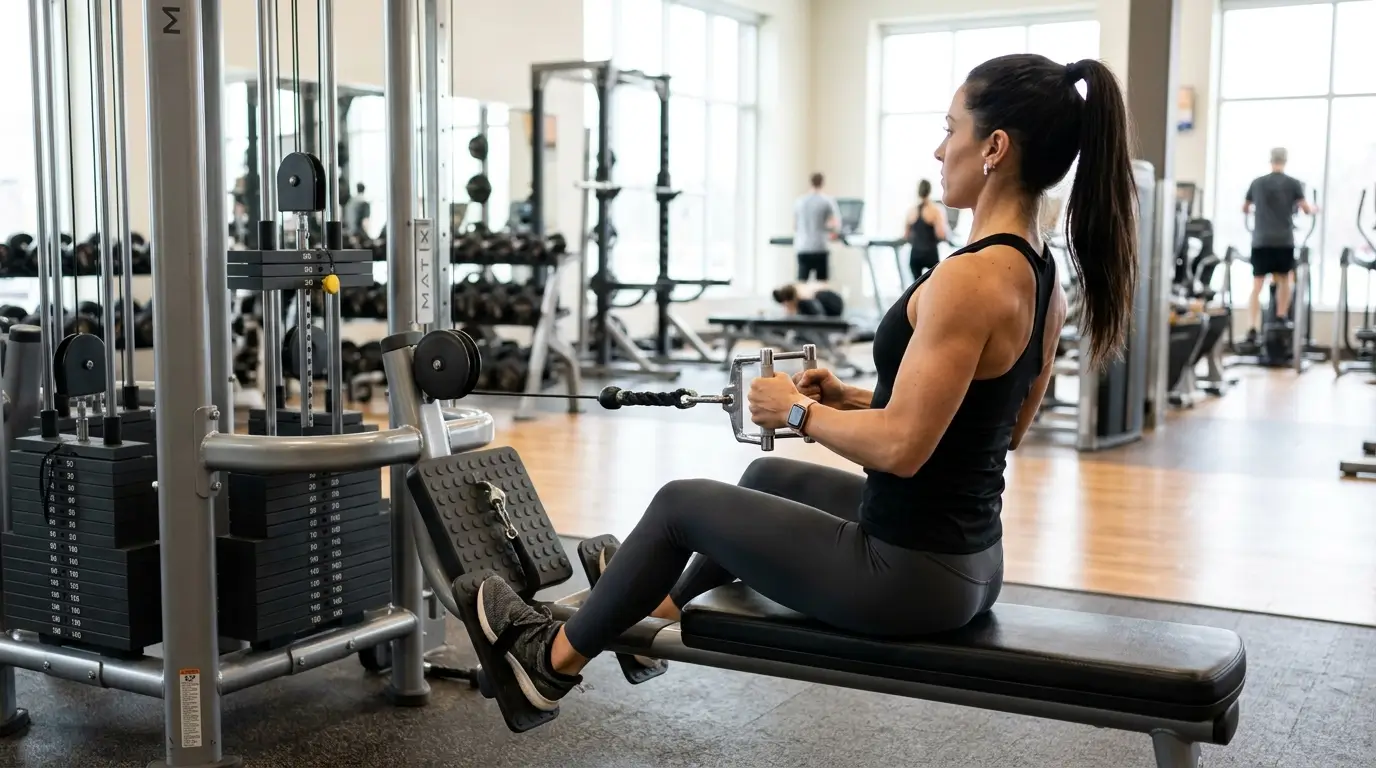
The best back cable exercises give you smooth, steady tension from the first inch of each rep to the last. A cable stack lets you pull from many angles, change grips in seconds, and adjust the load in small steps. That makes cables a good fit for beginners and for lifters who want more control over their back training.
This guide covers 11 of the best back cable exercises, with form steps, sets, reps, and easier and harder versions of each. You will also get a full workout and a weekly plan. All you need is a cable station with a lat bar, a seated row handle, and a rope attachment.
Quick Answer
The best back cable exercises are the lat pulldown, seated cable row, single-arm cable row, straight-arm pulldown, and face pull. Together they train your lats, mid-back, and rear shoulders. Do 3 sets of 8–15 reps, rest 60–120 seconds, and pull with your elbows instead of your hands.
Back Muscles You Are Training
Your back is not one muscle. It is a group of muscles that pull, steady, and rotate your shoulder blades and spine. Knowing the main players helps you pick the right exercise.
- Latissimus dorsi (lats): the large wing-shaped muscles that pull your arms down and back.
- Rhomboids and middle trapezius: sit between your shoulder blades and squeeze them together.
- Lower trapezius: helps pull your shoulder blades down.
- Rear deltoids and teres major: assist most pulling moves.
- Erector spinae: run along your spine and keep your torso steady.
- Biceps and forearms: help on every pull, so expect some arm work too.
Why Cables Work Well for Back Training
Cables keep the resistance pointing the same way throughout the rep. In contrast, a dumbbell gets easier or harder depending on your body angle. This steady pull makes it easier to feel the target muscle.
Cables are also easy to adjust. You can move the pin one plate at a time, and many machines have a pulley that moves up and down. As a result, you can progress slowly and set up a movement for your body size. That flexibility is why the best back cable exercises suit both beginners and experienced lifters.
Finally, they support unilateral training, where you train one arm at a time. Because each side works alone, you can spot and fix strength gaps.
Back training also supports general fitness goals. Adults should do muscle-strengthening activity on at least two days a week, according to the CDC physical activity guidelines, and that guidance includes the back. If you are building a home setup, our best Bowflex home gym overview covers machines with pulley systems. Small-space lifters can also check the best apartment workout equipment.
Best Back Cable Exercises at a Glance
| # | Exercise | Main target | Best for | Difficulty |
|---|---|---|---|---|
| 1 | Lat pulldown | Lats | Width, pull-up progress | Easy |
| 2 | Seated cable row | Mid-back, lats | Thickness | Easy |
| 3 | Single-arm cable row | Lats, mid-back | Fixing side gaps | Medium |
| 4 | Straight-arm pulldown | Lats | Lat feel, less arm | Medium |
| 5 | Face pull | Rear delts, upper back | Shoulder balance | Easy |
| 6 | Neutral-grip pulldown | Lats | Comfortable grip | Easy |
| 7 | Single-arm lat pulldown | Lats | Control and range | Medium |
| 8 | Cable reverse fly | Rear delts, rhomboids | Upper back detail | Medium |
| 9 | Wide-grip cable row | Upper back | Rear delts, traps | Medium |
| 10 | Cable shrug | Upper traps | Neck and trap size | Easy |
| 11 | Cable pull-through | Glutes, hamstrings, spinal erectors | Hip hinge practice | Medium |
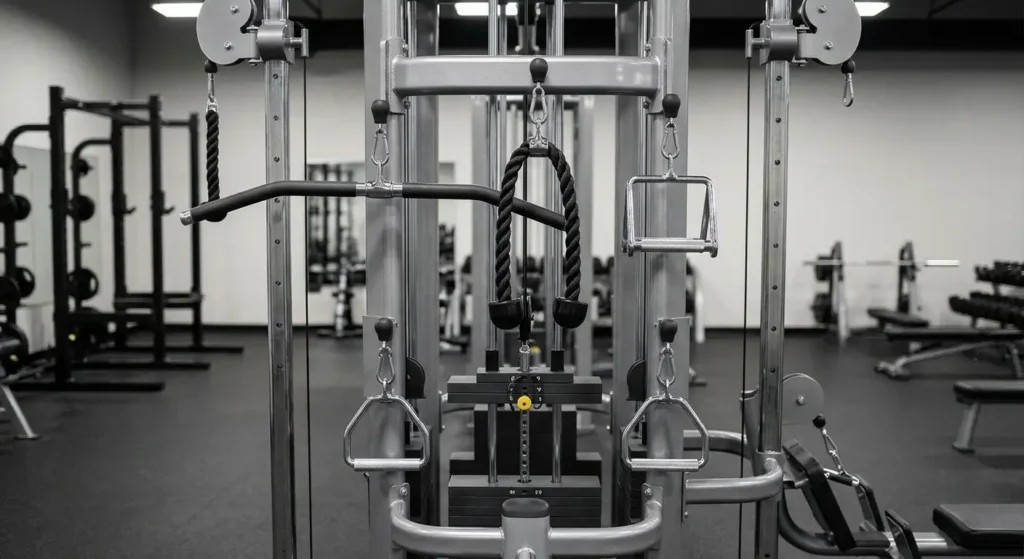
The 11 Best Back Cable Exercises
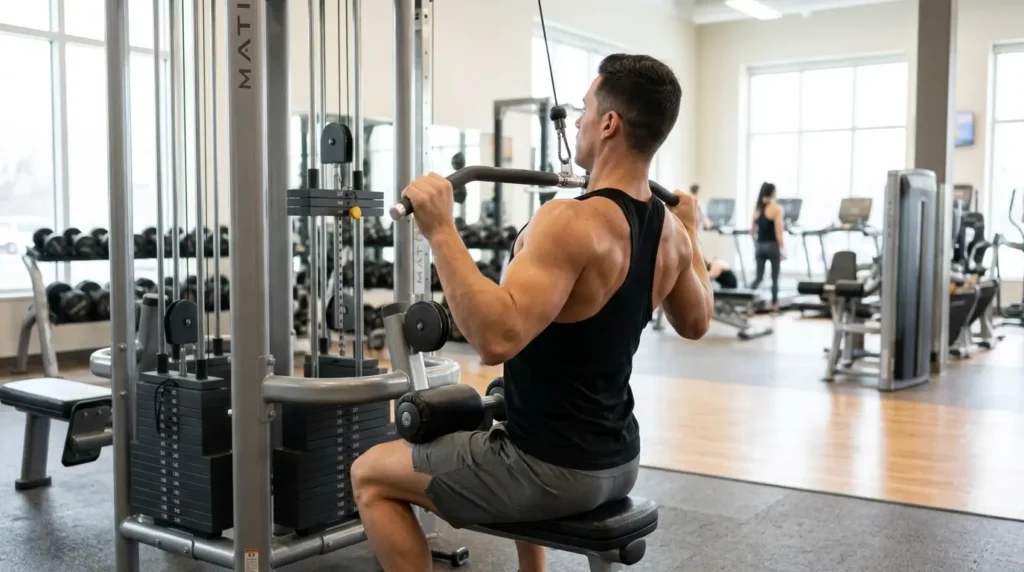
1. Lat Pulldown
The lat pulldown is the classic back cable exercise, and it is a good first pick. A study in the Journal of Strength and Conditioning Research found that a pronated (palms-away) grip produced greater lat activity than a supinated grip, whichever width was used. In addition, the study used a pull in front of the face, so skip behind-the-neck pulldowns.
How to do it:
- Sit with your thighs snug under the pad and your feet flat.
- Grab the bar slightly wider than your shoulders. For many people, that is roughly 24–30 inches (61–76 cm).
- Lean back a few degrees and lift your chest.
- Pull the bar to your upper chest by driving your elbows down and back.
- Squeeze for 1 second, then let the bar rise for about 3 seconds.
Sets and reps: 3–4 sets of 8–12 reps, resting about 90 seconds.
Easier: use a lighter weight and a shorter pull. Harder: add a 2-second pause at the bottom.
Coach’s Tip
Think “elbows to back pockets” instead of “hands to chest.” When you focus on your elbows, your lats usually take over from your arms. You should feel a stretch under your armpits at the top and a squeeze along your sides at the bottom.
2. Seated Cable Row
The seated cable row builds mid-back thickness. An EMG study of lat exercises reported that the seated row produced the highest activity in the middle trapezius and rhomboid group. It also showed one of the highest lat-to-biceps activation ratios, alongside the wide-grip pulldown [VERIFY authors and year].
How to do it:
- Sit with your feet on the platform and your knees slightly bent.
- Hold a V-handle with your arms straight and your torso tall.
- Pull the handle to your lower ribs, keeping your elbows close.
- Squeeze your shoulder blades together for 1 second.
- Return slowly for about 3 seconds, letting your shoulders reach forward slightly.
Sets and reps: 3 sets of 10–12 reps, resting 60–90 seconds.
Easier: use a lighter stack and a shorter range. Harder: add a 2-second squeeze or a slower return.
Common Mistake
Rocking your torso back and forth turns the row into a swing. Your lower back takes over and your back muscles do less. Fix it by lowering the weight, keeping your chest tall, and moving only your arms and shoulder blades.
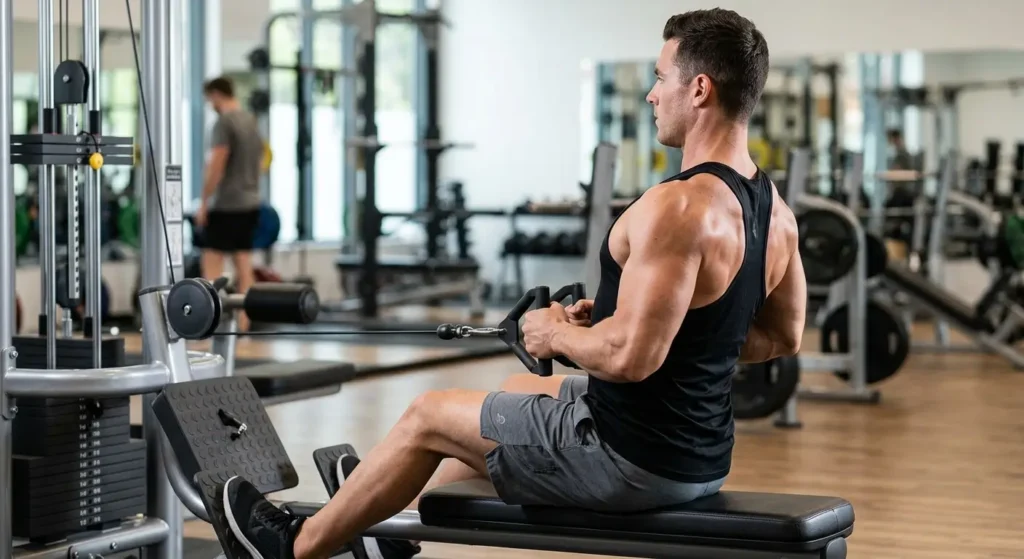
3. Single-Arm Cable Row
This move trains one side at a time. As a result, you can spot whether your right and left sides feel different. Use a D-handle set at about sternum height.
How to do it:
- Stand or sit facing the machine with a split stance.
- Grip the handle with your palm facing in.
- Pull your elbow past your ribs while keeping your hips square.
- Pause for 1 second, then return slowly.
Sets and reps: 3 sets of 10–12 reps per side, resting 60 seconds.
Easier: sit down and brace your free hand on your thigh. Harder: stand in a staggered stance and pause for 2 seconds.
4. Straight-Arm Pulldown
The straight-arm pulldown isolates your lats. Because your elbows stay mostly straight, your biceps tend to do less of the pulling. For that reason, many lifters feel it more clearly in their lats.
How to do it:
- Set a bar or rope at upper-chest height or higher.
- Step back, hinge slightly at the hips, and hold the bar with straight arms and soft elbows.
- Sweep the bar down in an arc toward your thighs.
- Squeeze your lats, then return with control.
Sets and reps: 3 sets of 12–15 reps, resting 60 seconds.
Easier: use a rope and lighter load. Harder: go single-arm or add a 2-second hold.
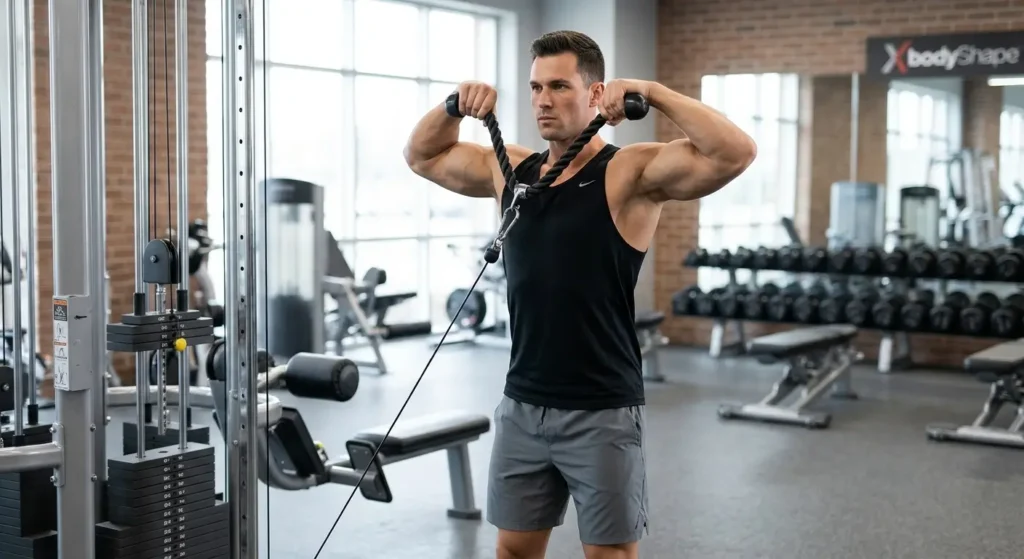
5. Face Pull
The face pull targets your rear delts and upper back. It is a common pick for desk workers who want more balanced shoulders. If you are shopping for posture aids as well, see our guide to the best posture correctors for rounded shoulders. Keep in mind that exercise and gear are not a cure for any condition.
How to do it:
- Attach a rope at about upper-chest to face height.
- Hold the ends with palms facing in and step back until the cable is tight.
- Pull the rope toward your face, splitting your hands apart near your ears.
- Keep your elbows high, squeeze for 1 second, then return slowly.
Sets and reps: 3 sets of 12–20 reps, resting 45–60 seconds. Start light, around 10–20 lb (4.5–9 kg).
Easier: lower the weight and shorten the range. Harder: add a 2-second pause at your ears.
6. Neutral-Grip (V-Bar) Pulldown
With a V-bar, your palms face each other. Many lifters find this grip comfortable for the shoulders and wrists. Meanwhile, a study on lat pulldown grip width found similar lat, trapezius, and infraspinatus activity across narrow, medium, and wide grips, while narrow and medium grips allowed slightly heavier loads [VERIFY authors and year].
How to do it:
- Attach a V-bar and sit with your thighs under the pad.
- Lean back slightly and pull the handle to your upper chest.
- Drive your elbows toward your ribs.
- Return slowly until your lats are stretched.
Sets and reps: 3 sets of 8–12 reps, resting 90 seconds.
Easier: lower the weight. Harder: use a 3-second lowering phase.
If you also train pull-ups, see what the pull-up works for a look at how the lat pulldown overlaps.
7. Single-Arm Lat Pulldown
This version lets you pull with a longer range of motion and helps with control. Use a D-handle on a high pulley.
How to do it:
- Sit or kneel facing the machine with your torso tall.
- Reach up and grab the handle with one hand.
- Pull your elbow down toward your hip.
- Pause, then return until your arm is fully extended.
Sets and reps: 3 sets of 10–12 reps per side, resting 60 seconds.
Easier: sit with a lighter load and use a shorter pull. Harder: slow the lowering to 4 seconds.
8. Cable Reverse Fly
The cable reverse fly trains your rear delts and the muscles between your shoulder blades. Set both pulleys at about shoulder height and cross the handles. For a dumbbell version, try our seated bent-over rear delt raise.
How to do it:
- Stand in the middle with your feet shoulder-width apart.
- Grab the left handle with your right hand and the right handle with your left hand.
- Keep slight elbow bends and pull your arms out to your sides.
- Squeeze for 1 second, then return slowly.
Sets and reps: 3 sets of 12–15 reps, resting 45–60 seconds. Use light weights, around 5–15 lb (2.3–7 kg).
Easier: use a lighter weight. Harder: add a pause at the back.
9. Wide-Grip Cable Row
This variation moves your elbows out and trains the upper back and rear delts. Use a straight bar or a wide row handle.
How to do it:
- Sit tall with your feet on the platform.
- Grip the bar a little wider than shoulder width.
- Pull the bar toward your upper chest, with elbows angled out.
- Squeeze your shoulder blades, then return slowly.
Sets and reps: 3 sets of 10–12 reps, resting 60–90 seconds.
Easier: use a lighter weight and keep the grip near shoulder width. Harder: add a 2-second squeeze.
10. Cable Shrug
Cable shrugs train your upper traps with steady tension. For a comparison, see our guide to dumbbell shrugs vs barbell shrugs.
How to do it:
- Set the pulley low and hold a straight bar in front of your thighs.
- Stand tall with your arms straight.
- Lift your shoulders toward your ears, then pause for 1 second.
- Lower slowly without rolling your shoulders.
Sets and reps: 3 sets of 12–15 reps, resting 60 seconds.
Easier: use a lighter weight. Harder: hold the top for 3 seconds.
11. Cable Pull-Through
The pull-through is a hip hinge. It mainly works your glutes and hamstrings, while your spinal erectors work to hold your back flat. Therefore, it is a helpful “backside” move, but it is not a lat exercise.
How to do it:
- Attach a rope to a low pulley and face away from the machine.
- Hold the rope between your legs and step forward until the cable is tight.
- Push your hips back with a flat back and soft knees.
- Drive your hips forward and squeeze your glutes at the top.
Sets and reps: 3 sets of 12–15 reps, resting 60 seconds.
Easier: use a lighter weight and a smaller hinge. Harder: add a 2-second pause at the bottom.
Sets, Reps, and Weight by Goal
Your goal sets the rep range and rest time. For beginners, the ACSM position stand on resistance training suggests loads in the 8–12 repetition-maximum range, and it recommends longer rests for heavier training. It also says untrained people should train major muscle groups 2–3 days a week. Use this table as a starting point.
| Goal | Sets | Reps | Weight guidance | Rest |
|---|---|---|---|---|
| Strength | 3–5 | 5–8 | Heavy; last reps feel hard | 2–3 min |
| Muscle size | 3–4 | 8–12 | Moderate; 1–2 reps in reserve | 1–2 min |
| Endurance | 2–3 | 15–20 | Light; smooth reps | 30–60 sec |
For beginners, start with a weight you can pull for 12 clean reps. On pulldowns and rows, that is often about 20–40 lb (9–18 kg), but this varies a lot. Use a tempo of about 1 second pulling and 3 seconds returning.
How to Build a Workout with the Best Back Cable Exercises
Order matters. The ACSM position stand also recommends doing large-muscle, multi-joint exercises before small-muscle, single-joint ones. Therefore, start with pulldowns and rows, then move to isolation work.
Warm-up (5–8 minutes): a 0.25-mile (0.4 km) brisk walk or easy rowing, then 10 band pull-aparts and 10 light face pulls.
| Order | Exercise | Sets | Reps | Rest |
|---|---|---|---|---|
| 1 | Lat pulldown | 4 | 8–12 | 90 sec |
| 2 | Seated cable row | 3 | 10–12 | 90 sec |
| 3 | Single-arm cable row | 3 | 10–12 per side | 60 sec |
| 4 | Straight-arm pulldown | 3 | 12–15 | 60 sec |
| 5 | Face pull | 3 | 15 | 45 sec |
| 6 | Cable curl (optional) | 2 | 12 | 45 sec |
If you want to finish with arms, our barbell curl vs cable curl comparison helps you pick one. Your biceps assist every pull, so you may also want to read about the hammer curl vs bicep curl.
Weekly Plan and Progression
- Beginners: train back twice a week with at least 48 hours between sessions. Use 2 sets per exercise for the first two weeks.
- Intermediate lifters: train back 2–3 times a week and rotate the exercises to include different angles.
- Progression: pick a rep range, such as 8–12. When you hit 12 reps on every set with clean form, add one plate or about 5 lb (2.3 kg) and start again at 8 reps.
The updated ACSM overview of resistance training [VERIFY authors and year] likewise says healthy adults should use progressive resistance training to build muscle function and size.
No Cable Machine?
If you do not have a cable machine, bodyweight pulling moves can help. Browse our calisthenics exercises list for options, such as inverted rows.
Safety Tips
The best back cable exercises are low-impact, but form still matters. Follow these rules to stay safe.
- Use a weight you can control. If your torso swings, the load is too heavy.
- Keep your neck relaxed. Do not shrug when pulling.
- Avoid pulling behind the neck. Pull in front of your face instead.
- Stop for sharp pain. Pain in your shoulder, elbow, or back is a sign to stop and get advice.
- Check the equipment. Make sure pins, cables, and attachments are locked in place.
People with back pain, shoulder or elbow injuries, older adults with health conditions, and anyone who is pregnant or postpartum should check with a doctor or physical therapist first. The same goes for anyone who has had recent surgery. Begin with light loads and simple moves.
Frequently Asked Questions
What is the best cable exercise for the back?
There is no single winner, but the lat pulldown and seated cable row cover the most ground. An EMG study found the wide-grip pulldown and seated row had the highest lat-to-biceps ratios. Many lifters use both in the same workout.
Are cable rows better than dumbbell rows?
Neither is better for everyone. Cables give steady tension and easy weight changes, while dumbbells need less equipment. Many coaches use both. Cable rows are often easier for beginners to set up and feel, and dumbbell rows work well when you have limited gear.
How many sets and reps should I do for back cable exercises?
Most people do well with 3–4 sets of 8–12 reps for muscle size, resting 1–2 minutes. For strength, use 5–8 reps with longer rests. For endurance, use 15–20 reps. Pick one range and adjust over time.
Can cable exercises build a wide back?
Yes, they can contribute. Lat-focused moves like pulldowns and straight-arm pulldowns train the lats, which add to back width. Results depend on your training, recovery, nutrition, and genetics. Pair cable work with consistent progression and enough rest.
How often should I train my back with cables?
Two sessions per week works well for most people. Leave at least 48 hours between hard sessions. The CDC guidelines recommend muscle-strengthening on at least two days a week. Add a third day only if you recover well.
What grip is best for lat pulldowns?
A pronated grip, with palms facing away, is a solid choice. Research in the Journal of Strength and Conditioning Research found higher lat activity with it than with a supinated grip. A medium width often feels best, so choose the one that feels comfortable.
Final Thoughts
The best back cable exercises give you a simple, adjustable way to build a stronger back. Start with the lat pulldown, seated row, and face pull, then add single-arm and straight-arm work as you improve. Focus on pulling with your elbows, controlling the return, and adding weight in small steps.
Train your back twice a week, and keep your form clean. Over time, these best back cable exercises can make your pulling movements feel stronger and more controlled.
