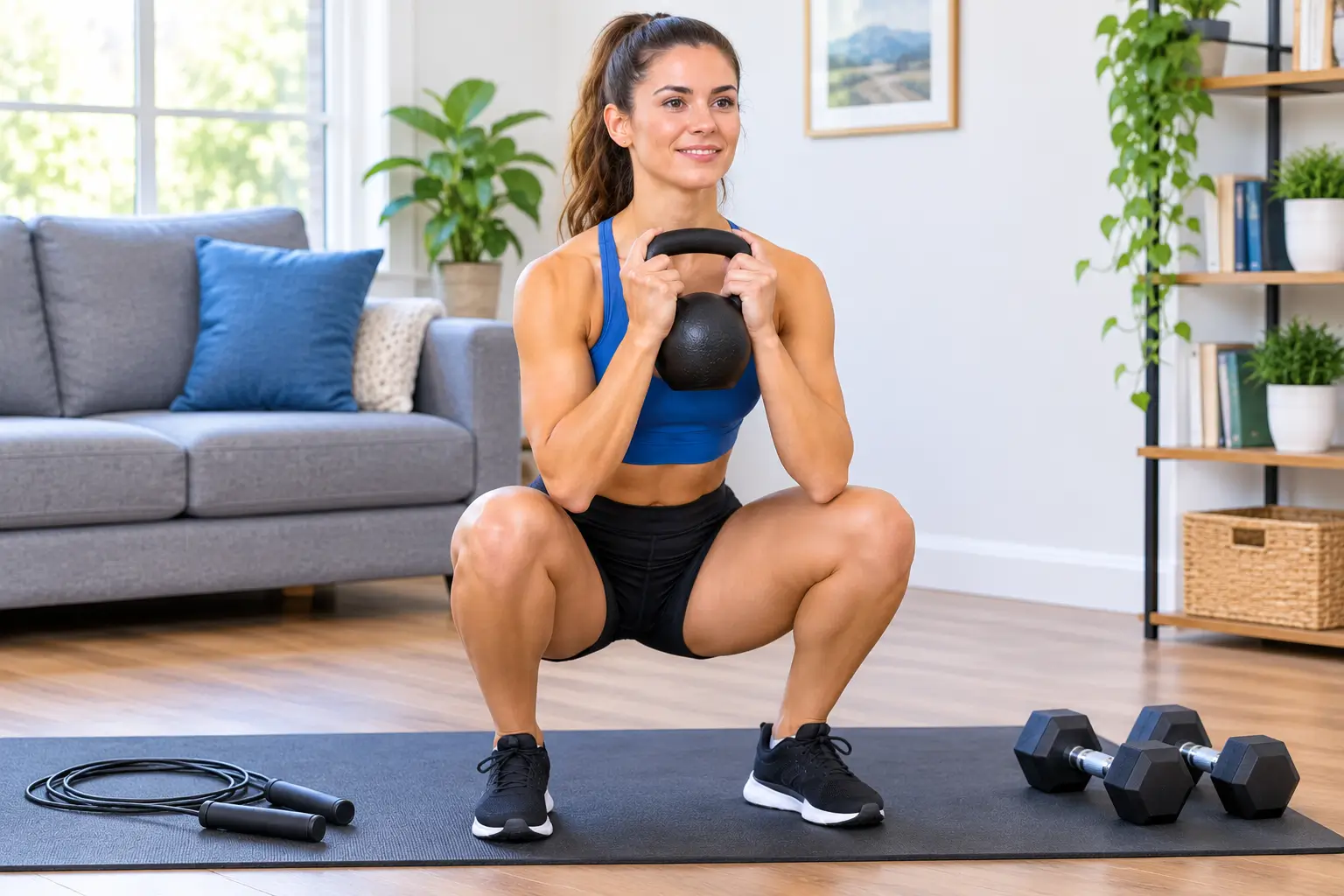
CrossFit at home lets you train hard with a small amount of gear and a few square feet of floor. It can be a great fit if you like short, varied workouts that mix strength and cardio. It also asks for good technique and smart pacing, which is where most beginners slip.
This guide explains what CrossFit at home is, what you need, and how to start safely. You’ll get a full warm-up, three beginner workouts, short form cues for every move, and a four-week plan. Along the way, you’ll learn how to scale each exercise up or down so the workout fits you.
Quick Answer: CrossFit at home is a constant-variety style of training that mixes weightlifting, bodyweight gymnastics, and cardio into short, timed workouts. To start, learn 8-10 basic movements, use light weights, and train three days a week for 20-40 minutes. A pair of dumbbells or one kettlebell, a jump rope, and floor space are enough.
Quick format snapshot: 3 days a week, 20-40 minutes per session, minimal equipment, and every move can be scaled.
What Is CrossFit at Home?
CrossFit is a branded fitness program built around “functional” movements: squatting, pushing, pulling, hinging, and carrying. A typical session mixes three things. First comes weightlifting, such as squats and deadlifts. Second is bodyweight gymnastics, such as push-ups and pull-ups. Third is cardio, such as rowing, running, and jumping rope.
At a CrossFit gym, a coach posts a “workout of the day,” or WOD. At home, you do the same thing on your own terms. You pick a WOD, use the gear you own, and scale the moves to your level. A home CrossFit workout can be as simple as five rounds of squats, push-ups, and sit-ups.
A note on the name: “CrossFit” is a trademark. Many people use “CrossFit-style” or “functional fitness” for similar training at home. We’ll use “CrossFit at home” here because that’s how most people search for it.
The Three Main Workout Formats
Most WODs use one of these formats. Learning them takes about five minutes, and then every workout makes sense.
- AMRAP (as many rounds as possible): You set a timer, such as 10 minutes. Then you repeat a short circuit as many times as you can with good form.
- EMOM (every minute on the minute): At the start of each minute, you do a set number of reps. Whatever time is left in that minute is your rest.
- For time: You complete a set list of work as fast as you can, while keeping clean technique.
What the Research Says
Research on CrossFit is still growing; as a result, the quality is mixed. A systematic review and meta-analysis in Sports Medicine – Open looked at 31 studies. It found that only two had a high level of evidence at low risk of bias. In plain terms, we have good clues but not final answers.
Injury risk is the big question. For example, a 2022 systematic review in The Physician and Sportsmedicine found CrossFit’s injury rate is similar to weightlifting and powerlifting. The shoulder, spine, and knee were the most affected areas. The authors also noted that study quality limits firm conclusions about risk factors.
Supervision may matter too. A clinical review on PubMed reported that injuries were more common where supervision wasn’t always available. That finding matters for home training, because you are your own coach. It’s why this guide leans on light loads, video checks, and slow progress.
Finally, a systematic review in Workplace Health & Safety found CrossFit to be comparable to other exercise programs in injury rates and health outcomes. That’s reassuring, but it doesn’t mean the risk is zero.
Check with your doctor first. If you have pain, a past injury, heart or blood pressure concerns, or you’re pregnant or postpartum, talk to a doctor or physical therapist before you start high-intensity training.
Who This CrossFit at Home Plan Is For
This plan fits you if you are new to structured training or coming back after a long break. It also works if you own a few dumbbells and want a plan instead of guessing. You don’t need to do pull-ups or lift heavy to begin.
It’s not designed for competitive athletes or anyone chasing a one-rep max. It also isn’t a replacement for medical guidance if you’re managing a health condition.
Here’s a quick way to check your starting point:
- You can do 5 slow bodyweight squats with your heels flat.
- You can hold a plank for 20 seconds with a straight line from head to heels.
- You can walk briskly for 20 minutes without pain.
If any of those feel tough today, don’t worry. Use the easier options in this guide and build from there.
Equipment You Need for CrossFit at Home
Good news: you can start with almost nothing. Many people try bodyweight-only CrossFit workouts for the first month, then add gear. Here’s a simple build-up order.
| Item | Priority | Why it helps | Space/size note |
|---|---|---|---|
| Open floor space | Must have | Room for squats, burpees, and jumps | About 72 × 72 in (183 × 183 cm) |
| Exercise mat | Must have | Grip and joint comfort | Standard mats run ~24 × 72 in (61 × 183 cm) |
| Jump rope | Must have | Cheap, high-impact cardio | Rope should reach your armpits when you stand on its center |
| Dumbbells or kettlebell | High | Squats, swings, presses, rows | Start light: 10-25 lb (5-11 kg) |
| Plyo box or sturdy step | Medium | Step-ups and box work | Start low: 12-20 in (30-51 cm) |
| Pull-up bar or rack | Optional | Builds pulling strength | Check door-frame weight limits [VERIFY per product] |
| Rower | Optional | Low-impact cardio | Large footprint; check manufacturer specs |
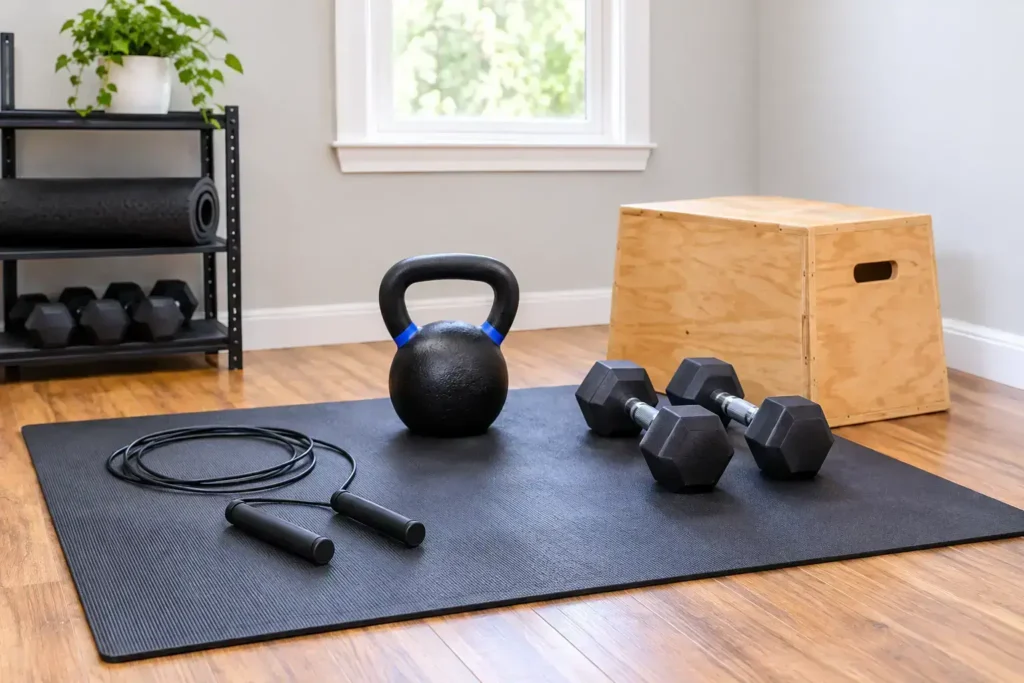
If you’re short on room, our guide to apartment workout equipment covers space-saving options. If you can only buy one weight, adjustable dumbbells let you scale loads as you get stronger. For later pulling work, a squat rack with a pull-up bar can anchor a larger home CrossFit gym.
Coach’s Tip: Clear a “landing zone” before every session. Move shoes, pets, and loose cables out of the way. Most home training mishaps happen from tripping, not from lifting.
Warm-Up: 8 Minutes Before Every Workout
A warm-up raises your heart rate and prepares your joints for the moves you’re about to do. Skipping it is one of the fastest ways to feel sore, stiff, or off balance. Keep it easy: you should finish feeling warm, not tired.
Do each move for 40 seconds, then rest 20 seconds. Go through the list once.
- Jog in place or easy jump rope: Stay light on your feet.
- Arm circles: 20 seconds forward, 20 seconds backward.
- Hip circles: Big, slow circles, both directions.
- Cat-cow: On hands and knees, round and arch your back slowly.
- Bodyweight squats: Sit back and down, then stand tall.
- World’s greatest stretch (or reverse lunge with twist): Move slowly and breathe.
- Inchworm walk-outs: Walk hands out to a plank, then walk back.
- Practice reps: Do 5 light reps of the first exercise in your workout.
That’s about 8 minutes, with transitions. Afterward, your hips should feel loose and your shoulders should move freely.
The CrossFit at Home Workouts for Beginners
Here are three beginner WODs. Each one targets a different pattern, so your week feels varied without being complicated. Use a timer and keep your first few rounds smooth.
Workout A: Squat and Push (AMRAP)
| Exercise | Sets | Reps | Rest |
|---|---|---|---|
| Goblet squat (strength warm-up) | 3 | 8 | 60-90 sec |
| 10-minute AMRAP: Push-ups (hands elevated if needed) | Rounds | 5 | Minimal |
| Air squats | Rounds | 10 | Minimal |
| Sit-ups | Rounds | 10 | Minimal |
Aim for 4-6 rounds. Stop a round early if your form slips.
Workout B: Hinge and Pull (EMOM)
| Exercise | Sets | Reps | Rest |
|---|---|---|---|
| Dumbbell Romanian deadlift (strength) | 3 | 8-10 | 60-90 sec |
| 12-minute EMOM, odd minutes: Kettlebell or dumbbell swing | 6 | 10 | Rest of minute |
| Even minutes: Dumbbell bent-over row | 6 | 8 per arm | Rest of minute |
If 10 swings take longer than 40 seconds, drop to 8.
Workout C: Full-Body Mix (For Time)
| Exercise | Rounds | Reps | Rest |
|---|---|---|---|
| Jump rope (or 40 fast steps in place) | 3 | 50 | None |
| Dumbbell thruster | 3 | 8 | None |
| Reverse lunge | 3 | 10 total | None |
| Plank | 3 | 30 sec | 60 sec between rounds |
Goal: finish in 15-20 minutes. Compare your time next week, not someone else’s.
How to Do Each Exercise (Short-Form Cues)
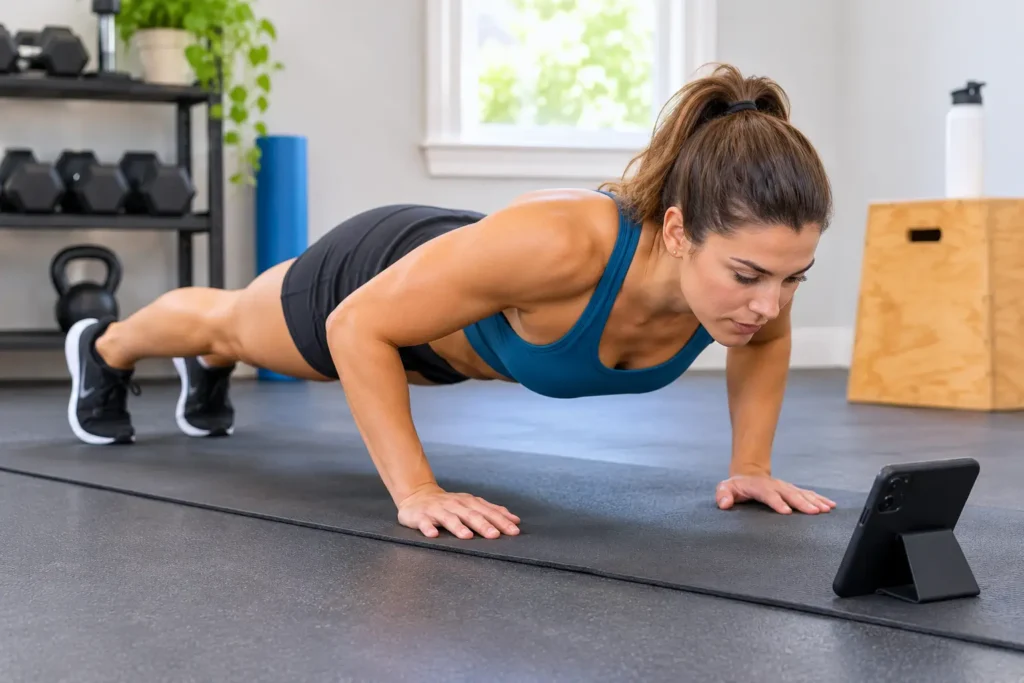
Good technique matters more than speed or weight. Because you may not have a coach beside you, consider filming a set from the side to check your form. The cues below are grouped by movement pattern so you can review them quickly before each workout.
Squat and Lunge Patterns
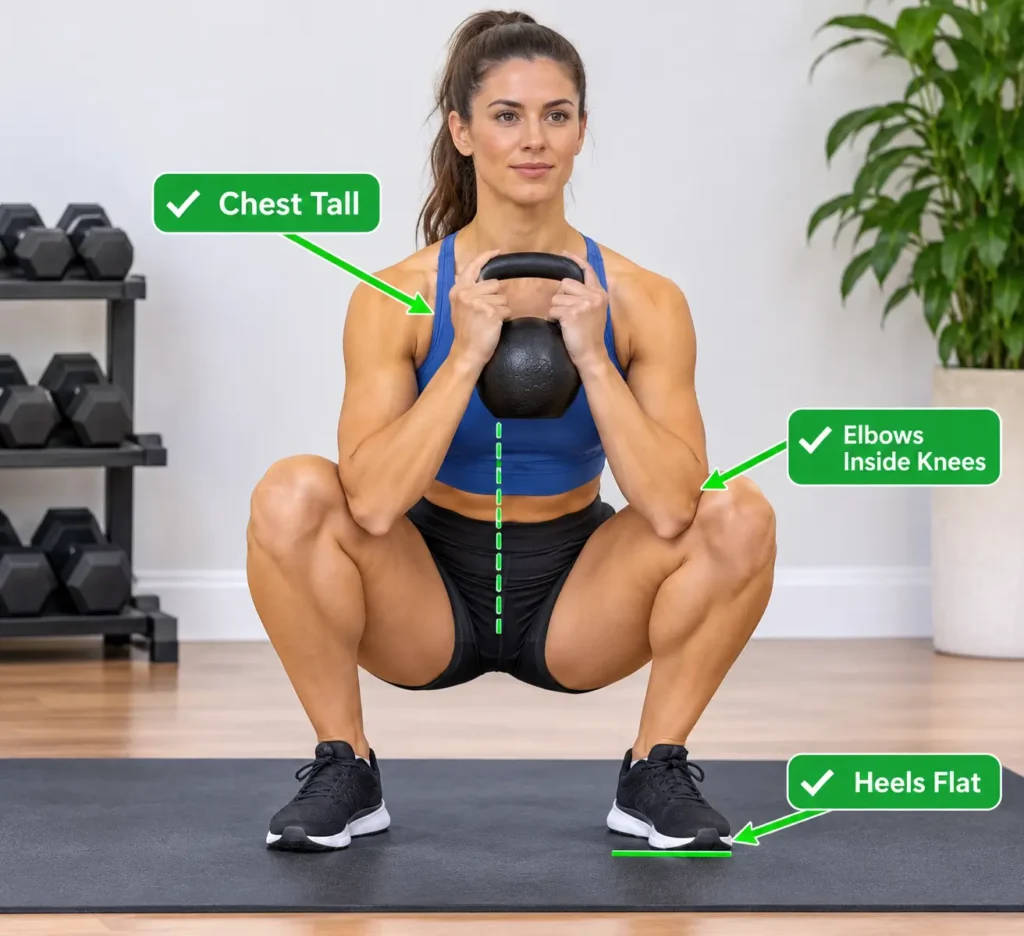
First, for the air squat, stand with feet shoulder-width apart and toes slightly out. Then push your hips back and bend your knees until your thighs are at or near parallel. Keep your chest tall and heels flat, and drive through your whole foot to stand. It should feel like your thighs and glutes are working, not your knees.
Next, for the goblet squat, hold one dumbbell or kettlebell at your chest. Use the same squat pattern, and as you lower, let your elbows slide inside your knees at the bottom. Start with 10–20 lb (5–9 kg).
Finally, for the reverse lunge, step back and lower until both knees are near 90 degrees. Then push through your front heel to return. Keep your torso tall throughout.
Push, Core, and Plank
Begin with the push-up: place your hands slightly wider than your shoulders and make a straight line from head to heels. Lower your chest to about an inch (2.5 cm) above the floor, then press away. Because your core should feel tight, think of it as a moving plank.
For the sit-up, lie on your back with knees bent and feet flat. Curl up using your abs, then lower with control. Cross your arms on your chest or tuck your hands lightly behind your head, but don’t yank on your neck.
Then, for the plank, place your forearms on the floor with elbows under shoulders. Squeeze your glutes and brace your abs. Stop when your hips sag.
Hinge and Pull
Start with the Romanian deadlift: hold dumbbells in front of your thighs with a soft bend in your knees. Push your hips back, slide the weights down your legs, and stop when you feel a stretch in your hamstrings. Then squeeze your glutes to stand. Use 10–25 lb (5–11 kg) per hand.
For the kettlebell swing, hinge at your hips and hike the bell back between your legs. Next, snap your hips forward to float it to chest height. Your arms guide the bell; your hips power it. A beginner often starts with 18–26 lb (8–12 kg). For more on what swings train, see our article on whether kettlebell swings work your abs.
For the dumbbell row, hinge forward with a flat back and one hand on a bench or chair. Pull the weight toward your hip, pause, and lower slowly. You should feel it in your upper back, not your lower back.
Full-Body and Cardio
Use the dumbbell thruster as a full-body option: hold light dumbbells at your shoulders. Squat down, then stand quickly and press the weights overhead in one smooth motion. Start with 8–15 lb (4–7 kg) per hand.
For the jump rope, keep your elbows near your ribs and turn the rope with your wrists. Jump only an inch or so (2.5 cm). If this is new, practice without a rope first.
Optional Add-On: Burpee
Finally, if you add burpees, start from standing, place your hands down, and step or jump your feet back. Do a push-up if you choose, step in, and stand. At first, step instead of jumping.
Common Mistake: Rushing reps to “beat the clock.” Fast, sloppy reps often mean a rounded back, collapsing knees, or shallow squats. Fix it: Pick a pace where the last round looks as good as the first. Remember that smooth is safe, and safe is fast over time.
Weekly Schedule and 4-Week Progression for CrossFit at Home
Three training days per week is a good start. For overall health, the CDC recommends adults get 150 minutes of moderate-intensity activity per week plus muscle-strengthening work on at least 2 days. The Physical Activity Guidelines for Americans back this up. This plan covers the strength side, so add walking or easy cycling on off days to cover the rest.
| Day | Session |
|---|---|
| Monday | Workout A |
| Tuesday | Rest or 30-minute walk |
| Wednesday | Workout B |
| Thursday | Rest or easy mobility |
| Friday | Workout C |
| Saturday | Optional: 30-60 minute walk (about 1.5-3 miles, or 2.4-4.8 km) |
| Sunday | Rest |
Four-Week Progression
| Week | Focus | How to progress |
|---|---|---|
| 1 | Learn the moves | Use the easiest versions. Keep every set smooth and well within your limit. |
| 2 | Build consistency | Add 1 round or 1-2 reps per set only if form stays clean. |
| 3 | Add load | Increase weight by 5 lb (2 kg) on strength moves if you can finish all reps cleanly. |
| 4 | Test and recover | Repeat Workout C and compare your time. Use lighter weights if you feel run down. |
Progress slowly. ACSM-linked research on HIIT shows interest in high-intensity training has surged, but the way people structure intervals varies a lot. A review on PMC also notes that adequate rest between hard efforts matters. That’s a good reason to keep your rest days real.
When you finish this month, consider moving on to our 12-week calisthenics program to build more bodyweight strength.
Beginner and Advanced Versions
Scaling is the heart of CrossFit at home. Every exercise below has an easier and a harder option, so you can keep the same workout and change the challenge.
| Movement | Easier (regression) | Harder (progression) |
|---|---|---|
| Air squat | Squat to a chair or box | Pause squat (2-3 seconds at the bottom) |
| Goblet squat | Bodyweight only | Heavier bell, or 3-second lowering |
| Push-up | Hands on a counter or bench | Feet elevated, or slow-tempo push-up |
| Sit-up | Crunch with feet anchored lightly | Weighted sit-up |
| Romanian deadlift | Lighter weights, shorter range | Single-leg version |
| Kettlebell swing | Hip-hinge drill, no bell | Heavier bell or one-arm swing |
| Dumbbell row | Rows with a resistance band | Heavier weight, slower lowering |
| Thruster | Squat and press as two steps | Heavier dumbbells |
| Reverse lunge | Assisted, holding a wall | Add dumbbells |
| Plank | Knees-down plank | Long-lever plank or 60+ seconds |
| Jump rope | Fast shadow-rope skips | Double-unders |
| Burpee | Step-back, no push-up | Jump burpee |
For a bigger list of pull and push options, see our calisthenics exercises list. If you plan to add pull-ups, read what muscles pull-ups work first, so you know what to build toward.
Cardio Options If You Hate Jumping
Not everyone can jump rope, especially in apartments with neighbors below. Fortunately, you have choices. Try fast marching, step-ups, shadow boxing, or a rower. If you own one, a 30-minute rowing workout can replace jump rope rounds. For arm-heavy conditioning, battle rope alternatives are handy when you don’t have the rope or the space.
Cool-Down: 5 Minutes After Every Workout
Slow your breathing first, then stretch. A short cool-down helps your heart rate settle and gives you a moment to notice how you feel. Hold each position for 30 seconds without bouncing.
- Walk in place for 1-2 minutes.
- Quad stretch: Pull your heel toward your glute.
- Hamstring stretch: Rest your heel forward and hinge at the hips.
- Chest stretch: Clasp your hands behind you and lift gently.
- Child’s pose: Sit back on your heels and reach forward.
You should feel a gentle stretch, never sharp pain. If something hurts, ease off.
Tips for Better Results with CrossFit at Home
Small habits make the biggest difference. These coaching tips will help you stay consistent and avoid common beginner traps.
- Start lighter than you think. If a weight feels easy for 10 reps, it’s probably right for your first month.
- Track your workouts. Write down the weight, reps, and time. Beating last week’s log is a simple, real sign of progress.
- Use the “two reps in reserve” rule. Stop each strength set when you feel you could do two more clean reps.
- Film your form. A side-view video catches rounded backs and shallow squats that a mirror can miss.
- Respect rest days. Your muscles adapt between workouts, not during them.
- Eat and sleep well. You don’t need a special diet, but regular meals and 7-9 hours of sleep support recovery.
- Stop if something feels wrong. Sharp pain, dizziness, chest pain, or unusual shortness of breath are reasons to stop and get medical advice.
FAQ
Can you do CrossFit at home?
Yes. You can follow a CrossFit-style plan at home with simple gear like dumbbells, a kettlebell, a jump rope, and floor space. Choose basic movements, scale the weights to your level, and keep rest days. Consider filming your form, since you won’t have a coach watching.
What equipment do I need for CrossFit at home?
Start with open space, a mat, and a jump rope. Add one kettlebell or a pair of dumbbells next, because they cover squats, swings, presses, and rows. A low box, pull-up bar, or rower can come later. Many beginners train bodyweight-only for the first month.
How many days a week should beginners do CrossFit?
Three days a week is a good start for most beginners, with at least one rest day between sessions. This leaves time for recovery and fits within the muscle-strengthening guidance for adults. As your fitness improves, you may add a fourth lighter day.
Is CrossFit at home safe?
It can be, if you scale properly. Research finds CrossFit’s injury rate is similar to weightlifting, with shoulders, spine, and knees most affected. Use light weights, learn form first, avoid training through pain, and check with a doctor if you have health concerns.
Can you do CrossFit without equipment?
Yes. Bodyweight moves like air squats, push-ups, sit-ups, lunges, planks, and burpees make a full workout. Use AMRAP or EMOM formats to add intensity without weights. You can add a jump rope or resistance bands later for variety.
How long should a CrossFit workout take?
Most beginner sessions take 30-45 minutes in total. That includes an 8-minute warm-up, a 10-20 minute workout, and a 5-minute cool-down. The hard part of a WOD is often short, so don’t confuse “short” with “easy.”
Conclusion
CrossFit at home works best when you keep it simple: learn a few movements, use light weights, and build consistency before intensity. Start with three sessions a week, use the four-week plan, and scale anything that doesn’t feel right. Over time, you can add weight, speed, or new moves.
Remember, the goal isn’t to crush every workout. It’s to finish each one feeling like you could do a little more, then come back two days later and do just that. If you want help choosing gear or next steps, our guides on apartment workout equipment and calisthenics are good places to continue.
