
The average bench press for men depends on three things: body weight, age, and training history. For example, a man who has never lifted may press about 0.75 times his body weight for one rep. In contrast, a man with a few years of steady training often presses his body weight or more. Therefore, this guide shows the average bench press for men by age and weight, explains how to test your own number safely, and then gives you a plan to move up.
Charts online often disagree, which is confusing. Some count only competitive lifters, while others mix in men who have never touched a barbell. To fix that, this guide uses simple body weight ratios so you can compare yourself fairly. As a result, you will know where you stand and what to do next.
Quick Answer: The average bench press for men who train regularly is about 1 to 1.25 times body weight for one rep. For a 175 lb (79 kg) man, that is roughly 175 to 220 lb (79 to 100 kg). Untrained men often lift less, and numbers usually fall after age 40.
What “Average” Really Means for a Bench Press
Before you compare yourself, you need to know what “average” means. First, the average bench press for men in the general population is lower than the average for men who lift each week. In fact, the gap is large.
The Gap Between the General Population and Gym-Goers
Here is why. According to a CDC data brief, about 31% of U.S. adults met the muscle-strengthening guideline in 2020 [VERIFY year and figure]. Therefore, many men in the general population never test a heavy lift at all.
Gym-goers, however, are a different group. For instance, one study of resistance-trained adults found that average relative bench press strength was about 1.19 times body weight [VERIFY full citation]. Because that figure sits right in the middle of our chart below, it makes a handy reference point.
Key Terms to Know
Three terms will help you read the numbers:
- One-rep max (1RM): the heaviest weight you can lift once with good form.
- Training age: how long you have trained consistently, rather than how old you are.
- Relative strength: your lift divided by your body weight.
Also, a standard Olympic barbell weighs 45 lb (20 kg), so every number in this guide includes the bar. Likewise, all lifts assume the bar touches your chest, with no bounce and no bridging.

Average Bench Press for Men by Body Weight
Body weight is the best single predictor of the average bench press for men. For this reason, heavier men usually lift more total pounds, since they carry more muscle. The chart below multiplies body weight by common coaching ratios.
Body Weight Chart
| Body weight | Beginner (0.75×) | Novice (1.0×) | Intermediate (1.25×) | Advanced (1.5×) |
|---|---|---|---|---|
| 130 lb (59 kg) | 100 lb (45 kg) | 130 lb (59 kg) | 165 lb (75 kg) | 195 lb (88 kg) |
| 150 lb (68 kg) | 115 lb (52 kg) | 150 lb (68 kg) | 190 lb (86 kg) | 225 lb (102 kg) |
| 170 lb (77 kg) | 130 lb (59 kg) | 170 lb (77 kg) | 215 lb (98 kg) | 255 lb (116 kg) |
| 190 lb (86 kg) | 145 lb (66 kg) | 190 lb (86 kg) | 240 lb (109 kg) | 285 lb (129 kg) |
| 210 lb (95 kg) | 160 lb (73 kg) | 210 lb (95 kg) | 265 lb (120 kg) | 315 lb (143 kg) |
| 230 lb (104 kg) | 175 lb (79 kg) | 230 lb (104 kg) | 290 lb (132 kg) | 345 lb (156 kg) |
One-rep max values, rounded to the nearest 5 lb. These are coaching benchmarks built from body weight ratios, not lab results. [VERIFY against a published dataset before publishing]
What Each Level Looks Like
Here is how the levels usually look in real life:
- Beginner: 0 to 3 months of training, while you are still learning the groove.
- Novice: about 3 to 9 months, once your form is steady and weight rises often.
- Intermediate: about 1 to 3 years, when progress slows and needs a plan.
- Advanced: 3 or more years of focused training.
For most men, the first big goal is to bench body weight. In short, a 170 lb (77 kg) man who presses 170 lb (77 kg) has reached a solid, respectable mark.
Why Ratios Shrink in Heavier Lifters
However, ratios tend to shrink as men get heavier. For example, a 230 lb (104 kg) man may find 1.25× harder than a 150 lb (68 kg) man does. Therefore, use the chart as a guide, not a verdict.
Coach’s Tip: Compare your lift to your own numbers from three months ago. Your personal trend matters more than any chart.
Average Bench Press for Men by Age
Age changes the average bench press for men, but training history changes it more. For instance, a 50-year-old who has lifted for 20 years often outpresses a 25-year-old beginner. Still, age does play a role.
Why Strength Changes With Age
Reviews of human muscle research report that strength and muscle mass begin to decline around the fourth decade of life [VERIFY full citation]. In addition, longitudinal studies show that at age 75, men lose strength at roughly 3–4% per year [VERIFY full citation]. Keep in mind that this is a population trend, not a rule for every man.
Age Chart
The table below shows a typical one-rep max range for a recreational lifter weighing about 175 lb (79 kg). First, we started from a 1.0× to 1.25× body weight range for men in their 20s and 30s. Then, we scaled it down for older ages.
| Age group | Typical 1RM range (175 lb / 79 kg man) |
|---|---|
| 18–19 | 160–200 lb (73–91 kg) |
| 20–29 | 175–220 lb (79–100 kg) |
| 30–39 | 175–220 lb (79–100 kg) |
| 40–49 | 165–205 lb (75–93 kg) |
| 50–59 | 150–185 lb (68–84 kg) |
| 60–69 | 130–165 lb (59–75 kg) |
| 70+ | 110–135 lb (50–61 kg) |
These are estimates, not research findings. [VERIFY against a published dataset before publishing]
Notice the slow slide rather than a cliff. Meanwhile, men who keep training often hold their strength well into their 50s. Moreover, the CDC says adults should do muscle-strengthening activity on at least two days a week, and that advice applies at every age.
Common Mistake: Comparing your age-50 lift to a 25-year-old’s chart. Instead, use the row for your own age, then compare to your own history.
How to Find Your Own One-Rep Max Safely
You do not need to max out to learn where you rank. A rep-based estimate is safer and often accurate enough. For example, one study of medical students found that repetitions performed on a bench press test were good predictors of 1RM (Journal of Strength and Conditioning Research, 2002).
Step-by-Step Rep Test
- First, warm up with the empty bar for 10 reps, then add weight in small jumps.
- Next, pick a weight you can lift for about 3 to 5 hard reps.
- Then perform one set and stop when you have one clean rep left in the tank.
- Use a spotter, or set the safety arms just above your chest.
- Finally, plug the numbers into this common formula: 1RM ≈ weight × (1 + reps ÷ 30).
For example, if you press 185 lb (84 kg) for 5 reps, the math is 185 × 1.167 ≈ 215 lb (98 kg). That is your estimated 1RM.
Why Keep the Rep Count Low
Research notes that prediction equations often lose accuracy at loads allowing 10 reps or more. So a heavy set of 3 to 5 beats a light set of 15, because the estimate stays closer to the truth.
Sets, Reps, and Weight by Goal
Once you know your number, you can use it to pick your training weight. Of course, the right load depends on your goal. These are practical coaching guidelines.
Goal Table
| Goal | % of 1RM | Reps | Sets | Rest |
|---|---|---|---|---|
| Strength | 80–90% | 3–6 | 3–5 | 3–5 min |
| Muscle size | 65–80% | 6–12 | 3–4 | 1–2 min |
| Endurance | 50–65% | 12–20 | 2–3 | 30–60 sec |
| Beginner skill | 60–70% | 8–10 | 2–3 | 1–2 min |
Tempo and Rest
These rest times line up with the ACSM position stand on resistance training progression, which suggests 3 to 5 minutes between sets for heavy loading. For muscle growth, it points to 1 to 2 minutes. In addition, the same document recommends training each muscle group 2–3 days a week for novices and 3–4 for intermediates.
Keep your tempo simple. First, lower the bar for about 2 seconds, then pause briefly at your chest, and finally press up with control. As a result, every rep stays honest and repeatable.
Meanwhile, a newer ACSM overview of resistance training reviews found that training to muscle failure, using machines versus free weights, and complex periodization did not consistently change results for the average healthy adult [VERIFY authors and year]. In other words, steady effort and consistency matter most.
Step-by-Step Bench Press Form
Good form protects your shoulders and helps you lift more. Therefore, learn it before you chase a bigger number.
- Set your eyes under the bar. First, lie back so the bar sits over your eyes.
- Plant your feet. Keep them flat on the floor, about shoulder width apart.
- Squeeze your shoulder blades. Pull them back and down, like tucking them into your back pockets.
- Grip the bar. Hold it slightly wider than shoulder width, with wrists stacked over elbows.
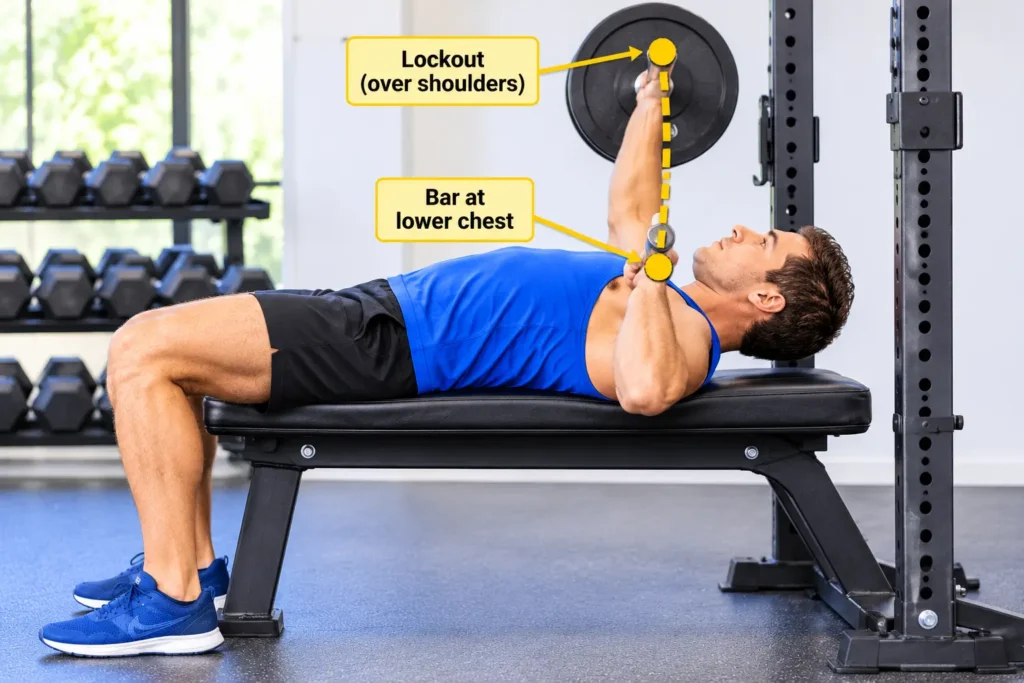
- Unrack and stabilize. Next, press the bar off the hooks and hold it over your shoulders.
- Lower under control. Bring it to your lower chest, with elbows about 45 to 70 degrees from your torso.
- Touch lightly. Tap your chest without bouncing.
- Press up and slightly back. Finally, drive through your feet and finish with locked elbows.
Done right, the lift should feel like a strong push from your chest, shoulders, and triceps. However, sharp pain in the front of your shoulder means you should stop and reassess.

Coach’s Tip: Think “bend the bar” as you grip it. That cue helps you keep your elbows tucked and your upper back tight.
Common Mistake: Flaring elbows straight out at 90 degrees. This puts extra stress on your shoulders. Instead, tuck them slightly, then check that your forearms stay vertical.
Easier and Harder Versions
Not every lifter should start with a barbell. Therefore, pick the version that fits your level today, then move on as you grow.
Easier Versions (Regressions)
- Incline push-ups with hands on a bench
- Dumbbell bench press with light weights
- Machine chest press, such as a Hammer Strength chest press
- Floor press with a lighter bar
Harder Versions (Progressions)
- Paused bench press, with a 2-second hold on your chest
- Tempo bench press, with a 4-second lowering phase
- Close-grip or incline barbell variations
- Heavier sets of 3 to 5 reps with longer rests
If your shoulders complain, explore bench press alternatives that feel better on your joints. Later, when you are ready for more, these bench press variations for every level offer a clear ladder to climb.
Muscles Worked by the Bench Press
The bench press is a compound lift, so it trains several muscles at once. The pectoralis major (chest) does most of the pressing, while the triceps brachii straighten the elbows. In addition, the anterior deltoids (front shoulders) assist at every rep, which is why many lifters ask if the lift can work your shoulders as well. It can. Finally, the serratus anterior and upper back muscles stabilize your shoulder blades.
Because many muscles help, a lagging area can cap your bench. For example, weak triceps often stall the lockout, while a weak upper back makes the bar feel unstable.
How to Raise Your Numbers: A 4-Week Starter Plan
Knowing the average bench press for men is useful only if you act on it. Here is a simple two-day plan for a novice or early intermediate lifter. It also fits the ACSM guidance of 2–3 days per week for novices.
The Plan
| Day | Exercise | Sets × reps | Rest |
|---|---|---|---|
| Day 1 (heavy) | Barbell bench press | 4 × 5 | 3 min |
| Dumbbell row | 3 × 8–10 | 90 sec | |
| Overhead press | 3 × 6–8 | 2 min | |
| Triceps pushdown | 3 × 10–12 | 60 sec | |
| Day 2 (volume) | Barbell bench press | 3 × 8–10 | 90 sec |
| Incline dumbbell press | 3 × 8–12 | 90 sec | |
| Seated cable row | 3 × 10–12 | 60 sec | |
| Plank | 3 × 30–45 sec | 45 sec |
How to Progress
When you finish every set with good form, add 5 lb (2.5 kg) next time. On the other hand, if you miss reps, repeat the same weight. After four weeks, retest with a rep-based estimate. For more tactics, read our guide on how to increase your bench press.
Recovery matters too. For that reason, sleep at least seven hours and eat enough protein and total food to support training. Above all, do not rush, since slow, steady gains last longer than quick jumps.
Safety Notes: Who Should Be Careful
The bench press is safe for most healthy adults when done with care. However, a heavy bar over your chest can be risky if you lift alone.
- Use a spotter or safety arms. A squat rack with safety bars lets you bail out safely.
- Warm up first. Light sets before heavy ones prepare your joints.
- Skip lifting through sharp pain. Stop and reassess instead.
- Avoid ego lifting. Trading form for weight raises injury risk.
Older adults, men with high blood pressure or heart conditions, and anyone with shoulder, elbow, or chest pain should check with a doctor or physical therapist before starting heavy bench work. After all, a professional can tell you which loads and variations fit your situation.
Related Tips for Better Results
Chest size and bench strength often rise together. Therefore, if you want both, pair your pressing with these exercises to build a bigger chest. In addition, train your back as hard as your chest, because a strong back keeps your shoulders healthy and gives you a stable base on the bench.
Finally, track your lifts in a notebook or app. Write down the weight, reps, and how the set felt. Over time, those notes show you what works.
FAQ
What is a good bench press for a beginner man?
A good starting goal is lifting about 0.75 times your body weight for one rep. For a 170 lb (77 kg) man, that is about 130 lb (59 kg). Many beginners reach this within a few months of steady training. Focus on clean form first, then add weight slowly.
Is benching 225 lb a good lift?
Yes, for most men. Pressing 225 lb (102 kg) means loading two 45 lb (20 kg) plates on each side of an Olympic bar. That is intermediate or better for men under about 180 lb (82 kg). For heavier men, it sits closer to the novice level, so body weight matters.
How much should a 40-year-old man bench?
A trained 40-year-old man often presses about 0.95 to 1.15 times body weight. For a 175 lb (79 kg) man, that is roughly 165 to 205 lb (75 to 93 kg). Training history matters more than birth year, so compare yourself to your own past numbers first.
Does body weight affect bench press?
Yes. Heavier men usually lift more total pounds because they carry more muscle. However, their lift relative to body weight is often lower. That is why charts use ratios, such as 1.0 times body weight, rather than one number for everyone.
How long does it take to bench 225?
Timelines vary a lot. Men who start near 135 lb (61 kg) often need a year or more of steady training to reach 225 lb (102 kg) [VERIFY]. Because body weight, sleep, food, and form all shape the pace, track progress monthly instead of weekly.
Final Thoughts on the Average Bench Press for Men
The average bench press for men sits near 1 to 1.25 times body weight for trained lifters, and lower for beginners and older men. Use the body weight and age charts as guideposts, not as grades. Then find your estimated 1RM with a safe rep test, and train with a plan, good form, and patience.
Next, pick one goal for the next four weeks. Maybe it is hitting your body weight, or adding 10 lb (4.5 kg) to your working sets. In the end, small, steady steps beat big, risky jumps every time.
