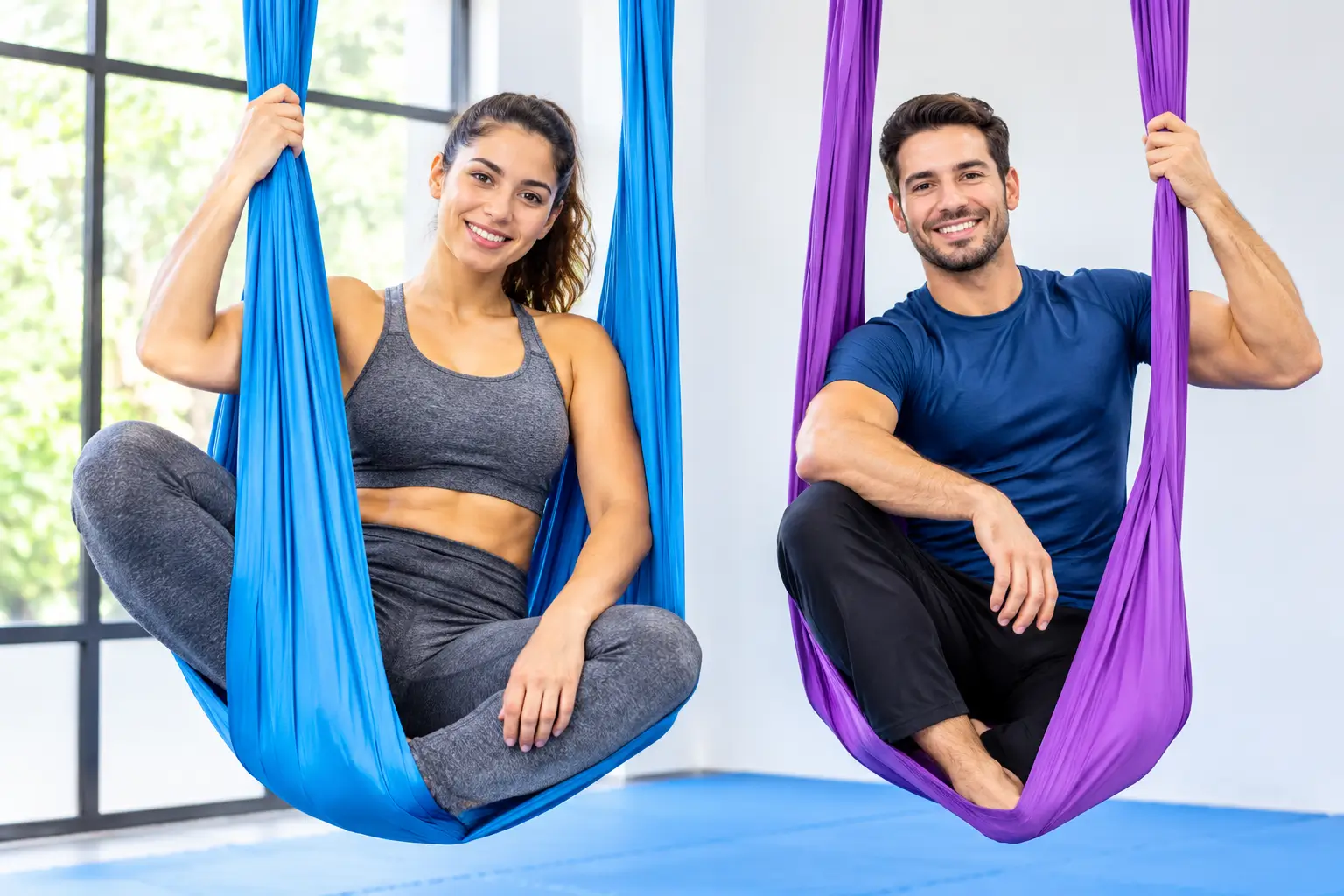
Aerial yoga benefits are real, but they are not magic. You get a low-impact workout that stretches your muscles, challenges your core, and calms your mind, all while a fabric hammock holds part of your weight. The research is still small, so it pays to know what is proven and what is hype.
This guide covers what the evidence says, how aerial yoga compares with regular yoga, and how to start safely. You will also get a beginner plan with sets, holds, and rest times.
Quick Answer: Aerial yoga benefits include better flexibility, core and upper-body strength, balance, joint comfort, and stress relief. One small study found a 50-minute class counted as moderate-intensity exercise. Research on aerial yoga itself is limited, and people with glaucoma, high blood pressure, or pregnancy should check with a doctor first.
What Is Aerial Yoga?
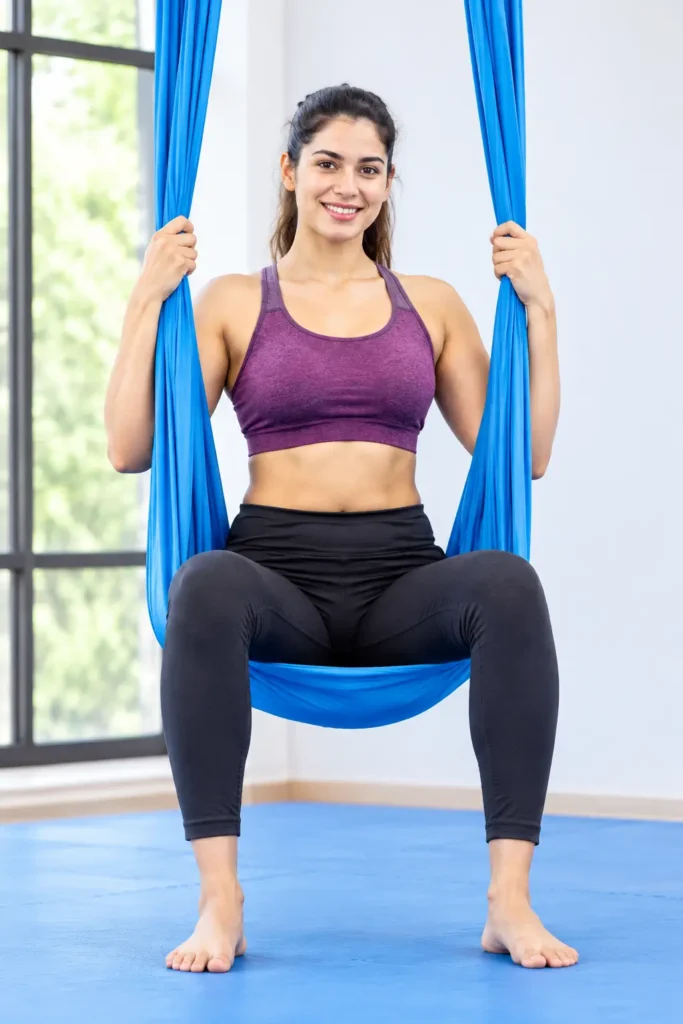
Aerial yoga (also called anti-gravity yoga or fly yoga) mixes yoga poses with a soft fabric hammock, often called a silk or sling. The hammock hangs from the ceiling at about hip height, roughly 30-40 in (76-102 cm) off the floor for most adults. You lean into it, sit in it, or wrap it around your body.
Some moves are fully supported, such as a floating relaxation pose. Others use the hammock as a prop for deeper stretches or for inversions. Because the fabric moves, your muscles must keep adjusting, which is where many of the benefits come from.
Aerial Yoga Benefits at a Glance
| Benefit | How it works | Strength of evidence |
|---|---|---|
| Flexibility | Hammock supports your weight so you can hold stretches longer | Moderate (yoga in general), limited for aerial |
| Core strength | Unstable fabric forces constant small corrections | Limited, mostly mechanism-based |
| Upper-body and grip strength | Hanging and pulling on the fabric | Limited |
| Cardio-level effort | Steady movement raises heart rate | One small ACE-commissioned study |
| Balance | Practice staying controlled on a moving surface | Moderate (yoga in general) |
| Joint comfort | Traction and light decompression | Unproven for aerial yoga |
| Stress relief | Slow breathing and supported rest | Moderate (yoga in general) |
Aerial Yoga Benefits for Flexibility and Range of Motion
Flexibility is the headline benefit, and it makes sense. In a floor stretch, your muscles must hold your body up while they lengthen. In the hammock, the fabric takes some of that load, so your muscles can relax into the stretch.
That support helps with hip openers, hamstring stretches, and gentle backbends. As a result, many beginners reach positions they cannot hold on the mat yet. Over time, repeating those positions may improve your range of motion.
Keep the evidence in perspective, though. Strong trials on yoga in general show better flexibility and balance, but aerial-specific trials are small and few. The NCCIH yoga overview notes that studies of yoga often vary in quality, so treat results as encouraging rather than guaranteed.
Coach’s Tip: Stretch should feel like a pull, not a pinch. Aim for about a 5 out of 10 on effort and breathe slowly through your nose. If you feel sharp pain or tingling, back out of the pose.
Easier version: Keep both feet on the floor and lean back into the hammock for a supported hamstring or chest stretch. Hold 20-30 seconds.
Harder version: Lift one leg into the hammock for a deeper hip stretch. Hold 45-60 seconds per side.
Aerial Yoga Benefits for Core and Upper-Body Strength
You might expect aerial yoga to be all stretching, but it asks more from your muscles than it looks. When you hold a pose in a swaying hammock, your deep abdominals (transverse abdominis) and obliques fire to keep you steady. Your shoulders, lats, and forearms work as well whenever you pull or hang.
This is a mechanism, not a proven result, so avoid expecting a six-pack from classes alone. Still, steady core control carries over to everyday tasks like lifting groceries or standing up from a chair. If you want to practice that skill off the hammock, try our guide on how to flex your abs for better core engagement.
The CDC says adults need muscle-strengthening activity on two or more days a week. Aerial yoga can contribute, but pair it with bodyweight calisthenics or weights to cover all major muscle groups. Likewise, if you enjoy supported, controlled strength work, the Pilates chair workout makes a good partner.
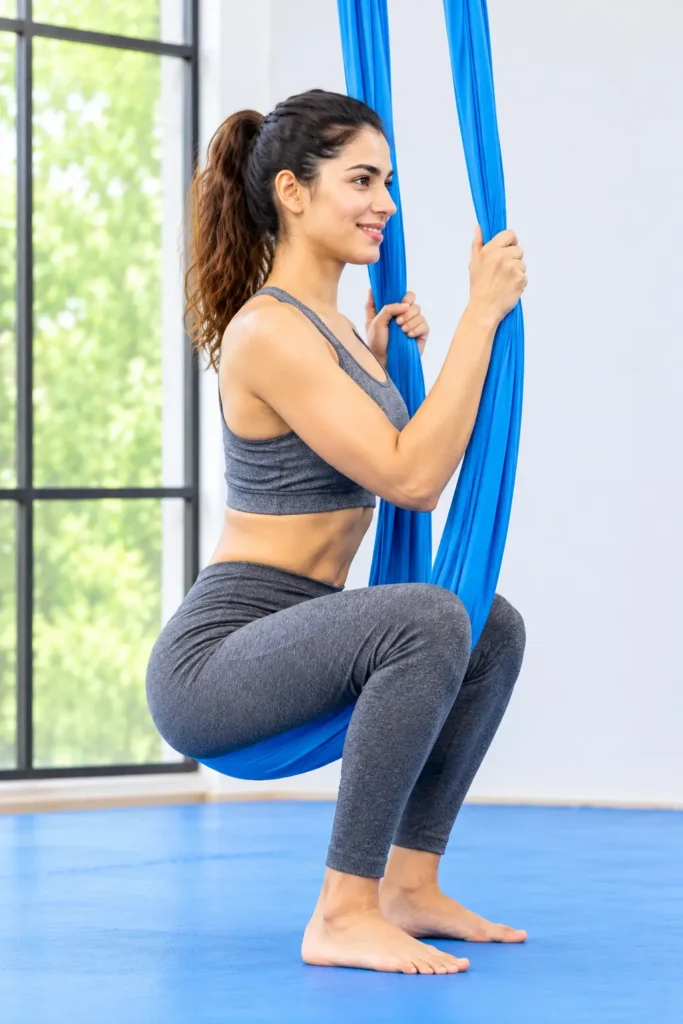
Sample strength block (hammock squat):
- Stand facing the hammock, holding one fabric loop in each hand.
- Sit your hips back and down as if lowering into a chair.
- Keep your chest tall and knees tracking over your toes.
- Push through your heels to stand.
Do 2-3 sets of 8-12 reps with a 3-second lowering phase and 30-45 seconds of rest.
Easier version: Pull on the hammock to assist, and squat only to a comfortable depth.
Harder version: Hold the fabric more lightly, pause 2 seconds at the bottom, and add a single-leg step-back.
Common Mistake: Letting the shoulders hike up toward your ears while hanging or pulling. Fix it by gently pulling your shoulder blades down and back before you load the fabric.
Aerial Yoga Benefits for Cardio Fitness: What the ACE Study Found
The most-cited research on aerial yoga came from a study the American Council on Exercise (ACE) commissioned. In the ACE-sponsored aerial yoga study, 16 healthy, physically active women ages 18 to 45 took part in three 50-minute classes a week for six weeks.
The researchers reported that each class burned about 320 calories on average and reached roughly 4.8 METs, which is moderate-intensity effort. After six weeks, they also saw improvements in measures including VO2max, body-fat percentage, waist circumference, systolic blood pressure, and HDL cholesterol.
Those numbers are promising, yet the study was small, and the women were already active. Therefore, you should not expect the same results, and calorie counts vary with your size and effort. Aerial yoga may be a useful way to build activity into your week, but it is not a guaranteed weight-loss tool.
It also helps to compare the effort with guidelines. The CDC recommends adults get 150 minutes of moderate-intensity activity each week. Two or three aerial classes can count toward that total, and a slow jog or fast walk can fill the rest.
Aerial Yoga Benefits for Balance and Body Awareness
Balance is a skill, and the hammock gives you a safe place to practice it. Because the fabric shifts under you, your body learns to make quick, small corrections. Poses like a supported tree or a standing lunge with a hand in the hammock train this skill without a big fall risk.
Research on traditional yoga is encouraging here. According to the NCCIH summary of yoga research, 11 of 15 studies in healthy people found improvement in at least one balance measure. That is not aerial-specific data, but it supports the general idea.
Body awareness also improves. You learn where your hips, ribs, and shoulders are in space, which tends to improve posture. If rounded shoulders bother you, consider posture corrector options alongside your classes, not instead of them.
Aerial Yoga Benefits for Joint Comfort and Back Pain
Studios often say hanging upside down “decompresses” the spine. The idea is that gravity pulls the vertebrae slightly apart, easing pressure on discs and joints. It sounds logical, but the proof is thin.
Cleveland Clinic experts note that research on inversion tables is mixed and that inversion should not be a stand-alone back-pain treatment. Aerial yoga is gentler than a full inversion table, since most poses are partial inversions, yet the same caution applies.
What has better support is yoga itself. The NCCIH clinical digest on yoga for pain says yoga may help relieve low-back pain and neck pain, although the quality of evidence varies. It adds that American College of Physicians guidelines include yoga among several recommended mind-body approaches for chronic low-back pain, based on low-quality evidence.
If you have back pain, talk with your doctor or physical therapist before starting. Then tell your instructor so they can offer supported options instead of deep inversions.
Aerial Yoga Benefits for Stress Relief and Mood
The final pose in most classes is a hammock “cocoon,” where the fabric wraps around yo,u and you lie still. Many people find it deeply calming. Slow breathing, gentle rocking, and a quiet room are the likely reasons.
Research on traditional yoga supports the stress benefit. Per the NCCIH yoga overview, 12 of 17 studies on yoga for stress management showed improvements in physical or psychological stress measures. The same source says yoga has not been shown to treat anxiety disorders or clinical depression, so it should not replace care from a professional.
The ACE researchers also suggested that participants may have found aerial yoga helpful for stress, and they called for more research on mood. In short, the effect is plausible, but aerial-specific proof is still missing.
Aerial Yoga vs. Regular Yoga: Key Differences
| Factor | Aerial yoga | Mat yoga |
|---|---|---|
| Support | Hammock holds part of your weight | Floor and your own strength |
| Stretch depth | Easier to relax into stretches | Depends on your flexibility |
| Core demand | Often higher due to unstable fabric | Varies by style |
| Learning curve | Needs setup and rigging knowledge | Low |
| Cost | Higher (studio fee or hammock and rigging) | Low |
| Evidence base | Small | Larger |
Choose aerial yoga if you like variety, want deeper stretches with less strain, or find the mat boring. Choose mat yoga if you want the cheapest, most flexible option or have a medical issue that makes hanging unsafe. Many people simply do both.
How to Get Aerial Yoga Benefits: A Beginner Plan
Start slowly, because your hands, shoulders, and core will work harder than you expect. Spend about 5 minutes warming up with shoulder circles, hip circles, and cat-cow on the floor. Then pick a beginner class or follow a simple routine under an instructor’s guidance.
| Phase | Frequency | Session length | Focus |
|---|---|---|---|
| Weeks 1-2 | 1 class per week | 45-60 minutes | Learn the hammock, supported poses only |
| Weeks 3-4 | 2 classes per week | 45-60 minutes | Add hammock squats and short inversions |
| Weeks 5-8 | 2-3 classes per week | 45-60 minutes | Longer holds, more control |
On non-class days, add strength and cardio so your week is balanced. For example, isometric leg exercises like wall sits build the leg strength that makes hammock work feel steadier.
Four Starter Moves
1. Supported child’s pose. Kneel facing the hammock, rest your chest and forearms in the fabric, and sink your hips back. Hold 30-60 seconds for 2 rounds. It should feel like a gentle stretch along your back and hips.
2. Hammock hamstring stretch. Lie on your back and place one foot in the hammock, with the other leg bent on the floor. Hold 30-45 seconds per side, resting 30 seconds between sides.
3. Standing hip opener. Stand beside the hammock, place one foot in it at hip height, and lean forward slightly with a flat back. Hold 30 seconds per side for 2 rounds.
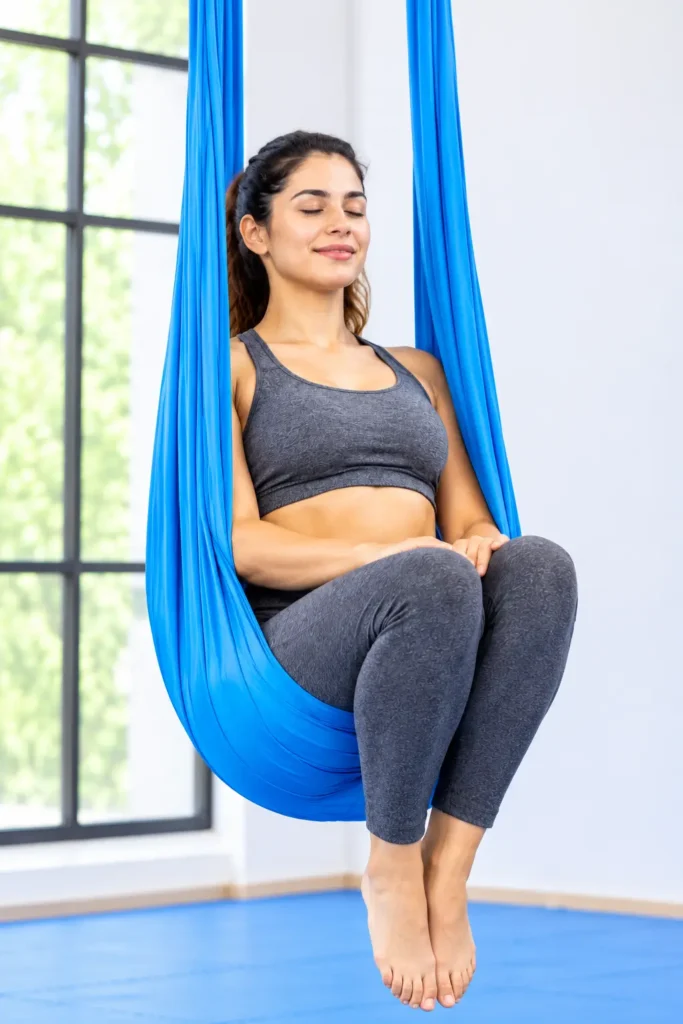
4. Cocoon rest. Sit in the hammock, lean back, and let the fabric wrap you while your feet rest on the floor or hang freely. Stay 3-5 minutes and breathe slowly.
Easier version: Keep your feet on the floor for every pose and stay no higher than your hips.
Harder version: Add a gentle inversion with your instructor spotting you, and hold for just 10-20 seconds at first.
Coach’s Tip: Come out of any head-low position slowly. Pause in a seated position for 20-30 seconds so the dizzy feeling can fade before you stand.
Safety Notes: Who Should Be Careful
Aerial yoga is not right for everyone, mainly because of the head-low positions. Studio guidance quoted in the ACE report says aerial yoga is not recommended for people with high blood pressure, cataracts, or pregnancy, or anyone for whom hanging upside down could cause problems.
The reasoning is solid. According to the Mayo Clinic’s inversion therapy guidance, staying inverted for more than a couple of minutes can slow your heartbeat, raise blood pressure, and sharply increase eye pressure. Cleveland Clinic similarly warns that inversion poses raise intraocular pressure, which makes it unsafe for people with glaucoma.
Talk with your doctor first if any of these apply:
- Glaucoma, retinal problems, or other eye conditions
- High blood pressure or heart disease
- Pregnancy or recent surgery
- Vertigo, inner-ear problems, or recent head or neck injury
- Shoulder or wrist injuries that limit hanging or pulling
Common Mistake: Rushing into full inversions in your first week. Instead, build up through supported poses first, then add short inversions only when you feel steady and your instructor approves.
How to Choose a Class or Hammock
A good class matters more than any gadget. Look for a studio with certified aerial instructors, padded flooring, and rigging installed by a qualified professional. Ask how many people are in each class, because smaller groups get more feedback on form.
If you want a home setup, be careful. A hammock is only as safe as its anchor point, so ask a qualified rigger or contractor to confirm the ceiling beam can handle dynamic loads. Check the manufacturer’s stated weight capacity as well, and keep a mat under you. If space is tight, our list of apartment workout equipment can help you plan.
For clothing, wear fitted long sleeves and leggings that cover the backs of your knees. Avoid zippers, jewelry, and lotion, since they can snag or slip on the fabric. Finally, eat lightly about two hours before class to avoid nausea in head-low poses.
Related Tips for Better Results
- Be consistent. Two classes a week for eight weeks will beat one big session a month.
- Mix your training. Add the CDC’s weekly strength and cardio targets so aerial yoga is one piece of the plan.
- Hydrate. Drink water before and after class, especially in a warm studio.
- Track how you feel. Note energy, sleep, and stiffness after each class rather than chasing calories.
- Be patient with grip. Forearm fatigue fades within a few weeks for most beginners.
FAQ
Is aerial yoga good for weight loss? In the ACE study, a class burned about 320 calories on average, and the women improved some body-composition measures. However, it was a small group, so results vary. Aerial yoga can add to your weekly activity, but weight changes depend on your overall movement and eating habits. Check with a doctor for weight goals.
Is aerial yoga hard for beginners? Most beginner classes are approachable because the hammock supports you. The hardest parts are usually grip fatigue and getting used to the swaying fabric. Start with supported poses, tell your instructor you are new, and skip inversions until you feel steady. Many people adapt within three or four classes.
Does aerial yoga help back pain? Yoga in general may help ease low-back pain, according to NCCIH, but aerial-specific research is limited. Spinal decompression claims are unproven, and inversion carries risks for some people. If you have back pain, ask your doctor or physical therapist before class, and request supported, non-inverted options.
How often should you do aerial yoga? For beginners, one to two 45-60 minute classes a week is a sensible start. After a month, you can move to two or three if you recover well. Keep other strength and cardio sessions on non-class days, so you meet standard weekly activity guidelines.
Who should not do aerial yoga? People with glaucoma, uncontrolled high blood pressure, heart disease, or pregnancy should get medical clearance first and may need to skip inversions altogether. Recent surgery, vertigo, and certain shoulder or neck injuries also call for caution. When in doubt, ask your healthcare provider before booking a class.
What should I wear to aerial yoga? Wear fitted, breathable clothing with long sleeves and leggings that cover the backs of your knees to protect your skin from fabric friction. Skip zippers, jewelry, and lotion. Use a sports top that stays put when you are upside down or leaning back, and go barefoot or in grippy socks.
Conclusion
Aerial yoga benefits include deeper stretches, a stronger core, better balance awareness, and a calmer mind, delivered in a fun, low-impact format. The best evidence comes from one small ACE-commissioned study and from research on yoga in general, so enjoy the benefits without expecting miracles.
Start with supported poses, build up to two or three classes a week, and treat inversions with respect. Pair your sessions with regular strength and cardio work, and you will get the most from this unusual workout.
