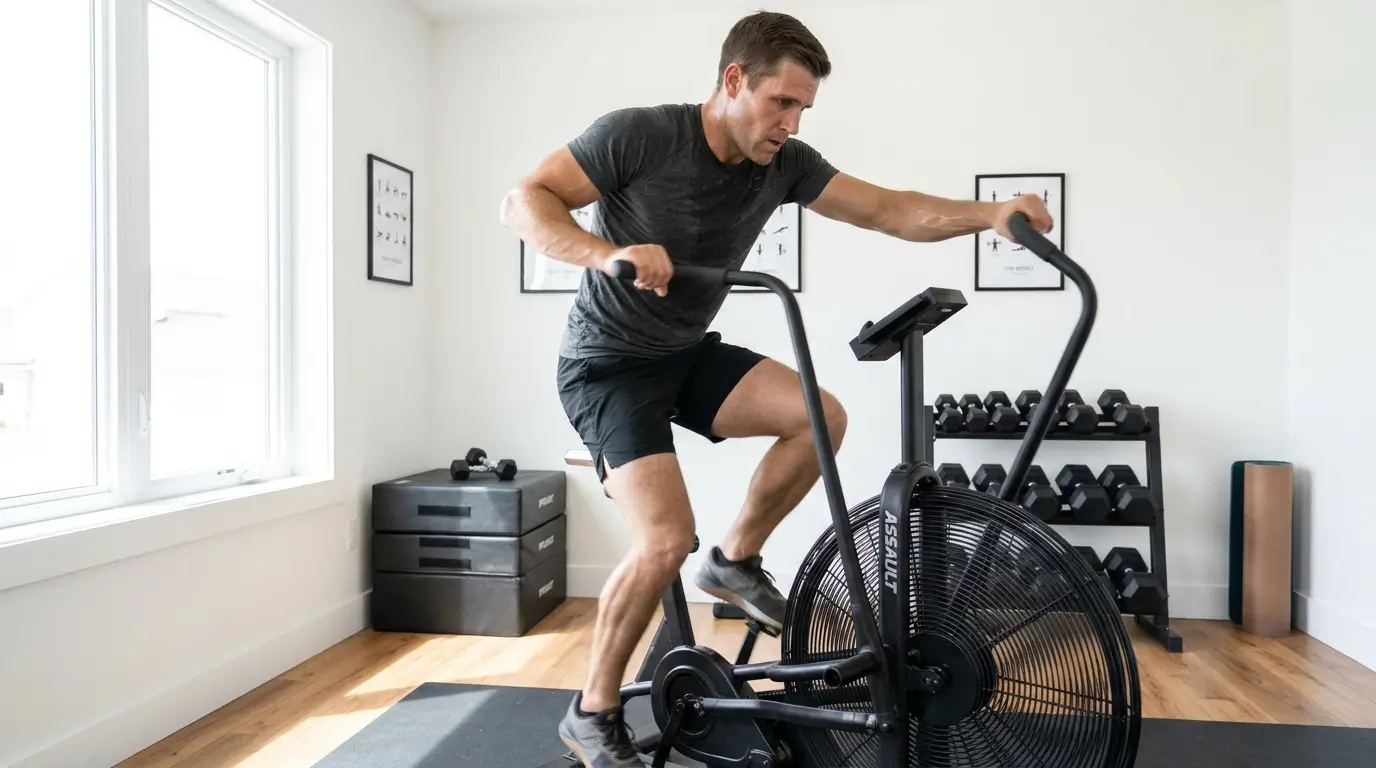
Air bike benefits start with a simple idea: you pedal against a fan, and the harder you push, the harder it pushes back. That design leaves even fit people gasping within a minute, and it is why this machine is so effective for short, intense cardio.
That one feature explains most of what the air bike does. The machine matches your effort automatically, so you control the difficulty. This guide covers what the research supports, what it doesn’t, and how to use the bike safely.
Quick Answer: Air bike benefits include improved cardiovascular fitness, efficient interval training, and full-body muscle involvement with low joint impact. Research suggests short sprint intervals can improve aerobic fitness in a few weeks. However, an air bike is mainly a cardio tool. It won’t replace strength training or guarantee fat loss.
What Is an Air Bike, and How Does It Work?
An air bike is a stationary bike with a large fan instead of a magnetic or friction brake. Moving handles connect to the pedals, so your arms and legs work together. As you speed up, the fan creates more air resistance. As you slow down, the resistance drops.
That design has two practical effects. First, there is no dial to set. Second, you can’t coast at a high resistance, because the load follows your effort. Researchers describe the machine as a stationary bike with added arm levers that became popular in high-intensity functional training and interval training.
Air Bike Benefits for Your Heart and Lungs
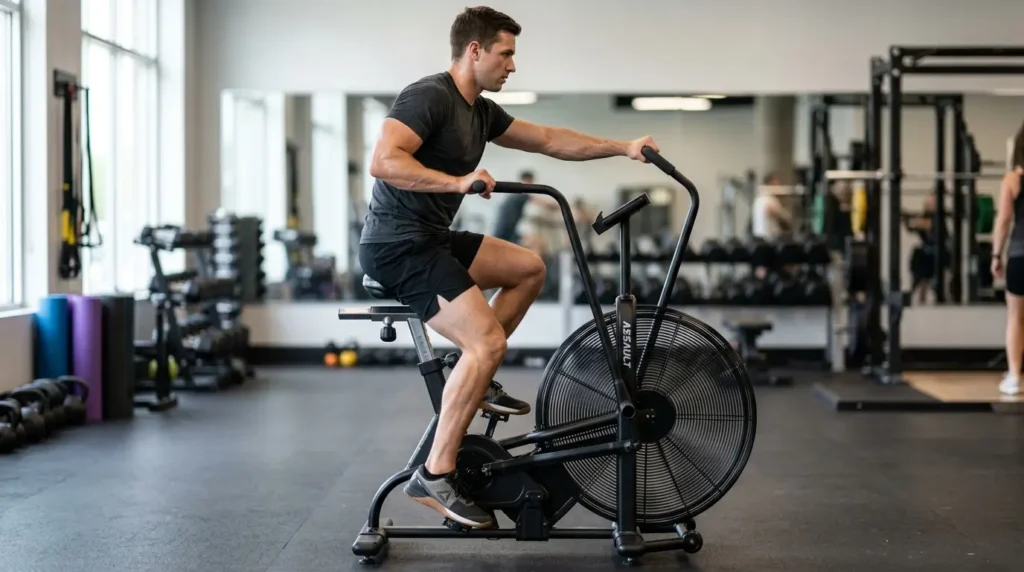
The biggest air bike benefit is cardiorespiratory fitness. In other words, the bike trains your heart, lungs, and muscles to deliver and use oxygen more efficiently.
A systematic review of 26 studies found that air biking can push heart rate, ventilation, and blood lactate to high levels. The authors concluded it appears well suited to developing cardiorespiratory function. They also noted that few intervention studies exist, so firm training guidelines are still missing.
Furthermore, one small study compared maximal tests on an air bike and a regular cycle ergometer. Maximal oxygen uptake and peak heart rate were significantly higher on the air bike [VERIFY authors and year]. That suggests using the arms and legs together lets people work harder. However, it was a small test, not a long-term training study.
More broadly, a narrative review of HIIT reports that repeated high-intensity efforts are linked to better stroke volume and VO2max. Since the air bike is built for intervals, those findings apply to it.
What the training studies show
Two studies stand out for beginners and home gym owners.
- Sprint intervals work in a short time. In a Journal of Strength and Conditioning Research trial, 32 recreationally active people trained three days a week for four weeks. The sprint groups did all-out intervals on an air bike, and the comparison group did 30 minutes of moderate cycling. The authors concluded air bike sprint training produced cardiorespiratory adaptations while saving time.
- Twice a week may be enough to notice changes. In a small study of 20 active young adults, air bike intervals of 15 to 45 seconds were done twice weekly. Aerobic endurance and VO2peak improved, and so did back squat and pulling strength. [VERIFY journal and year]. Because the group was small and young, treat the results as promising rather than proven.
Coach’s Tip: Judge effort by feel, not by the screen. On a hard interval, you should be unable to hold a full sentence. On an easy recovery, you should be able to speak in short phrases.
Air Bike Benefits for Calorie Burn and Fat Loss
Many people buy an air bike for weight loss. The honest answer is that it can help, but the bike alone doesn’t do the work.
Intervals are demanding, so you burn energy quickly. Even so, a systematic review and meta-analysis found that both HIIT and moderate steady training improved body composition in young and middle-aged adults. It also noted that experts still disagree on whether HIIT beats steady cardio for fat loss. Therefore, the best plan is the one you will repeat each week.
Meanwhile, be careful with the calorie display. A 2021 comparison of three air bikes (Assault, Echo, and Beast) found the machines gave different distance and calorie values for similar work. The authors still judged all three suitable for training. Consequently, compare your calorie numbers only on the same machine.
For related reading, see whether an elliptical burns belly fat or how a treadmill compares.
Check with a doctor before starting a weight loss plan, especially if you have a medical condition.
Air Bike Muscles Worked
An air bike is a full-body cardio machine, so the muscles worked include both the upper and lower body.
| Body area | Muscles | What they do |
|---|---|---|
| Legs (primary) | Quadriceps, glutes, hamstrings, calves | Drive the pedals |
| Upper back (secondary) | Lats, rhomboids, rear deltoids | Pull the handles toward you |
| Chest and shoulders | Pectorals, front deltoids, triceps | Push the handles away |
| Arms | Biceps, forearms | Pull and grip |
| Core | Abdominals, obliques, spinal muscles | Keep your torso steady |
During a hard sprint, the legs usually do most of the work. The arms then add power and reduce the load on the legs. Because of this, the arms often tire early in a session. That is normal.
Common Mistake: Many beginners stiffen their arms and “hang” on the handles. Instead, push and pull with a steady rhythm and keep your shoulders relaxed. Otherwise, your neck and upper traps will fatigue before your legs do.
Does an Air Bike Build Muscle?
It builds muscular endurance well. It is less effective for building size and maximal strength.
Pedaling against air resistance trains muscles to work repeatedly under fatigue. However, the CDC recommends muscle-strengthening activity on two or more days a week that works all major muscle groups. That’s separate from aerobic exercise. So pair the air bike with squats, rows, presses, or the moves in a calisthenics exercise list.
Low Impact, Time Efficient, and Easy to Scale
Three other air bike benefits matter in daily life.
- Low impact. Your body is seated, so there is no pounding on your knees, hips, or ankles as in running. A trial in adults with type 2 diabetes used a non-weight-bearing all-extremity ergometer. It was feasible and well tolerated, and no adverse events needed medical treatment. That was an all-extremity machine, not a specific air bike model. [VERIFY]
- Time efficient. Interval sessions can take 10 to 20 minutes. This helps if lack of time is your main barrier.
- Self-adjusting. A beginner and an athlete can use the same bike. Each simply pedals harder or softer.
In that diabetes trial, 58 people trained four times a week for eight weeks. Aerobic fitness improved by 10% with intervals and 8% with steady training, a similar result. If you are managing diabetes or another condition, talk with your doctor first.
Air Bike Benefits vs. Limits: A Quick Summary
| Claim | What the evidence supports | Caveat |
|---|---|---|
| Improves aerobic fitness | Supported in short trials | Small samples |
| Time-efficient training | Supported by sprint studies | Hard efforts required |
| Burns calories | Yes, like any hard exercise | Displays vary by machine |
| Guaranteed fat loss | Not supported | Diet and consistency matter |
| Builds big muscle | Limited | Add strength training |
| Low joint impact | Seated, non-weight-bearing | Seat fit still matters |
How to Use an Air Bike: Sample Workouts
The best air bike workout depends on your fitness level. Start with the beginner plan even if you are athletic. The first session often feels much harder than expected.
Set up first
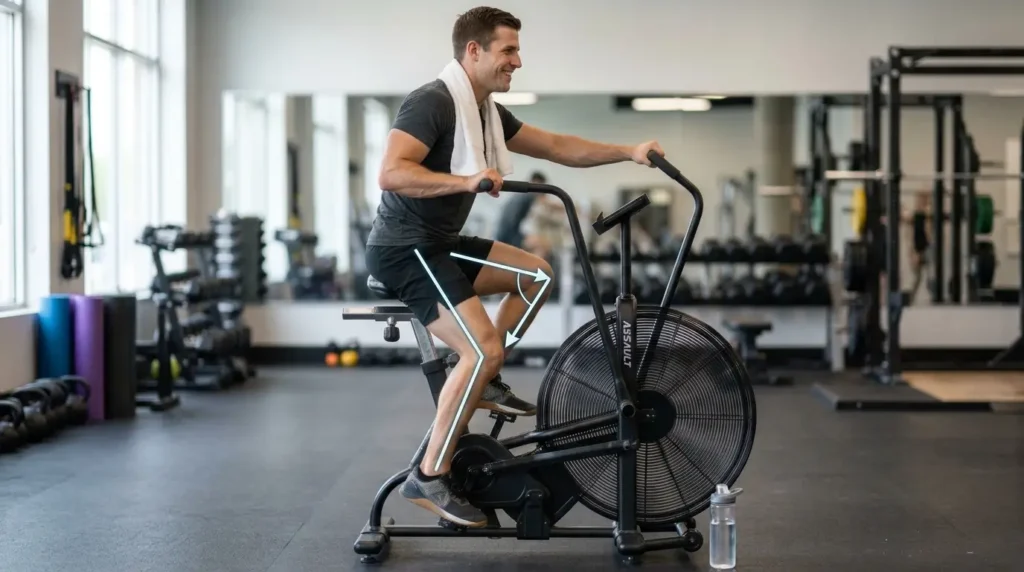
- Adjust the seat so your knee is slightly bent at the bottom of the pedal stroke.
- Sit tall with a long spine and relaxed shoulders.
- Grip the handles lightly.
- Push and pull evenly with your arms as you pedal.
- Breathe steadily. Don’t hold your breath.
Beginner workout (about 15 minutes)
| Segment | Time | Effort |
|---|---|---|
| Warm-up | 4 min | Easy pedaling |
| Intervals × 6 | 15 sec hard / 60 sec easy | Hard = 7 out of 10 |
| Cool-down | 3 min | Very easy |
Intermediate workout (about 18 minutes)
| Segment | Time | Effort |
|---|---|---|
| Warm-up | 5 min | Easy to moderate |
| Intervals × 8 | 20 sec hard / 60 sec easy | Hard = 8 out of 10 |
| Cool-down | 4 min | Very easy |
Advanced workout (about 22 minutes)
| Segment | Time | Effort |
|---|---|---|
| Warm-up | 6 min | Build gradually |
| Intervals × 8 | 30 sec hard / 90 sec easy | Hard = 9 out of 10 |
| Cool-down | 5 min | Very easy |
Easier version (regression): Shorten the hard efforts to 10 seconds. Alternatively, lengthen the rest to 90 seconds and keep your effort at 6 out of 10.
Harder version (progression): First add one more round. Then add 5 seconds to each hard effort. Only after that should you shorten the rest.
Frequency: Two to three sessions weekly is a sensible range. Leave at least one day between hard sessions. This lines up with the CDC guidance, which counts 75 minutes of vigorous activity a week as equal to 150 minutes of moderate activity.
Coach’s Tip: Don’t sprint flat out in your first round. Pace the first interval at about 80% effort. If it feels manageable, increase it in later rounds.
Safety: Who Should Be Careful
Air bike intervals are intense. Therefore, take extra care if any of the following apply:
- You have heart disease, high blood pressure, or diabetes.
- You are pregnant or postpartum.
- You are a senior who has not exercised in a while.
- You have shoulder, back, or knee pain.
- You feel chest pain, dizziness, or unusual shortness of breath.
In those cases, check with a doctor or physical therapist before training. Stop if you feel faint, have chest discomfort, or feel sharp joint pain. Older people can look at options in our stationary bike guide for older people, which suit gentler training.
Related Tips for Better Results
- Warm up every time. Cold muscles and a cold heart handle sprints poorly.
- Track the same numbers. Use time, rounds, and RPE rather than calories.
- Rotate your cardio. Mixing machines spreads the load. Our rowing machine vs. elliptical comparison helps with that choice.
- Consider alternatives. For a rowing option, read the Concept2 rower review. For another arm-and-leg machine, see Maxi Climber vs. VersaClimber.
- Plan your leg days. If you run, see our notes on running after leg day.
- Small spaces work. An air bike is one of the options in our apartment workout equipment list. Check the machine’s footprint first. [VERIFY dimensions]
Air Bike Benefits: Frequently Asked Questions
Is an air bike good for weight loss?
It can support weight loss because hard intervals burn energy quickly. However, research shows steady cardio improves body composition too. Results depend mostly on consistency, sleep, and nutrition. Talk with a doctor before starting a weight loss plan, especially if you have a health condition.
What muscles does an air bike work?
It works your quadriceps, glutes, hamstrings, and calves most. The moving handles add your lats, shoulders, chest, triceps, and biceps. Your core stabilizes your torso throughout. That is why the air bike counts as a full-body cardio machine.
Is an air bike hard on the knees?
It is generally gentler than running because your body is seated and not pounding the ground. Still, a seat that is too low can strain the knees. Keep a slight bend at the bottom of each stroke. Stop if pain appears.
How long should I ride an air bike?
Most people do well with 10 to 20 minutes of intervals, plus a warm-up and cool-down. Research cited above used short sprints in sessions lasting only a few minutes of hard work. Begin with the beginner plan and build gradually.
Can beginners use an air bike?
Yes. The bike responds to your effort, so you control the difficulty. Start with 10 to 15 seconds of hard work and at least 60 seconds of easy pedaling between rounds. Add rounds slowly over several weeks.
Are air bike calorie counts accurate?
Not reliably. A comparison of three popular air bikes found different calorie and distance readings for similar work. Use the display to track your own progress on one machine. Don’t compare it with other bikes or with other brands.
Conclusion: What Air Bike Benefits Really Add Up To
To sum up, air bike benefits are real but specific. The machine is an efficient way to train your heart and lungs. It works your arms and legs together and puts little impact on your joints. Short interval sessions have shown fitness improvements in small trials.
That said, an air bike is not magic. It doesn’t replace strength training, and its calorie readout needs caution. Use it two or three times a week, progress slowly, and pair it with resistance work. If you do, you will get what the air bike actually does best.
