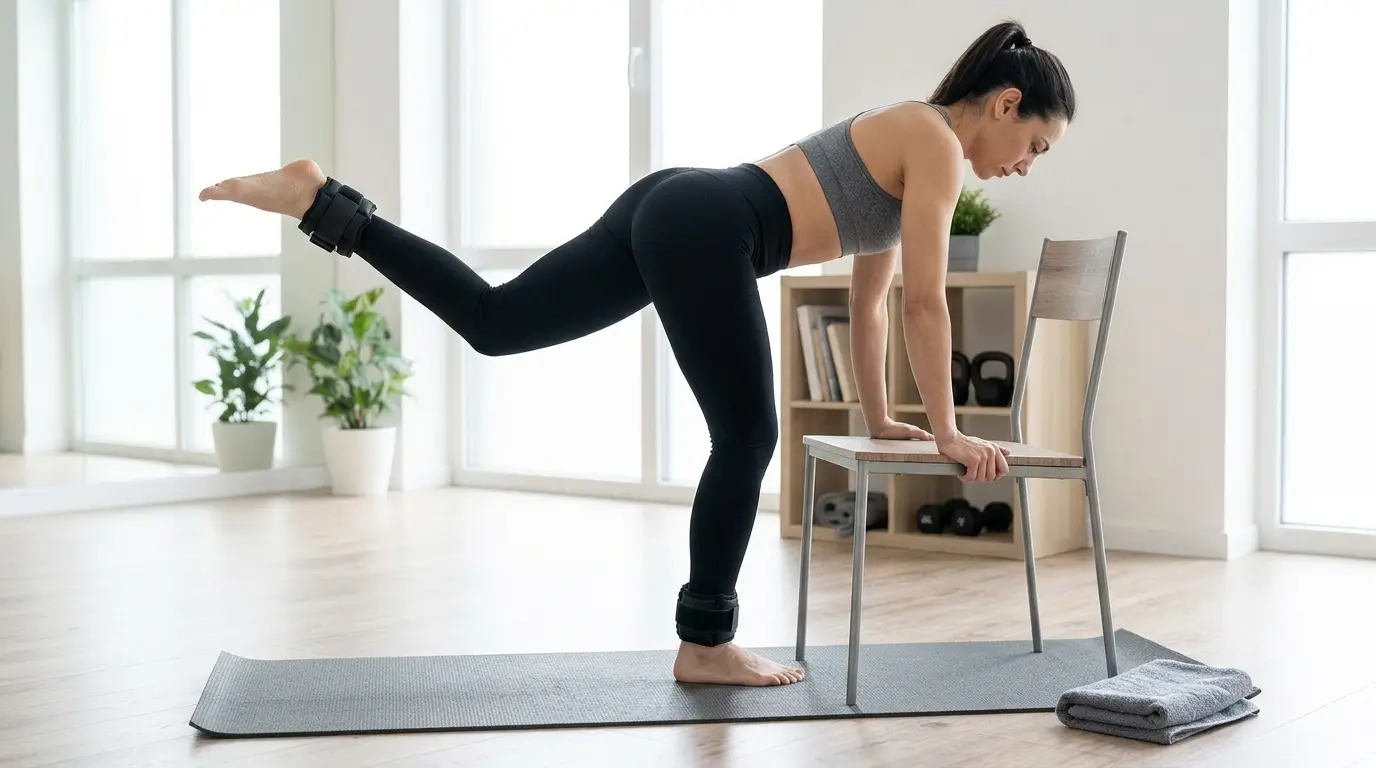
Ankle weights benefits are real, but they are narrower than social media suggests. Strap on a pair, and your leg and hip muscles do get more to work with. The catch is where and how you use them, because the same weights that help a leg lift can make a brisk walk harder on your joints.
In this guide, I’ll explain what ankle weights actually do, what research and medical sources say, and which exercises make the most of them. I’ll also cover safe weights, sets and reps, and a short sample routine. Think of it as a coach’s honest answer to a common question: are ankle weights worth it?
Quick Answer: Ankle weights benefits come from added resistance on leg and hip exercises, such as leg lifts and glute kickbacks. They also raise the energy cost of walking and running. However, Harvard Health and Mayo Clinic sources advise against wearing them for walking or aerobics, because they may strain the ankle, knees, hips, and back.
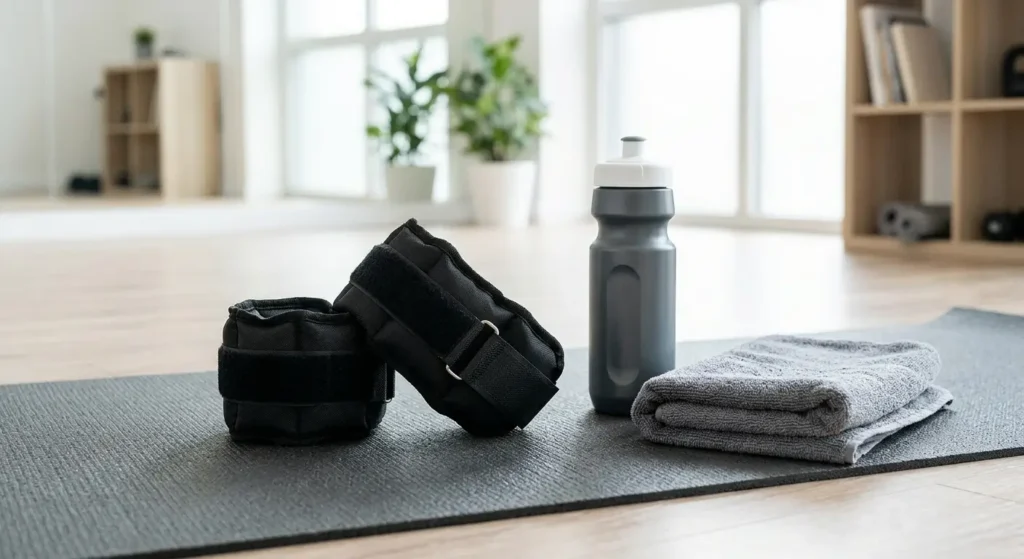
Ankle Weights Benefits: What the Research Says
Let’s separate what is well supported from what is hype. In short, ankle weights work best as a small, targeted tool, not as an “add-on” to everything you do.
Benefit 1: More Resistance for Leg and Hip Exercises
This is the clearest of all the ankle weights benefits. A Harvard-affiliated physical therapist quoted by Harvard Health says wearable ankle weights are helpful for exercises that target the leg and hip muscles, like leg lifts. That makes sense. Bodyweight leg lifts get easy quickly, and a cuff on each ankle makes them harder without a gym.
The muscles that benefit most are the gluteus medius (outer hip), gluteus maximus (the main butt muscle), hamstrings, quadriceps, and hip flexors. Which ones work depends on the movement you pick, which I’ll cover below.
Benefit 2: A Higher Energy Cost When You Walk or Run
Ankle weights do make walking and running harder. Mayo Clinic content notes that ankle weights can increase the energy you burn while walking [VERIFY: swap in the mayoclinic.org page if you prefer], though they may strain the ankle joint and leg muscles.
Researchers have also looked at where the weight sits. A study in Medicine & Science in Sports & Exercise [VERIFY: replace with the PubMed link] found that the metabolic cost of walking rises when mass is added to the legs, and that thigh loading was relatively inexpensive. In other words, weight near your feet costs more than weight near your hips.
Running shows the same pattern. In a treadmill study of 15 runners at about 6.7 mph (10.8 km/h) [VERIFY year and DOI], every 1,000 g (about 2.2 lb) added per leg raised gross metabolic power by roughly 16% at the foot and 11% at the shank for women. The figures were 11% and 8% for men, and only 4% for loads on the thigh.
That sounds like a perk. Still, “harder” does not always mean “better.” More cost often means more stress on tendons and joints, which is why medical sources advise caution.
Benefit 3: A Simple Way to Progress
Ankle weights are cheap, small, and easy to store. Most cuffs come in light steps, so you can add a little load every few weeks. This is the same idea as progressive overload with dumbbells, only scaled for smaller leg and hip moves.
Adults should also do muscle-strengthening activity on two or more days a week that works all major muscle groups, according to the CDC adult activity guidelines. A short ankle-weight session can count toward that goal when it is part of a fuller plan.
What Ankle Weights Do Not Do
Here is the honest part. Ankle weights are light. Most cuffs run about 1-10 lb (0.5-4.5 kg), which is far less than you can squat, press, or deadlift. So they will not replace heavy leg training.
They also do not fix walking form, and they are not a shortcut. Harvard Health warns that during walking or aerobics, ankle weights force you to use your quadriceps (front thigh) rather than your hamstrings (back thigh). That can leave you with an uneven load on your legs.
Ankle Weights Benefits vs. Risks by Activity
Use this table as a quick filter. It follows the advice from Harvard Health and Mayo Clinic content, plus the research above.
| Activity | Possible Upside | Main Concern | Coach’s Verdict |
|---|---|---|---|
| Leg lifts, glute kickbacks | Extra resistance for glutes and hips | Light loads only; slow reps | Good fit |
| Walking | Higher energy cost | Ankle strain; quad-dominant gait; joint pull | Skip |
| Running or jogging | Higher metabolic cost | More distal weight costs more; joint stress | Skip |
| Aerobics or dance | More effort | Same issues as walking | Skip |
| Rehab exercises | Supervised, light loading | Needs a clinician’s plan | Only with a professional |
If you want a harder walk, there are better options. Mayo Clinic content suggests simply picking up the pace, adding short jogging bursts if you are fit, or hiking uphill. Our guide on slow jogging vs. fast walking explains how to scale intensity safely.
Real Ankle Weights Benefits for Strength Training: Step-by-Step Exercises
Now for the useful part. These four moves give you the best return on ankle weights. Do them slowly, and stay in control of every rep.
Starting weights: Beginners should start with 1-3 lb (0.5-1.4 kg) per ankle. Intermediate lifters often use 3-5 lb (1.4-2.3 kg). Advanced lifters may use 5-10 lb (2.3-4.5 kg) on moves like side-lying leg lifts. Choose a weight that lets you finish every rep with a smooth tempo.
1. Side-Lying Leg Lift (Hip Abduction)
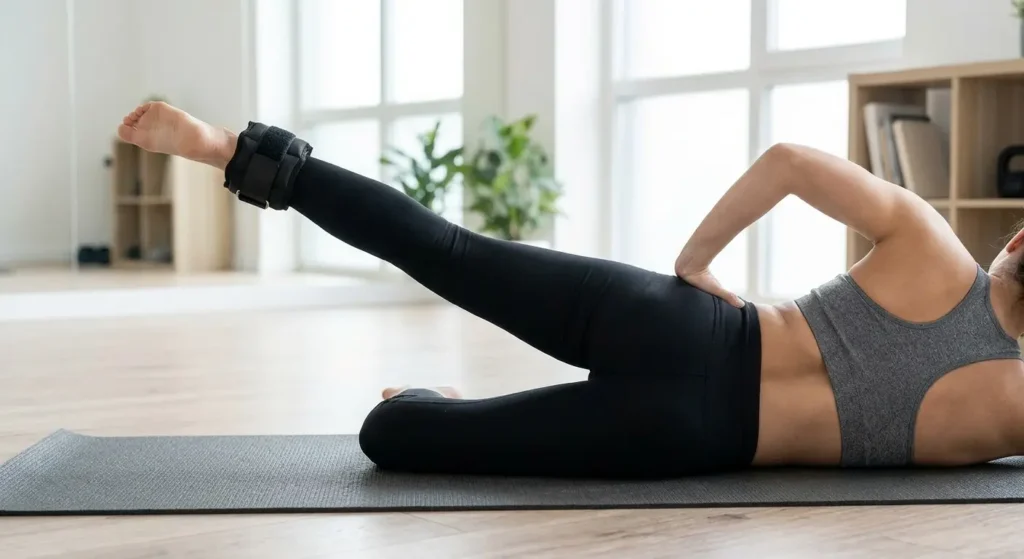
- Lie on your side with your legs straight and your hips stacked. Rest your head on your arm.
- Strap a cuff just above your top ankle.
- Slightly point your toes forward, not up, to keep your outer hip in charge.
- Lift your top leg about 12-18 inches (30-46 cm) over 2 seconds.
- Pause for 1 second at the top.
- Lower slowly over 3 seconds. Do not let the leg drop.
What it should feel like: a burn in the outer hip and upper glute. You should not feel it in your lower back.
Coach’s Tip: Place your top hand on your hip. If your hip rolls backward as you lift, the weight is too heavy or your range is too big. Shorten the lift and keep your pelvis stacked.
2. Standing Glute Kickback
- Stand facing a wall or sturdy chair. Rest your hands on it for balance.
- Put a cuff on the working ankle.
- Keep your torso tall, and your core braced.
- Drive the working leg straight back about 6-10 inches (15-25 cm) behind you, squeezing your glute.
- Hold for 1 second.
- Return slowly. Do not swing.
What it should feel like: a squeeze in the glute, not a pinch in the low back. If you arch your back, shorten the range.
3. Supine Straight Leg Raise
- Lie on your back. Bend one knee with the foot flat.
- Straighten the other leg and wear the cuff on that ankle.
- Tighten your thigh and lift the straight leg until it lines up with the bent knee.
- Hold for 1-2 seconds, then lower over 3 seconds.
What it should feel like: a strong effort in the front of the thigh (quadriceps) and hip flexor. Your lower back should rest gently on the floor.
4. Standing Leg Curl
- Hold a wall or chair and stand tall.
- Wear a cuff on the working ankle.
- Bend your knee and bring your heel toward your glute. Keep your thighs side by side.
- Pause for 1 second, then lower slowly over 3 seconds.
What it should feel like: work in the back of the thigh (hamstrings). Because Harvard Health notes that ankle weights during walking can overuse the quads, this move helps you give the hamstrings some attention on purpose.
Common Mistake: Wearing ankle weights for a regular walk or jog, assuming it makes the workout “free” extra effort. Instead, take them off for cardio, and use them only for controlled strength moves like the ones above. If you want a harder walk, walk faster or choose a hill.
Sets, Reps, and Weight for Ankle Weights by Goal
Because ankle weights are light, they favor higher reps and slow tempo. This table shows how to set it up. Add sets slowly, not all at once.
| Goal | Sets | Reps | Effort | Rest | Tempo (up / down) |
|---|---|---|---|---|---|
| Strength | 3-4 | 8-12 | 1-2 reps left | 60-90 sec | 2 sec / 3 sec |
| Muscle size | 3 | 12-15 | 1-3 reps left | 45-60 sec | 2 sec / 3 sec |
| Endurance | 2-3 | 20-30 | 2-4 reps left | 30-45 sec | 1 sec / 2 sec |
Tips for using the table
- If you can do more than 15 reps easily for strength, the cuffs are too light. Move to a cable station or machine instead of stacking more cuffs.
- Train each exercise on both legs. Always do the same reps on each side.
- Frequency: Two to three sessions a week is plenty. You can train your lower body often, but give tired muscles a day off. Our post on whether you can do squats every day covers how to think about leg training frequency.
Easier and Harder Versions
Everyone starts in a different spot. Use this ladder to match your level.
Easier versions (regressions)
- No weight, slow tempo: Do 10 reps with a 4-second lowering phase.
- Smaller range: Lift your leg only half as high.
- Seated or supported: Do leg lifts while seated or lying down to cut balance demands.
- 1 lb (0.5 kg) cuffs: Start light and build.
Harder versions (progressions)
- Slower tempo: Take 4 seconds to lower each rep.
- Pause reps: Hold the top for 3 seconds.
- Add a set: Go from 2 to 3 or 4 sets.
- Heavier cuffs: Add 1 lb (0.5 kg) once you hit the top of your rep range.
- Isometric holds: Add a hold at the end of each set. For more ideas, see our list of isometric leg exercises.
Common Mistakes and Fixes
Light weights make people careless. Here are the errors I would watch for.
- Swinging the leg. Momentum does the work, not the muscle. Fix: slow the lowering phase to 3 seconds.
- Arching the lower back. This is common in kickbacks. Fix: shorten the range and brace your abs.
- Loose straps. A cuff that slides can distract you and tug at the joint. Fix: fasten it snugly above the ankle bone, but not so tight that it pinches.
- Going too heavy too fast. A heavy cuff pulls on the ankle and knee. Fix: use a weight you can control for every rep.
- Skipping the other leg. One side gets stronger than the other. Fix: match sets and reps on both legs.
- Using them all day. Wearing weights during daily activity changes how you move. Fix: put them on for your workout, then take them off.
- Doing too much right before a run. Tired legs change your stride. Our guide on running after leg day explains how to space the two.
Safety Notes: Who Should Be Careful
Ankle weights are low-impact for strength moves. Even so, they are not right for everyone. Harvard Health advises talking to your doctor before buying wearable weights, especially if you have back, joint, or balance problems. The ankle weights’ benefits only count if you stay pain-free, so keep every rep slow and controlled.
Take extra care, or get advice first, if any of these apply:
- You have current knee, hip, ankle, or back pain.
- You have had a joint injury or surgery.
- You have balance problems or a history of falls.
- You are an older adult or new to exercise.
- You are pregnant or postpartum.
- You have a medical condition such as arthritis or high blood pressure.
Check with a doctor or physical therapist before starting if any of these apply. Also, stop any move that causes sharp pain, a pinching feeling in the joint, or tingling. A muscle burn is normal, but joint pain is a warning sign.
Remember why these cautions exist. Harvard Health notes that wearable ankle weights pull on the ankle joint, which poses a risk of tendon or ligament injuries to the knees, hips, and back. For walking or jogging, a study of added mass on the lower body [VERIFY authors] also notes that metabolic rate has been reported to rise with heavier and more distal loads. So stay away from ankle weights for cardio.
Sample Workout Using Ankle Weights
This 20-minute routine fits a home workout. Warm up first with 5 minutes of easy walking and a few bodyweight leg swings. Do the warm-up without weights.
| Order | Exercise | Sets | Reps | Rest |
|---|---|---|---|---|
| 1 | Side-lying leg lift | 3 | 12-15 per leg | 45 sec |
| 2 | Standing glute kickback | 3 | 12-15 per leg | 45 sec |
| 3 | Standing leg curl | 2-3 | 12-15 per leg | 45 sec |
| 4 | Supine straight leg raise | 2 | 12-15 per leg | 45 sec |
Weekly plan: Do this routine on Tuesday and Friday. On other days, walk without weights or train upper body. If you want a full-body day, pair it with our leg and shoulder workout.
Progression: Each week, add one rep per set. Once you reach 15 reps on every set with smooth form, add 1 lb (0.5 kg) per ankle or slow your tempo by a second.
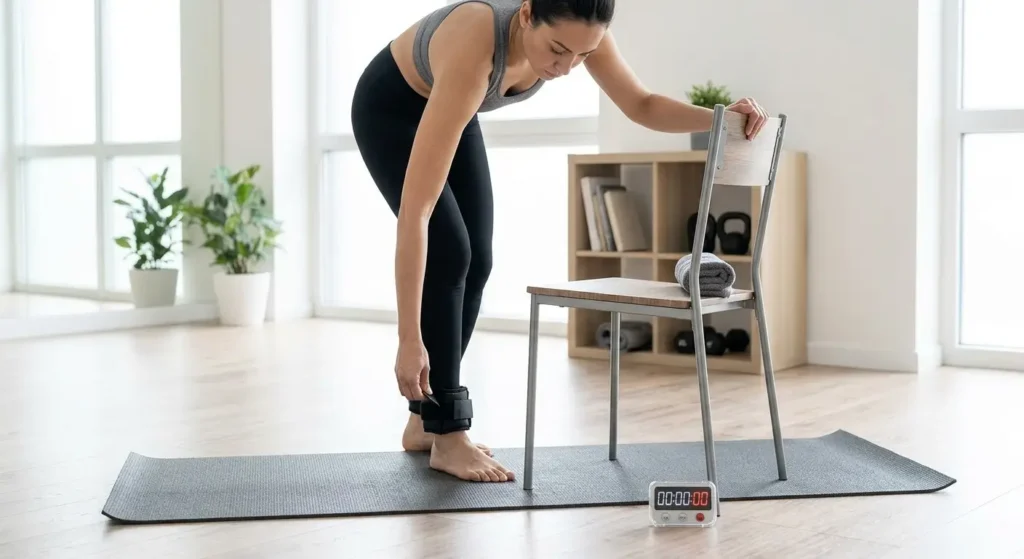
Related Tips: Better Ways to Add Resistance
Ankle weights are one tool. Depending on your goals, another may serve you better.
- Resistance bands. Mayo Clinic content suggests resistance tubing as an option that offers weight-like resistance. Bands are also easy to travel with.
- Bodyweight moves. Squats, lunges, and push-ups work too. Check our calisthenics exercises list for ideas that need no gear.
- A cable station. Cable kickbacks let you add a heavier load than cuffs can offer. If you want an all-in-one machine at home, read our best Bowflex home gym overview.
- A smarter walk. To get more from walking, pick up the pace, add short jogging bursts if you are fit, or climb hills.
In the end, ankle weights’ benefits depend more on how you use the cuffs than on which pair you buy. Choosing a pair is simple. Look for cuffs with an adjustable or removable weight so you can progress. Check that the strap feels secure and comfortable, and that the weight sits evenly around the ankle. If you are building a small home setup, our guide to the best apartment workout equipment shows compact tools that pair well with cuffs.
FAQ
Do ankle weights build muscle?
They can, when used on leg and hip exercises with enough effort. Ankle weights add resistance, which challenges muscles like the glutes and quads. However, the loads are light, so heavier tools like cables, machines, or dumbbells are better once the cuffs feel easy.
Are ankle weights good for walking?
Generally, no. Mayo Clinic content says ankle weights aren’t recommended for brisk walking because they may strain the ankle joint and leg muscles. Harvard Health also advises against wearing them while walking. To make walks harder, walk faster, climb hills, or add short jogging bursts.
How heavy should ankle weights be for beginners?
Start with 1-3 lb (0.5-1.4 kg) per ankle. Pick a weight that lets you finish 12-15 slow reps with good form. Add 1 lb (0.5 kg) only after you reach the top of your rep range on every set for two sessions in a row.
Can ankle weights hurt your knees?
They can, mainly when used for walking, jogging, or aerobics. Harvard Health notes that ankle weights pull on the ankle joint, which may raise the risk of tendon or ligament injuries to the knees, hips, and back. If you have knee pain, ask a doctor or physical therapist first.
Do ankle weights help you lose weight?
They may raise the energy cost of an activity slightly, but they are not a weight-loss tool by themselves. Results depend on your overall training, eating, and sleep. If weight loss is your goal, talk with a doctor or registered dietitian for a plan that suits you.
Are ankle weights good for older adults?
They can be used for seated or supported leg exercises, but caution matters. Balance, joint health, and medical conditions all affect what is safe. Harvard Health advises talking with a doctor first, especially with back, joint, or balance problems. A physical therapist can set the right weight.
Conclusion
Ankle weights’ benefits are real, but they are specific. They shine on controlled leg and hip exercises like leg lifts, kickbacks, and leg curls, where a small extra load makes a bodyweight move harder. They are a poor fit for walking, jogging, and aerobics, where medical sources warn about joint strain and uneven muscle use.
Your next step is simple. Pick one or two light cuffs, run through the sample routine twice a week, and track your reps. Add load slowly, and keep your cardio weight-free. Used that way, ankle weights’ benefits add up without adding risk.
