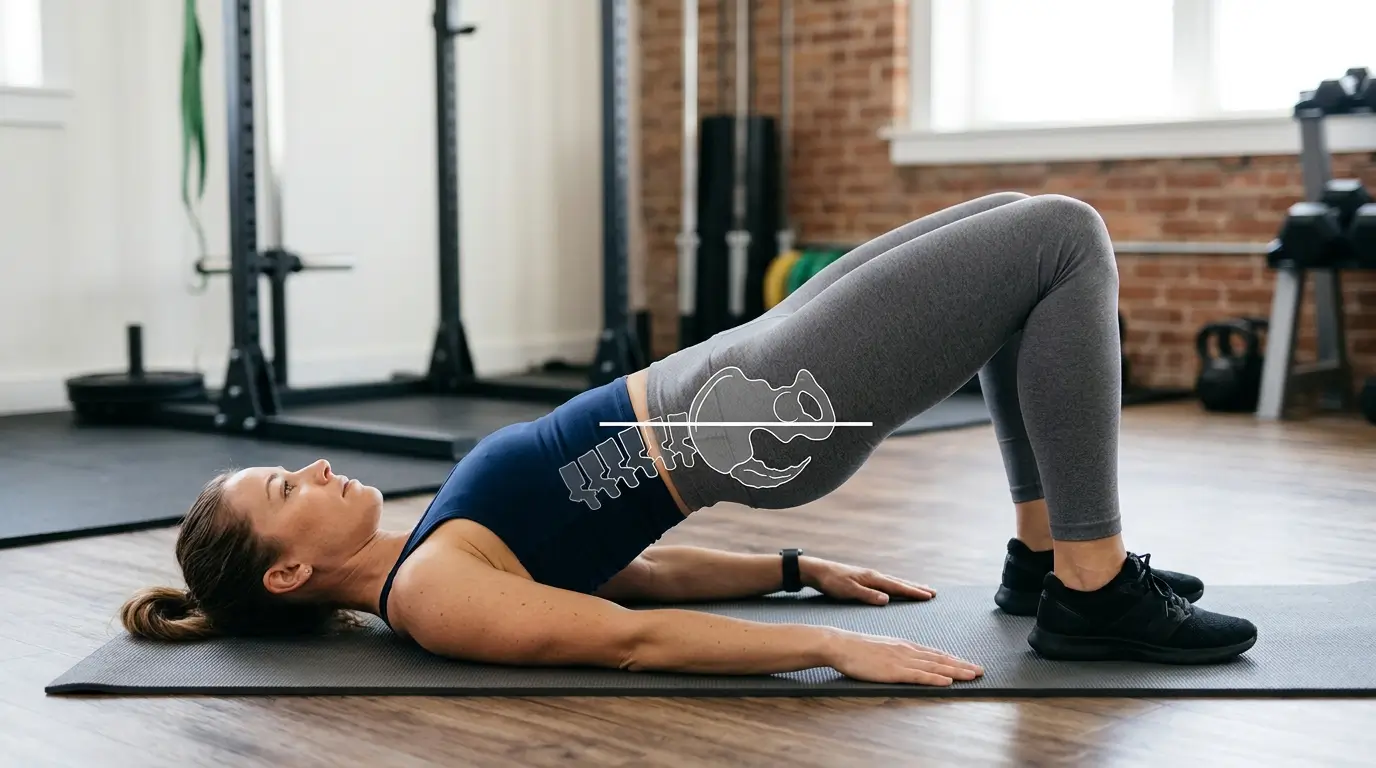
Anterior pelvic tilt exercises can help you build a stronger, more balanced hip and trunk position, especially if you sit for long stretches. With this pattern, your pelvis tips forward, your lower back arches, and your glutes may feel sleepy while your hip flexors feel tight. It is common, and a smart plan can improve how you move.
In this guide, you will learn what anterior pelvic tilt really is and what the research says about stretching versus strengthening. Then you will get 10 exercises with exact sets, reps, and rest times. Each move includes an easier and a harder version, and a four-week plan ties everything together.
Quick Answer: The best anterior pelvic tilt exercises combine glute and core strengthening with gentle hip flexor work. Start with the lying posterior pelvic tilt, glute bridge, dead bug, half-kneeling hip flexor stretch, and Romanian deadlift. Do them three days a week. A 2024 meta-analysis found strengthening beat stretching for posture.
What Is Anterior Pelvic Tilt?
Anterior pelvic tilt means the pelvis leans forward more than usual. Cleveland Clinic describes it as the pelvis tipping out of alignment, which can make your butt stick out and your low back arch. Picture your pelvis as a bowl of water. In an anterior tilt, the water spills toward your toes.
However, a forward tilt is not automatically a problem. The same Cleveland Clinic page notes that mild pelvic tilt may cause no symptoms. Also, a 2017 meta-analysis in The Spine Journal linked low back pain with smaller lumbar lordosis angles, not larger ones, although the studies varied. In other words, a bigger arch alone does not prove it is causing pain.
Coaches usually describe the pattern as a muscle imbalance. Cleveland Clinic says that strengthening weak muscles and stretching tight ones usually helps. Here is the typical picture:
- Often tight or overactive: hip flexors (iliopsoas, rectus femoris), quadriceps, and low back muscles (erector spinae)
- Often weak or underused: glutes (gluteus maximus), hamstrings, and abdominals (rectus abdominis, transverse abdominis)
If posture gear interests you, our guide to posture correctors for rounded shoulders covers the upper body side. For the pelvis, though, anterior pelvic tilt exercises matter more than any strap.
What the Research Says About Anterior Pelvic Tilt Exercises
First, the big picture. A 2024 systematic review and meta-analysis in Sports Medicine – Open pooled controlled trials in healthy people. Stretching alone did not change posture, including pelvic tilt. Strengthening produced larger improvements overall and beat stretching. However, the strengthening effect was not clear for the lumbar and pelvic region specifically.
Next, consider hip flexor stretching. In a 10-week randomized trial in older adults, a supervised hip flexor stretching program improved stride length and hip extension during walking. Anterior pelvic tilt during walking dropped in the stretching group, but it also dropped in the control group. So the stretching result is promising for movement, not proof that stretching fixes posture.
What does that mean for you? Build your anterior pelvic tilt exercises around strengthening, and treat stretching as a comfort tool. This approach also fits the CDC guideline that adults do muscle-strengthening activity on two or more days a week. As a result, the plan below uses three short strength sessions with a brief stretch built in.
Coach’s Tip: Judge progress by how you move and feel, not by a mirror. Better glute strength, easier hip extension, and a calmer low back are the real wins.
How to Check Your Pelvic Position (Quick Screen)
Before you start, try this simple wall check. It is a rough screen, not a diagnosis.
- Stand with your heels a few inches (about 5 cm) from a wall, and let your butt and upper back touch it.
- Slide a flat hand behind your low back.
- Notice the space. A very large gap with your ribs flared forward may suggest a big arch.
- Now gently tuck your tailbone and flatten your back toward the wall. Notice how that feels.
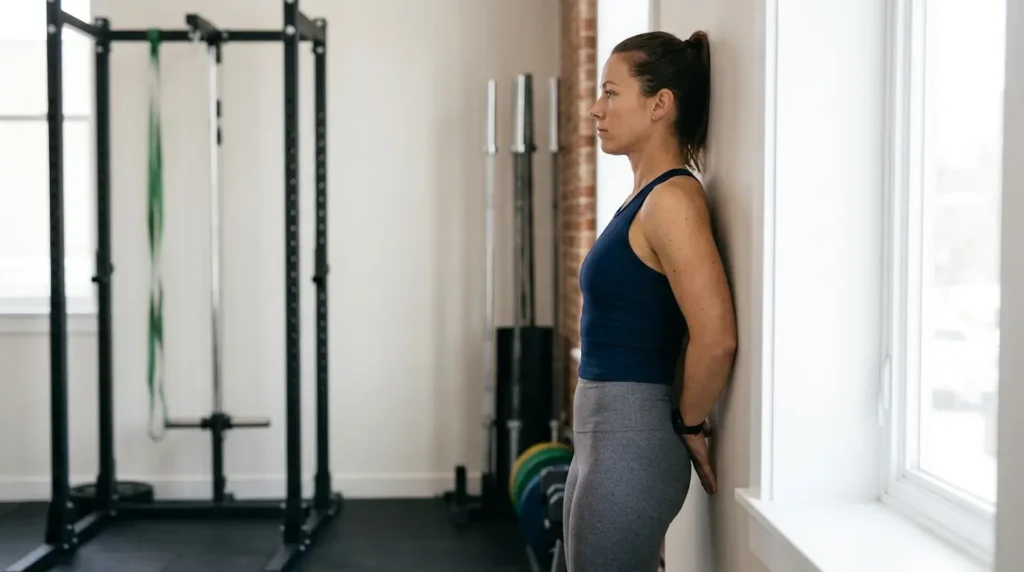
A physical therapist can assess your pelvic position properly. Cleveland Clinic says a healthcare provider can diagnose excessive pelvic tilt with a physical exam. If you have pain, get checked first.
The 10 Best Anterior Pelvic Tilt Exercises
These anterior pelvic tilt exercises move from simple awareness drills to real strength work. Do them in order. Move slowly, and stop each set while you still have good form.
1. Lying Posterior Pelvic Tilt
Lie on your back with knees bent and feet flat. Exhale, then gently roll the top of your pelvis toward your ribs so your low back flattens toward the floor. Hold for three seconds, then release slowly. You should feel a low-ab squeeze, not a push from your legs.
- Sets and reps: 2 sets of 10, 3-second hold, 30 seconds rest
- Why it works: It teaches the opposite motion of an anterior tilt and builds abdominal control
- Easier: Use half the range and skip the hold
- Harder: Lift your feet into a tabletop position while you tilt
2. Glute Bridge
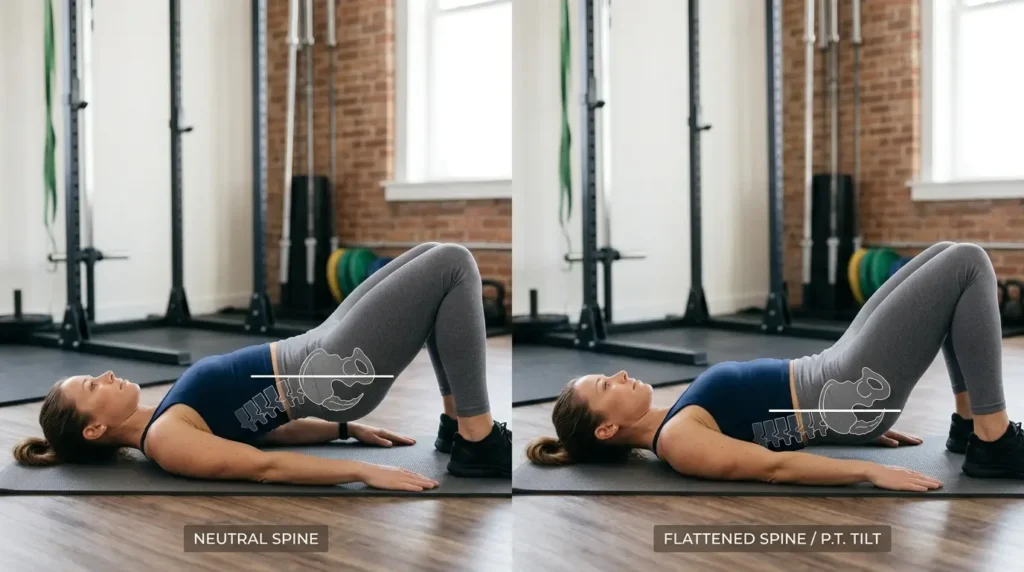
Lie on your back with feet about 10 inches (25 cm) from your hips. Tuck your pelvis slightly, press through your heels, and lift until your shoulders, hips, and knees form a line. Squeeze your glutes for two seconds. Then lower in three seconds.
- Sets and reps: 3 sets of 12, 60 seconds rest
- Why it works: It trains the glutes and hamstrings, which often feel weak in this pattern
- Easier: Lift only a few inches and hold for one second
- Harder: Do single-leg bridges, or rest a 15–25 lb (7–11 kg) dumbbell on your hips
Common Mistake: Arching your low back at the top. If your back works harder than your glutes, you lifted too high. Tuck your ribs down, squeeze your glutes first, and stop sooner.
3. Dead Bug
Lie on your back with arms pointing up and hips and knees bent at 90 degrees. Press your low back gently into the floor. Slowly lower your right arm and left leg toward the floor over four seconds. Return, then switch sides. Stop the reach if your low back lifts.
- Sets and reps: 3 sets of 8 per side, 45 seconds rest
- Why it works: It trains your abs to hold the pelvis steady while your limbs move
- Easier: Do heel taps with one leg at a time
- Harder: Hold a 5–10 lb (2–5 kg) dumbbell in both hands overhead
If you struggle to feel your abs working, our guide on how to flex your abs can help you find the muscle.
4. Half-Kneeling Hip Flexor Stretch With Glute Squeeze
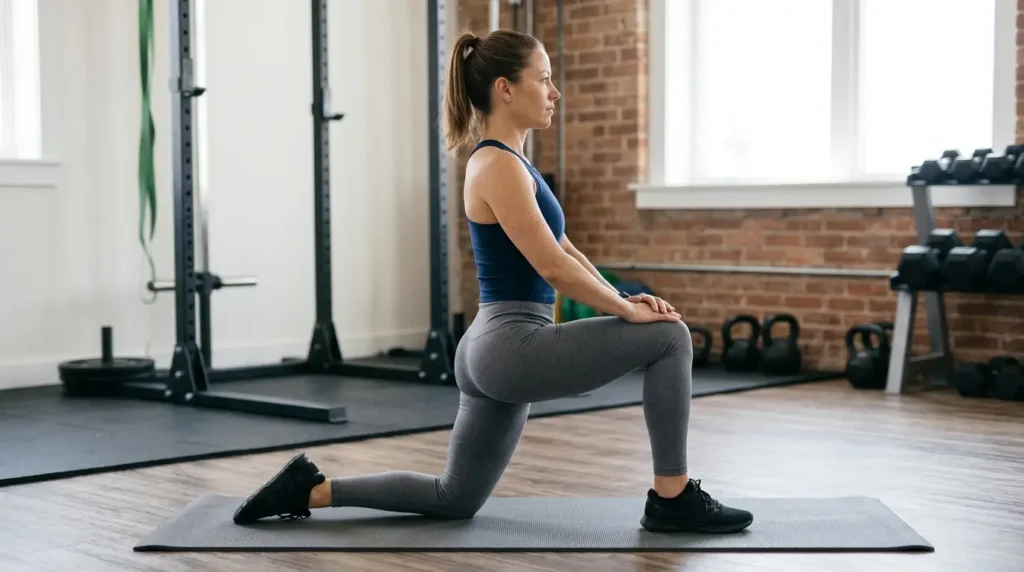
Kneel on a mat with your back knee under your hip and your front shin vertical. Tuck your pelvis first, then squeeze the back-leg glute. Shift forward a little until you feel a stretch in the front of that hip. Breathe slowly.
- Sets and reps: 2–3 holds of 30–45 seconds per side, 15 seconds rest
- Why it works: The tuck targets the hip flexors rather than letting your back arch
- Easier: Use a standing split stance with a hand on a wall
- Harder: Raise the back-leg arm overhead and lean slightly away
Coach’s Tip: The stretch comes from the tuck, not from lunging far. If you feel pinching in your low back, shrink the movement and squeeze the glute harder.
5. Dumbbell Romanian Deadlift
Stand holding two dumbbells, feet hip-width apart, with soft knees. Push your hips back, keep your spine long, and slide the weights down your thighs to mid-shin. Stop when you feel a hamstring stretch. Then drive your hips forward and squeeze your glutes.
- Sets and reps: 3 sets of 8–10, 3-second lowering, 90 seconds rest
- Why it works: It strengthens the hamstrings and glutes through a hip hinge
- Easier: Use bodyweight with a dowel along your spine, or start with 10 lb (4.5 kg) in each hand
- Harder: Use 25–40 lb (11–18 kg) in each hand, or try single-leg versions
6. Hip Thrust
Sit with your upper back against a bench about 16–18 inches (41–46 cm) high, and place your feet flat. Tuck your chin and ribs. Drive your hips up until your shins are near vertical. Pause for two seconds, then lower under control.
- Sets and reps: 3 sets of 10, 90 seconds rest
- Why it works: It loads the glutes hard at the top, where hip extension is strongest
- Easier: Return to the floor glute bridge
- Harder: Rest a 25–45 lb (11–20 kg) dumbbell on your hips, then progress slowly
7. Bird Dog
Start on hands and knees, with wrists under shoulders and knees under hips. Brace lightly, then reach your left arm and right leg until they are level with your torso. Hold for three seconds without rotating your hips. Return and switch sides.
- Sets and reps: 3 sets of 8 per side, 45 seconds rest
- Why it works: It builds trunk and glute control while your spine stays steady
- Easier: Lift only the arm or only the leg
- Harder: Add an elbow-to-knee touch, or use 1–2 lb (0.5–1 kg) ankle weights
The pause turns this into a quiet hold. For more slow-hold ideas, see our guide to isometric leg exercises.
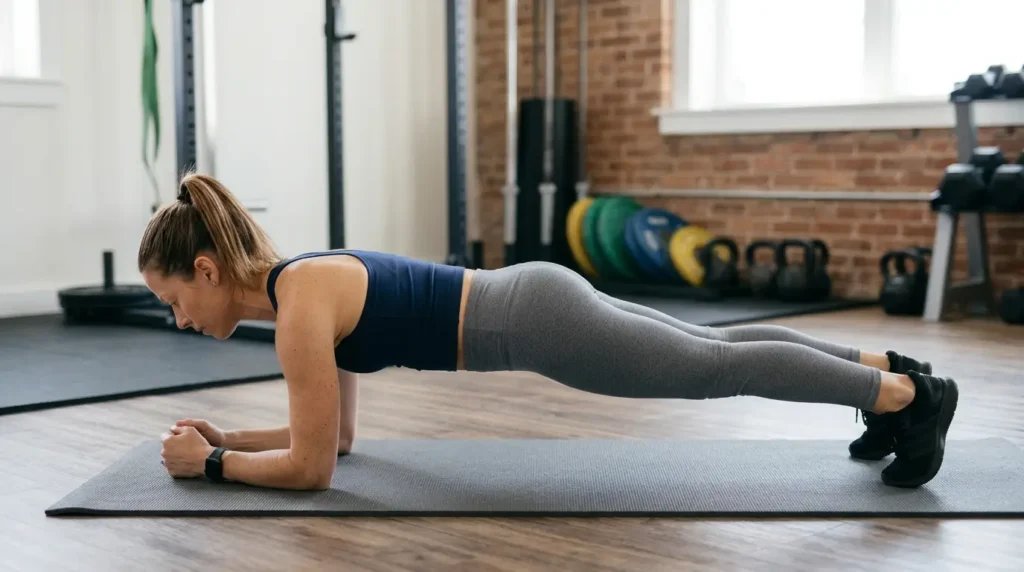
8. Forearm Plank With Pelvic Tuck
Place your elbows under your shoulders and extend your legs. Tuck your tailbone slightly. Squeeze your glutes and abs, and keep your ribs down. Breathe steadily, and stop when your hips sag or your back arches.
- Sets and reps: 3 holds of 20–30 seconds, 45–60 seconds rest
- Why it works: It teaches you to hold a neutral-to-tucked pelvis under load
- Easier: Drop to your knees or place your hands on a bench
- Harder: Hold 45–60 seconds, or walk your elbows forward one hand-width
9. Goblet Squat to Box
Hold a kettlebell or dumbbell at your chest. Stand in front of a box or bench about 16–18 inches (41–46 cm) high. Sit back and down until you lightly touch the box, keeping your ribs stacked over your pelvis. Then stand by pushing the floor away.
- Sets and reps: 3 sets of 8–10, 90 seconds rest
- Why it works: It strengthens the glutes and quads while you practice a steady trunk
- Easier: Do bodyweight sit-to-stands from a higher chair
- Harder: Use 35–50 lb (16–23 kg), or add a two-second pause at the bottom
Wondering about frequency? Read our take on squatting every day before you add extra sessions.
10. Banded Lateral Walk
Place a mini band just above your knees. Sink into a quarter squat with toes forward. Take 10 small steps to the right, then 10 to the left, keeping tension on the band the whole time. Keep your hips level.
- Sets and reps: 3 rounds of 10 steps each way, 45 seconds rest
- Why it works: It strengthens the outer hip muscles (gluteus medius) that steady your pelvis
- Easier: Walk without a band
- Harder: Use a thicker band or sink a little lower
How to Build an Anterior Pelvic Tilt Workout Plan
Now it is time to combine these anterior pelvic tilt exercises into one routine. This anterior pelvic tilt workout takes about 35–40 minutes. Do it three non-consecutive days a week, such as Monday, Wednesday, and Friday.
Warm-Up (5 Minutes)
Walk in place for two minutes. Then do 8 posterior pelvic tilts and one 30-second hip flexor stretch per side. Also, do 5 slow bodyweight glute bridges to wake up your hips.
The Workout
| Exercise | Sets | Reps | Rest |
|---|---|---|---|
| Glute bridge | 3 | 12 | 60 sec |
| Dead bug | 3 | 8 per side | 45 sec |
| Dumbbell Romanian deadlift | 3 | 8–10 | 90 sec |
| Bird dog | 3 | 8 per side | 45 sec |
| Banded lateral walk | 3 | 10 steps each way | 45 sec |
| Half-kneeling hip flexor stretch | 2 | 30–45 sec per side | 15 sec |
Four-Week Progression
| Week | Focus | What to change |
|---|---|---|
| 1 | Learn the moves | Use easier versions and slow tempo |
| 2 | Build consistency | Use standard versions, same weight |
| 3 | Add volume | Add 2 reps per set, or one extra set on bridges |
| 4 | Add load | Add 5 lb (2 kg) to the deadlift and bridge, if form stays clean |
After week four, swap in hip thrusts, goblet squats to a box, and planks. Rotate them every few weeks, so progress continues. Practical tip: no research gives a guaranteed timeline, so plan on at least 8–12 weeks of steady work before you judge results.
No gym? Our calisthenics exercises list offers more bodyweight options. For a small space, check our list of apartment workout equipment to pick a mat, band, and dumbbells.
Daily Habits That Support Your Training
Stand up and move every 30–45 minutes. If you work at a desk, a quiet under-desk elliptical or a pedal exerciser can add gentle movement between sessions. Meanwhile, keep your hip flexor stretch to a minute or two a day if it feels good.
Safety Tips and Who Should Be Careful
Do anterior pelvic tilt exercises carefully if you have pain, a past back or hip injury, or a diagnosed spine condition. Check with a doctor or physical therapist before starting, especially if you are pregnant, postpartum, older, or managing a medical condition. Some people are told to avoid certain spinal positions, so personal advice matters here.
- Stop if you feel sharp pain, numbness, or tingling
- Keep reps slow, and choose a range of motion you can control
- Never push a stretch into pain
- Add weight only after you can finish all reps with clean form
- Skip heavy loading on days when your back feels irritated
FAQ: Anterior Pelvic Tilt Exercises
Can you fix anterior pelvic tilt with exercise?
Anterior pelvic tilt exercises may help improve your pelvic position and, more importantly, how strong and comfortable you feel. Research suggests strengthening has better support than stretching alone for changing posture. Results vary, and a mild tilt is common. A physical therapist can tell you whether your tilt needs attention.
How long does it take to fix anterior pelvic tilt?
No trial promises a set timeline, so avoid anyone who does. As a practical coaching benchmark, train three days a week for at least 8–12 weeks before judging results. Strength and control usually improve before posture looks different, and some people never need a visible change.
What muscles are weak with anterior pelvic tilt?
The glutes, hamstrings, and abdominal muscles are commonly described as weak or underused. The hip flexors, quadriceps, and low back muscles are commonly described as tight. Individual patterns differ, so a screening by a physical therapist gives a clearer picture than a general rule.
Should you stretch hip flexors for anterior pelvic tilt?
Stretching can feel good, but it should not be your main tool. A 2024 meta-analysis found stretching alone did not change posture, while strengthening did better. Keep a short hip flexor stretch with a pelvic tuck in your warm-up, and spend most of your time on glute and core strength.
Do squats fix anterior pelvic tilt?
Squats alone will not fix it, but they can help when done with good control. Squatting builds the glutes and quads, and a box squat teaches you to keep your ribs stacked over your pelvis. Pair squats with bridges, hinges, and core work for a more complete plan.
Is anterior pelvic tilt bad?
Not necessarily. Cleveland Clinic notes that mild pelvic tilt may cause no symptoms. If you have pain, stiffness, or trouble with movement, see a doctor or physical therapist. Otherwise, strengthening your glutes and core is a smart habit that supports overall fitness anyway.
Conclusion
Anterior pelvic tilt exercises work best when they focus on strength first and stretching second. Start with the lying posterior pelvic tilt, glute bridge, and dead bug. Then add the Romanian deadlift, hip thrust, and bird dog as you improve. Stay patient, track your reps, and keep your form clean.
Do your anterior pelvic tilt exercises three days a week, move more during your workday, and re-check your progress after 8–12 weeks. If pain shows up or you are unsure where to begin, a physical therapist can tailor the plan to you. This article is for general information and is not a substitute for advice from a doctor or physical therapist.
