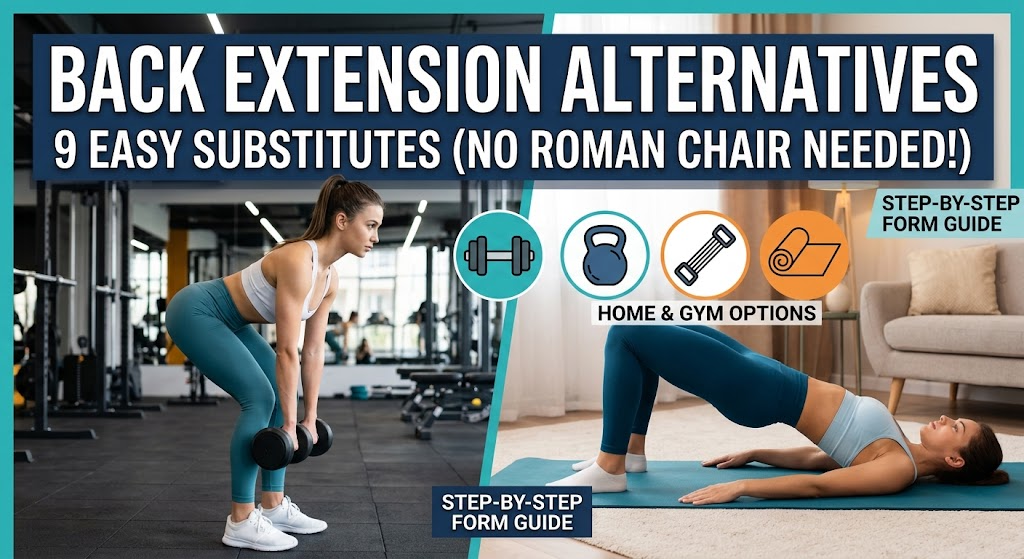
Back Extension Alternatives: 9 Easy Substitutes for Home and Gym
No Roman chair, no problem. The best back extension alternatives train the same muscles, your lower back, glutes, and hamstrings, using a dumbbell, a band, or just the floor.
This guide covers nine substitutes with step-by-step form, sets, reps, rest times, and easier and harder versions. Think of it as a coach talking you through each lift: light weight first, slow reps, and no hero sets.
Quick Answer: The best back extension alternatives are the bird dog, glute bridge, dumbbell Romanian deadlift, kettlebell swing, and cable pull-through. They train the same chain of muscles, your lower back, glutes, and hamstrings, without a Roman chair. Start with bodyweight options, then add weight once you can keep a flat back on every rep.
Why Look for Back Extension Alternatives?
The back extension, also called the hyperextension, uses a 45-degree bench (a Roman chair) to train your spinal erectors, glutes, and hamstrings. It is a solid exercise, but plenty of lifters can’t use it. The bench is taken, a home gym has no room, or the pad digs into the hips.
Others simply want a different feel. You might want a lower-load option on a tired-back day, or a movement that adds more glute work. The right back extension alternatives keep your posterior chain training on track either way.
Short on space? Our list of apartment workout equipment covers compact gear that fits most of these moves.
Muscles Worked by Back Extension Alternatives
| Muscle | Role | Where you feel it |
| Erector spinae and multifidus | Primary: hold and extend the spine | Along both sides of the lower back |
| Gluteus maximus | Primary: extends the hip | Seat, especially at the top of the rep |
| Hamstrings (biceps femoris, semitendinosus) | Secondary: assist hip extension | Back of the thigh, a stretch on the way down |
| Quadratus lumborum and abs | Stabilizers: keep the trunk steady | Deep in the sides and front of the core |
| Upper back and lats | Stabilizers: keep the weight close | Between the shoulder blades |
A hinge-style swap can load your lower back about as well as the bench. In a crossover study of resistance-trained women, a Journal of Sports Science and Medicine study found no difference in erector spinae activation between the Romanian deadlift, the 45-degree Roman chair back extension, and the seated machine back extension. The Roman chair did produce more glute and hamstring activity in the upper part of the movement, and the seated machine produced the least.
The sample was small and made up of trained women, so results may differ for you. Still, it supports the idea that you have options.
Benefits of Back Extension Alternatives
- Meets the strength guidelines. Adults should do muscle-strengthening activity that works all major muscle groups, including the back and hips, on two or more days a week, according to the CDC physical activity guidelines.
- More glute work. In a study of 13 trained women, the barbell hip thrust produced greater glute activity than the back squat at estimated 10-rep-max loads.
- Lower-load choices. Researchers have measured spine load and stability in moves like the bird dog, side bridge, and curl-up to help clinicians choose exercises for specific people.
- No special gear. Most swaps need a mat, a dumbbell, or a kettlebell.
- Fresh stimulus. Changing the movement can help when progress feels stuck.
How to Do the Best Back Extension Alternatives (Step-by-Step)
Two moves cover most needs: one for stability, one for strength. Learn these first.
Dumbbell Romanian Deadlift (Hip Hinge)
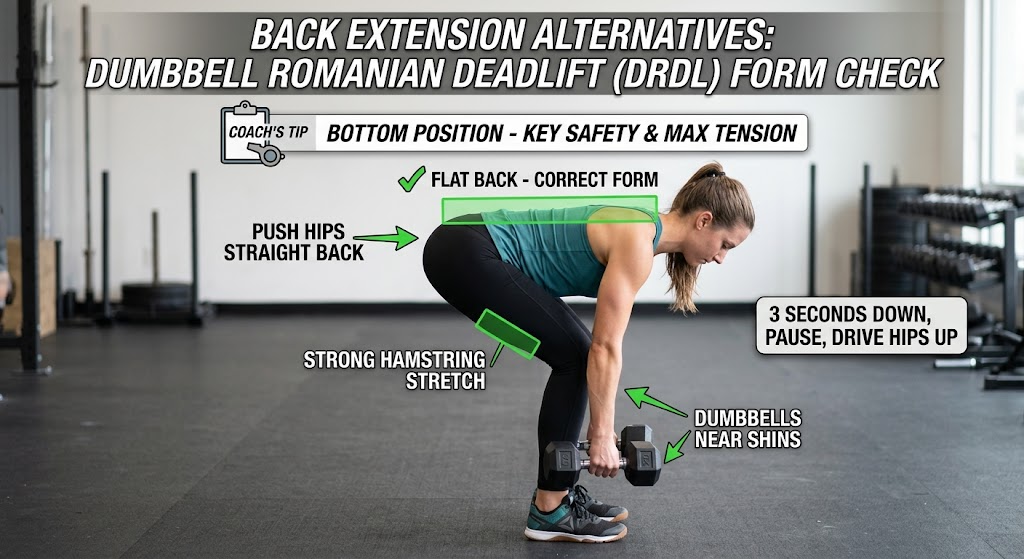
- Stand with feet hip-width apart, holding a dumbbell in each hand in front of your thighs, palms facing you.
- Soften your knees slightly and brace your core, as if someone were about to tap your stomach.
- Push your hips straight back, like closing a car door with your butt. The dumbbells slide down your thighs.
- Keep your neck in line with your spine and your shoulder blades gently pulled down.
- Lower until you feel a strong hamstring stretch, usually just below the knee. Stop before your back rounds.
- Drive your hips forward, squeeze your glutes, and stand tall without leaning back.
Tempo and load: Take 3 seconds down, pause for 1, and stand up in 1. Beginners can start with 10-15 lb (4.5-7 kg) per hand and work toward 20-30 lb (9-14 kg) per hand. Rest 60-90 seconds between sets.
What it should feel like: a stretch in the hamstrings, a glute squeeze at the top, and your lower back working to hold position. Sharp or pinching pain means stop.
Coach’s Tip: Hold a broomstick or dowel along your spine. It should touch the back of your head, upper back, and tailbone for the whole rep. If the gap opens at your lower back, you’ve gone too deep.
Bird Dog (Stability)
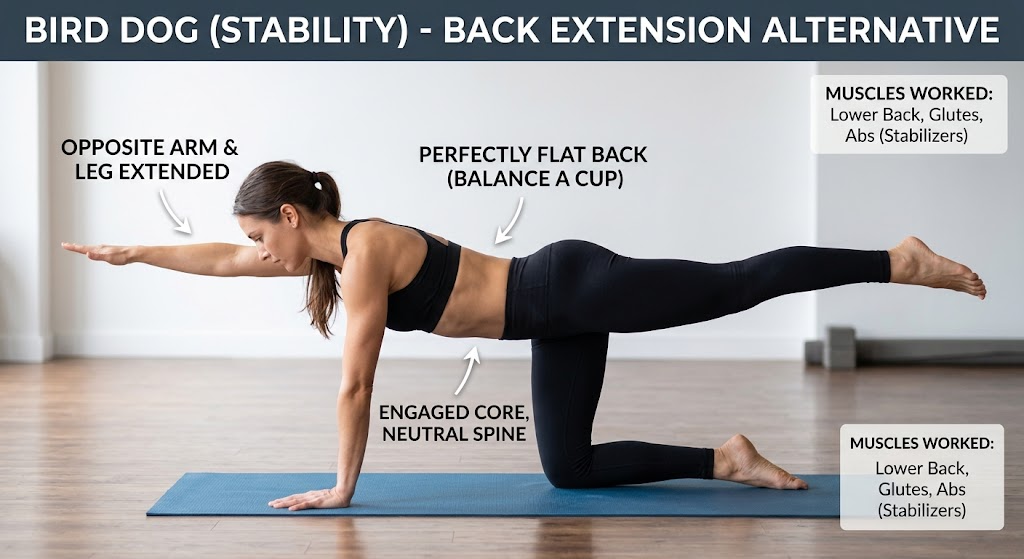
- Start on hands and knees, hands under shoulders and knees under hips.
- Brace your abs lightly and keep your spine neutral.
- Slowly reach one arm forward and the opposite leg back until both are in line with your torso.
- Hold 5-8 seconds without letting your hips twist or your lower back sag.
- Return with control and switch sides.
Aim for 6-8 reps per side. Picture balancing a cup of water on your lower back.
Sets, Reps, and Weight by Goal
| Goal | Sets | Reps | Rest | Tempo (down-pause-up) | Load guide |
| Strength (hinge moves) | 3-5 | 5-8 | 2-3 min | 2-1-1 | Heavy, but 1-2 reps left in the tank |
| Muscle size | 3-4 | 8-12 | 60-90 sec | 3-1-1 | Moderate, form stays flat-backed |
| Endurance | 2-3 | 15-20, or 20-40 sec holds | 30-60 sec | 2-0-2 | Light |
| Stability (bird dog, superman) | 2-3 | 6-8 per side, 5-8 sec holds | 30-45 sec | Slow and controlled | Bodyweight |
Train two days a week to start, with at least one rest day between sessions.
Common Mistakes and Fixes
Common Mistake: Rounding the lower back to reach a deeper stretch. This turns a hamstring-and-glute exercise into a spine-bending one. Shorten the range, slow down, and use the dowel drill above.
- Leaning back at the top. Finish by squeezing your glutes, not by arching. Stand tall and stop.
- Going too heavy. If your form changes, drop the weight 10-20%.
- Rushing or bouncing. Use the tempo in the table above and pause at the bottom.
- Turning it into a squat. Your shins stay nearly vertical. The hips go back, not down.
- Looking up. Keep your gaze on the floor about 6 feet (1.8 m) ahead.
Back Extension Alternatives: Easier to Harder
| Exercise | Easier (regression) | Harder (progression) |
| Bird dog | Lift arm or leg only | Add a 5-second hold and slow arm and leg movements |
| Dumbbell Romanian deadlift | Bodyweight hinge with a dowel | Heavier dumbbells, single-leg version, or barbell |
| Glute bridge | Both feet down, no weight | Single leg, then barbell hip thrust |
| Superman | Arms by your sides | Arms in a Y shape with a 3-second hold |
| Kettlebell swing | Kettlebell deadlift | Heavier bell or one-arm swings |
| Cable pull-through | Light weight, short range | Heavier stack with a slow 3-second return |
| Good morning | Bodyweight, hands behind the head | Light barbell across the upper back |
Back Extension Alternatives by Equipment
No Equipment
Superman (floor back raise). Lie face down, arms extended. Lift your arms, chest, and legs a few inches, squeeze your glutes, and lower slowly. Do 2 sets of 8-10 with a 2-second hold. The range is small, so it suits beginners.
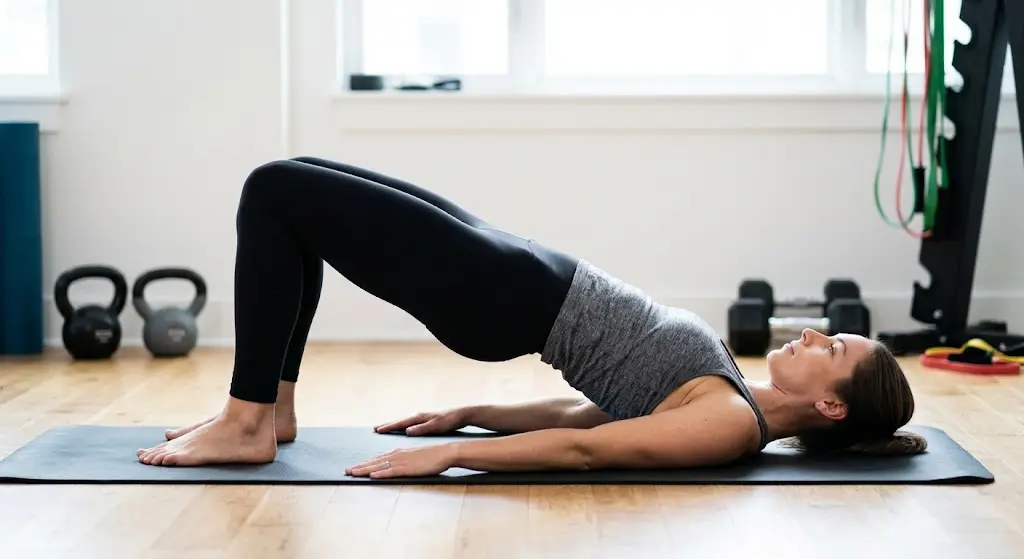
Glute bridge. Lie on your back, knees bent, feet flat. Drive your hips up until your body forms a straight line from shoulders to knees, then lower. Do 3 sets of 12-15.
If you enjoy bodyweight training, our calisthenics exercises list has more ideas to pair with these.
Dumbbell and Kettlebell
The dumbbell Romanian deadlift above is the staple. For equipment choices, see our guide to hex or round dumbbells.
Kettlebell swing. Hinge back, hike the bell between your legs, then snap your hips forward so the bell floats to chest height. Arms guide, hips do the work. Many beginners start around 18-26 lb (8-12 kg) for 3 sets of 12-15. Our kettlebell swing guide explains what the move trains.
Barbell
Hip thrust. Rest your upper back on a bench about 16-18 inches (41-46 cm) high, bar over your hips, and drive up until your torso is level. Start with a standard 45 lb (20 kg) bar or lighter. Do 3 sets of 8-12.
Good morning. Place a light barbell across your upper back and hinge as you would for a Romanian deadlift. Use light weight and 8-10 reps. It is demanding on the lower back, so progress slowly.
If you want a stronger lower-back stimulus, deadlift-style lifts may fit. A systematic review of deadlift EMG studies reported greater activation of the erector spinae and quadriceps than of the glutes and hamstrings, while the Romanian deadlift leaned more on the hamstrings. A trap bar is a friendly progression, and we cover how much a trap bar weighs if you are shopping.
Building a barbell setup at home? Compare a squat rack with pull-up bar and read Olympic vs standard barbell before you buy.
Cable
Cable pull-through. Attach a rope to a low pulley. Face away from the stack, straddle the cable, and hinge back with the rope between your legs. Stand by driving your hips forward. Use 3 sets of 12-15 and start around 20-30 lb (9-14 kg), then build up.
Machine
Seated back extension machine or reverse hyper. These are fine if you have access. Just know the seated machine produced the lowest glute and hamstring activity in the study above, so treat it as a lower-back-focused option. Use 2-3 sets of 10-15 slow reps.
Who Should Be Careful
Check with a doctor or physical therapist before you start if you have back pain, a disc problem, osteoporosis, a recent injury, or are pregnant or postpartum. Older adults with health conditions should also get clearance first.
Stop and seek care if back pain spreads down a leg, causes weakness, numbness, or tingling, or comes with bowel or bladder changes. Mayo Clinic’s back pain guidance lists these warning signs.
Sample Workout Using Back Extension Alternatives
Warm-up (5 minutes): brisk walk, 8 cat-cows, 8 bodyweight hip hinges.
| Order | Exercise | Sets x reps | Rest |
| A | Bird dog | 3 x 6 per side, 5-sec holds | 30-45 sec |
| B | Dumbbell Romanian deadlift | 3 x 10 | 60-90 sec |
| C | Glute bridge or hip thrust | 3 x 12-15 | 60 sec |
| D | Cable pull-through or kettlebell swing | 3 x 12-15 | 60-90 sec |
| E | Superman | 2 x 10, 2-sec hold | 30-45 sec |
Do this twice a week on non-consecutive days. When you finish every set with clean form, add 5 lb (2 kg) or one rep per set. Cool down with child’s pose for 30-45 seconds.
FAQ
What can I do instead of back extensions?
Good swaps are the bird dog, glute bridge, dumbbell Romanian deadlift, kettlebell swing, and cable pull-through. Each trains your lower back, glutes, and hamstrings without a Roman chair. Pick one bodyweight move and one weighted hinge, then train them twice a week with at least a day of rest between sessions.
Are back extensions necessary?
No. The back extension is one tool, not a requirement. A study in resistance-trained women found similar erector spinae activation across the Romanian deadlift, Roman chair, and seated machine versions, so other hinge exercises can do the job. Choose the movement you can perform with clean form and steady progress.
Can I do back extensions at home without a machine?
Yes. Lie face down on a mat for the superman, or hinge with a dumbbell Romanian deadlift. Both need almost no space. Begin with 2 sets of 8-10 slow reps, pause one second at the top, and stop if you feel sharp pain rather than muscle effort.
Is the Romanian deadlift better than the back extension?
Neither is clearly better; they do different jobs. Research in trained women found equal erector spinae activation, while the Roman chair raised glute and hamstring activity in the upper range. The Romanian deadlift lets you load heavier and builds hinge skill. Many lifters use both.
How often should I train my lower back?
The CDC advises muscle-strengthening that works all major groups, including the back, on two or more days a week. For most beginners, two sessions weekly with 2-3 sets of a hinge or back extension alternative is a sensible start. Leave a rest day between hard sessions and add load slowly.
Are supermans the same as back extensions?
Close, but not identical. Both extend the spine and hips, but the superman is done on the floor, so the range is small and loading is limited. A 45-degree back extension has a longer range and is easier to load. Supermans work well as a beginner step.
Conclusion
You don’t need a Roman chair to train your lower back and glutes. The best back extension alternatives, from the bird dog to the dumbbell Romanian deadlift, hit the same posterior chain with equipment you may already own. Start light, keep a flat back, and progress one small step at a time.
Pick two or three moves from the sample workout and run them for four weeks. Then add weight or move to a harder version.
