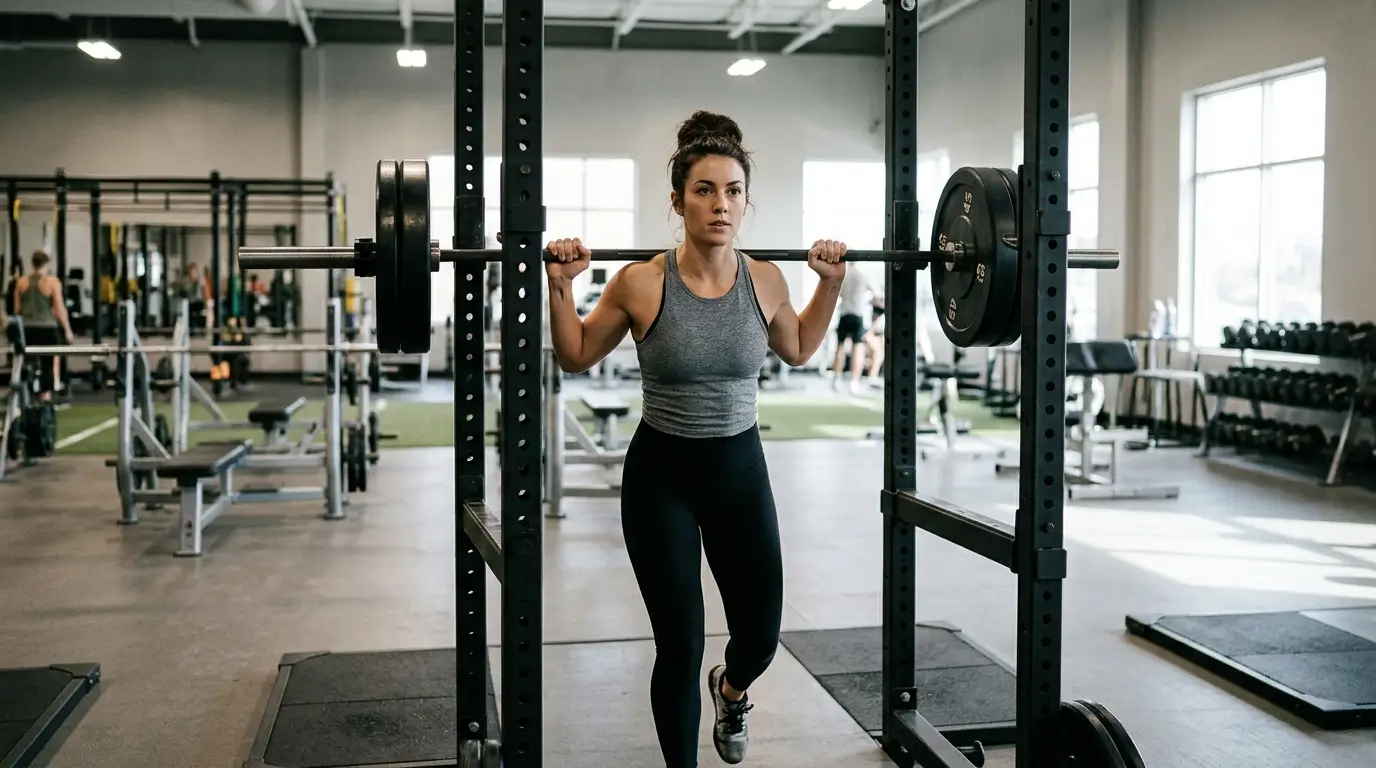
A barbell workout for women is one of the simplest ways to build full-body strength. One bar lets you train your legs, back, chest, shoulders, and core, and you can add weight in small steps as you improve. Best of all, you do not need a long list of machines or a big gym.
This guide gives you a complete plan: equipment, a warm-up, two full-body workouts, form steps, a weekly schedule, and easier and harder versions. Along the way, it also explains what the research says about women and resistance training. Overall, plan on about three short sessions a week.
Quick Answer
A good barbell workout for women alternates two full-body sessions, A and B, across three non-consecutive days a week. Each session takes 45–60 minutes. For equipment, you need an Olympic barbell, plates, a rack, and a bench. Start light, do 3 sets of 8–10 reps, and add 5 lb (2.3 kg) when every rep looks clean.
Barbell Workout for Women: Who This Plan Is For
This plan fits women who want to get stronger, learn the main barbell lifts, and train in a simple, repeatable way. For that reason, it works for first-timers, for women returning after a break, and for those who have used machines and want to try free weights. Likewise, women over 40 who want a structured strength routine can use it, as long as a doctor approves.
However, this is not a program for pregnancy, postpartum recovery, or active injuries. In those cases, talk to your doctor or a physical therapist first. They can tell you which lifts, loads, and positions are safe for you.
What the Research Says About Women and Lifting
For instance, a meta-analysis of resistance training in women reported large improvements in muscular strength and hypertrophy in healthy adult women. In addition, a sex-differences meta-analysis found that males and females adapted with similar effect sizes for hypertrophy and lower-body strength, and females had a larger effect for relative upper-body strength.
A narrative review in the Journal of Strength and Conditioning Research also noted that women gain muscle size and strength with strength training, and that women may see greater relative strength gains depending on age and muscle group [VERIFY authors]. Meanwhile, the cycle question comes up often. One 2023 umbrella review found highly variable results and concluded the evidence does not show a clear effect of cycle phase on strength gains [VERIFY authors]. So you can train on a regular schedule and adjust by how you feel.
Strength work also supports general health. Adults should do muscle-strengthening activity on at least two days a week, according to the CDC physical activity guidelines. Similarly, the NIH’s NIAMS guide to exercise and bone health says exercise can improve bone health and increase muscle strength.
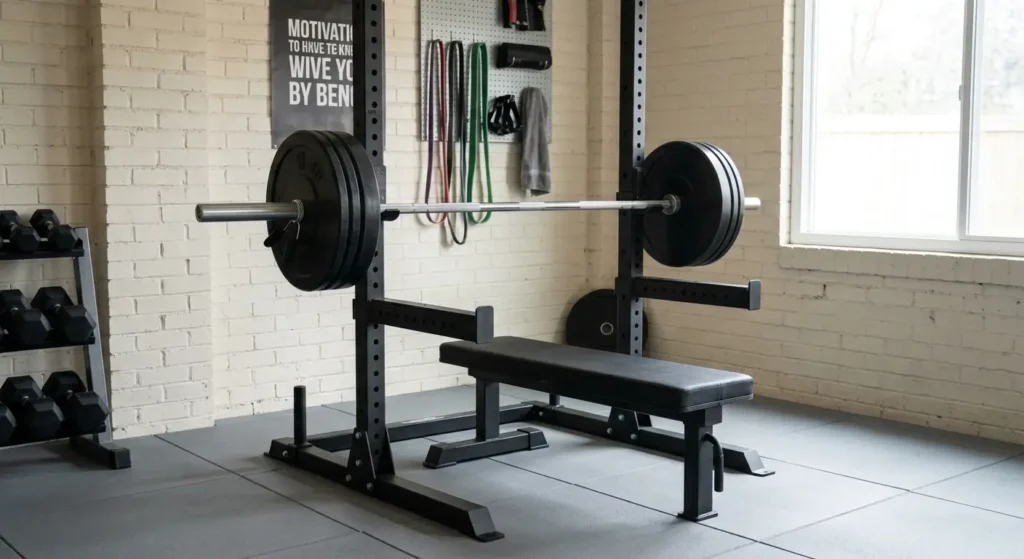
Equipment for a Barbell Workout for Women
You can start with a short list. In fact, quality and safety matter more than extras.
- Olympic barbell: a standard Olympic bar weighs 45 lb (20 kg). Many gyms also have a women’s Olympic bar, typically 35 lb (15 kg) with a slightly thinner grip [VERIFY]. Our guide to Olympic vs standard barbells explains the difference.
- Plates: start with 2.5 lb (1.1 kg), 5 lb (2.3 kg), and 10 lb (4.5 kg) plates so you can increase in small steps.
- Collars: keep plates from sliding.
- Power rack or squat stand with safety pins: this is the most important safety item. If you are shopping, see our best squat racks with pull-up bars.
- Adjustable bench: for bench press, hip thrusts, and overhead press.
- Flat, stable shoes: avoid soft running shoes for squats and deadlifts.
- Optional: a barbell pad for hip thrusts and a lifting belt for later.
If you train at home, our list of the best apartment workout equipment can help with space planning.
Warm-Up Before Your Barbell Workout for Women (8–10 Minutes)
A good warm-up raises your heart rate and wakes up the muscles you are about to use. Do it before every session.
- Easy cardio (3–5 minutes): a brisk 0.25-mile (0.4 km) walk, rowing, or cycling.
- Mobility (2–3 minutes): 10 hip circles per side, 10 arm circles, and 8 bodyweight good mornings.
- Activation (2 minutes): 10 glute bridges and 10 band pull-aparts.
- Warm-up sets: before your first main lift, do 2–3 lighter sets. For example, start with the empty bar for 8 reps, then add weight in two small steps.
The Barbell Workout for Women: Exercise Tables
Alternate Workout A and Workout B. Rest at least one day between sessions. Choose a weight that leaves about 2 reps in reserve on the last set.
Workout A
| Exercise | Sets | Reps | Rest |
|---|---|---|---|
| Barbell back squat | 3 | 8 | 2 min |
| Barbell bench press | 3 | 8 | 2 min |
| Barbell bent-over row | 3 | 10 | 90 sec |
| Barbell hip thrust | 3 | 10 | 90 sec |
Workout B
| Exercise | Sets | Reps | Rest |
|---|---|---|---|
| Romanian deadlift | 3 | 8 | 2 min |
| Overhead press | 3 | 8 | 2 min |
| Barbell reverse lunge | 3 | 8 per leg | 90 sec |
| Barbell bent-over row | 3 | 10 | 90 sec |
For novices, the ACSM position stand on resistance training suggests loads in the 8–12 repetition-maximum range, training the major muscle groups 2–3 days a week, and doing multi-joint exercises before single-joint ones. It also notes that heavier lifting calls for longer rests between sets. That is why the main lifts above come first, with 2 minutes of rest.
How to Do Each Exercise
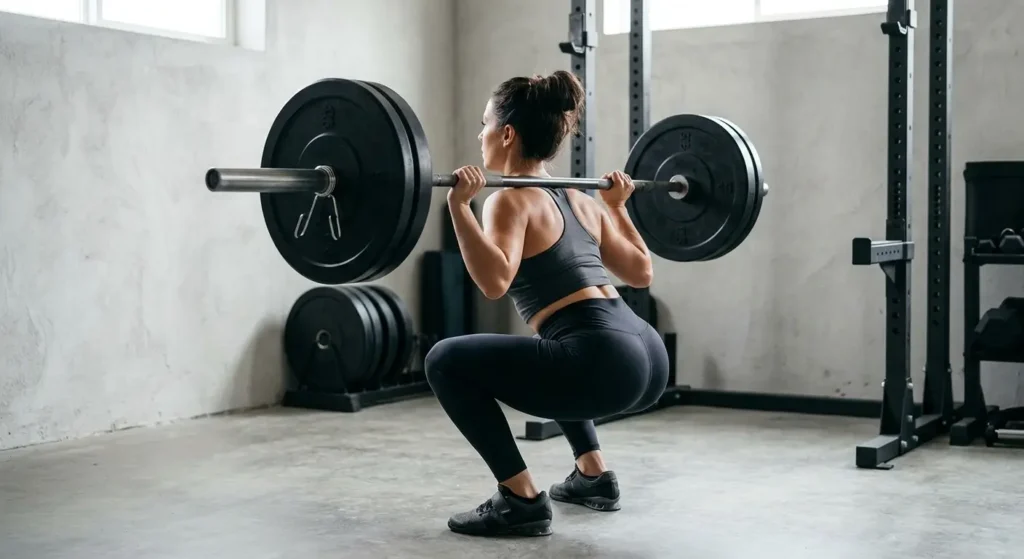
Barbell Back Squat
The squat works your quads, glutes, hamstrings, and core.
- Set the rack hooks at about upper-chest height and the safety pins just below your lowest squat position.
- Step under the bar and place it on your upper back, on the muscle shelf below your neck, not on the bone.
- Unrack, step back, and set your feet about shoulder-width apart, roughly 14–20 inches (36–51 cm), with toes slightly out.
- Take a big breath into your belly and tighten your core.
- Sit down and back, keeping your chest up and knees tracking over your toes.
- Lower until your thighs are about parallel, or as deep as you can with control.
- Drive up through your whole foot and breathe out near the top.
Easier: goblet squat with a dumbbell, or a box squat. Harder: add a 2-second pause at the bottom.
Coach’s Tip
Before loading the bar, do 5 slow bodyweight squats and notice where your weight sits. It should stay over the middle of your foot. If your heels lift, wear flatter shoes or place small plates under your heels while you build ankle mobility.
Barbell Bench Press
The bench press trains your chest, front shoulders, and triceps. If you lift alone, always use safeties or a rack with catch bars. Consider a machine alternative like the Hammer Strength chest press if you lack a spotter.
- Lie on the bench with your eyes under the bar and your feet flat on the floor.
- Pull your shoulder blades together and keep a small arch in your upper back.
- Grip the bar just outside shoulder width and unrack it over your chest.
- Lower the bar to your mid-chest in 2–3 seconds with elbows about 45–75 degrees from your torso.
- Press the bar up and slightly back to the start.
Easier: dumbbell press or push-ups. Harder: pause the bar on your chest for 1–2 seconds.
Barbell Bent-Over Row
The row builds your lats, upper back, and rear shoulders.
- Stand with the bar over your midfoot and feet hip-width apart.
- Hinge at the hips until your torso is about 45 degrees, with a flat back.
- Grip the bar just outside your knees.
- Pull the bar toward your lower ribs, keeping your elbows close.
- Squeeze for 1 second and lower under control.
Easier: chest-supported dumbbell row. Harder: pause for 2 seconds at the top.
Common Mistake
Standing up and heaving the bar with your lower back is the most common row error. It reduces back work and can strain your spine. Fix it by lowering the weight, keeping your torso angle steady, and moving only your arms and shoulder blades.
Romanian Deadlift
The Romanian deadlift (RDL) trains your hamstrings, glutes, and spinal erectors. It teaches the hip hinge.
- Start standing, holding the bar at hip height with an overhand grip.
- Soften your knees and push your hips back.
- Slide the bar down your thighs with a flat back until you feel a hamstring stretch, usually near mid-shin.
- Squeeze your glutes and drive your hips forward to stand tall.
Easier: dumbbell RDL, or a shorter range. Harder: slow the lowering to 4 seconds.
Overhead Press
The overhead press works your shoulders, triceps, upper chest, and core.
- Set the bar at upper-chest height in a rack and grip it just outside your shoulders.
- Unrack, squeeze your glutes, and keep your ribs down.
- Press the bar straight up, moving your head slightly back, then through once the bar passes your forehead.
- Lock out over your mid-foot and lower with control.
Easier: seated dumbbell press. Harder: add a 2-second pause at your shoulders.
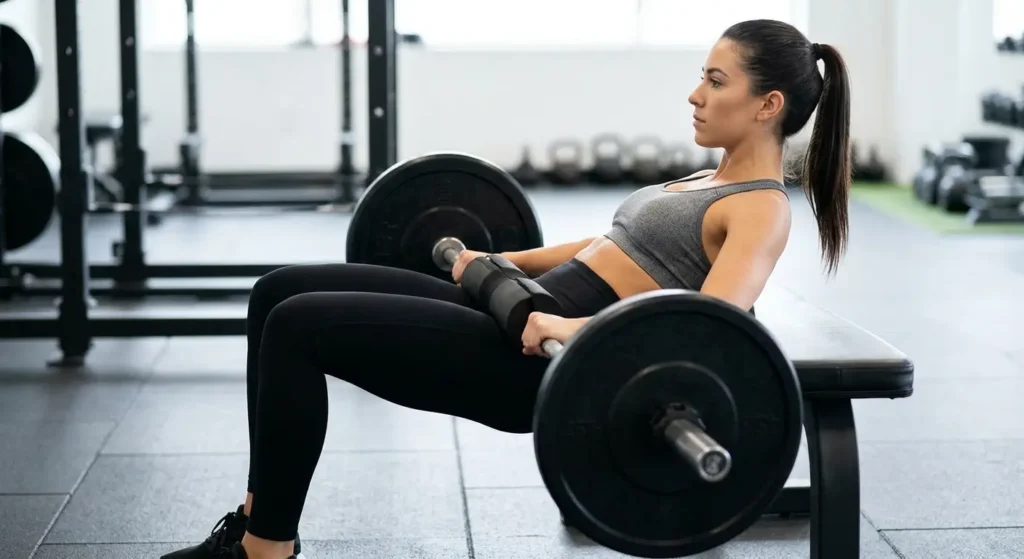
Barbell Hip Thrust
The hip thrust is a glute builder that is easy on your spine.
- Sit on the floor with your upper back against a bench and the bar over your hips, with a pad.
- Plant your feet about hip-width apart, shins vertical at the top.
- Tuck your chin, brace, and drive your hips up until your torso is level.
- Pause for 1 second, squeeze your glutes, and lower.
Easier: bodyweight or single glute bridge. Harder: add a 2-second pause at the top.
Barbell Reverse Lunge
The reverse lunge works your quads, glutes, and balance, and it is often gentler on the knees than a forward lunge.
- Hold the bar across your upper back as in a squat, or use light dumbbells.
- Step back about 2–3 feet (61–91 cm) and lower until your front thigh is near parallel.
- Push through your front heel to return to standing.
- Finish all reps, then switch sides.
Easier: bodyweight or holding a rack for balance. Harder: add more load or a 2-second pause at the bottom.
Barbell Workout for Women: Weekly Schedule and Progression
A simple schedule keeps you consistent.
| Week | Mon | Wed | Fri |
|---|---|---|---|
| 1, 3, 5 | Workout A | Workout B | Workout A |
| 2, 4, 6 | Workout B | Workout A | Workout B |
On off days, walk, stretch, or do easy cardio. If you also run, see our tips on running after leg day before you plan a 2-mile (3.2 km) easy run.
How to Add Weight
Use double progression. First, pick a rep range, such as 8–10 reps. Next, stay at the same weight until you complete all sets at the top of the range with clean form. Then add 5 lb (2.3 kg) on squats, bench, and rows, or 5–10 lb (2.3–4.5 kg) on RDLs and hip thrusts, and begin again at the bottom of the range.
The updated ACSM overview of resistance training [VERIFY authors and year] says healthy adults should use progressive resistance training to improve muscle function, size, and physical performance.
Weight Guidance by Goal
| Goal | Sets | Reps | Rest | Load feel |
|---|---|---|---|---|
| Learn the lifts | 2–3 | 8–10 | 90 sec–2 min | Light; stop 3 reps short of failure |
| Muscle | 3–4 | 8–12 | 1–2 min | Moderate; 1–2 reps in reserve |
| Strength | 3–5 | 4–6 | 2–3 min | Heavy; strong form |
Beginner and Advanced Versions
Beginner Version (Weeks 1–4)
- Train 2 days a week, using Workout A and Workout B once each.
- Do 2 sets per exercise.
- Use the empty bar, or a lighter training bar, on every lift.
- Replace the back squat with a goblet squat if the bar feels awkward.
- Rest 2 minutes between sets and film your form from the side.
Standard Version (Weeks 5–12)
Use the tables above with 3 sets per exercise and three days a week.
Advanced Version
- Train four days a week with an upper/lower split: two lower days (squat, RDL, hip thrust) and two upper days (bench, row, press).
- Use heavier loads on main lifts. The ACSM position stand suggests that intermediate and advanced lifters may eventually emphasize heavy loading with longer rests, around 3–5 minutes, for strength.
- Add a pause or a slower lowering phase to key lifts.
- Pair your lower days with our leg and shoulder workout ideas for extra variety.
If you wonder whether squats are too often, read our guide on whether you can do squats every day.
Cool-Down (5 Minutes)
Finish with easy walking for 2 minutes. Then hold each stretch for about 30 seconds: a quad stretch, a hamstring stretch, a hip flexor stretch, and a chest stretch against a rack. Breathe slowly.
Tips for Results
- Track every session. Write down weights, sets, and reps so you know when to add load.
- Prioritize form. A smaller load with clean reps beats a heavy load with sloppy form.
- Use safeties. Set safety pins on squats and bench press, every time.
- Add arms if you like. Barbell curls are optional. See our barbell curl vs cable curl comparison for ideas.
- No barbell yet? Bodyweight moves can help you prepare. Browse our calisthenics exercises list.
- Be patient. Strength usually improves first, and visible changes take longer.
- Recover well. Sleep, eat enough, and take rest days. Check with a doctor or registered dietitian for specific nutrition advice.
Who Should Be Careful
Check with a doctor or physical therapist before starting if you have joint, back, or pelvic pain, a recent injury or surgery, high blood pressure or heart disease, osteoporosis or low bone density, or if you are pregnant or postpartum. The same applies to women going through menopause who are unsure which lifts to use. Stop any lift that causes sharp pain.
Frequently Asked Questions
Is a barbell workout for women effective?
Yes. A meta-analysis of resistance training in women found large improvements in strength and muscle size in healthy adult women. A barbell workout for women is just one way to do resistance training, and it works well because you can add weight gradually.
Will lifting a barbell make women bulky?
Building large muscles takes years of focused training, and results vary by person. A meta-analysis found males and females gain muscle at similar relative rates. For most women, a beginner barbell routine builds strength and firmness, not sudden size.
How heavy should a woman lift with a barbell?
Start with the empty bar, 35–45 lb (15–20 kg), or lighter if needed. Choose a weight you can lift for all reps with clean form, leaving 2 reps in reserve. Add 5 lb (2.3 kg) when the work feels easy. Progress slowly rather than chasing a number.
How many days a week should women do a barbell workout?
Most beginners do well with two to three days a week. The CDC guidelines recommend muscle-strengthening on at least two days a week. Leave at least one rest day between full-body sessions so your muscles can recover.
What does a women’s barbell weigh?
A women’s Olympic barbell typically weighs 35 lb (15 kg), versus 45 lb (20 kg) for a men’s bar. It also has a slightly thinner shaft, which can feel better for smaller hands [VERIFY]. Check the product page for the exact weight, because manufacturers vary.
Can I do a barbell workout for women at home?
Yes, if you have the right setup. You need a barbell, plates, a rack with safety pins, and a bench. Without safeties or a spotter, skip heavy squats and bench presses and use dumbbells or lighter loads. A stable, flat floor and enough ceiling height are also important.
Final Thoughts
A well-planned barbell workout for women gives you a clear path to a stronger body: two simple workouts, three days a week, and small, steady weight increases. Start light, learn the form, and track your progress. Use the easier versions when needed and the harder ones when you are ready.
Stay consistent, rest well, and keep your reps clean. With patience, this barbell workout for women can help you build strength you can feel in daily life.
