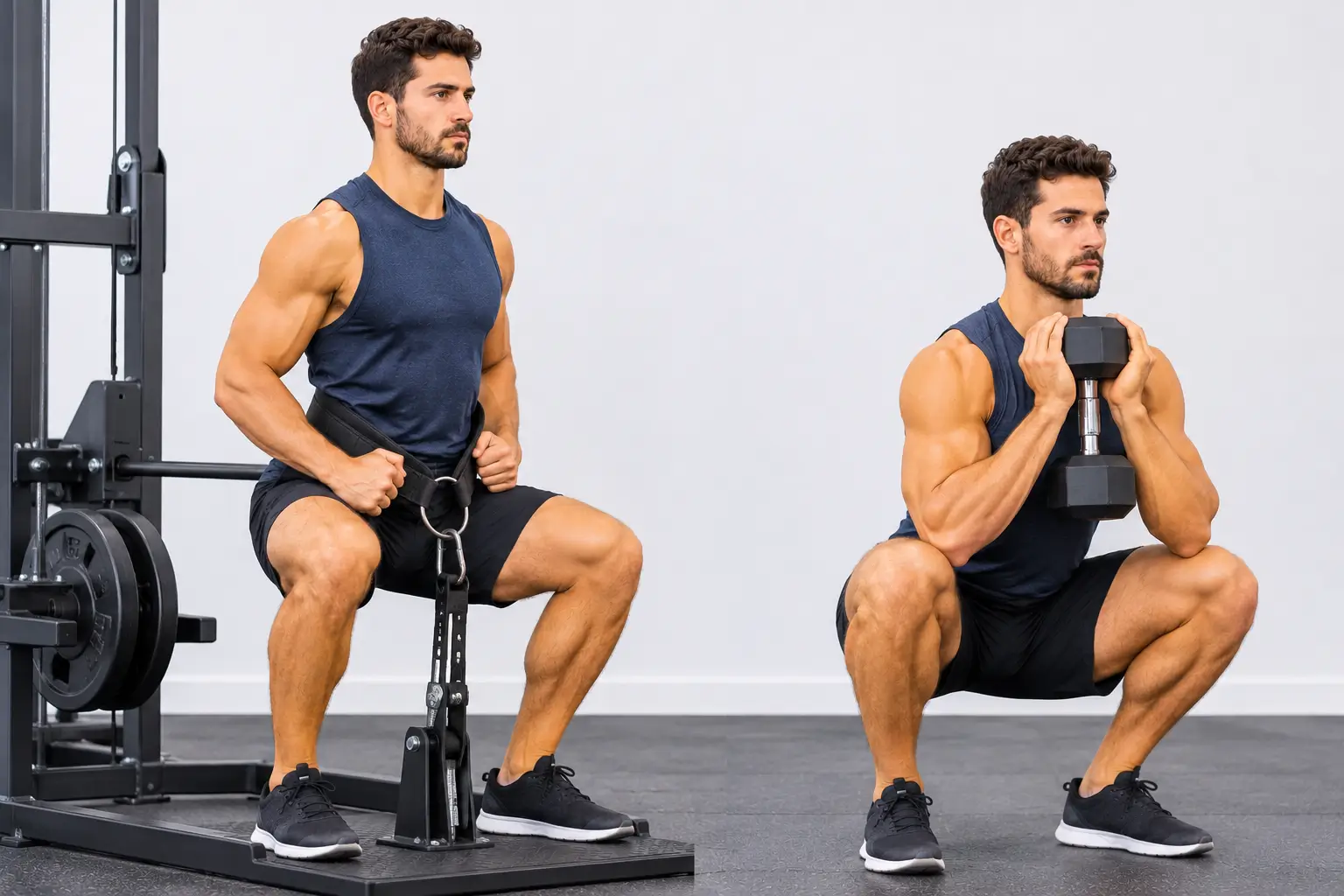
A belt squat loads your hips instead of your shoulders, so your legs work hard while your spine gets a break. The catch is the machine. Most gyms don’t own one, and most home gyms have no room for one. Fortunately, the best belt squat alternatives can give you a similar leg workout with no equipment, a pair of dumbbells, or a cable station.
In this guide, I’ll explain what a belt squat really does. Then I’ll show you which exercises copy it best, how to do each one, and how to build them into a weekly plan. Along the way, you’ll get sets, reps, rest times, and form cues you can use today.
Quick Answer
Quick Answer: The best belt squat alternatives are goblet squats, Bulgarian split squats, and cable squats. Slow bodyweight squats work when you have no gear. Each one loads your legs while keeping heavy weight off your spine. Pick the option that fits your equipment, then add reps, load, or tempo as you get stronger.
What a Belt Squat Does (and What You Need to Copy)
A belt squat hangs the weight from a belt around your hips. Because nothing sits on your shoulders, your upper body stays upright and relaxed. As a result, your quads and calves do most of the work.
Research backs this up. In one small lab study, belt squatting cut lower back muscle activity by roughly half compared with barbell back squats, while quad, hamstring, and calf activity stayed similar. However, the same study found lower glute, ab, and oblique activity. Another study found lower glute activation in belt squats than in back squats, so you may want extra glute work if you swap fully.
So, a good belt squat alternative should do three things:
- Load your legs hard without loading your spine.
- Keep your torso fairly upright.
- Let you progress the load or difficulty over time.
Muscles Worked by Belt Squat Alternatives
Most belt squat alternatives train the same big muscle groups. The exact mix shifts a little with each exercise, though.
Primary muscles
- Quadriceps: These muscles on the front of your thigh straighten your knees. They do the most work in upright squats.
- Gluteus maximus: Your largest hip muscle drives you up out of the bottom position. It works harder with deeper squats and split squats.
- Calves (plantar flexors): They help control your ankles as you lower and rise.
Secondary muscles
- Hamstrings and adductors: These muscles help your hips and knees stay steady.
- Gluteus medius: It keeps your knees from caving inward, especially in single-leg work.
- Core and erector spinae: They brace your trunk. Goblet and cable options use them more than a true belt squat does.
The Gulick and colleagues study compared a hip belt squat with a barbell back squat in 13 people. It found no significant difference in leg muscle activity between the two. The authors also noted that the belt location unloads the shoulders and spine.
Benefits of Belt Squat Alternatives
You don’t need a special machine to get the main benefits. Here is what these exercises can offer:
- Less spinal loading. Without a bar on your back, your lower back and upper traps face less stress. This may help if back squats irritate you.
- Easier technique. Holding weight in front or at your sides helps you stay upright, so beginners often find these moves easier to learn.
- More frequent leg training. Lower fatigue in the back may let you train legs more often. Still, how often you can squat depends on your recovery, sleep, and total volume.
- Muscle growth with lighter loads. A meta-analysis of 21 studies found that muscle size gains were similar across a wide range of loads when sets went close to failure. Heavy loads, though, did better for max strength.
- Home-friendly training. Most options need little space and little money.
- Meets guidelines. The CDC recommends that adults do muscle-strengthening activity at least two days a week, and leg work counts.
Keep in mind that these are general findings from small studies. Your own results will depend on effort, consistency, and recovery.
How to Do a Dumbbell Goblet Squat (The Best All-Round Alternative)
If you pick only one belt squat substitute, make it the goblet squat. It keeps your chest tall, loads your quads well, and teaches good squat form. Here is how to do it.
- Choose your weight. Hold one dumbbell vertically by its top end. Beginners can start with 15-25 lb (7-11 kg).
- Set your grip. Cup the top end of the dumbbell against your chest with both hands. Keep your elbows pointing down.
- Set your stance. Stand with your feet about shoulder-width apart, roughly 12-16 inches (30-41 cm), toes turned out slightly.
- Brace. Take a breath into your belly. Tighten your abs as if someone might tap your stomach.
- Sit down and back. Push your knees out in line with your toes. Lower until your thighs reach about parallel, or as deep as you can control.
- Pause briefly. Keep your heels flat and your chest up. Your elbows may touch the inside of your knees.
- Drive up. Push the floor away and stand tall. Squeeze your glutes at the top.
What it should feel like: Your quads and glutes should feel the work. Your lower back should feel calm, not pinched or sore.
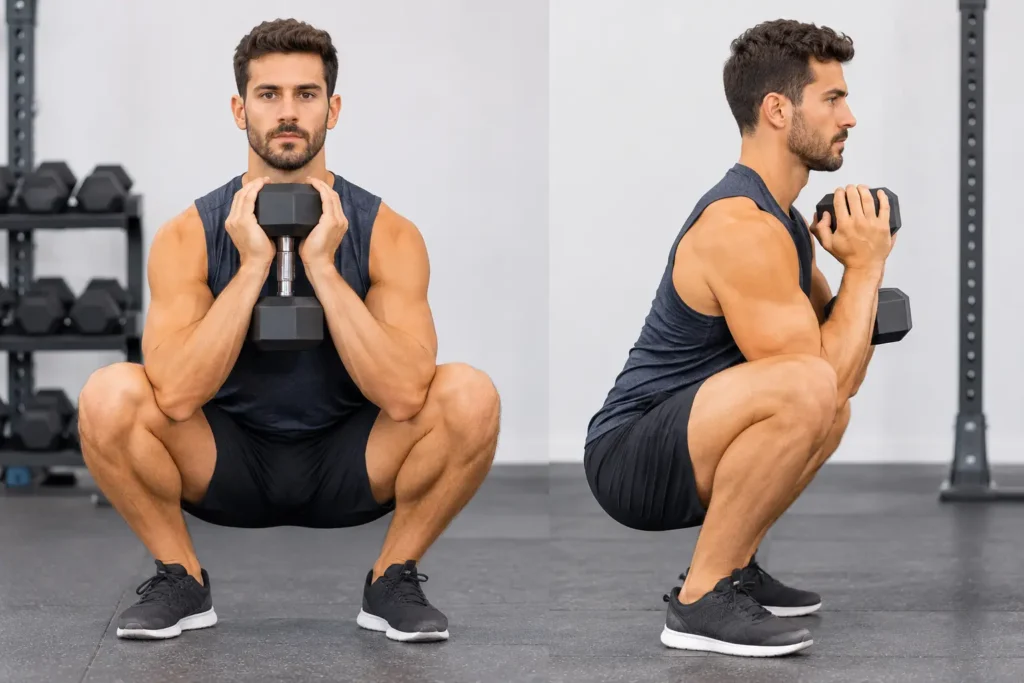
Coach’s Tip: Use a three-second lowering phase (tempo). It makes a light dumbbell feel heavy and builds control. This slow-down is the easiest way to mimic the steady tension of a belt squat machine.
Sets, Reps, and Weight by Goal
The right plan depends on your goal. These are common coaching ranges, not strict rules, so adjust them to how you feel. Heavier loads help most for max strength, while moderate loads work well for size.
| Goal | Sets | Reps | Rest | Weight guidance |
|---|---|---|---|---|
| Strength | 3-5 | 4-6 | 2-3 min | Heavy dumbbells or a dip belt; last rep is hard but clean |
| Muscle size | 3-4 | 8-15 | 60-90 sec | Moderate; stop 1-2 reps before failure |
| Endurance | 2-3 | 15-25 | 30-60 sec | Light; slow tempo, no rushing |
Start with two leg days per week, spaced at least two days apart. Then add a rep or a little weight each week. This approach is called progressive overload, and it is how you keep improving.
Common Mistakes and How to Fix Them
Common Mistake: Letting the weight pull your chest forward. When this happens, your lower back takes over and you lose the main benefit of a belt squat alternative. Fix: Keep the dumbbell snug to your chest and your elbows down.
Also watch for these errors:
- Knees caving in. Push your knees out over your toes. If it keeps happening, lower the weight or use a light band above the knees.
- Heels lifting. This often means tight ankles. Place thin plates under your heels, or squat to a slightly shallower depth.
- Rushing the bottom. Bouncing out of the hole wastes tension. Pause for one second instead.
- Going too heavy too soon. Ugly reps do not build legs faster. Choose a load that lets you keep the same form on every rep.
- Skipping the warm-up. Do five minutes of easy movement and a set or two of light squats first.
Variations: From Easier to Harder
These options let you scale the goblet squat to your level.
Easier (regressions)
- Box or bench squat: Sit to a 16-18 inch (41-46 cm) bench and stand up. It teaches depth and control.
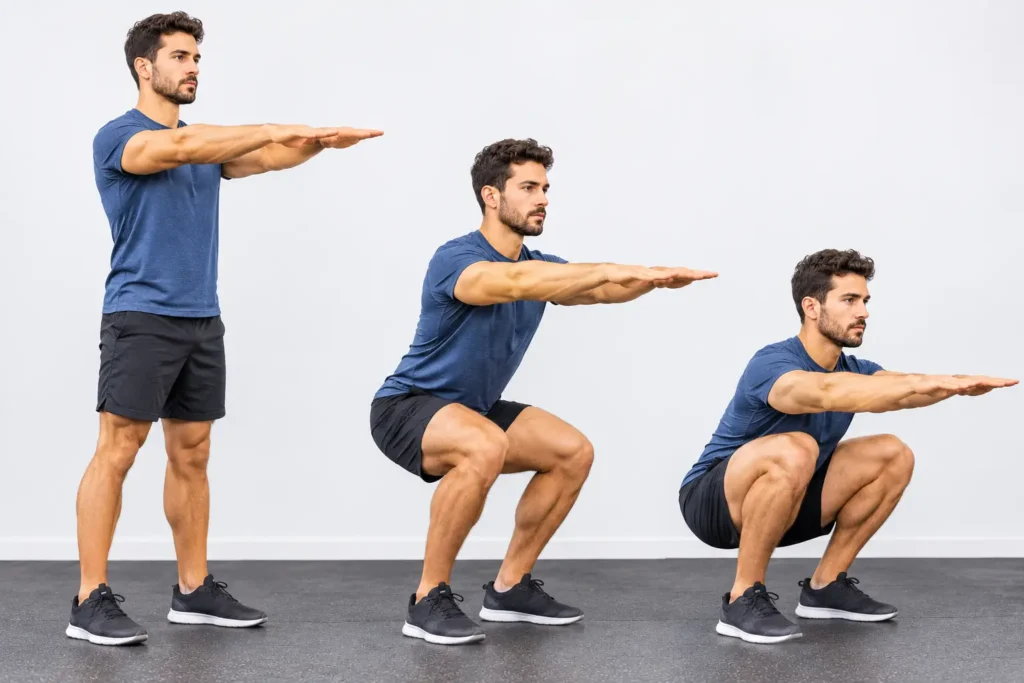
- Bodyweight squat with a counterweight: Hold a light weight straight out in front to help you balance.
- Partial range squat: Lower only halfway, then slowly work deeper over a few weeks.
Harder (progressions)
- Heavier goblet squat: Add 5 lb (2 kg) at a time once you reach the top of your rep range on all sets.
- Pause goblet squat: Hold the bottom for 3 seconds on every rep.
- Heel-elevated goblet squat: Raise your heels on a 1-inch (2.5 cm) plate for more quad work.
- Single-leg versions: Move to split squats, covered below.
Best Belt Squat Alternatives With No Equipment
No gear? You can still train your legs hard. The trick is to make the exercise harder with tempo, pauses, and single-leg work instead of extra weight.
1. Tempo Bodyweight Squat
Lower for four seconds, pause for two seconds, then stand up fast. Do 3-4 sets of 10-15 reps with 60 seconds of rest. Keep your chest tall and your heels flat.
- Easier: Squat to a chair.
- Harder: Add a one-and-a-half rep (go down, come halfway up, go back down, then stand).
2. Reverse Lunge
Step one foot back and lower your back knee toward the floor. Push through the front heel to return. Do 3 sets of 8-12 reps per leg, resting 60-90 seconds. The reverse step is easier on the knees than a forward lunge for many people.
- Easier: Hold a wall or doorframe for balance.
- Harder: Add a slow three-second lowering phase.
3. Wall Sit and Isometric Holds
Slide your back down a wall until your thighs are near parallel. Hold for 30-60 seconds for 3 rounds, resting 60 seconds. Learn more in our guide to isometric leg exercises. Holds like this keep tension on the quads without any spinal load.
4. Sissy Squat (Advanced)
This move targets the quads hard, but it stresses the knees. If you are new to it, read our guide to sissy squats first. Hold a post for support and keep the range small to start.
- Easier: Do the exercise to a shallow depth.
- Harder: Lower slowly for five seconds.
Best Belt Squat Alternatives With Dumbbells
Dumbbells are the easiest way to add real load at home. They let you hold weight in front or at your sides, so your torso stays upright. If you’re buying, compare adjustable dumbbells with fixed sets for your space and budget.
1. Goblet Squat
We covered the form above. Aim for 3 sets of 8-12 reps, resting 90 seconds. It’s the closest everyday match to the upright feel of a belt squat.
2. Dumbbell Bulgarian Split Squat
Put your back foot on a bench about 16-18 inches (41-46 cm) high. Step your front foot out about 24-30 inches (61-76 cm). Hold a dumbbell in each hand, lower straight down, then drive up. Do 3 sets of 8-10 reps per leg with 90 seconds of rest. For a full walkthrough, see our dumbbell Bulgarian split squat guide.
Start with 10-20 lb (5-9 kg) in each hand. What you should feel is a deep stretch and burn in the front leg’s quad and glute.
- Easier: Use bodyweight only, or put the back foot on the floor (a split squat).
- Harder: Use heavier dumbbells or lower for three seconds.
3. Dumbbell Dangle Squat (DIY Belt Squat)
This one copies the belt squat most closely. Stand on two sturdy boxes or step platforms, each about 12 inches (30 cm) high, with a gap between them. Hold one dumbbell between your legs by its end, or hang a dumbbell from a dip belt with a short chain. Squat down between the boxes.
Start with 25-45 lb (11-20 kg) and use slow reps. Test the setup with a light weight first, and make sure the boxes cannot slide. Use a belt and chain only if they are in good condition.
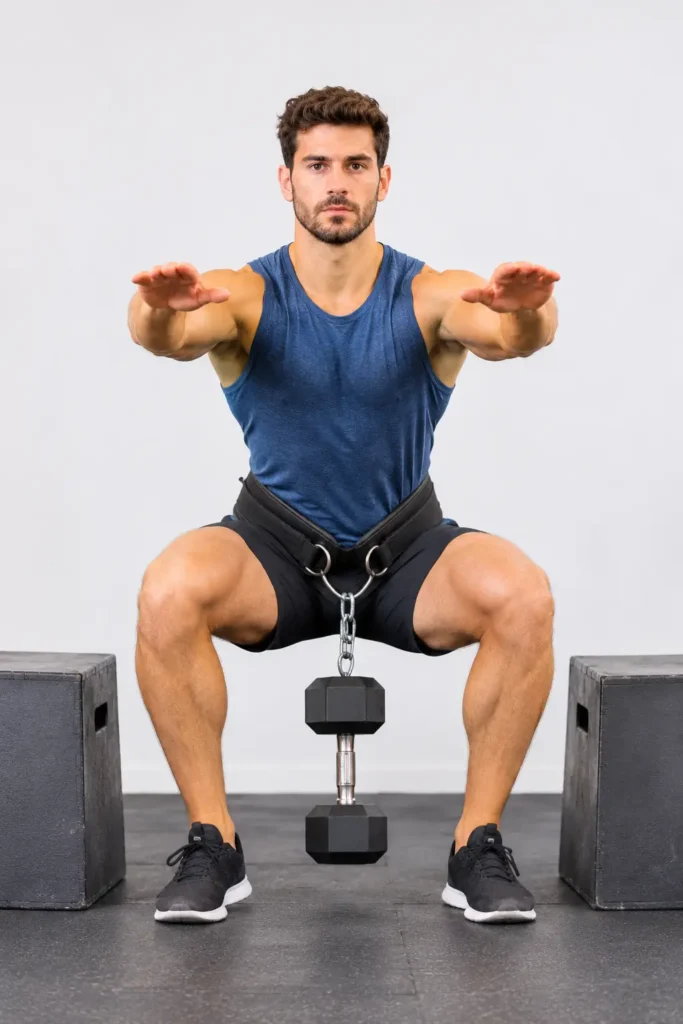
Coach’s Tip: Keep the dumbbell close to your body so it can’t swing. A swinging weight pulls you forward and defeats the point of the drill.
4. Dumbbell Romanian Deadlift (Glute Add-On)
Because belt squats may hit the glutes less, pair your squats with a hip hinge. Hold two dumbbells in front of your thighs, push your hips back, and lower to mid-shin. Do 3 sets of 8-12 reps, resting 90 seconds.
Best Belt Squat Alternatives With Cable Machines
Cables give smooth, steady tension, which is very close to the feel of a belt squat machine. They also let you adjust the load in small steps.
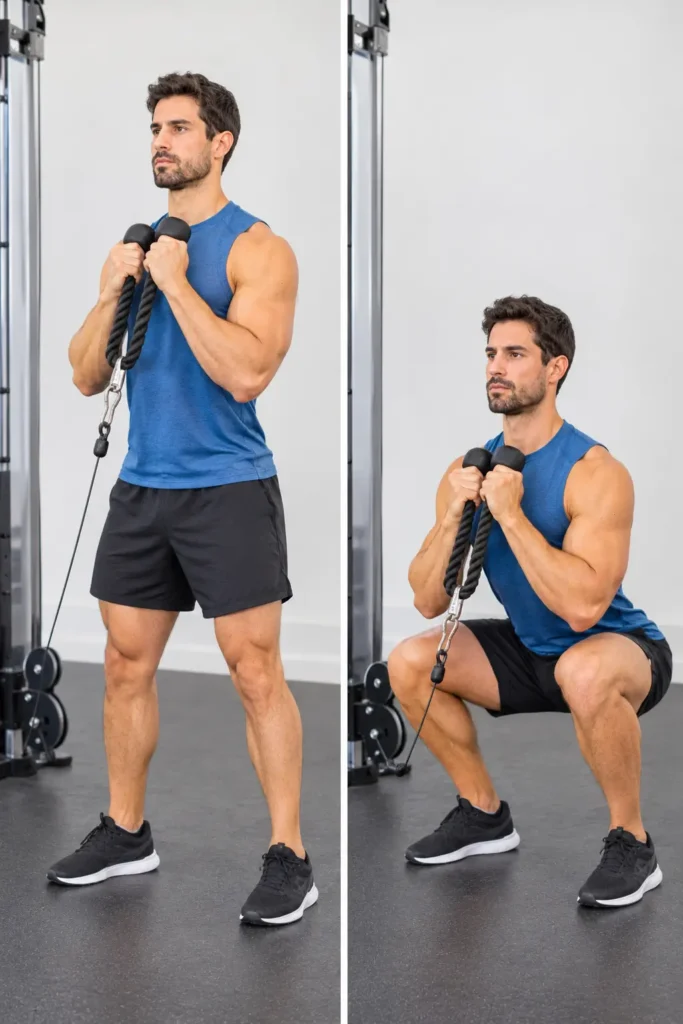
1. Cable Goblet Squat
Set the pulley low and attach a rope. Hold the rope against your chest and step back until the cable is tight. Squat down, keeping your elbows tucked. Do 3 sets of 10-15 reps with 60-90 seconds of rest.
- Easier: Use a lighter stack and squat to a box.
- Harder: Add a three-second pause at the bottom.
2. Cable Pull-Through
Face away from a low pulley with a rope between your legs. Hinge at your hips, then squeeze your glutes to stand tall. Do 3 sets of 12-15 reps with 60 seconds of rest. This move fills the glute gap that belt squats may leave.
3. Cable Hip-Belt Squat (Setup Dependent)
If your cable station has a low pulley and enough room, you can clip the cable to a hip or dip belt and stand on a platform. Check that the cable path is clear and that the platform is stable. If you are unsure, ask a trainer to check your setup. Start light, with 3 sets of 10-12 reps.
Machine Alternatives to Consider
Sometimes a machine is the simplest answer. Two of them are close to belt squat patterns:
- Leg press: It supports your back and lets you push heavy loads safely. Check our guide to the best leg press machines if you’re shopping.
- Hack squat: It keeps your torso supported while you squat. For other options on that pattern, see this hack squat alternative guide.
Use 3 sets of 8-12 reps with 90 seconds of rest for either machine. Keep your lower back flat against the pad and stop before your hips roll under.
Who Should Be Careful
These exercises are gentler on the spine, but they are not risk-free. Check with a doctor or physical therapist before starting if you have:
- Ongoing back, hip, or knee pain
- A recent injury or surgery
- Balance problems or dizziness
- Pregnancy or postpartum recovery
- Heart or blood pressure conditions
If you feel sharp pain, numbness, or tingling, stop right away. Also, beginners should start with bodyweight or a light goblet squat before trying single-leg moves. Older adults can use a chair or a box for support.
Sample Workout Using Belt Squat Alternatives
Try this 40-minute home leg session twice a week. Rest at least two days between sessions. You can also add it to a leg and shoulder workout day.
| Exercise | Sets | Reps | Rest |
|---|---|---|---|
| Warm-up: bodyweight squats and leg swings | 2 | 10 | 30 sec |
| Goblet squat (3-sec lowering) | 4 | 8-10 | 90 sec |
| Dumbbell Bulgarian split squat | 3 | 8-10 per leg | 90 sec |
| Dumbbell Romanian deadlift | 3 | 10-12 | 90 sec |
| Cable pull-through or glute bridge | 3 | 12-15 | 60 sec |
| Wall sit | 2 | 30-45 sec | 60 sec |
Progression plan: Add one rep to every set each week. When you hit the top of the rep range on all sets, add 5 lb (2 kg) and drop back to the lower rep range. After four to six weeks, take an easier week with lighter weights.
Frequently Asked Questions
What can I use instead of a belt squat machine?
Goblet squats, Bulgarian split squats, and cable squats are the best swaps. They load your legs while keeping weight off your spine. With no equipment, try slow bodyweight squats, reverse lunges, and wall sits. Pick the one that fits your gear and comfort level.
Can I do a belt squat at home?
Yes, with a DIY setup. Stand on two sturdy boxes and hang a dumbbell from a dip belt, or hold it between your legs. Start light, keep the weight close to your body, and make sure the boxes cannot slide.
Is a belt squat better than a back squat?
Not necessarily. A small study found belt squats cut lower back muscle activity but also lowered glute and core activity. Which is better depends on your goals, your back, and your gear. Many lifters use both.
Do belt squats work the glutes?
Yes, but they may work them less than back squats. One study found lower glute activation in belt squats. To balance things out, add hip hinges such as Romanian deadlifts, pull-throughs, or glute bridges to your plan.
Can dumbbells replace a belt squat?
For most people, yes. Dumbbells let you load your legs and keep your torso upright. Goblet squats and Bulgarian split squats build strength and size well. You may reach a point where you need heavier loads, which an adjustable set or a dip belt can provide.
Are belt squats good for lower back pain?
They may be easier on the back because the load sits at your hips. Still, pain has many causes, so talk to a doctor or physical therapist before training through it. Start light and stop if symptoms get worse.
Conclusion
You don’t need a belt squat machine to train your legs hard and protect your back. The best belt squat alternatives (goblet squats, split squats, cable work, and slow bodyweight squats) give you the same upright, leg-focused pattern. Add a hip hinge to cover your glutes, and you have a complete plan.
Start with the goblet squat, learn the form, and add reps or weight slowly. If you want a clear next step, try the sample workout twice a week for four weeks and track your numbers. Keep your effort high and your form clean, and your legs will respond.
