The Best Calf Cable Exercises for Maximum Lower Leg Growth
Building strong, defined calves requires more than just a few mindless reps at the end of leg day. If you want serious lower leg development, you need constant tension and a full range of motion. That is exactly why the best calf cable exercises are a game-changer for your routine. Unlike dumbbells or machines that lose tension at certain angles, a cable pulley provides smooth, continuous resistance from the very bottom of the stretch to the peak contraction.
Whether you are a gym beginner trying to build a foundation or an experienced lifter looking to break through a plateau, cable variations offer unmatched versatility. In addition, this guide breaks down the anatomy of the calf, details the most effective cable movements, and provides a complete workout plan. Ultimately, you will learn how to grow your calves safely and effectively.
Quick Answer: Top Cable Calf Exercises
The best calf cable exercises include the standing cable calf raise (for the gastrocnemius), seated cable calf raise (for the soleus), single-leg cable calf raise (to fix imbalances), and cable tibialis raises (for lower leg balance). Aim for 3–4 sets of 12–20 reps with a slow, controlled tempo, emphasizing a deep stretch at the bottom and a hard squeeze at the top.
Why Cable Machines Are Superior for Calf Growth
The calf muscles are notoriously stubborn. First, they are designed for endurance, handling your body weight with every single step you take. Therefore, to force them to grow, you must apply progressive overload and maximize time under tension.
Constant Tension Throughout the Rep
Free weights rely entirely on gravity. As a result, tension drops at the top of a dumbbell calf raise, where the muscle is fully contracted. In contrast, cables pull at an angle, maintaining resistance through the entire range of motion. This continuous load is one reason the best calf cable exercises outperform many free-weight variations.
Micro-Loading for Steady Progress
Moreover, you can add small increments of weight on a cable stack — often just 2.5 lb or 5 lb [1.1–2.2 kg]. For the smaller calf muscles, which fatigue quickly, these tiny jumps matter. Instead of jumping from 50 lb to 70 lb [23–32 kg], you can progress in smooth, manageable steps.
Versatility Across the Whole Lower Leg
Finally, by simply changing the pulley height or your body position, you can target the gastrocnemius, the soleus, and even the tibialis anterior without switching equipment. According to the American College of Sports Medicine (ACSM), muscle hypertrophy is best achieved through controlled movements that emphasize both the concentric (lifting) and eccentric (lowering) phases. For this reason, the cable pulley is an ideal tool for calf development.
Calf Anatomy: What You Are Actually Training
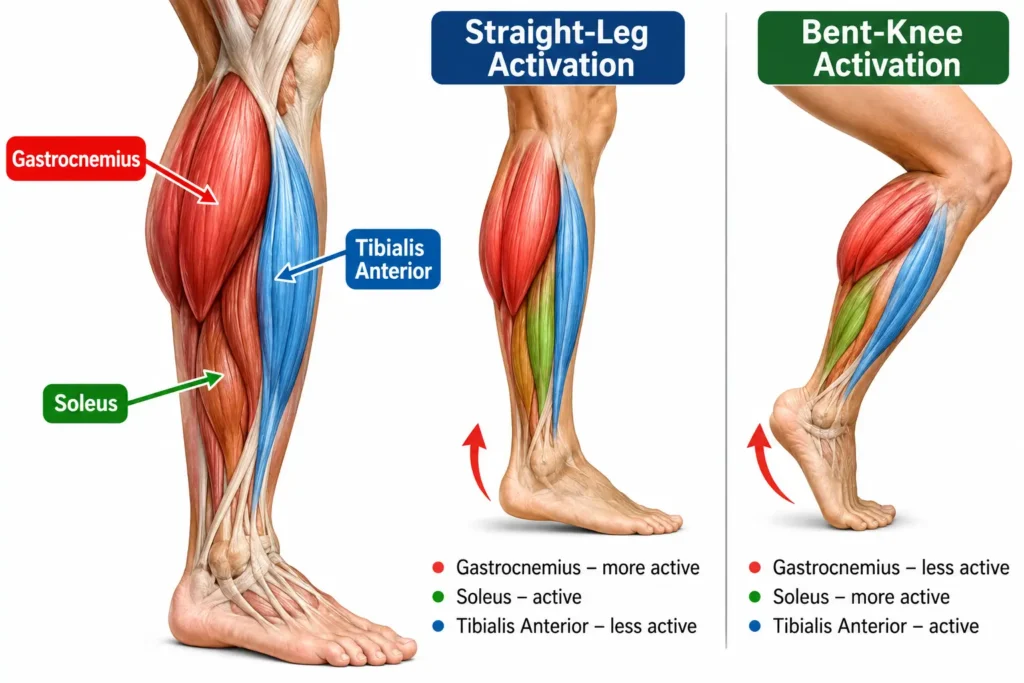
To choose the right movement, you must first understand the two primary muscles that make up your lower leg. Specifically, each one works best under a different knee angle.
- Gastrocnemius: This is the large, diamond-shaped muscle that gives the calf its visible bulk. It crosses both the knee and ankle joints. Therefore, it is best activated when the leg is straight.
- Soleus: This is a flatter, wider muscle lying underneath the gastrocnemius. It only crosses the ankle joint. As a result, bending the knee to about 90 degrees takes the gastrocnemius out of the equation, isolating the soleus for targeted growth.
- Tibialis Anterior: Located on the front of the shin, this muscle is responsible for ankle dorsiflexion (pulling your toes up). In addition, training it prevents muscle imbalances and reduces the risk of shin splints.
In short, to get the most from the best calf cable exercises, you need straight-leg work for the gastrocnemius, bent-knee work for the soleus, and a little front-of-shin work for balance.
The Best Calf Cable Exercises (Step-by-Step)
Here are the six best calf cable exercises to build bigger, stronger calves. Each one includes form cues, rep ranges, and progressions to match your fitness level.
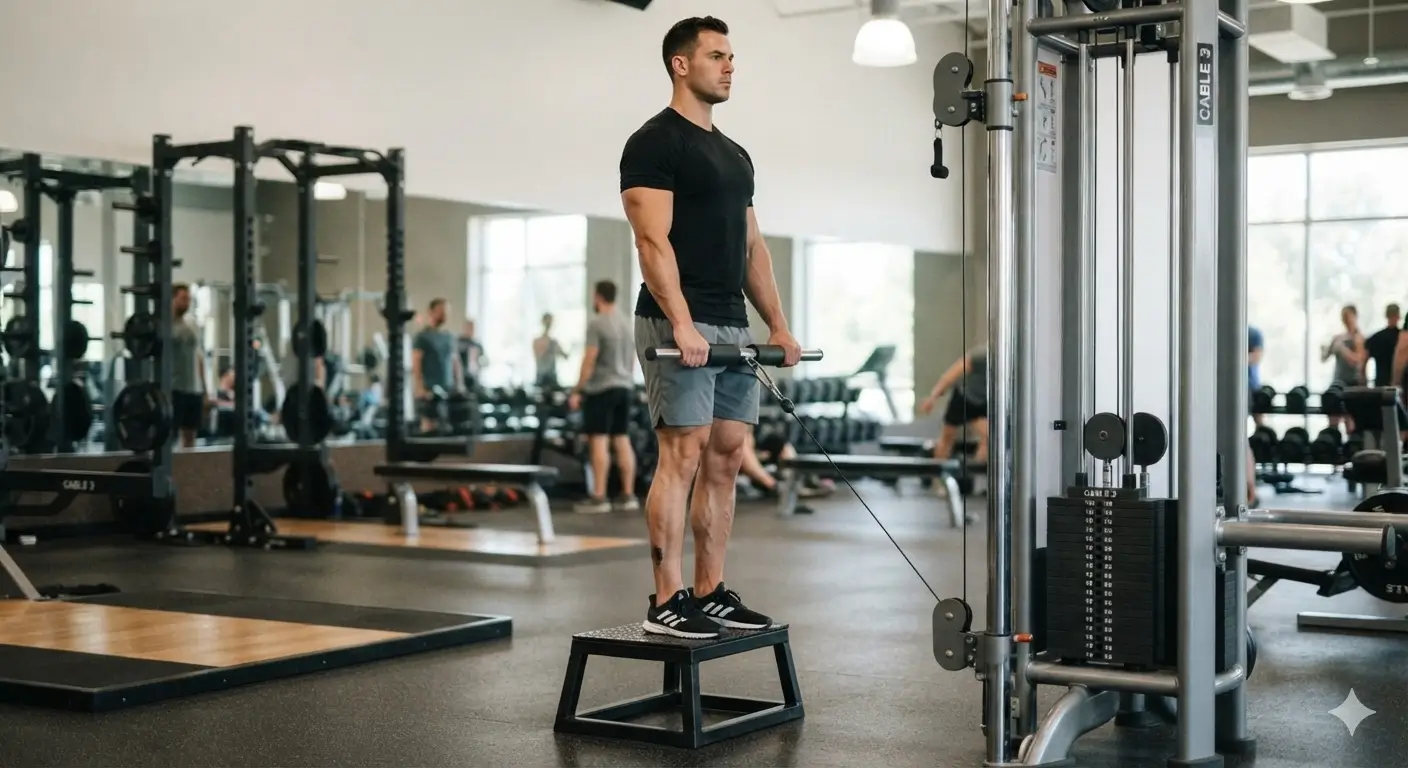
1. Standing Cable Calf Raise
This is the foundational movement for overall calf mass, and it heavily targets the gastrocnemius.
- How to do it:
- First, attach a straight bar to the low pulley of a cable machine.
- Next, step onto a 4-inch (10 cm) aerobic step or weight plate with the balls of your feet, letting your heels hang off the edge.
- Then, rest the bar across your upper thighs or hips, holding it securely with both hands.
- Lower your heels as far as possible to feel a deep stretch in your calves (ankle dorsiflexion).
- Finally, press through the balls of your feet to raise your heels as high as possible, squeezing the calves at the top.
- Sets & Reps: 3–4 sets of 12–15 reps. Rest 60 seconds.
- Why it works: The elevated surface allows for a greater stretch than a flat floor. In fact, research in the Journal of Strength and Conditioning Research links training in a stretched position to superior muscle growth.
- Regression: Perform the same movement using only bodyweight, holding onto a wall for balance.
- Progression: Perform the exercise one leg at a time, holding the cable bar with one hand for stability.
2. Seated Cable Calf Raise
Because your knees are bent, this variation shifts the workload almost entirely to the soleus muscle. Likewise, it adds width and thickness to the lower calf.
- How to do it:
- Place a flat bench about 2 feet (60 cm) in front of a low cable pulley.
- Then, sit on the bench and place a dumbbell or a specialized calf block across your lower thighs, just above the knees.
- Loop the cable handle under the dumbbell or block.
- Keep your knees bent at 90 degrees. Lower your heels toward the floor for a full stretch.
- Finally, push through the balls of your feet to lift the weight, focusing on a strong peak contraction.
- Sets & Reps: 3–4 sets of 15–20 reps. Rest 45–60 seconds.
- Why it works: The soleus is composed of more slow-twitch muscle fibers. As a result, it responds best to higher rep ranges and continuous tension.
- Regression: Seated bodyweight calf raises on a step, without any added cable resistance.
- Progression: Add a 3-second isometric pause at the top of every rep to maximize time under tension.
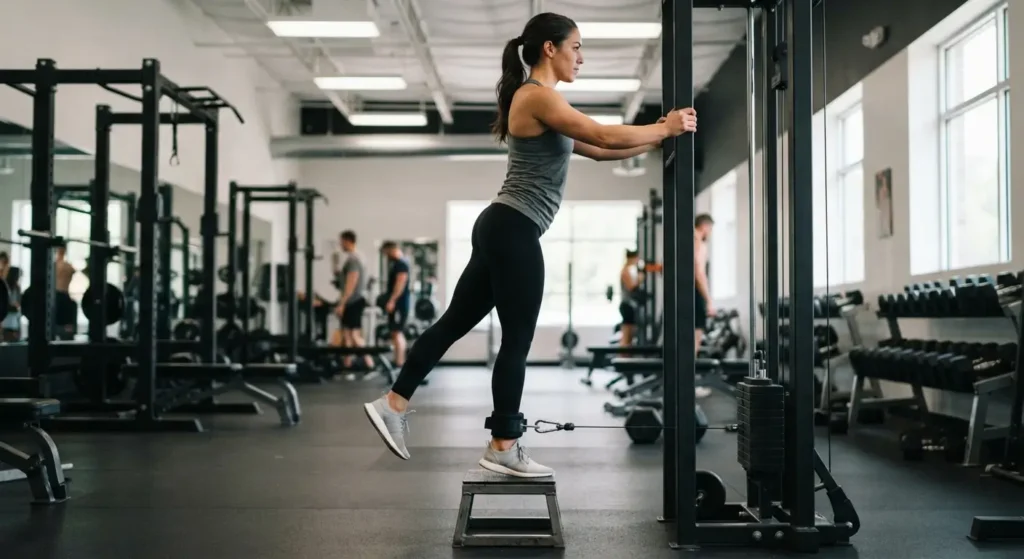
3. Single-Leg Cable Calf Raise
Muscle imbalances between your left and right legs are common, especially if you play sports like tennis or baseball. Fortunately, this exercise ensures both legs develop equally.
- How to do it:
- First, attach an ankle strap to the low pulley.
- Then, secure the strap around the ankle of your working leg.
- Stand on a small block or plate with the working foot, holding the cable machine frame for balance.
- Lower your heel until you feel a deep stretch. Next, drive upward through the big toe and ball of the foot.
- Sets & Reps: 3 sets of 10–12 reps per leg. Rest 45 seconds between legs.
- Why it works: Unilateral training forces the ankle’s stabilizing muscles to work harder. In addition, it improves overall ankle stability and functional lower body strength. For more on building foundational leg strength, check out this guide to a balanced leg and shoulder workout.
- Regression: Single-leg bodyweight calf raises while lightly touching a wall.
- Progression: Hold the top contracted position for 2 seconds on every single rep.
4. Cable Calf Raise on an Elevated Block (Deep Stretch)
Maximizing the stretch at the bottom of the movement is critical for calf growth. Specifically, this variation takes the standard standing raise to the next level.
- How to do it:
- First, set up a sturdy 6-inch (15 cm) box or stack two weight plates.
- Then, use a cable harness, or drape a padded bar across your shoulders, similar to a squat.
- Stand on the edge of the box with the cable pulling slightly upward or straight back, depending on pulley height.
- Drop your heels as low as physically possible, holding the deep stretch for 1–2 seconds.
- Finally, explode upward to the top position.
- Sets & Reps: 3 sets of 10–12 reps. Rest 60 seconds.
- Why it works: A greater range of motion recruits more muscle fibers. As a result, the eccentric stretch under load triggers mechanotransduction, a key driver of muscle growth.
- Regression: Perform the movement on a flat floor to reduce the intensity of the stretch.
- Progression: Slow down the eccentric (lowering) phase to a 4-second count.
5. Cable Tibialis Raise
Most lifters ignore the front of their lower legs. However, training the tibialis anterior balances the joint, improves running mechanics, and protects against shin splints.
- How to do it:
- First, attach an ankle strap to the low pulley.
- Then, face away from the cable machine and secure the strap around the top of your foot.
- Step forward to create light tension in the cable. Keep your heel planted firmly on the ground.
- Next, pull your toes and the front of your foot upward toward your shin (dorsiflexion).
- Finally, slowly lower the foot back to the starting position.
- Sets & Reps: 3 sets of 15–20 reps per leg. Rest 30 seconds.
- Why it works: It directly isolates the tibialis anterior, which is rarely activated during traditional pushing movements like squats.
- Regression: Bodyweight toe raises while leaning your back against a wall.
- Progression: Increase the cable weight and perform the movement with a strict 2-second pause at the top.
6. Isometric Cable Calf Hold
Isometrics are a powerful tool for building tendon stiffness and muscular endurance. In addition, if you want to explore this training style further, read our breakdown of isometric leg exercises.
- How to do it:
- First, set up for a standing cable calf raise with moderate weight.
- Then, rise to the very top of the movement, achieving maximum plantar flexion.
- Hold this contracted position statically for 10–15 seconds. Do not let your heels drop.
- Finally, lower slowly and rest.
- Sets & Reps: 3 sets of 2–3 holds (10–15 seconds each). Rest 60 seconds between holds.
- Why it works: Isometric holds increase blood flow to the tendon. As a result, they improve the mind-muscle connection, teaching your nervous system to fully recruit the calf fibers.
- Regression: 5-second bodyweight holds at the top of a standard calf raise.
- Progression: Increase the cable weight and extend the hold to 20–30 seconds.
A Sample Workout Using the Best Calf Cable Exercises
You do not need to do all six exercises in one day. Instead, here is a highly effective, 20-minute calf routine you can add to the end of your lower body days.
| Exercise | Sets | Reps | Rest | Tempo (Eccentric-Pause-Concentric) |
|---|---|---|---|---|
| Standing Cable Calf Raise | 4 | 12–15 | 60 sec | 2-1-2 (2 sec down, 1 sec pause at bottom, 2 sec up) |
| Seated Cable Calf Raise | 3 | 15–20 | 45 sec | 3-1-1 (focus on the deep stretch) |
| Single-Leg Cable Calf Raise | 3 | 10–12 / leg | 45 sec | 2-0-1 (controlled, no bouncing) |
| Cable Tibialis Raise | 3 | 15–20 / leg | 30 sec | 1-2-1 (2 sec hold at the top) |
Coach’s Tip: Calves respond exceptionally well to high training frequency. For example, instead of annihilating them once a week with 20 sets, try hitting them 2–3 times per week with 6–8 total sets per session. This mirrors the advice from the National Strength and Conditioning Association (NSCA) regarding training frequency for smaller muscle groups. Just be mindful of your overall recovery, especially if you are wondering if you can do squats every day or engage in heavy lower body volume.
How to Progress This Routine
As you adapt, change one variable at a time. First, add reps within the given range. Next, add a small amount of weight. Finally, slow the tempo or add a pause at the bottom. In short, small, consistent steps beat big, erratic jumps every time.
Common Mistakes in the Best Calf Cable Exercises
Even with the best equipment, poor form will stall your calf muscle growth. Therefore, avoid these three common pitfalls.
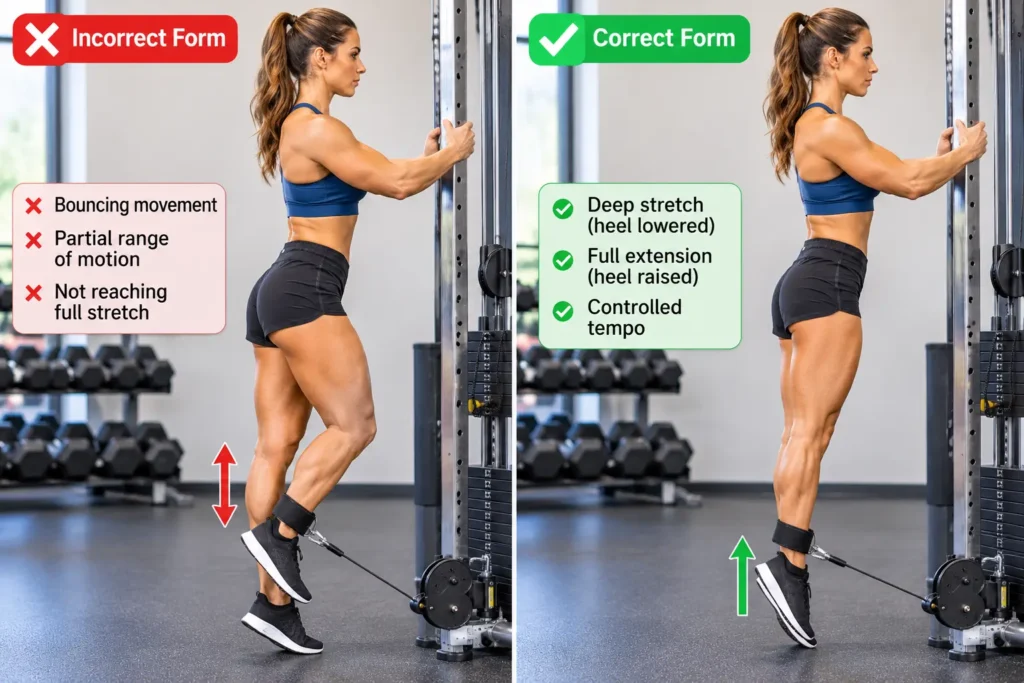
Mistake 1: Bouncing at the Bottom
Many lifters use the elastic energy of their Achilles tendon to “bounce” out of the bottom of a calf raise. As a result, this robs the muscle of tension and shifts the load to the tendon, increasing injury risk. The fix: Pause for a full 1–2 seconds at the bottom of every rep. In addition, if you cannot lift the weight without bouncing, the weight is too heavy.
Mistake 2: Partial Range of Motion
Only moving the ankle an inch or two does not stimulate the muscle fibers adequately. In fact, research suggests that training through a full range of motion produces greater hypertrophy than partial reps. The fix: Use an elevated surface, like a 4-inch [10 cm] block, to ensure your heel drops below parallel, achieving full ankle dorsiflexion.
Mistake 3: Rushing the Tempo
Cranking out 30 fast reps in 15 seconds relies on momentum, not muscle contraction. Instead, adopt a controlled tempo. For example, a 2-second lowering phase and a 1-second squeeze at the top will dramatically increase the effectiveness of the set.
Safety Tips and Who Should Be Careful
While cable calf exercises are generally safe, the Achilles tendon and ankle joints are vulnerable to overuse injuries. Therefore, keep the following points in mind.
Protecting the Achilles Tendon
If you feel sharp pain at the back of your heel or lower calf, stop immediately. Do not push through tendon pain. In addition, if symptoms persist for more than a few days, see a physical therapist before resuming heavy calf work.
Choose the Right Footwear
Wear flat, hard-soled shoes (like Converse or dedicated weightlifting shoes) or train barefoot if your gym allows it. On the other hand, thick, squishy running shoes absorb force and destabilize the ankle. As a result, they reduce the effectiveness of the exercise.
Warm Up Before Loading
Always perform 1–2 light, bodyweight sets before loading the cable machine. This lubricates the ankle joint and prepares the tendon for heavier work.
If you have a history of ankle sprains, plantar fasciitis, or Achilles issues, consult a doctor or physical therapist before starting a heavy calf training program. Furthermore, if your calves are exceptionally sore from a heavy session, be cautious about high-impact activities. You can learn more about managing lower body fatigue in our guide on running after leg day. Also, ensure your overall posture is aligned; issues like an anterior pelvic tilt can subtly alter your center of gravity and affect how your calves engage during standing exercises.
Frequently Asked Questions (FAQ)
1. What are the best calf cable exercises for muscle growth?
The standing cable calf raise and seated cable calf raise are the best for overall muscle growth. The standing version targets the gastrocnemius for height and peak, while the seated version isolates the soleus for lower-leg thickness and width.
2. How to do cable calf raises with proper form?
Stand on an elevated block with the balls of your feet. Lower your heels as far as possible for a deep stretch. Then, pause for one second and press through the balls of your feet to rise as high as possible. Finally, squeeze the calves at the top and lower slowly. Avoid bouncing.
3. Do cable calf raises build muscle effectively?
Yes. Cable machines provide constant tension throughout the entire range of motion, which is a key driver of muscle hypertrophy. As a result, this continuous resistance is often superior to free weights, where tension can drop at the top of the movement.
4. How many reps and sets for cable calf raises?
For muscle growth, aim for 3–4 sets of 12–20 reps. The calf muscles are highly endurance-based. Therefore, they respond well to moderate-to-high rep ranges with short rest periods (45–60 seconds) and strict, controlled tempos.
5. Can you build big calves with just a cable machine?
Absolutely. A cable machine offers enough resistance and versatility to fully exhaust the calf muscles. In addition, by using variations like single-leg raises, elevated stretches, and isometric holds, you can stimulate maximum growth without needing specialized calf machines.
6. Cable calf raise vs machine calf raise: which is better?
Both are effective. However, cable calf raises often provide a more natural movement path and superior constant tension. Machine calf raises can be more convenient and stable for absolute beginners. In contrast, cables allow for better unilateral (single-leg) work and stretch variations. If you do not have a cable machine, you might also consider a leg press machine for calf variations.
Conclusion
Developing impressive, strong calves does not require complicated routines or endless hours in the gym. Instead, by incorporating the best calf cable exercises into your weekly split, you can take advantage of constant tension, full range of motion, and targeted muscle isolation. Remember to focus on your form: control the eccentric phase, pause at the bottom stretch, and squeeze hard at the top.
Start with the standing and seated cable calf raises. Next, master the mind-muscle connection. Finally, progressively add weight over time. Overall, your lower legs will respond with newfound strength, stability, and size.
