Best Exercises for Bad Knees: 12 Low-Impact Moves That Build Strength Safely
Sore knees can turn stairs, walks, and workouts into a guessing game. The good news is that the best exercises for bad knees are simple, low-impact, and easy to do at home. Stronger muscles around the joint share the load, so your knee does less of the work.
This guide covers 12 knee-friendly moves. Each one includes sets, reps, rest times, form cues, and an easier and harder version. Think of it as a coach walking you through each exercise: slowly, clearly, and with a focus on what the movement should feel like. Before you begin, check with your doctor or physical therapist, especially if you have ongoing pain, swelling, or a diagnosed knee condition.
Quick Answer: The best exercises for bad knees strengthen the muscles that support the joint without pounding it. Top picks: quad sets, straight-leg raises, glute bridges, sit-to-stands, and stationary cycling. Keep effort comfortable, build slowly, and check with a doctor or physical therapist first, especially if you have swelling, instability, or diagnosed arthritis.
Why the Best Exercises for Bad Knees Start With Strength
It can feel backward to exercise a joint that hurts. Still, avoiding movement rarely helps in the long run. A Cochrane review of 44 trials in people with knee osteoarthritis found that land-based exercise reduced pain and improved physical function, and the benefit lasted at least two to six months after formal treatment ended.
A newer Cochrane update rated the evidence as low to moderate certainty. It also found no clear differences between types of exercise. In plain terms, the best program is the one you can do safely and stick with.
Muscle strength matters for a simple reason. Harvard Health Publishing explains that strong quadriceps and hamstrings can share some of the shock-absorbing work that cartilage and the meniscus normally handle. In addition, the CDC reports that adults with arthritis may reduce pain and improve function by about 40% when they stay physically active.
That is why this list focuses on the thigh and hip muscles that support the knee, plus low-impact cardio. Your quads, hamstrings, and glutes do the heavy lifting. As a result, the knee gets a calmer ride.
Ground Rules Before You Try the Best Exercises for Bad Knees
- Warm up first. Spend 5 minutes on easy marching in place or light cycling so the joint feels loose.
- Use the traffic-light rule. Mild effort or discomfort up to about 3 out of 10 that settles within 24 hours is usually fine. Sharp, pinching, or catching pain means stop. [VERIFY: confirm this threshold with your clinical reviewer]
- Control the tempo. Lift in about 2 seconds and lower in about 3. Slow lowering builds strength and keeps the joint steady.
- Rest between sets. Take 45–60 seconds. Also, leave a day between harder strength sessions.
- Change one thing at a time. Add reps, load, or range, but never all three in the same week.
12 Best Exercises for Bad Knees (Step by Step)
Start with exercises 1–6 for your first two weeks. Then add the rest as your knees allow.
1. Quad Sets
Targets: quadriceps.
- Sit with one leg straight and a small rolled towel under that knee.
- Press the back of the knee down into the towel and tighten the front of your thigh.
- Hold for 5 seconds while breathing normally, then relax.
Sets and reps: 2–3 sets of 10 holds per leg, with 30 seconds of rest.
Why it works: The muscle works hard, but the joint barely moves. That makes quad sets a gentle starting point when your knee feels irritated. For more static options, see our guide to isometric leg exercises.
Easier: hold for 2–3 seconds. Harder: hold for 10 seconds, or add a straight-leg lift (exercise 2).
2. Straight-Leg Raise
Targets: quadriceps and hip flexors.
- Lie on your back with one knee bent and that foot flat. Keep the other leg straight.
- Tighten the thigh of the straight leg first, so the knee stays locked.
- Lift the leg to the height of the bent knee, about 12 inches (30 cm). Pause for 2 seconds.
- Lower slowly over 3 seconds.
Sets and reps: 2–3 sets of 8–12 per leg, with 45 seconds of rest.
Why it works: It strengthens the front of the thigh without bending the knee under load. You should feel the work in the thigh, with no pinch around the kneecap.
Easier: lift only 6 inches (15 cm). Harder: add 1–3 lb (0.5–1.4 kg) ankle weights. Our article on the benefits of ankle weights explains how to choose a pair.
Common Mistake: Letting the knee bend and swinging the leg up with momentum. Fix: tighten the thigh before every rep, and slow down the lowering phase.
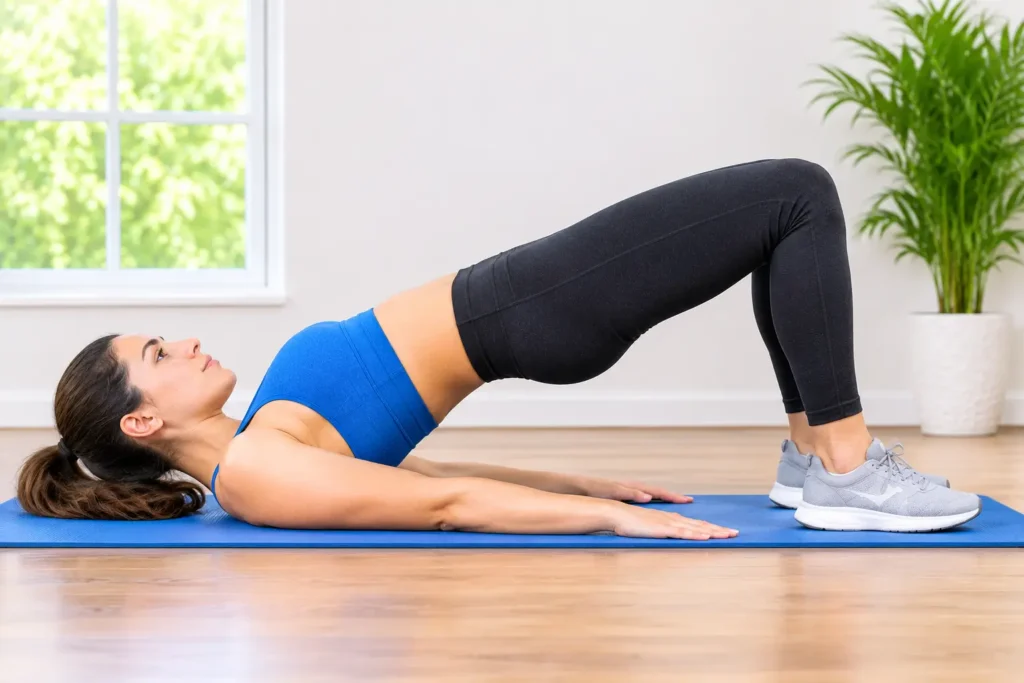
3. Glute Bridge
Targets: glutes and hamstrings.
- Lie on your back with knees bent and feet flat, hip-width apart. Place your heels about 10–12 inches (25–30 cm) from your hips.
- Press through your heels and lift your hips until your shoulders, hips, and knees form a straight line.
- Squeeze your glutes for 2 seconds, then lower slowly.
Sets and reps: 2–3 sets of 10–15, with 45–60 seconds of rest.
Why it works: Your hips sit right above your knees. Harvard Health notes that strengthening the upper and lower legs, hips, and core can help these muscles better support the knee.
Easier: use a smaller lift and skip the pause. Harder: try single-leg bridges, add a mini band above the knees, or place a 10–20 lb (5–9 kg) dumbbell on your hips.
4. Side-Lying Leg Raise
Targets: gluteus medius and other hip abductors.
- Lie on your side with the bottom knee bent for balance. Keep the top leg straight, in line with your body.
- Point your toes forward and lift the top leg about 12 inches (30 cm) without rolling your hips backward.
- Lower slowly over 3 seconds.
Sets and reps: 2–3 sets of 10–12 per side, with 45 seconds of rest.
Why it works: Good knee programs go beyond the quads and hamstrings. Harvard Health lists the hip abductors among the muscles worth training. For people with pain around the kneecap, one systematic review found that hip strengthening and knee strengthening were about equally effective for pain and function.
Coach’s Tip: Imagine your heel leading the lift instead of your toes. This keeps the work in your outer hip rather than your hip flexor. If you feel it mostly in your lower back, shorten the range.
Easier: lift 6 inches (15 cm). Harder: add a mini band above the knees or 1–2 lb (0.5–0.9 kg) ankle weights.
5. Standing Hamstring Curl
Targets: hamstrings.
- Hold a counter or sturdy chair and stand tall, feet hip-width apart.
- Bend one knee and bring your heel toward your glutes, keeping your thighs side by side.
- Pause for 1 second, then lower over 3 seconds.
Sets and reps: 2–3 sets of 10–12 per leg, with 45 seconds of rest.
Why it works: Your hamstrings pair with your quads to control the knee, so it makes sense to train both. This move is easy to do anywhere, and it needs no equipment.
Easier: curl only halfway. Harder: add 2–5 lb (1–2 kg) ankle weights or take 5 seconds to lower. If bending bothers the back of your knee, simply stop at a shallower angle.
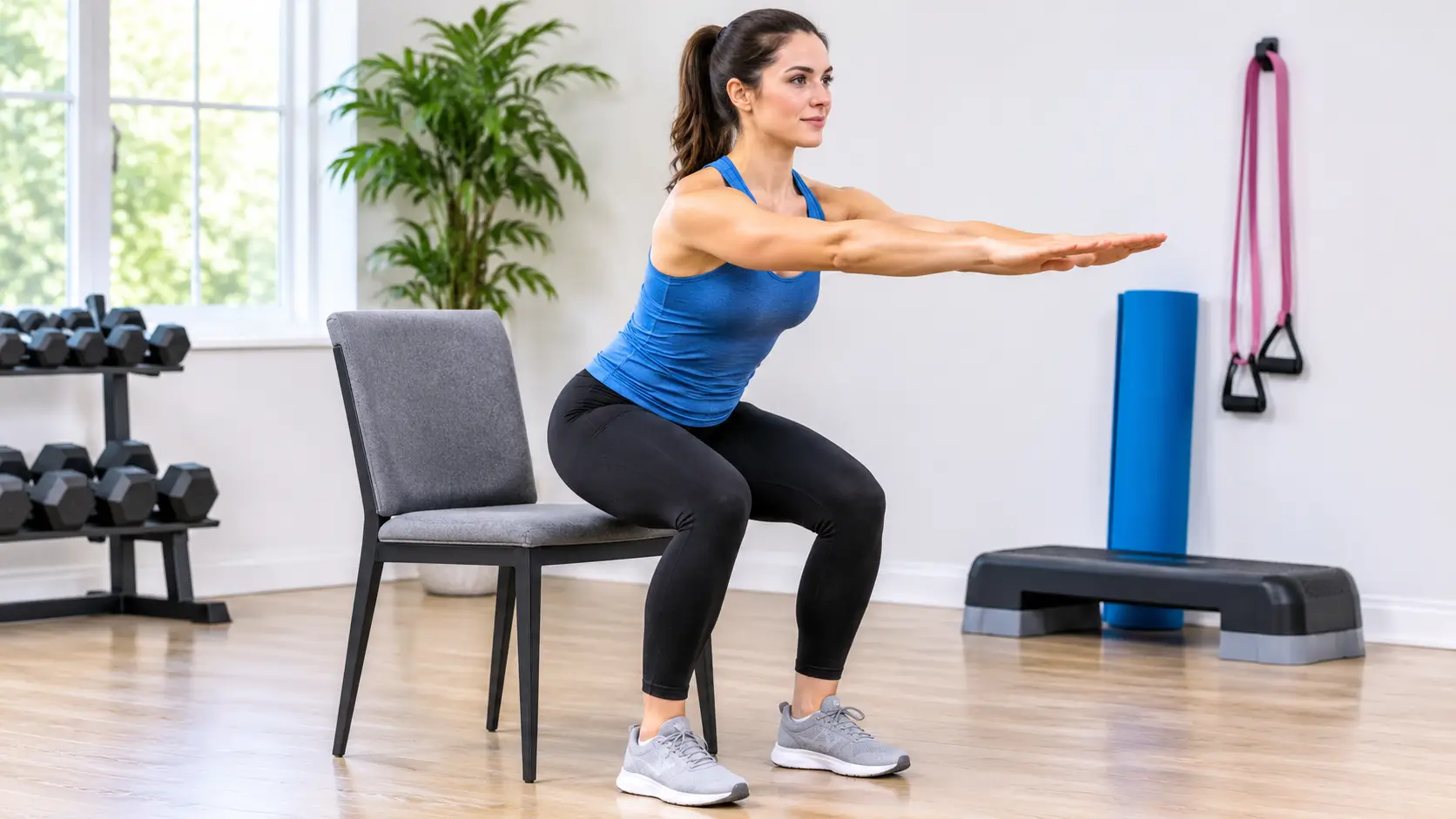
6. Sit-to-Stand (Chair Squat)
Targets: quads, glutes, and hamstrings.
- Sit near the front edge of a sturdy chair with a seat height of about 17–19 inches (43–48 cm). Put the chair against a wall.
- Place your feet hip-width apart and slightly behind your knees. Lean your chest forward.
- Press through your whole foot and stand tall.
- Lower slowly for 3 seconds until you lightly touch the seat, then stand again.
Sets and reps: 2–3 sets of 8–12, with 60 seconds of rest.
Why it works: It copies standing up from a chair, toilet, or car, so it carries over to daily life. The chair also sets a safe depth. If you wonder how often to repeat it, read whether you can do squats every day.
Common Mistake: Knees drifting inward or heels lifting off the floor. Fix: keep your whole foot planted and think about pushing your knees gently in line with your toes.
Easier: raise the seat with a firm cushion and use your hands lightly. Harder: use a lower seat, hold a 5–10 lb (2–5 kg) dumbbell at your chest, or take 5 seconds to lower.
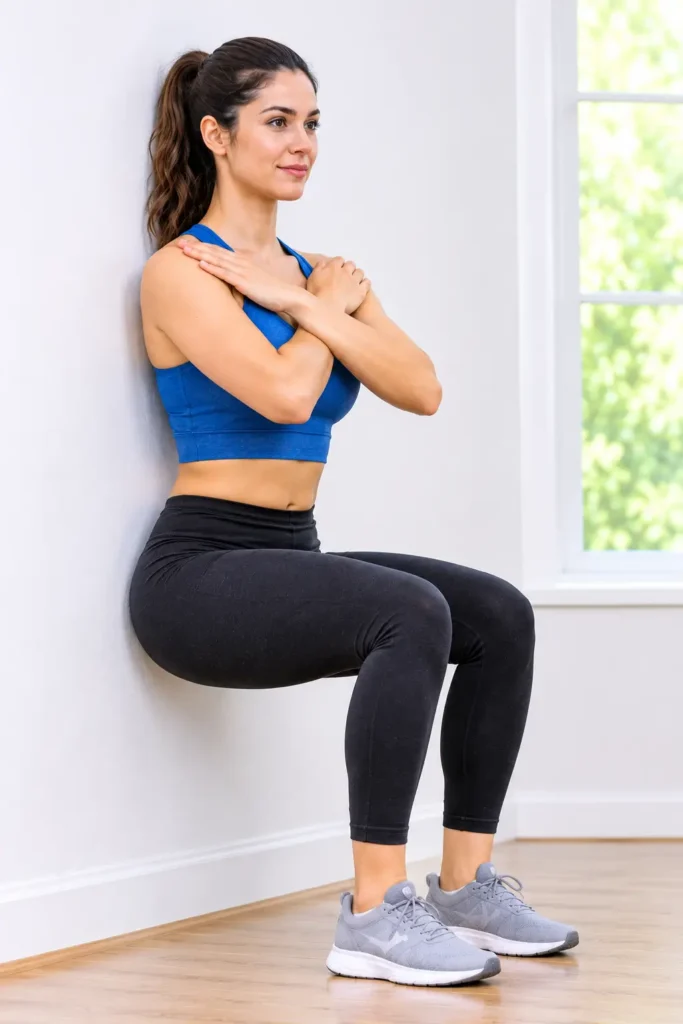
7. Wall Sit
Targets: quads and glutes.
- Stand with your back against a wall and your feet about 18–24 inches (46–61 cm) away from it.
- Slide down a few inches until your knees bend about 30–45 degrees. Think of it as a quarter squat.
- Keep your knees above your ankles and your back flat. Hold, then slide back up.
Sets and reps: 3 holds of 15–30 seconds, with 60 seconds of rest.
Why it works: Because the hold is isometric, you choose a depth that feels comfortable. Time under tension then builds quad endurance without any bouncing or impact.
Easier: hold for 10 seconds with a smaller bend. Harder: go slightly deeper only if it stays pain-free, hold for 45–60 seconds, or hold 5–10 lb (2–5 kg) dumbbells.
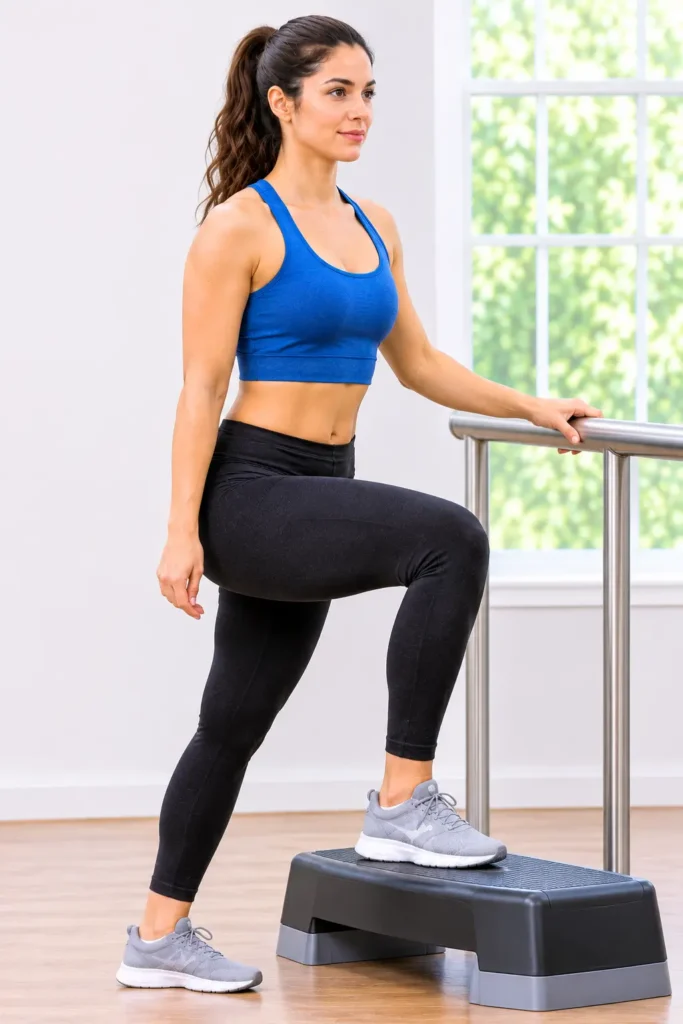
8. Low Step-Up
Targets: quads, glutes, and calves.
- Face a step that is 4–6 inches (10–15 cm) high, with a rail or wall nearby for balance.
- Place your whole foot on the step, press through the heel, and stand tall. Tap the other foot on the step.
- Lower with control over 3 seconds, keeping the working leg steady.
Sets and reps: 2–3 sets of 8–10 per leg, with 60 seconds of rest.
Why it works: Single-leg strength matters for stairs and uneven ground. Meanwhile, the low height limits how far the knee has to bend.
Easier: use a 2–4 inch (5–10 cm) step. Harder: use a 7–8 inch (18–20 cm) step or hold 5–10 lb (2–5 kg) dumbbells in each hand.
9. Banded Side Step
Targets: gluteus medius and hip abductors.
- Loop a light mini band above your knees (easier) or around your ankles (harder).
- Stand with a small knee bend and your toes pointing forward.
- Step sideways for 10 steps, keeping the band tight. Then step back the other way.
Sets and reps: 2–3 rounds of 10 steps each direction, with 45 seconds of rest.
Why it works: These muscles steady your hips every time you walk or climb stairs. A stable pelvis helps the knee track more smoothly.
Easier: skip the band. Harder: move the band to your ankles, sink into a slightly deeper quarter squat, or add steps.
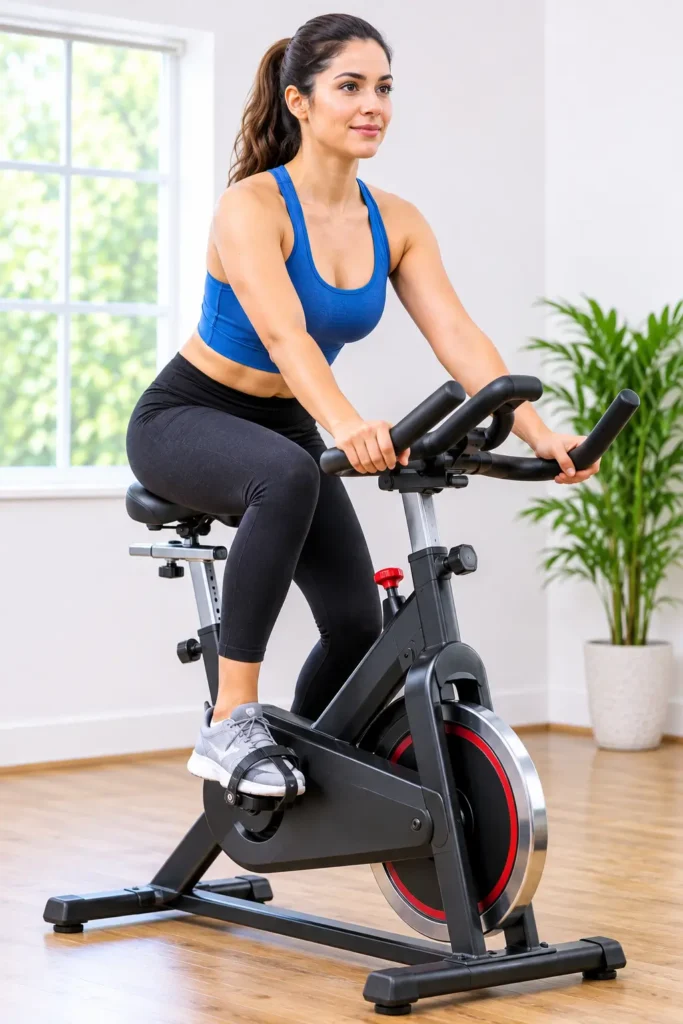
10. Stationary Cycling
Targets: quads, hamstrings, glutes, and heart and lungs.
- Set the seat so your knee keeps a slight bend at the bottom of each pedal stroke and never locks out.
- Use light resistance and a smooth, comfortable pace.
- Start with 5–10 minutes and stop if you feel sharp pain.
Sets and reps: 10–20 minutes, 3–5 days per week. Add 2–3 minutes each week as it feels comfortable.
Why it works: The CDC lists biking with walking, swimming, and water activities as low-impact options that are safe for most adults with arthritis. Shopping for a stationary bike? See our picks for the best bikes for older adults. If your knees are very stiff, a compact pedal exerciser can be an even gentler start.
Easier: raise the seat slightly and ride for 5 minutes. Harder: do 5 rounds of 1 minute with slightly firmer resistance, followed by 2 minutes easy.
11. Pool Walking and Water Exercise
Targets: whole lower body, with less joint loading.
- Wade into waist- to chest-deep water.
- Walk forward for 5 minutes, then side-step, then walk backward slowly. Swing your arms naturally.
- Finish with slow marching and gentle leg swings.
Sets and reps: 20–30 minutes, 2–3 times per week.
Why it works: Water supports your body weight, and the research is encouraging. A Cochrane review found that aquatic exercise gave small, short-term improvements in pain and disability for people with knee or hip osteoarthritis. No serious side effects were linked to the aquatic programs.
Easier: stay waist-deep for 10 minutes. Harder: move faster or use water dumbbells. Note that deeper water takes more weight off your joints, so pick a depth that feels comfortable.
12. Tai Chi
Targets: legs, balance, and body control.
- Find a beginner class at a community center, hospital program, or online.
- Keep your knees softly bent, never locked, and use a shallow stance.
- Move slowly and stay inside a comfortable range.
Sets and reps: 1–2 sessions per week of 30–45 minutes, plus 10–15 minutes at home on other days if you enjoy it.
Why it works: A systematic review of six randomized trials concluded that Tai Chi was effective for relieving pain and improving function in knee osteoarthritis. However, the authors called for larger, longer studies. Slow, balanced movement also challenges the leg muscles in a gentle way.
Easier: try seated Tai Chi arm sequences. Harder: use a lower stance and longer sessions, but only when your knees stay comfortable.
How to Put the Best Exercises for Bad Knees Into a Weekly Plan
Harvard Health suggests leg resistance exercises two to three times per week to support the knee. The CDC also recommends about 150 minutes of moderate activity per week for people with arthritis. The plan below stays well under that load at first, so build toward it gradually and only with your doctor’s approval.
Strength A (beginner circuit):
| Exercise | Sets × reps | Rest |
|---|---|---|
| Quad sets | 2 × 10 holds (5 sec) | 30 sec |
| Straight-leg raise | 2 × 10 per leg | 45 sec |
| Glute bridge | 2 × 12 | 45–60 sec |
| Side-lying leg raise | 2 × 10 per side | 45 sec |
| Standing hamstring curl | 2 × 10 per leg | 45 sec |
| Sit-to-stand | 2 × 8–10 | 60 sec |
Strength B uses the wall sit, low step-up, banded side step, and glute bridge, with 2 sets each.
| Day | Session | Time |
|---|---|---|
| Monday | Strength A | 25–30 min |
| Tuesday | Stationary bike or pool walking | 15–20 min |
| Wednesday | Quad sets plus an easy flat walk | 10–15 min |
| Thursday | Strength B | 25–30 min |
| Friday | Stationary bike or pool walking | 20 min |
| Saturday | Tai Chi or an easy walk (roughly 1 mile / 1.6 km) | 20–30 min |
| Sunday | Rest | None |
Progression: In weeks 1–2, do 2 sets. In weeks 3–4, add a third set. In weeks 5–6, upgrade one exercise at a time, such as holding a dumbbell or using a slightly higher step. If your knees feel worse the next morning, drop back to the previous week’s level.
Beginner and advanced versions: Beginners can stick with exercises 1–6 and 10 minutes of cycling. More experienced exercisers can use every exercise with the harder options. If walking is your main cardio, our comparison of slow jogging vs fast walking can help you pick an intensity.
Exercises to Skip When Choosing the Best Exercises for Bad Knees
Often, you can modify a movement instead of dropping it. Reduce the depth, load, or speed first. Then bring harder moves back slowly as your knees feel steadier.
- Deep, heavy squats and long lunges: shorten the range and hold a support.
- Sissy squats: these load the knees heavily, so save sissy squats for when you are pain-free and cleared by a clinician.
- Jumping and running on hard surfaces: swap them for cycling, pool work, or brisk walking.
- Sudden twisting or pivoting: sports like pickleball can aggravate sore knees, so return to them gradually.
- Heavy leg extensions: if the front of your knee complains, use light weight and a shorter range.
Safety Tips for the Best Exercises for Bad Knees
Stop an exercise if you feel sharp pain, catching, locking, or swelling afterward. According to Mayo Clinic, call your doctor if you cannot bear weight, your knee feels unstable or gives out, you have marked swelling, or you cannot fully straighten or bend the knee. Also get help for visible deformity, severe pain after an injury, or fever with a red, painful, swollen knee.
Body weight matters too. In adults with a higher body weight and knee osteoarthritis, each pound lost was linked to about a 4-pound reduction in knee load per step, which is roughly 1 lb (0.45 kg) lost for 4 lb (1.8 kg) less load. If weight loss is one of your goals, ask your doctor for a safe plan.
Footwear can also change how walking feels. Some people like rocker-bottom shoes for comfort, and a physical therapist can tell you whether they suit your knees.
FAQs About the Best Exercises for Bad Knees
What Are the Best Exercises for Bad Knees?
There is no single best exercise. A 2024 Cochrane update found no clear difference between types of exercise for knee osteoarthritis, so the best choice is the one you can do safely and often. Good starting points include quad sets, glute bridges, sit-to-stands, and easy stationary cycling.
Is walking good for bad knees?
Often, yes. The CDC lists walking among the low-impact activities that are safe for most adults with arthritis. Start on flat ground for 10 minutes, add a few minutes each week, and slow down if you feel sharp pain. If pain lingers, talk with a physical therapist.
Are squats bad for bad knees?
Not always. Shallow, controlled squats such as sit-to-stands and wall sits are a common starting point because you control the depth and load. Deep, heavy, or fast squats may aggravate sore knees. If a squat causes sharp or lingering pain, raise the seat, shrink the range, or ask a physical therapist to check your form.
What exercises should I avoid with bad knees?
Often, you can modify a movement instead of dropping it. Common troublemakers include jumping, deep loaded squats, long lunges, and sudden twisting or pivoting. Reduce depth, load, or speed first. Then reintroduce harder moves slowly once your knees feel stable. A doctor or physical therapist can tell you which movements to limit based on your diagnosis.
How often should I do knee exercises?
Aim for leg strength work two to three times a week, which matches Harvard Health guidance, with a rest day between sessions. Add low-impact cardio most days, working toward the CDC’s 150 minutes per week if your doctor agrees. Quad sets and gentle mobility can often be done daily.
Is cycling or swimming better for knee pain?
Both are low-impact, so choose the one you enjoy and can repeat. The CDC lists biking and swimming as low-impact options for arthritis, and a Cochrane review found that aquatic exercise gave small short-term improvements in pain and disability for knee or hip osteoarthritis. Try both and track how your knees feel.
Final Thoughts on the Best Exercises for Bad Knees
The best exercises for bad knees are not fancy. They build the thigh and hip muscles around the joint, keep impact low, and respect your pain signals. Start with quad sets, glute bridges, and sit-to-stands, then add cycling or pool work, and progress one small step at a time.
Pick two exercises from this list and do them this week. Notice how your knees feel the next morning, and adjust from there. If you notice pain, swelling, or instability, pause and talk with a health specialist.
