
Do kettlebell swings work abs? That’s one of the most common questions I’d expect from anyone who has felt their midsection light up after a hard set. The honest answer has two parts. Swings do train your core, but not the way crunches do. And they can’t melt belly fat on their own.
This guide explains what your abs actually do during a swing. It also covers what research says, how to do the move safely, and how to build a routine that supports a stronger, more defined midsection.
Quick Answer
Yes, kettlebell swings work your abs, but mostly as stabilizers. Your glutes and hamstrings drive the movement while your core keeps your spine steady. Swings can build core endurance and strength, yet they won’t spot-reduce belly fat. For visible abs, pair swings with direct core work, smart eating, and consistent training.
What Your Abs Actually Do During a Kettlebell Swing
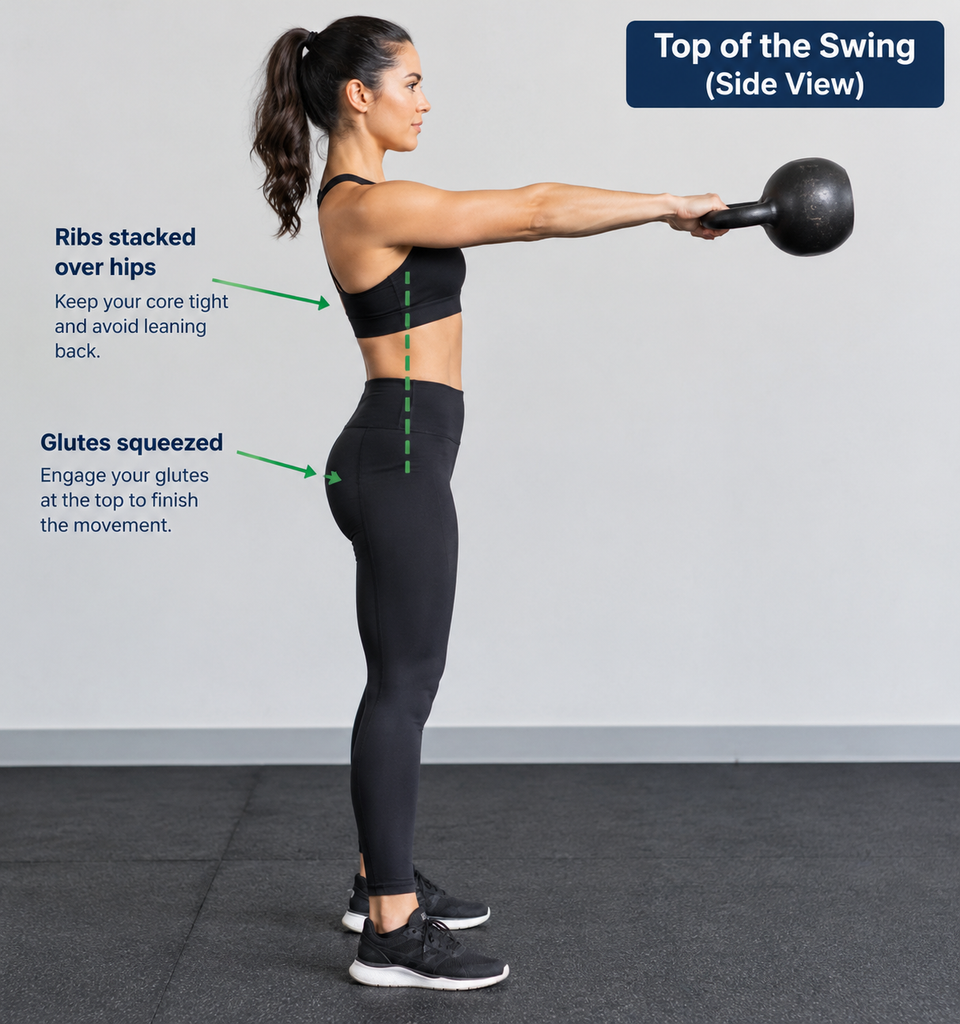
The swing is a hip hinge. You push your hips back, then snap them forward to launch the bell. Your hips make the power. Your abs make sure that power travels safely through your body.
Think of your trunk as a steel pole between your hips and shoulders. The hips push, and the pole must not bend. Your core muscles hold that pole steady, and coaches call this “anti-extension” and “anti-rotation” work. Your abs aren’t crunching. They’re bracing against a swinging weight that wants to pull you forward and, in one-arm swings, twist you sideways.
Four core muscle groups share this job:
- Rectus abdominis: the “six-pack” muscle. It resists your lower back arching at the top of the swing.
- Transverse abdominis: the deep belt-like muscle that tightens your trunk.
- Obliques: they resist twisting, especially in one-arm swings.
- Erector spinae and lats: the back muscles that keep your spine long and the bell close.
Do Kettlebell Swings Work Abs? What the Research Says
Most swing research measures the hips and back, not the abs. That matters for how we read the evidence.
A study by McGill and Marshall in the Journal of Strength and Conditioning Research looked at back and hip muscle activation, motion, and low-back loads during swings, snatches, and carries. A later study in the International Journal of Sports Physical Therapy measured 19 healthy young adults. It found average peak glute activation of roughly 75% of maximal effort and biceps femoris (hamstring) activation of about 79%. Those are high numbers for muscles that drive the hips.
An EMG study in the British Journal of Sports Medicine reported that the swing targets a hamstring muscle called the semitendinosus. Together, these studies describe the swing as a hip-dominant exercise. Your abs work alongside the hips, but they aren’t the star.
[VERIFY: add an ab-specific EMG study here if you have one. I’m not quoting an ab-activation percentage because the studies above focus on hips and back.]
What does this mean for you? Swings likely build core stability and endurance, especially when you add reps, weight, or one-arm variations. But if you want a bigger, stronger rectus abdominis, you’ll still want some direct ab work.
Muscles Worked in a Kettlebell Swing
| Muscle group | Role in the swing | Main job |
|---|---|---|
| Glutes | Primary | Drive the hips forward |
| Hamstrings | Primary | Load and extend the hips |
| Erector spinae | Secondary | Keep the spine neutral |
| Abs and obliques | Secondary (stabilizers) | Brace the trunk, resist arching and twisting |
| Lats | Secondary | Keep the bell close to the body |
| Forearms and grip | Secondary | Hold the handle during the swing |
| Quads and calves | Supporting | Help with the hip and knee extension |
How Swings Compare to Direct Ab Exercises
Both kinds of training have a place. Here’s a simple way to compare them.
| Feature | Kettlebell swing | Crunch or sit-up | Plank |
|---|---|---|---|
| Core job | Stabilize under motion | Create spinal flexion | Hold position |
| Main driver | Hips and glutes | Abs | Abs and shoulders |
| Cardio demand | High | Low | Low to moderate |
| Best for | Power, endurance, conditioning | Direct ab muscle work | Core endurance |
If you can only pick one move, the swing gives more total-body return. If your goal is a stronger six-pack muscle, add a direct exercise as well. Our guide to how to flex your abs covers how to feel and train those muscles on purpose.
Do Kettlebell Swings Work Abs for Belly Fat?
This is where many people get misled. A strong core is not the same thing as a visible one. Abs show when the muscle is developed and body fat is low enough to reveal it.
Research is clear that you can’t choose where fat comes off. In a randomized trial in the Journal of Strength and Conditioning Research, 24 adults did seven ab exercises five days a week for six weeks while keeping calories steady. Their ab endurance improved, but belly fat and waist measurements didn’t change significantly. A systematic review with meta-analysis of localized exercise reached a similar conclusion: training one area didn’t reduce fat there. [VERIFY: confirm journal name, authors, and year for this review.]
Here’s where swings help. They burn energy. In an American Council on Exercise study led by University of Wisconsin–La Crosse researchers, 10 experienced kettlebell users did a 20-minute snatch interval workout. They burned an average of 272 calories, about 13.6 per minute. Keep two limits in mind. The workout used snatches, not swings, and the volunteers were experienced. Beginners will likely burn less.
The takeaway: swings can be part of a fat-loss plan because they’re demanding and time-efficient. They won’t target your stomach specifically. Cardio like a treadmill or an elliptical can add to your weekly energy burn, and food habits matter just as much.
If weight loss is your goal, check with your doctor before starting a new program, especially if you have any health conditions.
How to Do a Kettlebell Swing (Step by Step)
Learn this one slowly. Good form protects your back and makes your core do its job.
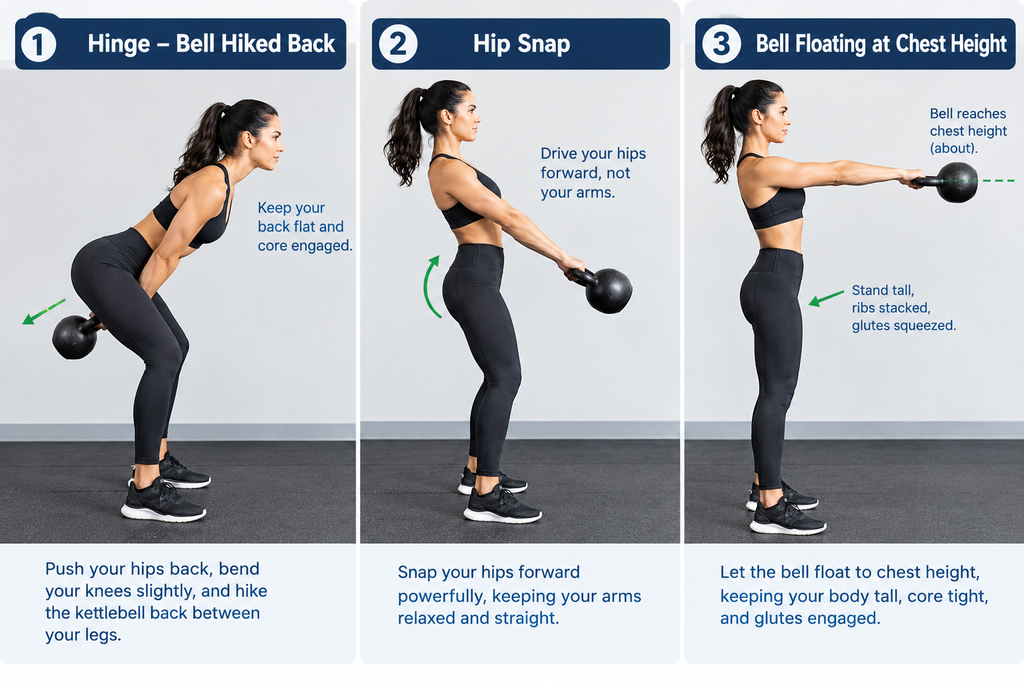
- Set your stance. Stand with feet about shoulder-width apart, roughly 12 to 18 inches (30 to 46 cm). Turn your toes out slightly. Place the bell about 12 inches (30 cm) in front of you.
- Hinge to grab the bell. Push your hips back like closing a car door with your backside. Keep your spine long, shins nearly vertical, and chest proud. Grip the handle with both hands.
- Hike the bell back. Tilt the bell toward you, then hike it between your legs, high on your thighs. Your forearms should touch your inner thighs, and your arms stay loose.
- Snap your hips forward. Drive your hips forward hard and squeeze your glutes. This is the power move. Your arms just guide the bell.
- Let the bell float. The bell rises to about chest height. Your ribs stay stacked over your pelvis and your abs stay braced, as if someone were about to tap your stomach.
- Hinge back down. As the bell falls, send your hips back again and let the bell travel between your legs. Don’t squat down. Reset your brace and swing again.
- Finish with control. After your last rep, let the bell swing back and set it down in front of you with a hinge.
Coach’s Tip: Imagine you’re trying to stand up as fast as possible from a hinged position. The bell is just a passenger. If your shoulders feel it more than your glutes, slow down and re-check your hinge.
Sets, Reps, and Weight by Goal
Pick the goal, then match the setup. Rest between sets by feel, but don’t rush so much that form falls apart.
| Goal | Bell weight | Sets × reps | Rest | Frequency |
|---|---|---|---|---|
| Learn the movement | Light | 5 × 5 to 8 | 45–60 sec | 2–3 days/week |
| Core endurance | Moderate | 3–4 × 15–20 | 45–60 sec | 2–3 days/week |
| Strength and power | Heavy | 6–10 × 5–10 | 60–90 sec | 2 days/week |
| Conditioning (EMOM) | Moderate | 10–15 reps every minute for 8–12 min | Rest of each minute | 1–2 days/week |
Weight guidance: Many beginners start around 18 to 26 lb (8 to 12 kg) for women and 26 to 35 lb (12 to 16 kg) for men. These are starting points, not rules. Choose a bell that lets you keep a flat back and snap the hips for 10 clean reps. If your arms lift the bell, it’s too heavy or your hinge needs work.
Tempo should feel crisp and rhythmic. The hip snap is fast, the hinge down is controlled, and each rep is the same.
Common Mistakes and How to Fix Them
Common Mistake: Squatting the swing. Many people bend their knees deeply and sit down, which turns the swing into a front-loaded squat and robs the hip snap. Fix: Think “hips back, not knees down.” Your shins should stay close to vertical.
Other errors I’d watch for:
- Lifting with the arms. The arms are ropes, not engines. Let the hips throw the bell. If your shoulders burn first, lower the weight.
- Leaning back at the top. This stresses your lower back and fools you into thinking you’ve finished the rep. Finish tall, with ribs down and glutes squeezed.
- Rounding the spine. A rounded back at the bottom of the hinge is a red flag. Reduce the weight and practice kettlebell deadlifts first.
- Skipping the brace. If your belly goes soft at the top, your abs aren’t doing their job. Take a small breath, tighten your trunk, and then snap.
- Going too heavy too soon. Form breaks down before strength shows up. Earn the heavier bell.
How to Make Kettlebell Swings Work Your Abs Harder
You can raise or lower the challenge without changing the exercise completely.
Easier versions (regressions)
- Kettlebell deadlift: Set the bell on the floor and practice the hinge with no swing.
- Hip-hinge wall tap: Stand about 12 inches (30 cm) from a wall and tap your hips back to it.
- Light two-hand swing: Use a lighter bell for sets of 5 to 8 until the snap feels natural.
Harder versions (progressions)
- Heavier bell: Increase weight in small jumps once you can complete all reps with a flat back.
- Single-arm swing: One side pulls the bell off-center, so your obliques must resist twisting.
- Hand-to-hand switch: Switch hands at the top for more core control.
- Swing plus plank: After a set of swings, hold a plank for 20 to 30 seconds to keep the core under tension.
- Longer sets: Build up to 20 to 25 reps per set for endurance.
If you like the idea of training the core in different directions, a rotational core workout gives you more ideas. For bodyweight ab options that don’t need equipment, our calisthenics exercises list is a good place to start.
Alternatives to Kettlebell Swings
No kettlebell? You can still train the same hinge and core pattern.
- No equipment: Hip hinge with a hip thrust, bird dog, and plank.
- Dumbbell: Hold one dumbbell vertically with both hands and swing it like a kettlebell.
- Cable: Cable pull-throughs train the hinge with steady tension.
- Machine: A back extension or glute-ham station works the same hip extension muscles, though with less core demand.
Short on space? Our list of apartment workout equipment includes compact tools that pair well with a single kettlebell.
Who Should Be Careful With Kettlebell Swings
Swings are explosive. That’s part of their appeal and part of their risk. Talk with a doctor or physical therapist before starting if any of these apply:
- You have current or recent low-back pain, a disc problem, or a past back injury.
- You’re pregnant or postpartum, or you have diastasis recti or a hernia.
- You have high blood pressure, heart disease, or other medical conditions.
- You’re a senior new to strength training.
- You have shoulder, hip, or wrist pain that worsens with swinging.
For some people, kettlebell training may actually help. A randomized controlled trial in working adults found kettlebell training was linked to less neck, shoulder, and low-back pain. That doesn’t mean it’s right for every body, and form still matters. Stop if you feel sharp pain, numbness, or tingling.
Sample Kettlebell Swing Workout for Your Core
This 25-minute workout fits a beginner or home gym lifter. Do it two or three days a week, with at least a day between sessions.
Warm-up (5 minutes): 10 hip hinges, 10 bird dogs per side, 10 glute bridges, and 5 light kettlebell deadlifts.
| Exercise | Sets | Reps | Rest |
|---|---|---|---|
| Two-hand kettlebell swing | 4 | 15 | 45–60 sec |
| Plank | 3 | 20–40 sec | 30–45 sec |
| Goblet squat | 3 | 8–10 | 45–60 sec |
| Single-arm kettlebell swing | 2 | 8 per arm | 45–60 sec |
| Farmer carry (about 40 yards or 36 m) | 3 | 1 trip | 45–60 sec |
Cool-down (3–5 minutes): Easy walking, then a gentle hip flexor stretch and child’s pose.
Progression plan: Weeks 1–2, keep the weight light and focus on form. Weeks 3–4, add one set of swings. Weeks 5–6, move to a heavier bell or add single-arm sets.
Related Tips for Better Results
- Train swings 2–3 days a week. More isn’t always better. Fatigue steals form, and form is what protects your back.
- Add real recovery. Sleep and rest days help you adapt. If you also train legs often, see how our guide on doing squats every day approaches frequency and fatigue.
- Meet the baseline guidelines. Adults should do muscle-strengthening activity at least two days a week, according to the CDC physical activity guidelines [VERIFY URL].
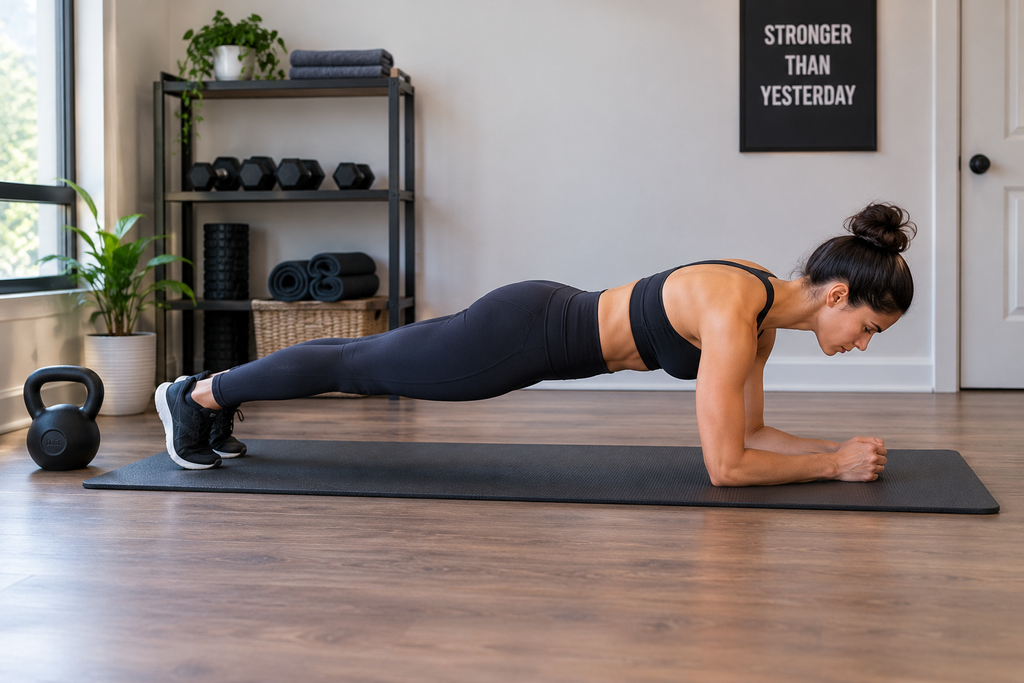
- Mix in other core work. Add planks, carries, and a flexion move like a reverse crunch once or twice a week.
- Track your swings. Log weight, reps, and how the set felt so you can add load slowly.
- Film a set from the side. A quick video shows whether your back stays flat and your hips finish tall.
If you’re curious how another popular bodyweight move compares for the midsection, read our breakdown of whether pull-ups work your abs.
Frequently Asked Questions
Do kettlebell swings give you abs?
Swings can strengthen the muscles under your belly, but abs only show when body fat is low enough. Swings help by building muscle and using energy, yet no exercise picks where fat comes off. Combine them with direct core work and steady habits around food and sleep.
How many kettlebell swings a day for abs?
There’s no magic number. Most people do well with 100 to 200 total swings, split into sets of 10 to 20, three or four days a week. Daily swinging isn’t required and can pile up fatigue. Quality beats quantity, so stop a set when your hips or back start to drift.
Can kettlebell swings replace crunches?
Not completely. Swings train your core to resist movement, while crunches train it to create movement. Both matter. For a well-rounded midsection, use swings for stability and power, then add planks, carries, and a flexion exercise like a reverse crunch once or twice a week.
Are kettlebell swings bad for your back?
Done with a clean hip hinge, they’re generally considered a reasonable choice for healthy adults, and one randomized trial linked kettlebell training to less low-back pain. Squatting the weight or rounding your spine can irritate your back. With current pain, see a doctor or physical therapist first.
What weight kettlebell should a beginner use for swings?
Many beginners start around 18 to 26 lb (8 to 12 kg) for women and 26 to 35 lb (12 to 16 kg) for men. Choose a weight that lets you keep a flat back and snap your hips for 10 reps. If your arms do the lifting, the bell is too heavy.
Russian or American swing: which is better for abs?
The Russian swing, to chest height, is the standard starting point. The American swing goes overhead, which asks more of your shoulders and lower back and can tempt you to lean back. For ab training, the Russian swing is usually safer and easier to control.
Conclusion: Do Kettlebell Swings Work Abs?
So, do kettlebell swings work abs? Yes, but as stabilizers, not as a replacement for direct ab training. Your hips and glutes produce the power while your core braces to keep your spine safe. That makes swings a strong choice for building core endurance, conditioning, and total-body strength.
Swings won’t spot-reduce belly fat, and abs show through a mix of muscle, nutrition, sleep, and consistent training. Start light, master the hip hinge, and add weight slowly. Then pair swings with planks, carries, and a flexion move for a well-rounded midsection.
