Adjustable dumbbells benefits usually get summed up in one line: “one pair replaces a whole rack.” That line is true, but it hides what matters most. The real value is how an adjustable set shapes your habits, your progress, and your floor space.
This guide explains what adjustable dumbbells actually do, where they shine, and where they fall short. You will see what research says about strength training, how to pick the right weight, and how to build a simple routine. It is written for home gym owners and gym beginners who want a straight answer before spending money.
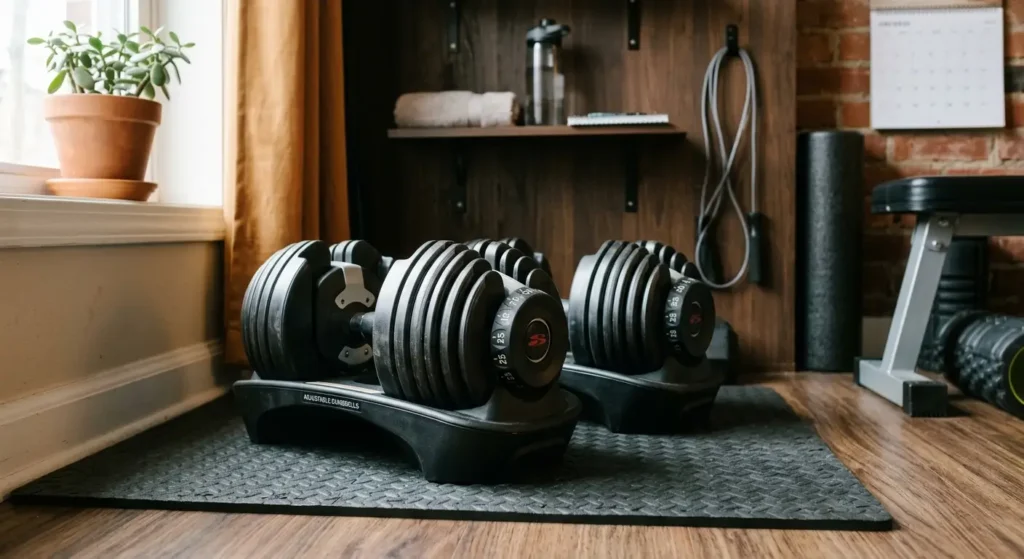
Quick Answer: Adjustable dumbbells let one pair act as many weights, so you can add load in small steps while saving floor space and money compared with buying full fixed racks. They do not build muscle on their own. Results still come from progressive overload, consistent effort, and good form two or more days a week.
What Are Adjustable Dumbbells and How Do They Work?
An adjustable dumbbell is a single handle with removable or selectable weight plates. Instead of owning ten separate pairs, you change the load on one pair in seconds. Most designs fall into three groups, and each one feels different in your hands.
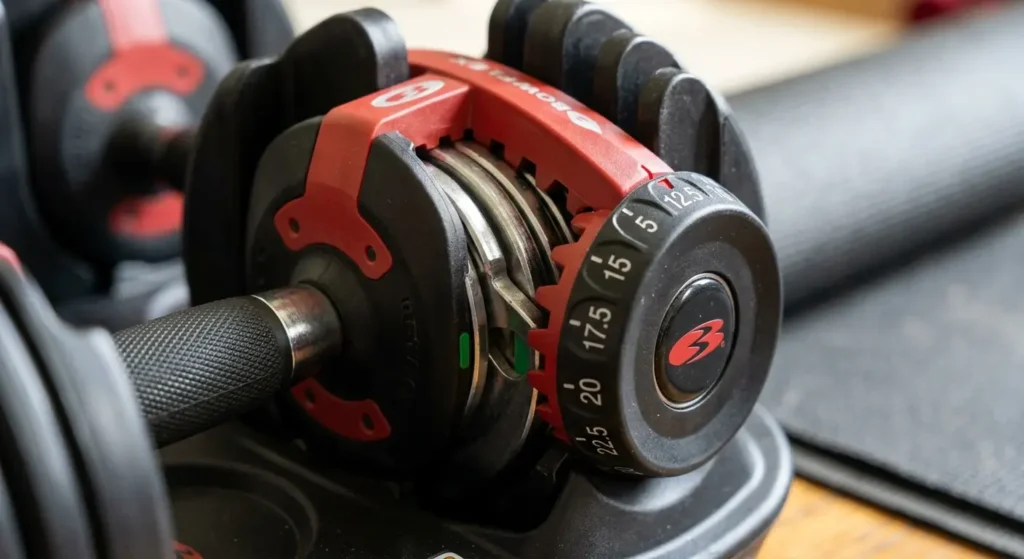
- Dial or selector style: You turn a dial or move a pin, and the dumbbell picks up only the plates you chose. Bowflex SelectTech, PowerBlock, and similar designs work this way.
- Spin-lock or collar style: You slide plates onto a bar and tighten a collar. This is the cheapest option, but changing weights takes the longest.
- Quick-lock plate style: You clip plates on and off with a fast latch. These sets sit between the other two in speed and price.
The popular Bowflex SelectTech 552 is a good example of the dial style. It lists a range of 5-52.5 lb (2.3-23.8 kg) per dumbbell, with 2.5 lb (1.1 kg) steps up to 25 lb (11.3 kg) and 5 lb (2.3 kg) steps after that [VERIFY on the official manufacturer page]. Each dumbbell is also fairly long, at about 16.9 inches (43 cm) per the retailer listings I found [VERIFY].
Fixed dumbbells, in contrast, have one weight each. If you are weighing that route, our guide to hex or round dumbbells covers shape and rolling differences.
Adjustable Dumbbells Benefits Backed by Research
First, a key point. The benefits people attribute to adjustable dumbbells are really the benefits of strength training. The dumbbells are simply a convenient tool for doing it at home. That distinction keeps your expectations realistic.
The CDC adult activity guidelines say adults need muscle-strengthening activity on two or more days a week that works all major muscle groups. Adjustable dumbbells can cover legs, hips, back, chest, shoulders, arms, and core with a handful of exercises. As a result, one pair can meet that guideline without a gym membership.
Beyond the guideline, large studies point to a health link. A British Journal of Sports Medicine meta-analysis found that muscle-strengthening activity was associated with a 10-17% lower risk of all-cause mortality, cardiovascular disease, total cancer, diabetes, and lung cancer. The biggest drop in risk showed up at about 30-60 minutes per week. These are observational findings, so they show an association, not proof of cause and effect.
The Mayo Clinic strength training overview also notes that you may see stronger muscles from strength training at least two times a week for about 20 to 30 minutes each time. It adds that strength training can help you keep muscle mass as you age and may support bone health and body composition. Therefore, you do not need long sessions to get started.
Finally, the sport-science side supports the idea of changing the load over time. The updated ACSM position stand on resistance training concludes that healthy adults should perform progressive resistance training to improve muscle function, size, and physical performance [VERIFY publication year and author list]. Adjustable dumbbells fit that advice well, because changing the weight takes seconds.
Coach’s Tip: Think of the set as a progress tool, not a status piece. The question to ask every month is, “Did my working weight go up, or did my reps go up?” If neither moved, change the plan, not the dumbbells.
Everyday Adjustable Dumbbells Benefits for Home Gyms
Here are the practical gains, in the order most home lifters notice them.
Space Savings That Make Training Possible
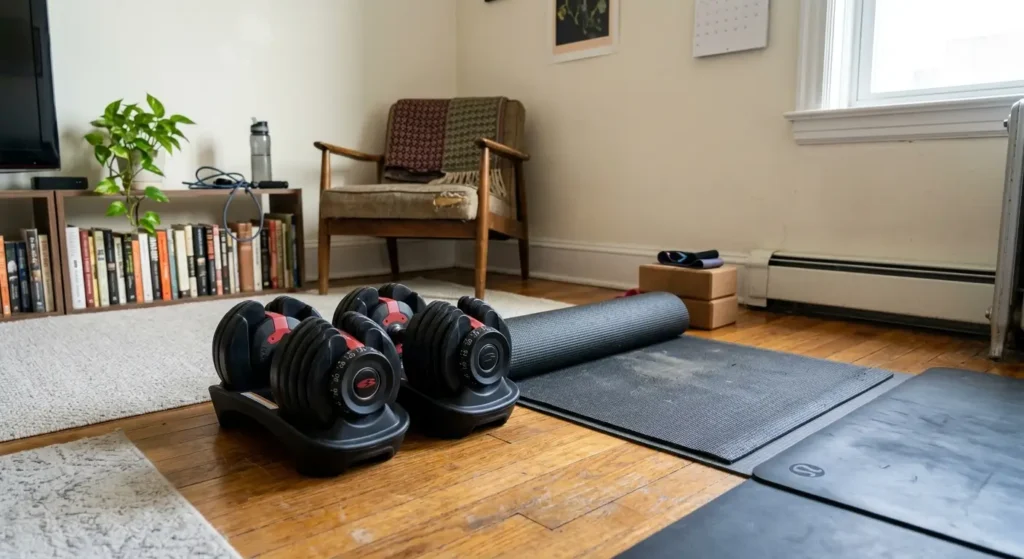
A full rack from 5 to 50 lb (2.3 to 22.7 kg) in 5 lb steps means about ten pairs. That rack can take a whole wall, while one adjustable pair and a tray fit in a corner.
For small homes, this matters more than any spec. If you are building a compact setup, see our list of apartment workout equipment for other space-smart options. In addition, a tidy corner removes one of the biggest barriers to training: the setup.
Cost That Can Be Lower Than a Full Rack
Buying ten pairs of fixed dumbbells usually costs more than one quality adjustable pair, especially once you count the rack. Prices vary widely by brand and weight range, and sales change often. As a rough guide, budget spin-lock sets sit at the low end, while dial-style sets sit in the mid to upper range [VERIFY current price ranges before publishing].
However, if you will only ever use two or three weights, a few fixed pairs may cost less.
Small Jumps for Steady Progress
This is the benefit most beginners underrate. Many fixed racks jump in 5 lb (2.3 kg) steps, and that is a big leap for a lateral raise or a curl. A set with 2.5 lb (1.1 kg) steps lets you move up in smaller increments.
The 2009 ACSM progression models position stand recommends a 2-10% load increase once you can complete your current workload for the target reps. Small steps make that rule easier to follow on small muscles. For example, a 10 lb (4.5 kg) curl needs a 0.2-1.0 lb change, so even 2.5 lb (1.1 kg) jumps are on the coarse side. That is why many lifters also use extra reps or a slower tempo to bridge the gap.
One Pair, Many Exercises
Free weights train your muscles through many movement patterns. With one pair, you can squat, hinge, press, row, curl, and carry. That covers the quadriceps, glutes, hamstrings, pectorals, latissimus dorsi, deltoids, biceps, triceps, and core.
A goblet squat might use 35 lb (15.9 kg), while a lateral raise might use 10 lb (4.5 kg). One adjustable pair gives you both in under a minute.
A Better Chance of Actually Showing Up
The best workout is the one you do. A home setup removes the commute and the wait for equipment. For many people, that convenience is the biggest of all adjustable dumbbells benefits, even though it is hard to measure.
Short sessions are enough, too. A systematic review of 151 trials in older adults concluded that a low resistance training volume can substantially improve physical function and benefit lean mass and muscle size, while a higher volume seems necessary for larger strength gains. Short, regular home sessions are a realistic way to start.
Adjustable vs. Fixed Dumbbells: Quick Comparison
The table below shows how the two styles compare on the factors home lifters ask about most.
| Factor | Adjustable Dumbbells | Fixed Dumbbells |
|---|---|---|
| Space needed | Small: one pair plus a tray | Large: a rack with many pairs |
| Weight change speed | Seconds with dial sets; longer with spin-lock | Instant, since you grab another pair |
| Weight steps | Often 2.5-5 lb (1.1-2.3 kg), set by model | Usually 5 lb (2.3 kg) or more |
| Upfront cost | Moderate for the whole range [VERIFY] | Higher for a full range, plus a rack |
| Handle feel | Longer, bulkier heads on many models | Compact, balanced, consistent |
| Best for | Small spaces, beginners, progression | Fast circuits, heavy lifting, shared gyms |
| Main drawback | Bulk and a weight ceiling | Space and total cost |
As the table shows, neither style wins everywhere. Instead, the right choice depends on your space, budget, and training style.
What Adjustable Dumbbells Do Not Do
An honest look at what a tool does also means looking at its limits. Several claims around adjustable dumbbells are overstated, so it helps to separate fact from marketing.
First, they do not build muscle by themselves. Muscle growth depends on effort, enough weekly volume, and recovery. Even the best set sitting in a corner does nothing.
Second, they have a weight ceiling. A set topping out at 52.5 lb (23.8 kg) per hand suits most beginners and many intermediate lifters. However, strong lifters may outgrow it on lower-body lifts such as Romanian deadlifts. Heavier models exist, but they cost more and take more room [VERIFY current heavier models and ranges].
Third, they are slower in circuits. Changing the weight takes time, so quick supersets between very different loads can feel clumsy.
Fourth, they do not replace every piece of gear. You still need a bench or a sturdy chair for some presses, and you may want a pull-up bar or bands for vertical pulling. If you want a machine-based setup instead, our overview of the best Bowflex home gym options shows a different route.
Common Mistake: Picking a set by its top weight alone. Many beginners buy a heavy range they will not use for a year, then find the small steps at the low end too coarse. Check your starting weights first, and then check the top end.
How to Use Adjustable Dumbbells: Sets, Reps, and Weight by Goal
Choosing a weight is simple once you use the effort rule. Pick a load that lets you finish the target reps while leaving about one to three good reps in reserve on most sets. The last rep should look hard, but your form should stay clean.
The ACSM 2009 stand lists 8-12 repetitions as a common range for building strength in newer lifters, and it suggests lighter loads of about 40-60% of one-rep max for local muscular endurance. The Mayo Clinic suggests a weight heavy enough to tire the muscles after about 12 to 15 reps for general fitness. Use the table below as a practical starting point, and adjust it with your own results.
| Goal | Sets | Reps | Rest | Weight guidance |
|---|---|---|---|---|
| Strength | 3-4 | 5-8 | 2-3 min | Heavy, with 1-2 reps in reserve |
| Muscle size | 2-4 | 8-12 | 60-90 sec | Challenging, last 2 reps hard |
| Endurance | 2-3 | 15-20 | 30-60 sec | Light to moderate |
| General fitness (beginner) | 1-2 | 12-15 | 60 sec | Tires muscles by the final reps |
Research on healthy older adults, such as this dose-response review in Sports Medicine, suggests that training period, intensity, time under tension, and rest between sets all matter for strength and muscle. In plain words, do not rush your rest, and do not skip the slow lowering phase. A tempo of about two seconds up and three seconds down is a simple place to start.
How to Progress Over Time
Use a double-progression plan. First, work within a rep range, such as 8-12. Once you reach the top of the range on every set with good form, increase the weight to the next setting. Then drop back to the low end of the range and build up again.
For example, if you do 3 sets of 8, 9, and 8 reps with 25 lb (11.3 kg) on a shoulder press, keep that weight until you hit 12 reps on all sets. After that, move up one setting. This keeps progress steady and reduces the guesswork.
Easier and Harder Versions
Not every move suits every body on day one. Use these options as you learn.
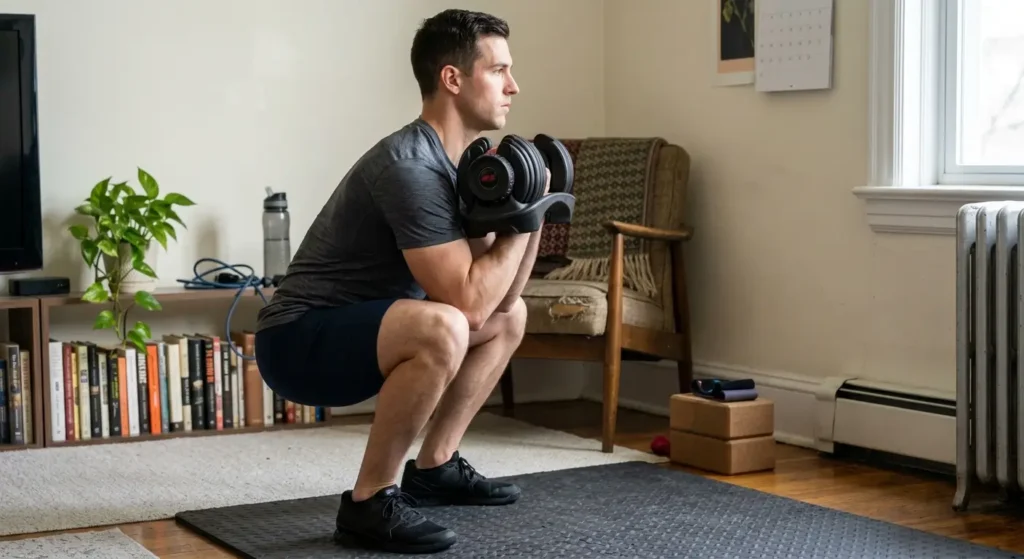
- Easier (regression): Use the lightest setting, slow the tempo, and cut the range of motion slightly. For squats, hold one dumbbell at your chest and squat to a box or chair. If you want a no-load starting point, check our calisthenics exercises list for bodyweight options.
- Harder (progression): Add reps first, then weight. You can also slow the lowering phase to four seconds, add a pause at the hardest point, or switch to single-arm and single-leg versions.
Sample Full-Body Workout With Adjustable Dumbbells
This workout takes about 40 minutes, and you can do it two or three non-consecutive days a week. It covers the major muscle groups the CDC guideline mentions. Warm up first with 5 minutes of brisk walking or easy marching, then add one light set of each lift before your working sets.
| Exercise | Sets | Reps | Rest | Main muscles |
|---|---|---|---|---|
| Goblet squat | 3 | 8-12 | 90 sec | Quads, glutes, core |
| One-arm dumbbell row | 3 | 8-12 per side | 60-90 sec | Lats, upper back, biceps |
| Dumbbell Romanian deadlift | 3 | 8-12 | 90 sec | Hamstrings, glutes, lower back |
| Floor press or bench press | 3 | 8-12 | 90 sec | Chest, triceps, front delts |
| Standing overhead press | 2-3 | 8-10 | 90 sec | Shoulders, triceps, core |
| Hammer or biceps curl | 2 | 10-12 | 60 sec | Biceps, forearms |
| Suitcase carry | 2 | 30-40 sec per side | 60 sec | Core, grip, obliques |
Form Cues for the Key Lifts
Goblet squat. Hold one dumbbell vertically at your chest with your elbows pointing down. Keep your ribs stacked over your hips, and push your knees in line with your toes. You should feel the work in your thighs and glutes, not your lower back.
One-arm row. Place one hand and knee on a bench or a sturdy chair. Pull the dumbbell toward your hip, not your shoulder, and pause for one second at the top. Your torso should stay still, and you should feel your upper back working.
Romanian deadlift. Push your hips back with a soft knee bend, and slide the dumbbells down your thighs. Stop when you feel a stretch in your hamstrings. Keep your spine long, and avoid rounding your back to reach lower.
Overhead press. Brace your core and squeeze your glutes. Press the weights in a slight arc, and finish with your biceps near your ears. Avoid leaning back, because that shifts stress to your lower back.
Where to Add Variety
Once the base workout feels easy, add a rear delt raise to balance your posture after all the pressing. Try dumbbell shrugs for the upper traps, which are easy to load with adjustable sets.
For arm days, compare the hammer curl and the standard biceps curl. If you like split days, our leg and shoulder workout adapts easily to one adjustable pair.
Safety Notes for Adjustable Dumbbells
Adjustable sets are safe when used as designed. A few habits matter most.
- Check the lock every time. Before you lift, confirm the selector has fully engaged and the plates are secure. Give the handle a gentle shake while it sits in the tray.
- Keep the tray flat and stable. A wobbly tray can make the dumbbell tilt as you lift it. Place it on a hard, level floor.
- Do not drop them. Many designs have plastic housings or moving parts, and drops can cause cracks. Lower the weight to the tray or the floor with control.
- Mind the long ends. Adjustable heads are often longer than fixed dumbbells. Leave extra room for moves like flyes and lunges so the ends do not hit your legs or walls.
- Respect the weight limit. Stay under the maximum listed for your model, and do not add unapproved plates.
- Stop if something hurts. Mild muscle effort is normal. Sharp or joint pain is not, so lower the weight or stop the exercise.
If you have pain, an injury, a heart or blood pressure condition, are pregnant or postpartum, or are an older adult starting from a low fitness level, check with a doctor or physical therapist first. They can tell you which exercises and loads fit your situation.
Coach’s Tip: Start every new lift with a weight that feels too light. Do three controlled reps and ask yourself where you feel it. If it is the target muscle, add weight. If it is your lower back or neck, fix your setup before you add anything.
Setup, Care, and Buying Tips
A few small choices make a set last longer and feel better to use. Start with the checklist below before you buy.
- Measure your space. Allow room for the tray plus a clear area at least 6.5 feet (2 meters) wide for lifting.
- Check the weight range and steps. Match the lowest setting to your lightest lifts, and match the top setting to your heaviest exercise in the next 12 months.
- Look at the handle. A knurled, comfortable grip matters for rows and carries. A handle that spins or feels thin can be annoying over time.
- Read the warranty. Moving parts can wear out, so a longer warranty is a plus [VERIFY individual brand warranty terms].
- Plan the surface. Use a mat or rubber flooring to protect your floor and reduce noise.
For care, wipe the handles and plates with a damp cloth after sessions to remove sweat and chalk. Keep dial mechanisms free of dust and debris, and do not use harsh cleaners on the plastic parts. If your set has rubber parts, our guide on how to clean rubber dumbbells has simple steps. Also, store the set on its tray, not on bare carpet, so it stays level and tidy.
Frequently Asked Questions About Adjustable Dumbbells
Are adjustable dumbbells good for building muscle?
Yes, they can be. Muscle growth depends on challenging sets, enough weekly volume, and recovery, not on whether a dumbbell is fixed or adjustable. As long as the weight range gives you hard sets in the 8-12 rep zone, an adjustable set works well for most beginners and intermediate lifters.
Are adjustable dumbbells worth it for beginners?
Often, yes. Beginners need small weight changes, many exercise options, and a setup they will actually use. One adjustable pair covers all three. However, if you only plan to use two or three weights, a few fixed pairs may be simpler and cheaper.
How much weight do I really need?
It depends on the exercise. Many beginners start with 5-15 lb (2.3-6.8 kg) for shoulder and arm moves, and 20-40 lb (9-18 kg) for squats and rows. Choose a set that covers your lightest lift now and your heaviest lift for the next year.
Are adjustable dumbbells better than fixed dumbbells?
Neither is better everywhere. Adjustable sets win on space and range, while fixed dumbbells win on speed, balance, and simple use. The right pick depends on your room, your budget, and whether you train with fast circuits or slower, heavier sets.
Can I get strong with only one pair of dumbbells?
Yes, within limits. You can build real strength using reps, tempo, pauses, and single-limb versions to raise difficulty. Eventually, very strong lifters may need heavier loads for the lower body. For most people, one pair supports months or years of progress.
Do adjustable dumbbells break easily?
Quality sets are built for regular use, but moving parts can wear out, especially if you drop them or force the selector. Follow the manufacturer’s care guidance, check the lock before every set, and read warranty terms before buying [VERIFY brand-specific durability claims].
Conclusion: What Adjustable Dumbbells Actually Do
So, what do the adjustable dumbbells benefits really come down to? They give you compact storage, a wide weight range, small progression steps, and a convenient way to train at home. They do not replace effort, patience, or good technique. Used well, they remove the barriers that stop many people from starting.
If you want one simple plan, begin with the full-body workout above two or three days a week. Pick a weight that makes the last two reps hard, and add weight or reps when you reach the top of your range. Track your sessions for four weeks, and let the numbers guide your next move.
Before you buy, count your likely working weights, measure your space, and check the weight steps. For most home gym owners, that is what adjustable dumbbells do best: they make consistent strength training easier to start and easier to keep.
