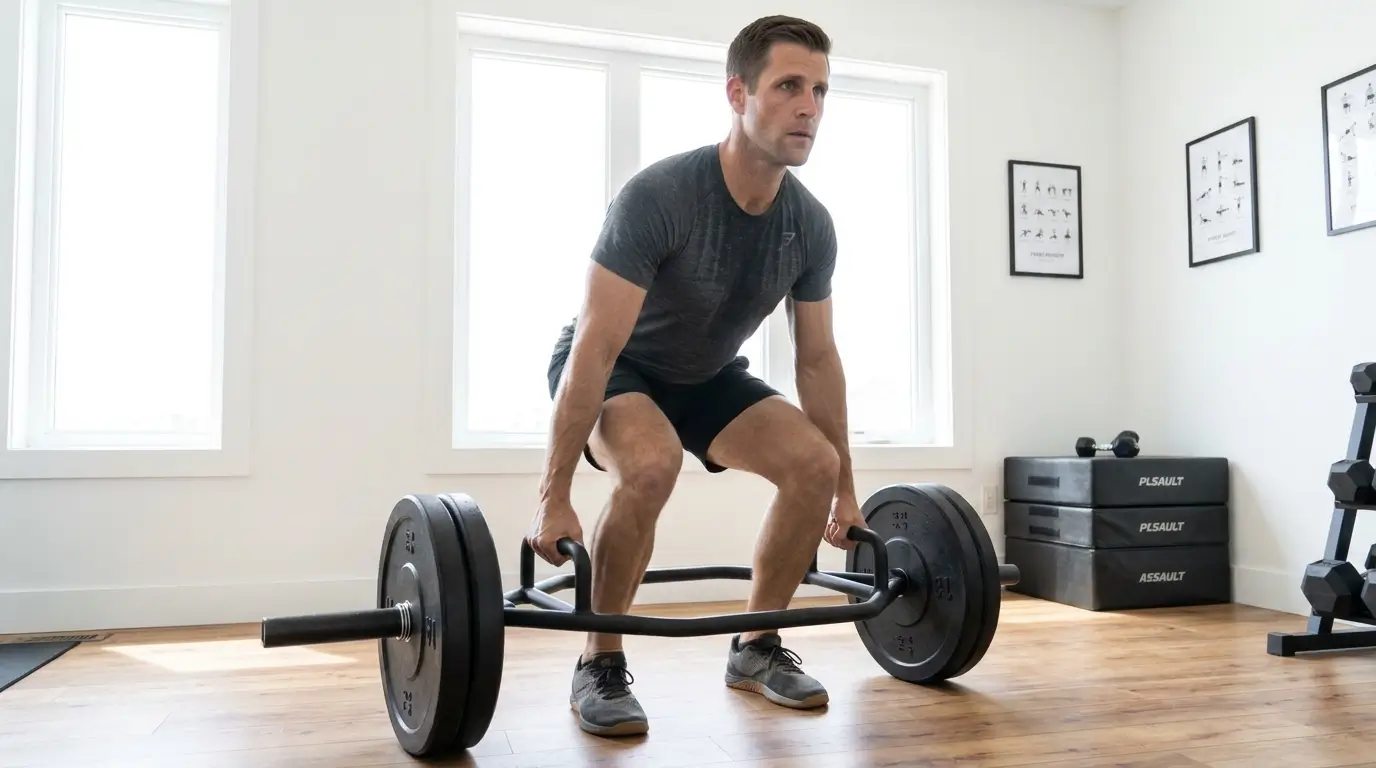
Deadlifts for tall people feel different from the lifts you see in most tutorials. Longer legs and a taller frame change where the bar starts, how far it travels, and where your hips need to sit. As a result, a setup that works for a shorter lifter can leave you rounded, stuck, or sore.
The good news is that height doesn’t stop you from getting strong. Instead, you need to choose the right variation and set up with your proportions in mind. In addition, this guide covers what the research says, how to adjust your form, and a simple plan you can start this week.
Quick Answer: Deadlifts for tall people work best when you pick a variation that fits your proportions. Taller lifters pull the bar farther, so try a trap bar, sumo stance, or raised starting height. Keep your spine steady, start light, and add weight gradually. Height changes the setup, not your ability to get strong.
Why Deadlifts for Tall People Feel Different
Height changes the lift in a few predictable ways. Understanding them helps you fix problems instead of guessing.
The bar travels farther
A standard barbell sits on the floor at a fixed height. Competition-sized plates put the bar roughly 9 inches (23 cm) off the ground. Therefore, a taller lifter has more distance to cover between that height and a standing lockout.
Research supports this. A Journal of Strength and Conditioning Research study linked greater height and leg length to longer lift distance and more mechanical work in the high-handle hex bar deadlift. The same study tied greater height and limb length to a longer conventional lift distance in women. As a result, the same weight can be more work for a taller lifter.
Strength per pound may look lower
Absolute strength and relative strength are different. A study on deadlift anthropometry summarized earlier findings that height correlated negatively with relative (not absolute) hex bar strength in men. That suggests taller men may have a mechanical disadvantage when strength is measured against body mass.
However, this does not mean you can’t build a big deadlift. It only means you may need to be patient and choose your variation wisely.
Proportions matter more than height
For example, two people who are 6 ft 3 in (191 cm) can be built very differently. One may have long legs and a short torso, while another has a long torso and shorter legs. The same JSSM study found that people with a greater torso-to-height ratio did better with the sumo deadlift than the conventional deadlift. Those findings came from beginners, so treat them as a starting point, not a rule.
| Your build | What you may notice | Likely fix |
|---|---|---|
| Long legs, short torso | Hips start high, back rounds early | Elevate the bar or try a trap bar |
| Long torso | Back feels stretched, hard to stay tight | Try sumo, then compare |
| Long arms | Bar starts closer to your shins | Often a natural advantage |
| Tight hamstrings | Pelvis tucks under at the bottom | Raise the bar and work on mobility |
Muscles Worked in the Deadlift
The deadlift trains your whole back side and more.
Primary muscles:
- Glutes
- Hamstrings
- Erector spinae (the muscles along your spine)
Secondary muscles:
- Quadriceps
- Lats and upper back
- Traps
- Forearms and grip muscles
- Core
In fact, taller lifters often feel the hamstrings and glutes first. That is normal, because your hips travel through a larger arc.
Benefits of Deadlifting
Deadlifts train many muscles in one movement, which makes them efficient. Furthermore, the pattern of lifting something from the floor matches daily life.
The CDC recommends muscle-strengthening activity on two or more days a week that works all major muscle groups. A well-planned deadlift session covers many of them. You also build grip strength, which helps with carrying and pulling.
Taller people sometimes avoid deadlifts because they feel awkward. That is a setup issue, not a reason to skip the lift.
Choosing the Best Deadlift Variation for Tall Lifters
Not every deadlift suits every build. Try these and see which feels strongest and most comfortable.
| Variation | Why tall lifters may like it | Watch out for |
|---|---|---|
| Trap bar (high handles) | Easier to learn, upright torso | Handles are fixed, so range is still long |
| Sumo | Wide stance, shorter path for many lifters | Needs hip mobility |
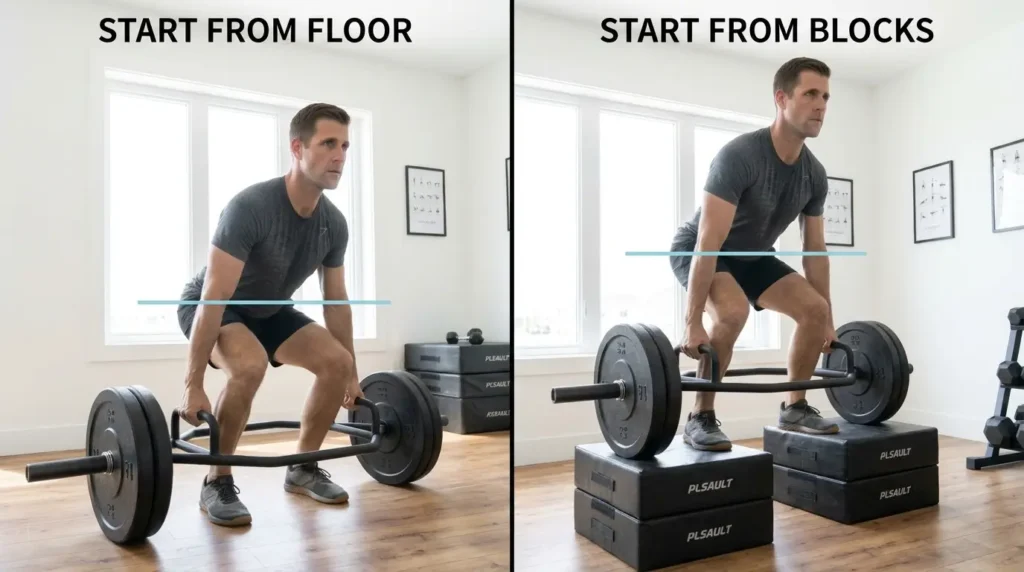
| Conventional from blocks | Reduces distance | Not the same as a floor pull |
| Romanian deadlift (RDL) | Great for hamstrings, no floor start | Needs a good hip hinge |
| Rack pull | Heavy loading, less range | Limited work off the floor |
Trap bar deadlift
For many beginners, the trap bar is the most forgiving start. In a biomechanical study of 19 male powerlifters, the hexagonal bar lowered peak moments at the lumbar spine, hip, and ankle, while it raised the peak knee moment. Lifters also managed heavier one-rep max loads with it.
That means the trap bar shifts some work from the lower back to the knees. It also lets you stand inside the frame, so the bar stays close to your center of mass. Check our guide on how much a trap bar weighs before you buy or plan your loading.
Sumo deadlift
A wide stance lets your torso stay more upright. Many tall lifters with a longer torso find sumo smoother. On the other hand, it demands more hip mobility, and your toes must point out.
Coach’s Tip: Test both stances with an empty bar. Do 5 reps of each and note which one lets you keep your back flat without struggling. Pick the one that feels stable, not the one that looks cooler.
Romanian deadlift and rack pulls
The Romanian deadlift starts standing, so it skips the awkward floor position. It is excellent for building hamstrings and learning the hinge. Rack pulls start with the bar at knee height or above, which cuts distance and lets you handle more weight.
How to Set Up Deadlifts for Tall People: Step by Step
First, follow these steps with a light load until the pattern feels automatic. Most standard Olympic bars weigh 45 lb (20 kg). Our comparison of an Olympic barbell vs. a standard barbell explains why that matters for bar choice.
- First, choose your starting height. If you can’t reach the bar with a flat back, raise it. Use plates, blocks, or a rack so the bar starts about 2 to 4 inches (5 to 10 cm) higher.
- Next, set your feet. Stand with the bar over the middle of your feet. Use a hip-width stance for conventional, wider for sumo.
- Then hinge and bend your knees. Push your hips back until you can grip the bar. Your shins should be close to vertical.
- Grip the bar. Keep your arms straight and just outside your legs. Use a mixed or hook grip as your grip allows.
- Take the slack out. Pull gently until you feel the bar press against the plates. Your lats should feel tight, like you are protecting your armpits.
- Brace your core. Take a breath into your belly and tighten your midsection.
- Push the floor away. Drive your feet into the ground, keep the bar close, and let your hips and chest rise together.
- Lock out. Stand tall, squeeze your glutes, and do not lean back.
- Finally, lower under control. Hinge your hips back first, then bend your knees after the bar passes them.
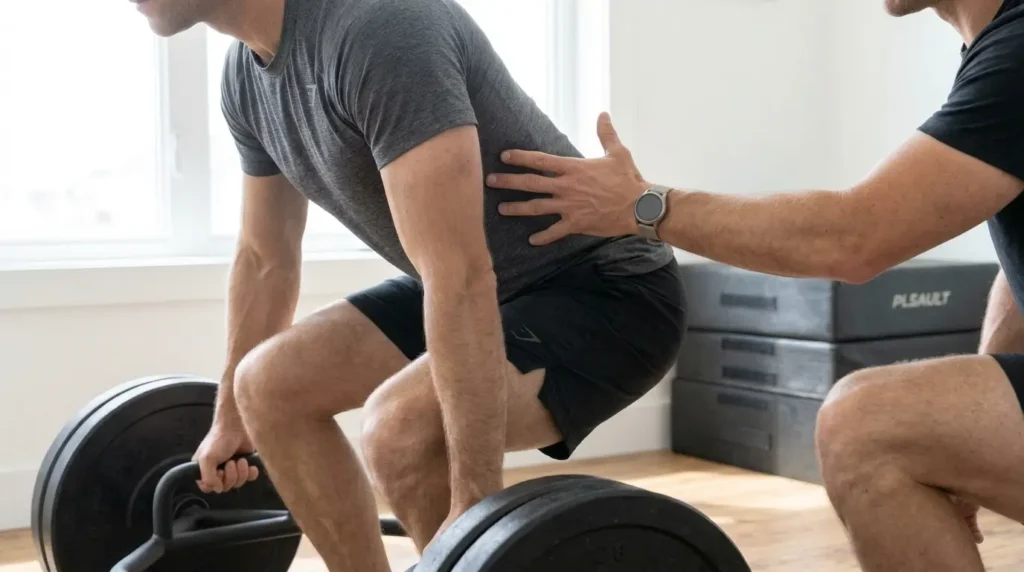
Tempo: Pull for about 1 second and lower for 2 to 3 seconds. What it should feel like: Tension in the hamstrings and glutes, a tight midsection, and no pinching in the lower back.
Shoes and equipment
Flat, thin-soled shoes keep you close to the floor. That reduces distance, and it keeps your feet stable. Some lifters also deadlift in socks or flat slippers. Avoid cushioned running shoes, since they raise your heels and make you wobble.
Sets, Reps, and Weight by Goal
Pick the row that matches your goal. Use these as a starting range, and stop each set with at least 1 or 2 reps left in reserve.
| Goal | Sets | Reps | Rest | Starting load guide |
|---|---|---|---|---|
| Learn the movement | 3 | 5 to 8 | 90 sec | Empty bar or 65 to 95 lb (29 to 43 kg) |
| Strength | 3 to 5 | 2 to 5 | 3 to 4 min | Heavy but with perfect form |
| Muscle size | 3 to 4 | 6 to 10 | 2 to 3 min | Moderate load |
| Endurance and technique | 2 to 3 | 10 to 15 | 60 to 90 sec | Light load |
Also, add weight in small steps, about 5 to 10 lb (2.3 to 4.5 kg), only when all sets look clean. Frequency matters as well. Most beginners do well deadlifting once or twice a week, because the lift is demanding.
Common Mistakes and Fixes
Common Mistake: Tall lifters often start with hips too high and a rounded upper back because they can’t reach the bar. Instead, raise the bar or switch to a trap bar instead of forcing the floor pull.
| Mistake | Why it happens | Fix |
|---|---|---|
| Rounded upper back | Bar too low for your reach | Elevate the bar or use a trap bar |
| Hips shoot up first | Weak legs, long torso | Cue “push the floor away” |
| Bar drifts forward | Lats not engaged | Pull the bar toward your shins |
| Squatting the lift | Hips too low | Start with hips higher than knees |
| Hyperextending at lockout | Leaning back | Finish with glutes, stand tall |
| Grip failing first | Long distance, long reps | Use hook grip or straps for volume |
Variations: Easier to Harder
Easier (regression):
- Elevated deadlift: Raise the bar on plates or blocks.
- Kettlebell or dumbbell deadlift: Start with a smaller load and a shorter range.
- Bodyweight hinge: Practice the movement with no load.
Standard:
- Trap bar or conventional deadlift from the floor.
Harder (progression):
- Tempo deadlift: Lower for 4 to 5 seconds.
- Pause deadlift: Stop for 1 to 2 seconds just below the knee.
- Deficit deadlift: Stand on a low platform. This is not recommended for beginners, especially tall ones, because it adds even more distance.
Alternatives to the Deadlift
If a deadlift doesn’t suit you right now, try these:
- No equipment: Bodyweight good mornings, glute bridges, single-leg hip hinges.
- Dumbbell: Dumbbell Romanian deadlifts, single-leg RDLs.
- Kettlebell: Swings and deadlifts. Our article on whether kettlebell swings work abs explains how this hinge pattern works.
- Cable: Cable pull-throughs.
- Machine: 45-degree back extensions, hamstring curls, and hip thrust machines.
Accessory Work That Helps
Strong support muscles make the lift safer. Add 2 or 3 of these:
- Upper back: Seated bent-over rear delt raises help keep your upper back tight.
- Traps: Both versions in our dumbbell vs. barbell shrugs guide build the muscles that hold the bar.
- Quads: Many lifters like a hack squat alternative for leg strength without heavy spinal loading.
- Core: Planks and side planks improve bracing.
Who Should Be Careful
Deadlifts place a real load on your lower back. A narrative review of repetitive deadlifts notes that the lift places a considerable mechanical load on the lower back and that more research is needed on injury risk. In addition, a study of competitive lifters describes neutral spinal alignment as important during the lift. Even good technique involves some natural spinal movement, so aim for control, not perfect rigidity.
Check with a doctor or physical therapist before deadlifting if you:
- Have back, hip, or knee pain
- Are pregnant or postpartum
- Are an older adult returning to exercise
- Have a heart condition or high blood pressure
- Are recovering from an injury
Stop if you feel sharp pain, numbness, tingling, or pain that travels down a leg.
Sample Workout: Deadlifts for Tall People
This 4-week plan uses two lifting days a week. Add a third light day if you feel fresh. For a good companion session, see our leg and shoulder workout.
Day 1: Deadlift focus
| Exercise | Sets | Reps | Rest |
|---|---|---|---|
| Warm-up: hinge and glute bridges | 2 | 10 | 30 sec |
| Trap bar or elevated deadlift | 4 | 5 | 2 to 3 min |
| Romanian deadlift | 3 | 8 | 2 min |
| Seated rear delt raise | 3 | 12 | 60 sec |
| Plank | 3 | 30 to 45 sec | 45 sec |
Day 2: Lighter pull and legs
| Exercise | Sets | Reps | Rest |
|---|---|---|---|
| Sumo or conventional deadlift (light) | 3 | 6 | 2 min |
| Hack squat alternative | 3 | 10 | 90 sec |
| Dumbbell shrug | 3 | 10 | 60 sec |
| Back extension | 2 | 12 | 60 sec |
Progression:
- Week 1: Learn the pattern with light loads.
- Week 2: Add 5 to 10 lb (2.3 to 4.5 kg) if every rep felt clean.
- Week 3: Add one set or one rep.
- Week 4: Repeat Week 2 loads with better speed, or lower the bar slightly if mobility has improved.
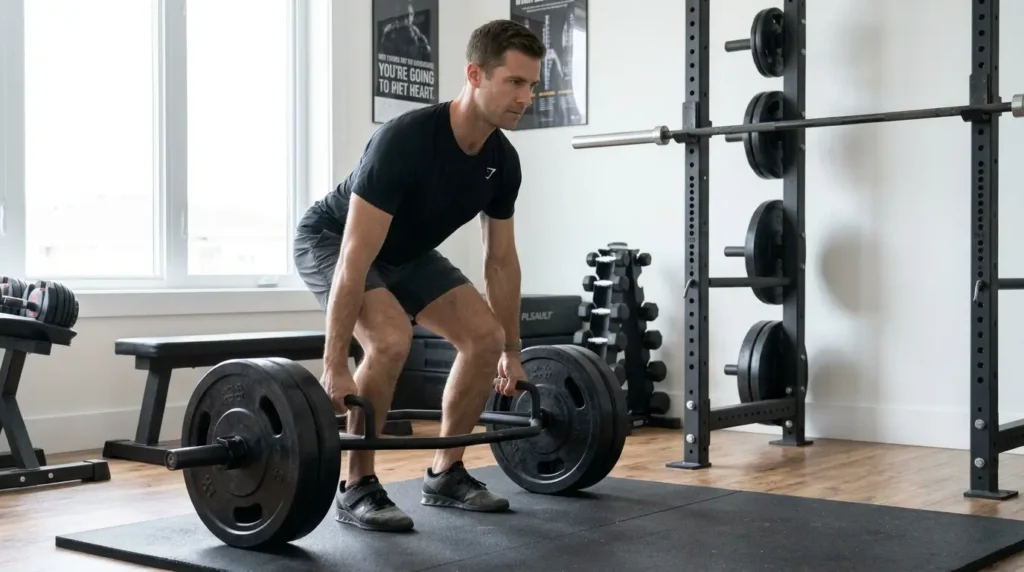
Coach’s Tip: Film one set from the side each week. Check whether your back angle stays the same from the floor to the knee. Your phone is a free coach.
Related Tips for Tall Lifters
- Warm up your hips and hamstrings before every session.
- Do not train heavy deadlifts every day. Rest between hard pulls helps your back recover. Our post on whether you can do squats every day shares the same recovery principles.
- Improve mobility a little each week, not all at once.
- Keep a log of the setup that works for you, including stance, bar height, and grip.
Deadlifts for Tall People: Frequently Asked Questions
Are tall people bad at deadlifts?
No. Taller lifters often have a longer range of motion, which makes the lift feel harder. However, long arms and strong legs can offset that. With the right variation and patient progression, tall lifters can build a strong deadlift.
Is sumo or conventional better for tall people?
It depends on proportions, not height alone. Research on beginners found sumo may favor longer torsos, while conventional may suit shorter torsos. Test both with light weight and choose the one that keeps your back steady.
Is a trap bar better for tall lifters?
Often, yes, especially for beginners. Research found hex bar lifting lowered peak lumbar spine moments while raising knee demands. It also feels more natural to learn. However, it still has a long range for tall lifters, so adjust your setup as needed.
Should tall people deadlift from blocks?
Blocks or plates can help if you can’t keep a flat back from the floor. Raising the bar by 2 to 4 inches (5 to 10 cm) reduces distance. As your mobility and strength improve, you can lower it toward the floor.
How often should I deadlift?
Most beginners do well with one or two sessions a week. The deadlift is demanding, so give yourself recovery time. The CDC also recommends muscle strengthening on two or more days a week, so you can mix in other lifts.
What shoes are best for deadlifts?
Flat, firm shoes work best because they keep you stable and close to the floor. Skip cushioned running shoes. Some lifters use thin slippers or socks, as long as the floor is safe and non-slippery.
Conclusion: Deadlifts for Tall People Can Be Strong and Safe
Deadlifts for tall people come down to three ideas. Choose a variation that fits your body, set up so your spine stays steady, and add weight slowly. A trap bar, sumo stance, or raised bar can all make the lift more comfortable.
Furthermore, track your results and adjust over time. Your height is simply part of the setup, not a limit on your strength.
