A dumbbell-only back day can build a strong, thick back with nothing more than a pair of weights and a little floor space. You do not need a cable station, a lat pulldown, or even a pull-up bar. You need good form, smart exercise choices, and a plan that adds work over time.
In this guide, I’ll give you a complete dumbbell-only back day workout with sets, reps, rest times, and form cues. I’ll also show you easier and harder versions, a weekly schedule, and tips for steady progress. Think of it as the plan I would hand a client who trains at home.
Quick Answer: A dumbbell-only back day takes about 45-55 minutes and uses a pair of dumbbells, plus an optional bench or chair. Do 6-7 exercises: rows, a Romanian deadlift, pullovers, reverse flys, and shrugs. Train back twice a week with slow, controlled reps, and add reps or weight gradually.
Who This Dumbbell-Only Back Day Is For
This plan fits you if you train at home or in a busy gym where the cable machines are always taken. It also works for beginners who want a clear plan and for lifters who travel with adjustable dumbbells. If you have a bench, great. If you don’t, a sturdy chair and the floor will do.
It is not ideal for one type of lifter: someone chasing a very heavy deadlift or a max pull-up. Dumbbells have a weight limit, and pulling straight down from overhead is hard to copy without a bar. We’ll cover that gap in the tips below.
Equipment Needed for a Dumbbell-Only Back Day
You need very little for a dumbbell-only back day.
- Dumbbells: Adjustable sets save space. If you are still choosing, read our comparison of hex vs. round dumbbells to see which shape suits your floor and your plans.
- A flat bench or a sturdy chair: Useful for chest-supported and one-arm rows. Check that it won’t slide.
- A mat: For floor pullovers and warm-up moves.
- A small space: About 6 feet by 6 feet (1.8 m by 1.8 m) is enough.
If your space is tight, our guide to the best apartment workout equipment shows compact options that pair well with dumbbells.
Why a Dumbbell-Only Back Day Works
Your back has many muscles, so no single exercise trains them all. A study from the University of Wisconsin-La Crosse compared eight back exercises and found that the middle trapezius responded best to I-Y-T raises, bent-over rows, seated rows, and inverted rows [VERIFY: this is a thesis, not a journal article]. The same study found that pull-ups and chin-ups produced the greatest latissimus dorsi activity. Its conclusion was that a variety of exercises is needed to train the entire back.
That is exactly why this plan mixes rows, a hinge, a pullover, and a reverse fly. Another study on lat exercises found that variations can produce small changes in lat activation [VERIFY authors and year], so you don’t need to chase one “perfect” move. Instead, cover your bases and train them hard.
Adults should also do muscle-strengthening activity on two or more days a week that works all major muscle groups, according to the CDC adult activity guidelines. A back day fits that goal neatly.
Warm-Up Before Your Dumbbell-Only Back Day (5-7 Minutes)
A good warm-up makes your first set safer and stronger. Move through these without weights, then do one light set of the first exercise.
- Cat-cow: 8 slow reps on hands and knees.
- Arm circles: 10 forward and 10 backward.
- Hip hinge practice: 10 reps with hands on your hips, pushing your hips back.
- Scapular squeezes: 10 reps, pulling your shoulder blades back and down.
- Light dumbbell row: 1 set of 10 with a weight at half your working load.
The Dumbbell-Only Back Day Workout
Here is the full plan. Rest times are listed so you can keep the session on track.
| Order | Exercise | Sets | Reps | Rest |
|---|---|---|---|---|
| 1 | Two-dumbbell bent-over row | 4 | 8-12 | 90 sec |
| 2 | One-arm dumbbell row | 3 | 10-12 per side | 75 sec |
| 3 | Dumbbell Romanian deadlift | 3 | 8-10 | 90 sec |
| 4 | Dumbbell pullover | 3 | 10-12 | 60-75 sec |
| 5 | Dumbbell reverse fly | 3 | 12-15 | 60 sec |
| 6 | Dumbbell shrug | 3 | 12-15 | 60 sec |
| 7 | Hammer curl (optional finisher) | 2 | 10-12 | 45 sec |
Weight guidance (per hand unless noted):
- Beginner: rows 15-25 lb (7-11 kg), Romanian deadlift 20-30 lb (9-14 kg), reverse fly 5-10 lb (2-5 kg).
- Intermediate: rows 30-50 lb (14-23 kg), Romanian deadlift 35-55 lb (16-25 kg), reverse fly 10-15 lb (5-7 kg).
- Advanced: rows 55 lb (25 kg) or more, Romanian deadlift 60 lb (27 kg) or more, reverse fly 15-25 lb (7-11 kg).
Pick a weight that leaves you 1-3 reps in the tank on your last set. That keeps the effort hard but your form clean.
How to Do Each Dumbbell-Only Back Day Exercise
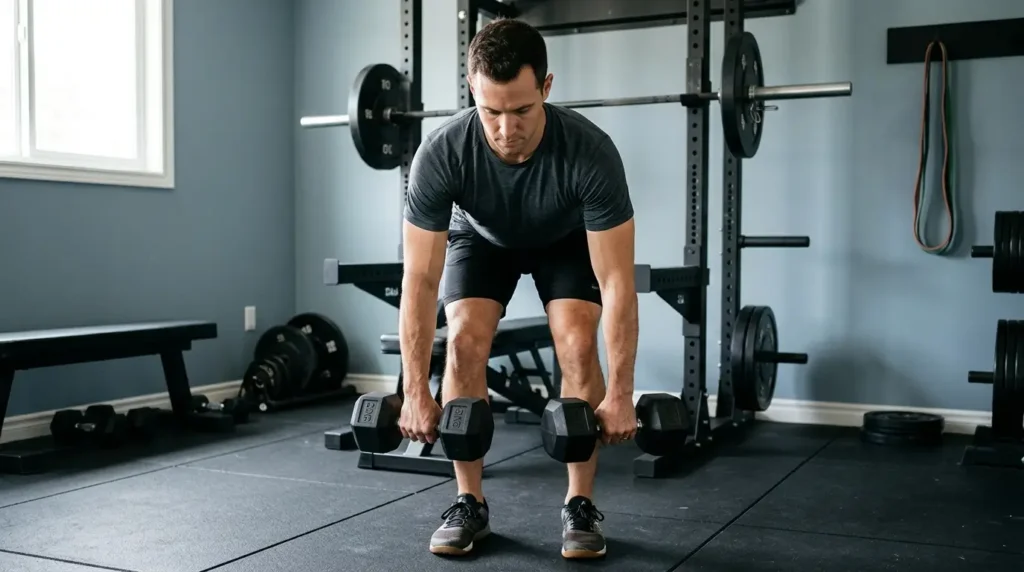
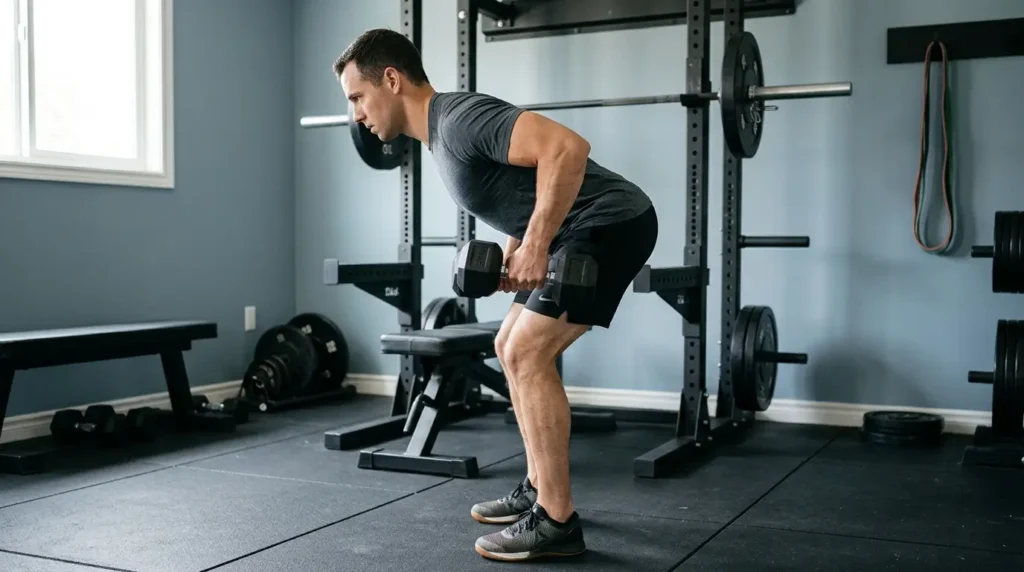
1. Two-Dumbbell Bent-Over Row
- Stand with feet hip-width apart, holding a dumbbell in each hand.
- Hinge at your hips until your torso is about 45 degrees to the floor. Keep your back flat and your knees soft.
- Let the dumbbells hang under your shoulders with your arms straight.
- Pull your elbows back toward your hips. Squeeze your shoulder blades together at the top.
- Lower slowly over 2-3 seconds.
What it should feel like: a strong pull through the middle of your back and lats, with your hamstrings holding the hinge. Your lower back should feel braced, not strained.
Coach’s Tip: Think “elbows to hips,” not “hands to chest.” Picturing your elbows driving back keeps your biceps from taking over and puts the work on your lats and mid-back.
Easier: Rest your forehead on a bench and do chest-supported rows, or use lighter weights.
Harder: Pause for 2 seconds at the top, or slow the lowering phase to 4 seconds.
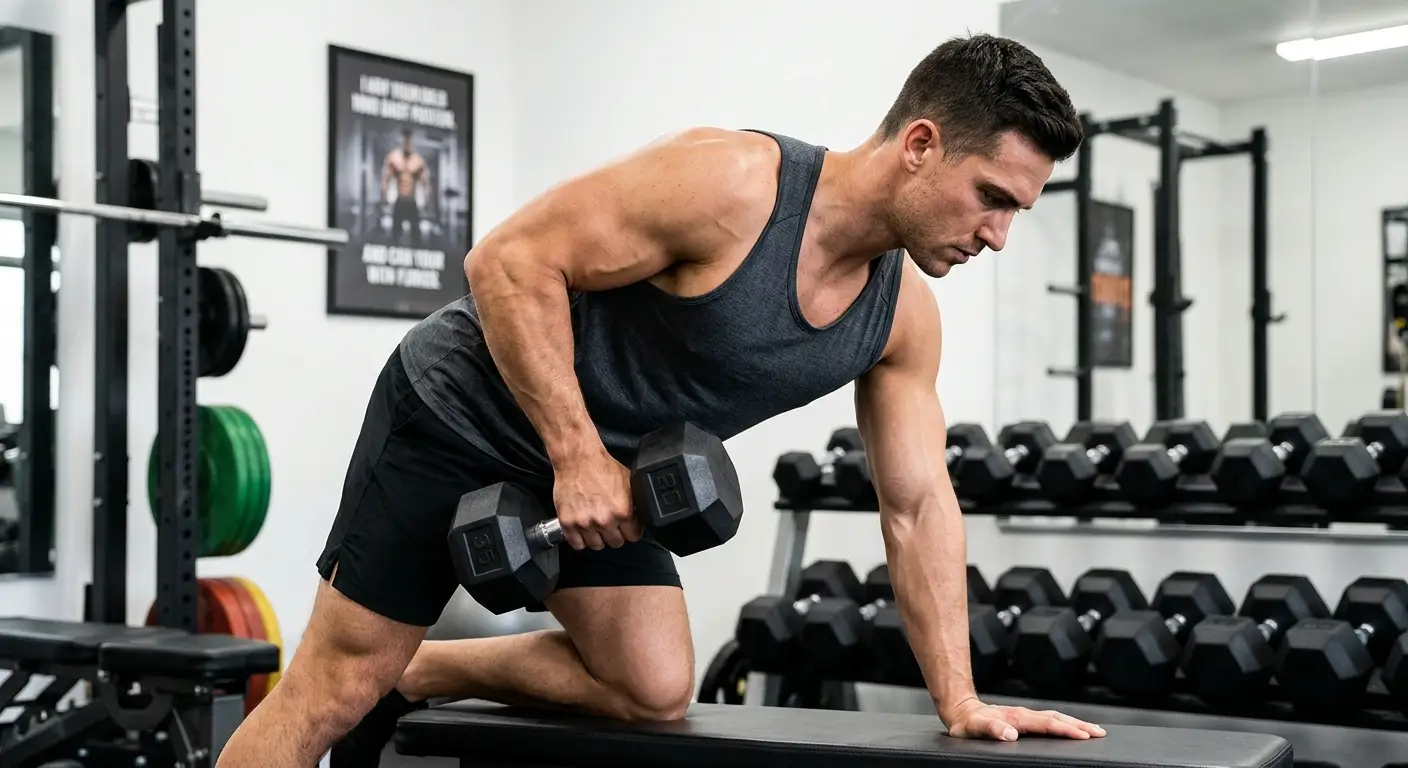
2. One-Arm Dumbbell Row
- Place your left knee and left hand on a bench, with your right foot on the floor.
- Hold a dumbbell in your right hand with your arm straight.
- Keep your back flat and your hips square to the floor.
- Pull the dumbbell toward your hip, leading with the elbow.
- Lower under control and repeat. Switch sides after your set.
What it should feel like: a deep squeeze along the side of your back, near the lat. If your torso twists, the weight is too heavy.
Easier: Use a lighter dumbbell and place your free hand on a higher surface, such as a chair seat.
Harder: Use a heavier dumbbell, or add a 2-second hold at the top.
3. Dumbbell Romanian Deadlift
- Stand tall holding a dumbbell in each hand, resting on your thighs.
- Push your hips back, letting the dumbbells slide down your legs.
- Keep your back flat and your knees slightly bent.
- Lower until you feel a stretch in your hamstrings, usually mid-shin.
- Drive your hips forward to stand tall.
What it should feel like: a stretch in the hamstrings and a firm hold in the glutes and lower back muscles. This move trains your erector spinae, which keep your spine steady.
Common Mistake: Rounding your back to reach lower. This shifts the load onto your spine instead of your hips. Instead, stop when you feel the hamstring stretch, even if the dumbbells are only at knee height.
Easier: Use lighter dumbbells, or hold one dumbbell at your chest.
Harder: Slow the lowering phase to 4 seconds, or use a single-leg version.
4. Dumbbell Pullover
- Lie on your back on a bench or mat, holding one dumbbell with both hands above your chest.
- Keep a slight bend in your elbows.
- Lower the dumbbell back over your head in an arc until you feel a stretch in your lats and chest.
- Pull it back to the start by squeezing your lats.
What it should feel like: a long stretch along the sides of your back and ribs, then a firm pull as you come up. It’s the closest dumbbell move to a straight-arm pulldown.
Easier: Use a lighter dumbbell and a shorter range.
Harder: Add a 2-second pause at the stretched position.
5. Dumbbell Reverse Fly
- Hinge forward with a flat back, holding light dumbbells under your shoulders.
- Keep a soft bend in your elbows.
- Raise your arms out to the sides until they reach shoulder height.
- Lower slowly over 3 seconds.
What it should feel like: a burn in the rear delts and the muscles between your shoulder blades. Use light weights. For a seated version and extra cues, see our guide to the seated bent-over rear delt raise.
Easier: Sit on a bench and lean forward.
Harder: Add a 2-second hold at the top.
6. Dumbbell Shrug
- Stand tall with a dumbbell in each hand at your sides.
- Lift your shoulders straight up toward your ears, without rolling them.
- Hold for 1-2 seconds.
- Lower slowly.
What it should feel like: a strong squeeze in the upper traps. Keep your neck relaxed. If you also train with a barbell, our comparison of dumbbell vs. barbell shrugs explains the differences.
Easier: Use lighter dumbbells.
Harder: Hold the top for 3 seconds.
7. Hammer Curl (Optional Finisher)
Stand tall with palms facing each other. Curl both dumbbells toward your shoulders, keeping your elbows by your sides. Lower in 3 seconds. This finisher trains the biceps and forearms that help every row. For a deeper comparison, see our post on hammer curls vs. bicep curls.
Weekly Plan for Your Dumbbell-Only Back Day
How often should you train your back? Research on volume gives a useful guide. A meta-analysis described in a study on resistance training volume found a dose-response relationship between weekly sets and muscle growth, with the analysis able to confirm effects up to about 10 weekly sets per muscle group. That means a plan with around 10 or more hard sets for your back each week is a reasonable target.
Frequency matters less than total work. A meta-analysis of 25 studies [VERIFY: replace with the PubMed link] found that when volume is equal, training frequency did not meaningfully change muscle growth. So pick a schedule you can keep.
Sample two-day split
| Day | Focus | Notes |
|---|---|---|
| Monday (Day A) | Heavier rows | 4 sets of 6-10 reps on rows; full workout |
| Thursday (Day B) | Higher reps | 3 sets of 12-15 reps on every move |
| Other days | Legs, chest, shoulders, walking | See our leg and shoulder workout |
Progression plan (double progression)
- Pick a rep range, such as 8-12 on rows.
- Use a weight you can lift for 8 reps with good form.
- Add one rep each week until you hit 12 on every set.
- Then add 2-5 lb (1-2 kg) per hand and drop back to 8 reps.
Beginner and Advanced Versions
Beginner version (30-35 minutes)
- Do the first five exercises only.
- Use 2 sets each, except rows, which get 3.
- Use lighter weights and slow tempo: 3 seconds down, 1 second up.
- Train once or twice a week with at least 48 hours between sessions.
Advanced version (60 minutes)
- Add a fourth set to rows and pullovers.
- Use tempo: 4 seconds down, 1 second pause, 1 second up.
- Swap two-arm RDLs for single-leg versions.
- Add pull-ups or chin-ups if you have a bar. Our guide to what muscles pull-ups work shows how they add vertical pulling to your plan.
Common Mistakes and Fixes
- Using momentum. Swinging your torso turns a back exercise into a jerky pull. Fix: slow the lowering phase and use a lighter weight.
- Pulling with the hands. Your biceps take over. Fix: think about driving your elbows back.
- Rounded back. This is common in rows and RDLs. Fix: keep your chest proud and your neck in line with your spine.
- Skipping the stretch. Short reps leave results behind. Fix: let your arms fully extend before each pull.
- Going too heavy on reverse flys. The rear delts are small. Fix: stay light and focus on squeeze.
- Only training rows. You miss upper traps and rear delts. Fix: keep the mix of exercises in the workout.
Cool-Down (3-5 Minutes)
Finish with easy stretches. Breathe slowly and don’t force any position.
- Child’s pose: 30 seconds, reaching your arms forward.
- Doorway or wall lat stretch: 20-30 seconds per side.
- Standing hamstring stretch: 20-30 seconds per leg.
- Cat-cow: 8 slow reps.
Tips for Results
These habits matter more than any single exercise.
- Log your workouts. Write down weights and reps so you know when to progress.
- Use full range of motion. Reach, stretch, and squeeze on every rep.
- Train close to your limit. Stop sets 1-3 reps before failure.
- Fill the vertical-pull gap. Dumbbells don’t copy a pulldown. Pullovers help, and a pull-up bar adds the missing piece if you can get one.
- Keep your gear tidy. If you use rubber dumbbells, our guide on how to clean rubber dumbbells keeps them grippy and fresh.
- Be patient. Muscle builds over weeks, not days.
Who Should Be Careful
Back training is safe for most people when done with control. However, take extra care, or get advice first, if any of these apply:
- You have current back, neck, shoulder, or hip pain.
- You have had a recent injury or surgery.
- You are pregnant or postpartum.
- You are an older adult or new to strength training.
- You have a medical condition such as high blood pressure or a disc problem.
Check with a doctor or physical therapist before starting if any of these apply. Also, stop any exercise that causes sharp pain, tingling, or numbness. Muscle fatigue is normal, but joint or nerve pain is a signal to stop.
FAQ
Can you build a big back with dumbbells only?
Yes. Dumbbell rows, Romanian deadlifts, pullovers, and reverse flys cover most back muscles. Progressive overload is the key. Add reps or weight gradually, train close to your limit, and aim for roughly 10 or more hard back sets each week.
Can dumbbells replace pull-ups?
Not completely. Research on back exercises found pull-ups and chin-ups produced the greatest latissimus dorsi activity. Dumbbell pullovers and rows train the lats well, but if you want a close match to vertical pulling, add pull-ups or use an assisted version.
How heavy should dumbbells be for back day?
Choose a weight that lets you finish your target reps with 1-3 reps left. Beginners often row with 15-25 lb (7-11 kg) per hand. Intermediate lifters often use 30-50 lb (14-23 kg). Keep reverse flys much lighter.
How often should I train my back?
Two sessions a week works well for most people. Research suggests that when total weekly volume is equal, training frequency has little effect on muscle growth. Pick a schedule you can keep, leave at least 48 hours between hard back sessions, and increase gradually.
How many sets do I need for back?
A good target is around 10 or more hard sets per week. This plan gives you roughly 16-20 sets per session, split among rows, hinges, pullovers, and rear delt work. Beginners can start with about half of that and build up over several weeks.
Why does my lower back hurt after dumbbell rows?
Common causes include rounding your spine, using momentum, or lifting too heavy. Keep your back flat, brace your abs, and lower the weight. If pain persists, stop and see a doctor or physical therapist before continuing.
Conclusion
A dumbbell-only back day can be complete, effective, and easy to do at home. With rows, a hinge, a pullover, and rear delt work, you hit your lats, mid-back, traps, and spinal muscles. Add weekly progression and two sessions a week, and you have a plan that works for years.
Your next step is simple. Pick your weights, run the workout on Monday and Thursday, and log every set. Add one rep each week, and let steady effort do the work. Your dumbbell-only back day will build strength you can see and feel.
