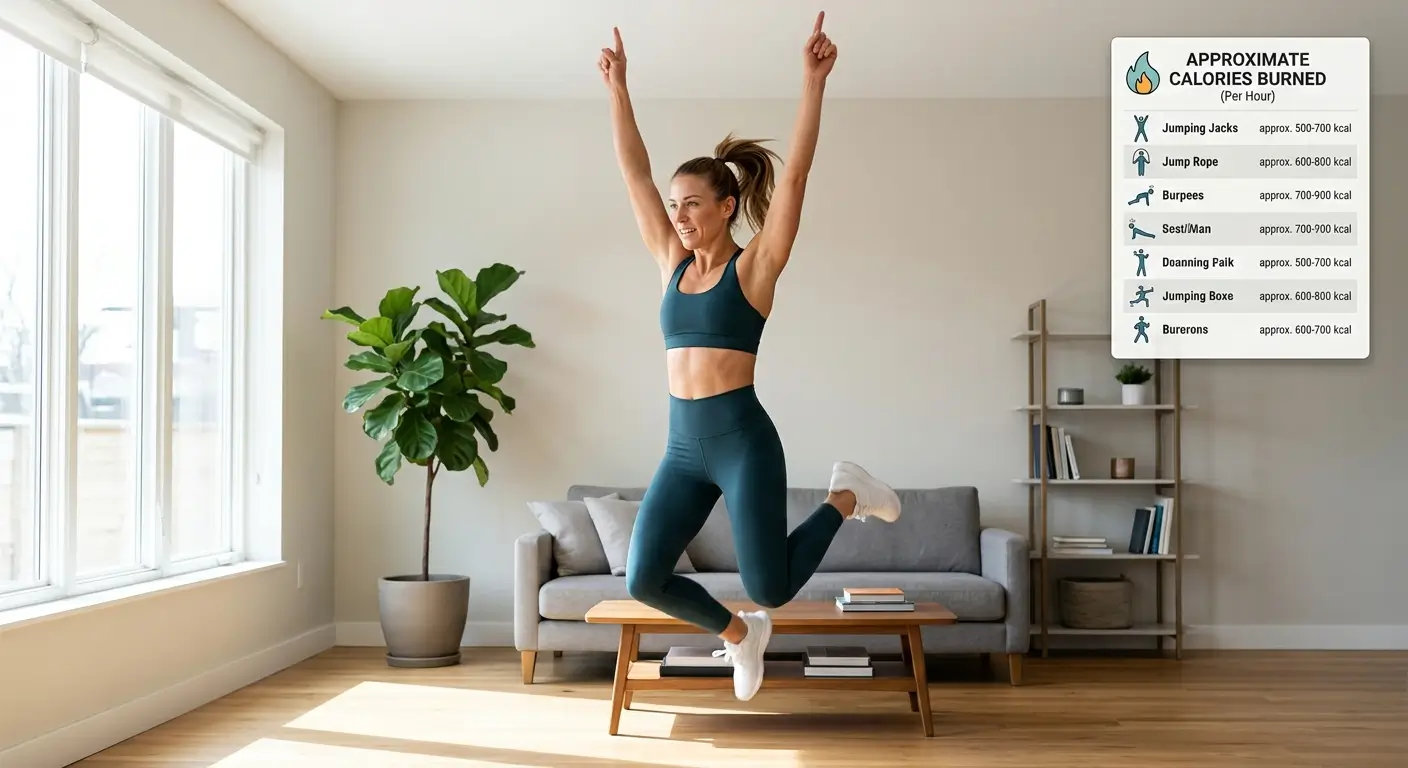
The 100 jumping jacks calorie total is smaller than most people expect, usually between 10 and 25 calories. However, your body weight and how hard you move decide where you land in that range.
That may sound low, but jumping jacks still earn a place in your routine. First, they cost nothing and need no gear. Also, 100 reps take only about two minutes, and small moves add up when you repeat them week after week.
In this guide, you will see the math behind the estimate and charts by body weight. Next, you will learn how many jumping jacks it takes to burn 100 calories. Finally, you will get a step-by-step form guide and simple routines for beginners.
Quick Answer: For most adults, 100 jumping jacks calories lands between about 10 and 25. A 155 lb (70 kg) person burns roughly 12 to 18. Body weight and effort change the result. Also, a fast pace finishes the set sooner, so total calories per set can drop.
100 Jumping Jacks Calories: The Detailed Answer
No device counts the exact energy cost of every jack. Instead, researchers use MET values, where one MET equals the energy you use sitting at rest. According to the CDC, physical activity at 6.0 METs or more is vigorous intensity.
The 2024 Adult Compendium of Physical Activities lists calisthenics such as jumping jacks, pushups, and burpees at 7.5 METs when done with vigorous effort. In contrast, it gives 3.8 METs for moderate-effort calisthenics. Therefore, those two numbers are the base for every estimate in this article.
The Simple Math
First, calories per minute equal MET × 3.5 × body weight in kg ÷ 200 [VERIFY: confirm ACSM equation source]. For example, a 155 lb (70 kg) person at 7.5 METs burns about 9.2 calories per minute. Then you only need to know how long 100 jacks take.
At an easy pace of about 40 jacks per minute, 100 reps take around 2.5 minutes. A steady pace of 50 per minute takes 2 minutes. Meanwhile, a fast pace of about 67 per minute takes 1.5 minutes. Keep in mind that these speeds are practical estimates, not lab results, so time yourself once to check.
100 Jumping Jacks Calories by Body Weight and Pace
| Body weight | Easy pace (2.5 min, 3.8 METs) | Steady pace (2 min, 7.5 METs) | Fast pace (1.5 min, 7.5 METs) |
|---|---|---|---|
| 125 lb (57 kg) | ~9 | ~15 | ~11 |
| 155 lb (70 kg) | ~12 | ~18 | ~14 |
| 185 lb (84 kg) | ~14 | ~22 | ~17 |
| 215 lb (98 kg) | ~16 | ~26 | ~19 |
Estimates built from Compendium MET values and the pace assumptions above. They are not lab-tested.
Notice something odd? The fast pace burns fewer total calories than the steady pace. That happens because you finish the 100 reps sooner. In other words, pace raises calories per minute, but it shortens the clock when the rep count is fixed.
Coach’s Tip: If calories are your goal, count minutes, not reps. For instance, ten minutes of steady jacks beats 100 reps done in a rush. Set a timer, keep a smooth rhythm, and stop when your form gets sloppy.
What Changes Your 100 Jumping Jacks Calories Total
Body Weight
Heavier bodies move more mass with each jump, so they use more energy. In the table, a 215 lb (98 kg) person burns about 26 calories at a steady pace. By comparison, a 125 lb (57 kg) person burns about 15. That gap says nothing about fitness; it simply reflects the cost of moving a bigger body.
Pace and Effort
The Compendium’s gap between 3.8 and 7.5 METs shows how much effort matters. Smooth, small jacks with relaxed arms sit near the moderate end. On the other hand, big jumps with full overhead arm swings sit near the vigorous end.
You can check your effort with the CDC’s talk test. At vigorous intensity, you cannot say more than a few words without pausing for breath. Therefore, if you can chat easily, you are probably in the moderate zone.
Range of Motion
Wide feet and full arm swings ask more of your legs and shoulders. Short, lazy reps do less work. So aim for feet about 24 to 30 inches (61 to 76 cm) apart and hands that meet overhead.
Rest Breaks
Stopping every 20 reps lowers your average rate. Likewise, a set with 30 seconds of rest burns fewer calories per clock minute than non-stop work. For that reason, the time-based table below assumes no breaks.
Your Own Body
Two people with the same weight can still differ. For example, fitness level, age, and movement efficiency all play a part. As a result, you should treat every number here as an estimate, not a promise.
Jumping Jacks Calories Per Minute and Per Workout
Most people think in minutes, not reps. Because of that, this table assumes vigorous effort at 7.5 METs with no rest.
| Body weight | Per minute | 5 min | 10 min | 15 min | 30 min |
|---|---|---|---|---|---|
| 125 lb (57 kg) | ~7 | ~37 | ~74 | ~112 | ~223 |
| 155 lb (70 kg) | ~9 | ~46 | ~92 | ~138 | ~277 |
| 185 lb (84 kg) | ~11 | ~55 | ~110 | ~165 | ~330 |
| 215 lb (98 kg) | ~13 | ~64 | ~128 | ~192 | ~384 |
However, few beginners can do 30 straight minutes. Expect lower totals once you add rest, which is normal and fine. Besides, intervals still build fitness, so do not skip them.
How Many Jumping Jacks Burn 100 Calories?
At a steady pace, you need roughly this many reps:
- 125 lb (57 kg): about 670 jacks, or 13 minutes
- 155 lb (70 kg): about 540 jacks, or 11 minutes
- 185 lb (84 kg): about 455 jacks, or 9 minutes
- 215 lb (98 kg): about 390 jacks, or 8 minutes
In short, you burn 100 calories in roughly 8 to 13 minutes of non-stop effort. That is a doable target if you break it into rounds of 20 to 50 reps.
How Jumping Jacks Compare With Other Workouts
Harvard Health publishes a calorie chart for 30-minute activities. The table below pairs those numbers with our jumping jack estimate for the same time.
| Activity (30 min) | 125 lb (57 kg) | 155 lb (70 kg) | 185 lb (84 kg) |
|---|---|---|---|
| Weight lifting, general | 90 | 108 | 126 |
| Calisthenics, moderate | 135 | 162 | 189 |
| Aerobics, low impact | 165 | 198 | 231 |
| Weight lifting, vigorous | 180 | 216 | 252 |
| Jumping jacks, vigorous, non-stop (our estimate) | ~223 | ~277 | ~330 |
Note that the jacks row assumes you never stop, which is hard to hold for half an hour. For another pace-based comparison, read our guide on slow jogging vs fast walking.
Do 100 Jumping Jacks Help With Weight Loss?
The Calorie Math
On their own, 100 jacks make a tiny dent. For instance, Harvard Health notes that losing one pound by exercise takes roughly 3,500 calories, and that exercise alone is not the fast track. At about 18 calories per set for a 155 lb (70 kg) person, that means roughly 190 sets. Clearly, one daily set will not bring fast changes.
Where Jacks Do Help
Still, jacks have real value. The CDC adult guidelines call for 150 minutes of moderate or 75 minutes of vigorous activity each week, plus muscle-strengthening on two or more days. Because hard jumping jacks sit at 7.5 METs, above the 6.0 vigorous mark, they can count toward the vigorous minutes. For example, 15 minutes on five days adds up to 75 minutes.
In addition, pairing jacks with strength work gives you better balance. If you are curious, see whether squats for weight loss make sense in your plan.
What About Belly Fat?
Unfortunately, no exercise lets you pick where fat comes off [VERIFY: add PubMed source on spot reduction]. However, jacks add to your total energy use, like other cardio. Our look at whether the treadmill and belly fat connect covers the same idea.
Finally, if weight loss is your goal, check with your doctor before starting a new program.
How to Do a Jumping Jack Correctly (Step by Step)
First, clear a space of about 72 by 72 inches (183 by 183 cm). Also, wear cushioned shoes and avoid bare concrete.
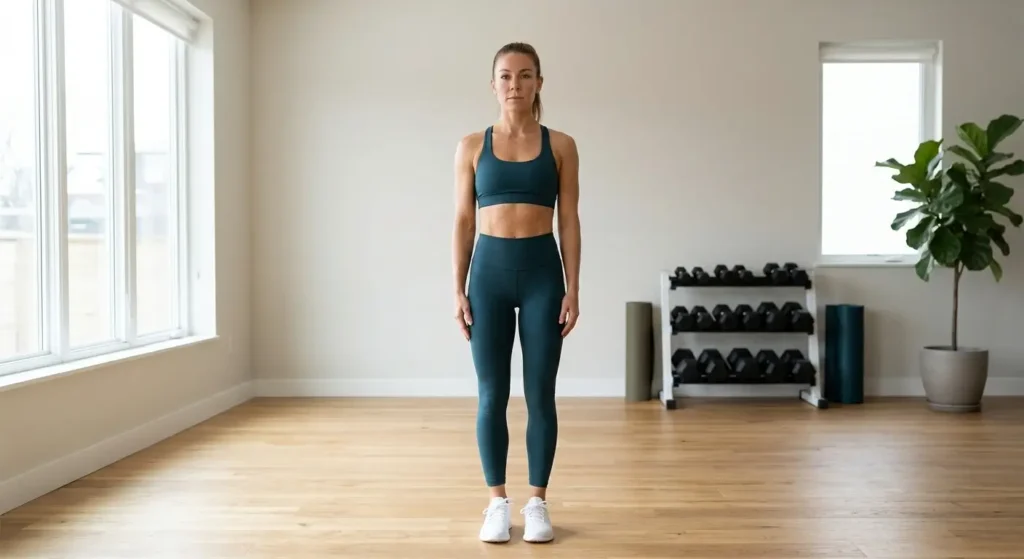
- Start tall. Put your feet together and your arms at your sides. Stack your ribs over your hips.
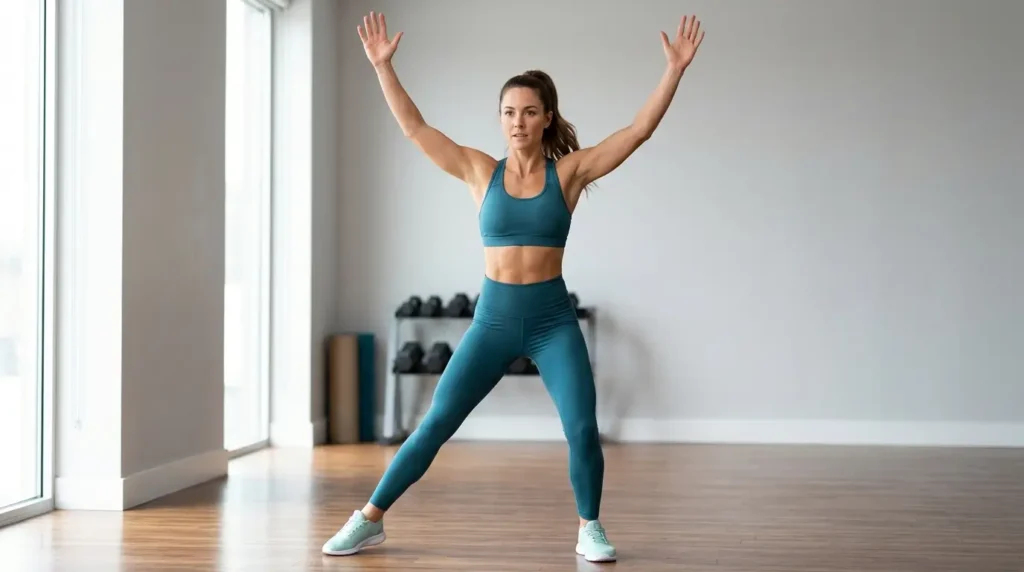
- Next, jump and open. Bend your knees slightly and hop your feet 24 to 30 inches (61 to 76 cm) apart. Turn your toes out a little.
- Then raise your arms. Swing them out and up until your hands meet or nearly meet overhead. Keep your elbows soft.
- After that, jump and close. Hop your feet back together as your arms return to your sides.
- Finally, land quietly. Hit the floor on the balls of your feet, let your heels touch lightly, and keep your knees soft.
For tempo, aim for one full rep every 1 to 1.5 seconds. At first, you should feel your calves and thighs warm up. Later in a set, your shoulders will tire, and your breathing will quicken. Throughout, the landing should feel light and springy, never pounding.

Common Mistake: Landing stiff-legged and heavy. Locked knees send the impact straight into your joints. Fix: Soften your knees, shrink the jump, and listen for a quiet landing. If you hear stomping, slow down.
Sets, Reps, and Rest: A Plan Built on 100 Jacks
| Level | Plan | Rest between sets | Days per week | Reps per session |
|---|---|---|---|---|
| Beginner | 5 sets × 20 reps | 45 to 60 sec | 3 | 100 |
| Intermediate | 4 sets × 25 reps | 30 to 45 sec | 3 to 4 | 100 |
| Advanced | 3 sets × 100 reps | 60 sec | 3 to 4 | 300 |
Add 5 reps per set every week or two, but only when your landings stay quiet and your form stays clean. Otherwise, hold your current level. If you feel pain, drop back a level.
Easier Version (Regression)
Try step jacks instead. Here, you step one foot out to the side while your arms rise, then switch. As a result, there is no jump and impact is lower. A seated version also works: raise your arms overhead and tap your feet out and in.
Harder Version (Progression)
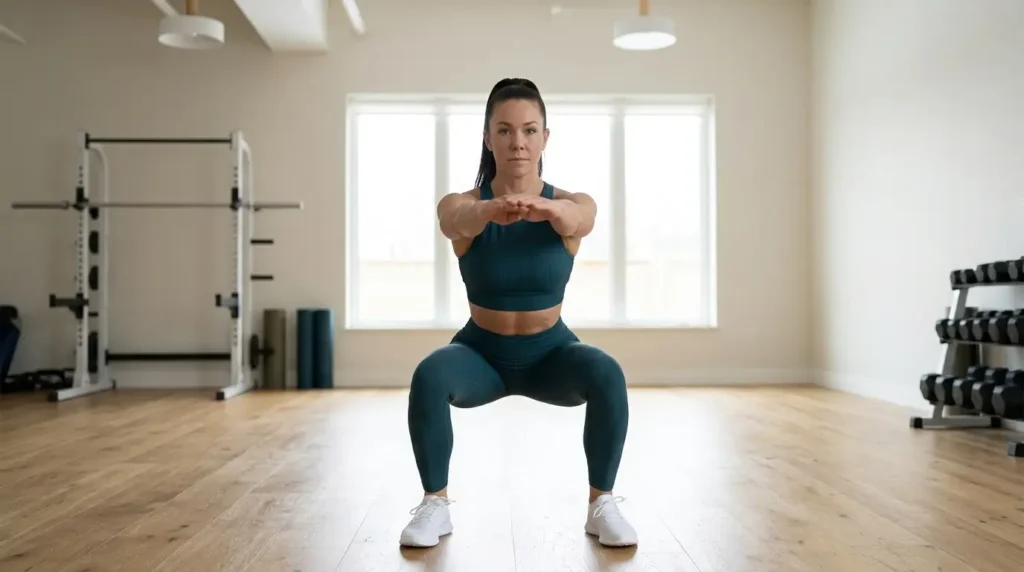
To progress, move up to squat jacks. Land with your feet wide, drop into a quarter squat, then hop back together. Alternatively, try power jacks with a higher jump, or interval rounds of 30 seconds fast and 30 seconds easy. Advanced lifters with healthy joints can also add a light vest of 5 to 10 lb (2.3 to 4.5 kg).
For example, ten rounds of 30 seconds on and 30 seconds off give you 5 minutes of work. At 7.5 METs, a 155 lb (70 kg) person burns about 46 calories that way.
Sample 10-Minute Circuit
- Warm-up (2 min): March in place and do arm circles.
- Circuit (3 rounds): Do 30 jumping jacks, then 10 bodyweight squats, then 20 seconds of easy marching. Rest 60 seconds between rounds.
- Cool-down (2 min): Walk slowly, then stretch your calves and shoulders.
Safety Notes and Who Should Be Careful
Jumping jacks are an impact move. Therefore, check with a doctor or physical therapist first if you have joint pain, heart or blood pressure issues, osteoporosis, or pelvic floor concerns. The same goes for anyone who is pregnant or postpartum, and for older adults with health conditions. Until you get clearance, use step jacks or a seated version.
If impact bothers you, low-impact cardio can fill the gap. For example, under-desk ellipticals suit office days. Likewise, stationary bikes for older adults are another gentle choice.
Stop right away and seek care if you feel chest pain, dizziness, or sharp joint pain.
Can You Trust Your Watch’s Calorie Count?
A Stanford-led study in the Journal of Personalized Medicine tested seven wrist devices. It found they measured heart rate fairly well, but estimated energy use poorly. However, the tasks were sitting, walking, running, and cycling, not jumping jacks.
So treat your watch number as a rough guide. Meanwhile, if you are shopping for a tracker, our Oura Ring vs Fitbit comparison can help you choose. Either way, your own minutes and effort level are the most reliable data you have.
More Tips to Get the Most From Every Set
A few habits make every set count:
- Warm up first. Two minutes of marching and arm circles prepare your calves and shoulders.
- Breathe on purpose. Exhale as your arms go up, then inhale as they come down.
- Mix in other moves. Pair jacks with squats, lunges, and other calisthenics exercises for a full-body session.
- Keep it quiet at home. Step jacks and soft landings are neighbor-friendly, and our guide to apartment workout equipment has more ideas for small spaces.
- Track weekly minutes. Aim for steady totals instead of one heroic session.
FAQ
How many calories does 100 jumping jacks burn?
For most adults, 100 jumping jacks burn about 10 to 25 calories. For instance, a 155 lb (70 kg) person burns roughly 12 to 18, based on the 2024 Compendium MET values. However, body weight, pace, and arm range change the result, so treat the number as an estimate.
How many jumping jacks to burn 100 calories?
At a steady pace, a 155 lb (70 kg) person needs about 540 jumping jacks, or roughly 11 minutes of non-stop work. Meanwhile, a 215 lb (98 kg) person needs about 390, and a 125 lb (57 kg) person about 670. Keep in mind that these figures come from MET-based math, so real results vary.
Is 100 jumping jacks a day enough?
It is a good start, but not enough alone. The CDC guidelines call for 150 minutes of moderate or 75 minutes of vigorous activity weekly, plus strength work on two or more days. Because 100 jacks take about two minutes, add walking, other cardio, and resistance training.
Are jumping jacks or jump rope better for burning calories?
Jump rope usually burns more per minute. For example, the 2024 Compendium lists a jump-rope style entry at 9.0 METs [VERIFY: confirm exact rope code], versus 7.5 for vigorous jacks. Still, jacks need no rope and less skill, so the better choice is the one you will repeat.
Do jumping jacks burn belly fat?
No, jumping jacks cannot target belly fat [VERIFY: add PubMed source on spot reduction]. Instead, weight change depends on energy in versus energy out over time. Therefore, combine jacks with strength work, daily movement, and sound eating habits, and check with your doctor first.
Are jumping jacks bad for your knees?
Jumping jacks are an impact move, so hard landings can stress your joints. To reduce the load, land softly on the balls of your feet with soft knees, wear cushioned shoes, and avoid concrete. Moreover, if you have knee pain or arthritis, try step jacks and ask a doctor or physical therapist first.
Final Thoughts on 100 Jumping Jacks Calories
The 100 jumping jacks calories total is modest: about 10 to 25, with 12 to 18 typical for a 155 lb (70 kg) person. Although pace changes calories per minute, weight and time on task drive the total for a set. Therefore, if you want bigger numbers, think in minutes and intervals, not rep counts.
Jumping jacks are not a shortcut. Still, they are a smart, free way to raise your heart rate and add vigorous minutes to your week. To begin, follow the beginner plan, keep your landings soft, and build up slowly. Then pair them with strength work for a balanced routine.
If you have pain, an injury, a medical condition, or a weight-loss goal, check with a doctor or physical therapist before you start.
