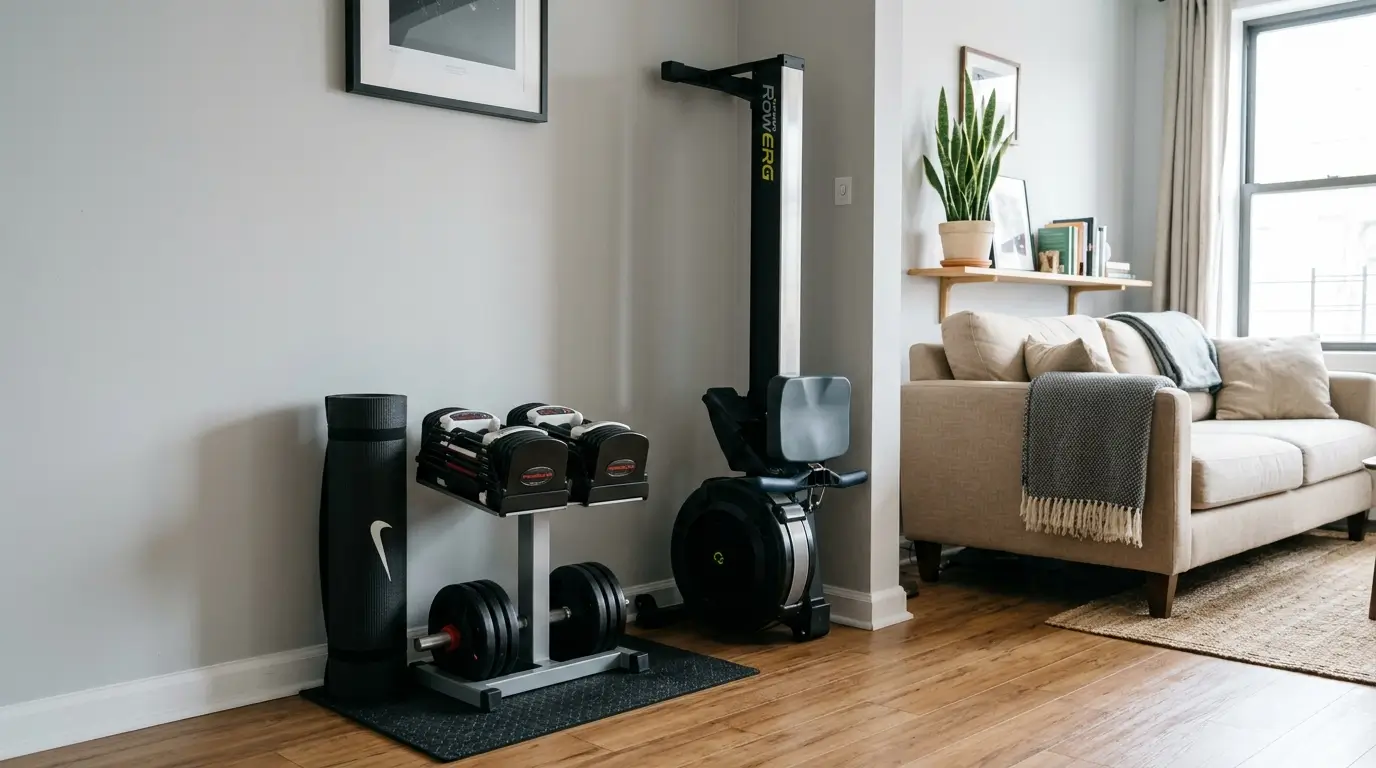
You do not need a garage, a basement, or 500 square feet to train well. A smart apartment home gym can fit in a closet, a corner of the bedroom, or the space behind your couch. The trick is picking gear that does several jobs, stores quickly, and stays quiet.
This guide shows you what to buy, what to skip, and how to set it all up. You will also get a 30-minute workout to start with. First, here is the short answer.
Quick Answer
A good apartment home gym uses adjustable dumbbells (top pick), resistance bands (budget pick), and an upright-storing rower (upgrade pick), plus a thick mat to cut noise. These fit in a closet, train every major muscle, and need only about 6 by 8 feet (183 by 244 cm) of floor.
Why an Apartment Home Gym Works
Many people think small spaces mean small results. That is not true. The CDC says adults should get at least 150 minutes of moderate aerobic activity each week, plus muscle-strengthening activity on two or more days. You can meet both goals in a studio apartment.
Strength training also offers benefits beyond muscle. A review of resistance training research links it to better strength, body composition, and heart and metabolic health. In other words, a few well-chosen tools can support your overall health.
Heavy weights are not required either. A meta-analysis in the Journal of Strength and Conditioning Research found that lighter loads can build muscle about as well as heavier ones when sets are taken close to failure. However, heavier loads tend to give bigger strength gains. A network meta-analysis in Medicine & Science in Sports & Exercise reached a similar conclusion.
That is good news for apartment lifters. You can build muscle with moderate weights, bands, and bodyweight work. Then you can add heavier loads as you progress.
If you have a heart condition, joint pain, or another health concern, check with your doctor before starting a new program.
Apartment Home Gym Comparison Table
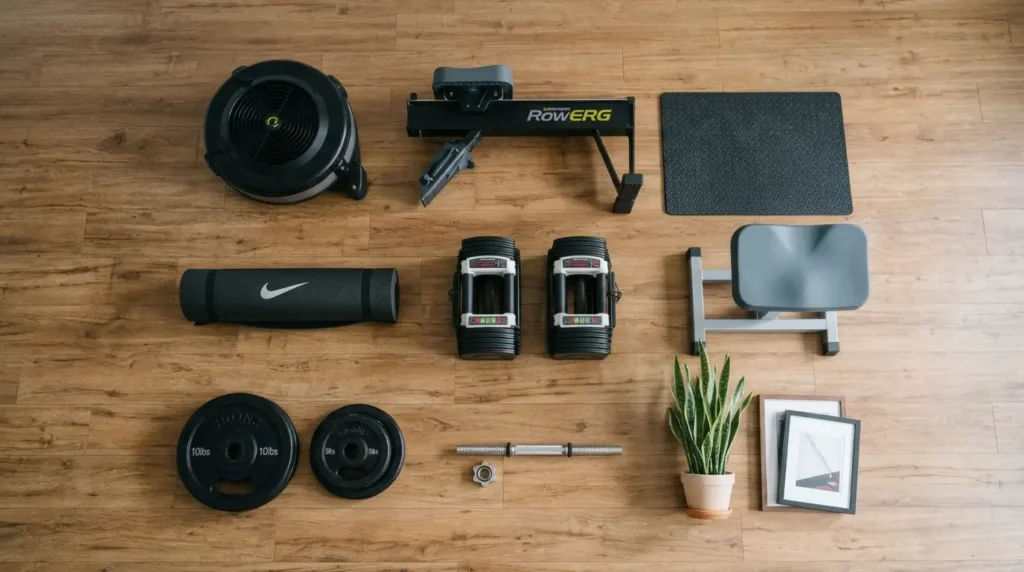
Use this table to compare the nine picks at a glance. Price ranges are rough estimates and should be checked before publishing [VERIFY].
| Equipment | Key Spec | Best For | Price Range |
|---|---|---|---|
| Adjustable dumbbells | One pair replaces many; often 5–52.5 lb (2.3–23.8 kg) per hand [VERIFY] | Full-body strength | $$$ [VERIFY] |
| Resistance bands | Loop and tube bands, about 1 lb (0.5 kg) of storage weight | Budget, travel, joint-friendly work | $ [VERIFY] |
| Suspension trainer | Straps that hang from a door anchor | Rows, push-ups, core | $–$$ [VERIFY] |
| Folding adjustable bench | Folds flat for storage | Presses, rows, step-ups | $$ [VERIFY] |
| Doorway or tension pull-up bar | Fits many door frames | Back and biceps | $ [VERIFY] |
| Kettlebell | Single solid weight | Swings, carries, goblet squats | $–$$ [VERIFY] |
| Upright-storing rower | About 96 in (244 cm) long in use; stands upright [VERIFY] | Low-impact cardio plus strength | $$$$ [VERIFY] |
| Under-desk elliptical or pedal exerciser | Fits under a desk or couch | Easy daily movement | $–$$ [VERIFY] |
| Mat and floor tiles | About 72 × 24 in (183 × 61 cm) for a mat | Noise and floor protection | $ [VERIFY] |
Best Equipment for Your Apartment Home Gym
Each pick below covers who it suits, key features, and honest pros and cons. For a wider list of gear ideas, see our guide to apartment workout equipment.
1. Adjustable Dumbbells (Top Pick)
Who it’s for: Anyone who wants one purchase that covers most of the program.
Adjustable dumbbells swap many pairs of fixed weights for one compact set. Most models let you change the load with a dial or pin in a few seconds. A common range is 5 to 52.5 lb (2.3 to 23.8 kg) per hand, according to the Bowflex SelectTech page [VERIFY].
With one pair, you can do goblet squats, presses, rows, Romanian deadlifts, and curls. If you are unsure whether adjustable or fixed sets suit you better, read our comparison of adjustable vs fixed dumbbells.
Pros:
- Replaces a whole rack of weights
- Quick load changes for supersets
- Easy to store on a shelf
Cons:
- Higher upfront cost
- Bulkier handles than fixed dumbbells
- Dials and pins can wear over time
Coach’s Tip: Choose a weight where your last two reps of a set feel hard but your form stays clean. If your back arches or your elbows flare, the weight is too heavy for now.
2. Resistance Bands (Budget Pick)
Who it’s for: Beginners, travelers, and anyone on a tight budget.
Bands are light, cheap, and nearly silent. Loop bands work well for glute bridges, lateral walks, and assisted pull-ups. Tube bands with handles suit rows, presses, and curls. A door anchor lets you attach a band for pulling movements [VERIFY].
Bands also respect the “lighter load” research above. Take each set close to failure, and you can still build muscle. Meanwhile, the constant tension makes the top of each rep feel harder than it does with a dumbbell.
Pros:
- Very low cost
- Quiet and portable
- Gentle on the joints
Cons:
- Resistance is hard to measure
- Bands can snap or wear out, so check them often
- Less loading for big lower-body lifts
3. Suspension Trainer
Who it’s for: People who like bodyweight training and want more exercise options.
A suspension trainer hangs from a door anchor or a sturdy overhead point. You adjust your body angle to change the difficulty. Rows, push-ups, and core exercises all become more demanding as you lean further.
It takes up less space than a small bag of laundry. For more bodyweight ideas, browse our calisthenics exercises list.
Pros:
- Scalable difficulty
- Works your core in almost every move
- Packs into a small bag
Cons:
- Needs a strong, safe anchor point
- Takes practice to feel stable
- Door anchors can mark painted frames
Common Mistake: Hanging the trainer from a flimsy hook or a hollow door. Always test the anchor with your full body weight before loading it, and check your lease for rules about hardware.
4. Folding Adjustable Bench
Who it’s for: Lifters who want to press, row, or step up with dumbbells.
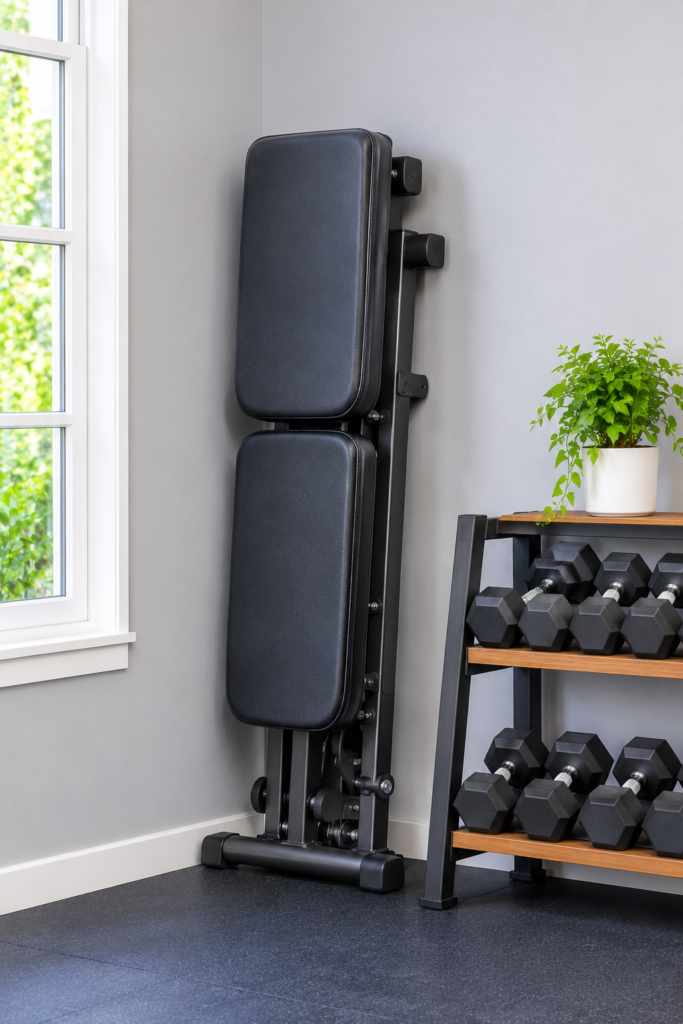
A bench opens up chest presses, supported rows, and incline work. Folding models store flat against a wall or under a bed. Look for a flat-to-incline design with a weight limit well above your body weight plus the dumbbells you plan to use [VERIFY for each model].
If a bench feels like too much, a sturdy chair or the edge of a couch can work for step-ups. However, a real bench is more stable for heavier presses.
Pros:
- Adds many exercises
- Folds away
- Safer base for pressing
Cons:
- Takes more space than other picks
- Cheap models can wobble
- Some fold slowly
5. Doorway or Tension Pull-Up Bar
Who it’s for: Anyone who wants back and biceps work without a cable machine.
Pull-ups are one of the best upper-body moves, and a doorway bar lets you do them at home. Tension bars press against both sides of the frame, so they often avoid screws. Check the width range on the product page before you buy, since door frames vary [VERIFY].
If you want a sturdier setup later, look at a squat rack with a pull-up bar. Until then, a doorway bar keeps things simple.
Pros:
- Cheap and quick to install
- Excellent for lats and arms
- Removes easily for storage
Cons:
- Can mark door frames
- Not every frame is strong enough
- Pull-ups are hard for beginners without assistance
6. Kettlebell
Who it’s for: Lifters who want power, grip strength, and conditioning from one tool.
A single kettlebell can do goblet squats, swings, farmer carries, and presses. A common starting weight is 18 lb (8 kg) for many women and 35 lb (16 kg) for many men. However, your own level matters most, so start lighter if you are new.
Swings are loud only if you drop the bell. Place the bell on a mat, and the sound is mostly a soft thud.
Pros:
- Builds full-body strength and conditioning
- Takes up very little room
- One piece covers several movements
Cons:
- Less adjustable than dumbbells
- Swings need coaching to learn well
- Heavy weights can be risky near furniture
7. Upright-Storing Rower (Upgrade Pick)
Who it’s for: People who want serious cardio without joint pounding.
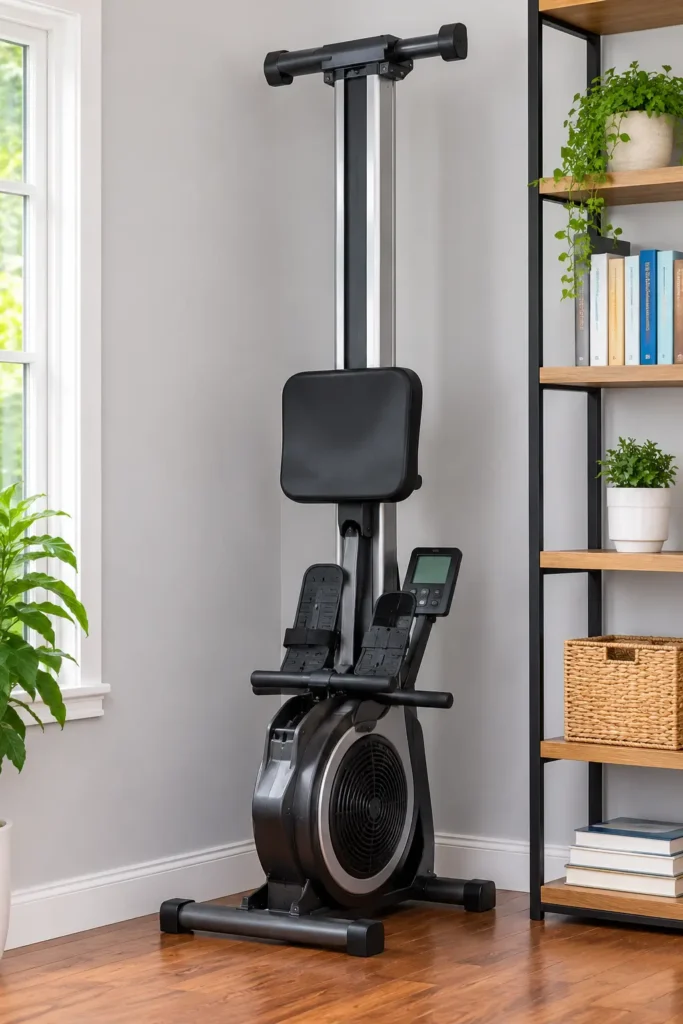
A rower works your legs, back, and arms in one smooth motion. It is low impact, which suits shared buildings. Many models, such as the Concept2 RowErg, are about 96 in (244 cm) long in use [VERIFY], but they separate and stand on end to store.
Read our Concept2 rower review for a closer look. It is the priciest item on this list, so add it only after the basics are in place.
Pros:
- Full-body, low-impact cardio
- Stores upright
- Strong build on well-known models [VERIFY]
Cons:
- High price
- Needs a long, clear floor space during use
- Some models make a whooshing sound
8. Under-Desk Elliptical or Pedal Exerciser
Who it’s for: Desk workers who want gentle daily movement.
These small machines tuck under a desk or couch. They add easy movement to long work days. They do not replace a hard cardio session, but they help you move more.
Compare options in our guide to the best under-desk ellipticals.
Pros:
- Nearly silent
- Adds low-effort daily activity
- Small footprint
Cons:
- Low intensity
- Cheaper models can slide or squeak
- Not a substitute for real conditioning
9. Mat and Floor Tiles
Who it’s for: Every apartment lifter. This is the least exciting item and one of the most useful.
A thick mat, or interlocking rubber tiles, protects the floor and softens sound. A common mat size is 72 by 24 inches (183 by 61 cm). For deadlifts and kettlebell work, tiles that cover roughly 48 by 48 inches (122 by 122 cm) give you a safe landing zone.
Pros:
- Protects floors and joints
- Cuts noise
- Gives you a clear workout zone
Cons:
- Cheap mats can slip
- Rubber tiles can smell at first
- Tiles add weight to carry
How to Choose Your Apartment Home Gym Equipment
Start with your space and your goals, not with a shopping cart. Use this checklist before you buy anything.
- Floor space: Measure a clear area. Aim for at least 72 by 96 inches (183 by 244 cm) for most exercises.
- Storage: Decide where each item will live. If it will not fit in a closet, under a bed, or on a shelf, think twice.
- Noise: Pick quiet gear first. Bands, mats, and rowers beat jump ropes and loose plates.
- Weight capacity: Check bench and pull-up bar limits against your body weight plus the load [VERIFY per product].
- Budget: Buy a few good pieces rather than many cheap ones.
- Warranty: Read the return and warranty terms. Adjustable gear has more moving parts.
- Lease rules: Check whether screws, anchors, or heavy items are allowed.
Coach’s Tip: Buy in this order: mat, bands, adjustable dumbbells, bench, then cardio. Use each piece for four weeks before adding another. You will learn what you actually need.
How We Picked These Items
These picks come from standard coaching principles, not lab testing. We did not run product tests for this guide. We looked for items that:
- Fit in a small space
- Train many muscle groups
- Work quietly in a shared building
- Let you add weight or difficulty over time
Specs and prices were kept general or marked [VERIFY] where we could not confirm them.
Keep Noise Down and Protect Your Floor
Your neighbors are part of your apartment home gym plan. A few habits help a lot.
- Lower the weights; never drop them. Control every rep on the way down.
- Train at reasonable hours. Avoid early mornings and late nights.
- Use a thick mat or tiles. They absorb sound and spread out the load.
- Choose low-impact moves. Swap jumping jacks for step-jacks or squat presses.
- Move heavy items near an outside wall or onto a lower floor, if you can.
Common Mistake: Doing jump squats and burpees on a bare floor in a second-story apartment. The thud travels down fast. Replace jumps with tempo squats, which are harder and almost silent.
Apartment Home Gym Layout Ideas
Small spaces call for simple plans. Here are three setups.
- Studio setup: Roll out the mat between the bed and the couch. Keep dumbbells on a low shelf, and tuck bands in a drawer.
- Closet gym: Use a corner of a walk-in closet for a bench and a rack of weights. Close the door when you are done.
- Living room corner: Place a mat, a kettlebell, and a rower standing upright. Cover the corner with a small bookshelf or screen if you like.
Sample 30-Minute Apartment Home Gym Workout
This full-body circuit uses only dumbbells, a mat, and bands. It is quiet and fits in a small space. Do 3 rounds and rest 60 seconds between exercises.
| Exercise | Sets | Reps | Rest |
|---|---|---|---|
| Goblet squat | 3 | 10–12 | 60 sec |
| Push-up (or incline push-up) | 3 | 8–12 | 60 sec |
| One-arm dumbbell row | 3 | 10 each side | 60 sec |
| Romanian deadlift | 3 | 10–12 | 60 sec |
| Dumbbell overhead press | 3 | 8–10 | 60 sec |
| Dead bug (core) | 3 | 8 each side | 45 sec |
Warm-up (5 minutes): Do 1 minute each of marching in place, arm circles, hip hinges, bodyweight squats, and cat-cow.
Tempo cue: Lower each rep for about 3 seconds, then lift smoothly. This keeps it quiet and builds control.
How to Do Each Exercise
- Goblet squat: Hold one dumbbell at your chest. Sit your hips back and down, keep your chest tall, and drive through your whole foot. You should feel it in your quads and glutes.
- Push-up: Keep your body in a straight line. Lower your chest to about a fist’s height from the floor. Press back up without sagging your hips.
- One-arm row: Place one hand and one knee on the bench or couch. Pull the dumbbell toward your hip and squeeze your shoulder blade back. If you want more back work, see our dumbbell-only back day.
- Romanian deadlift: Push your hips back with soft knees and a flat back. Lower the weights along your thighs until you feel a stretch in your hamstrings.
- Overhead press: Stack your wrists over your elbows. Press straight up without leaning back.
- Dead bug: Lie on your back with arms and knees up. Lower one arm and the opposite leg while keeping your lower back on the floor.
Easier and Harder Versions
| Exercise | Easier (Regression) | Harder (Progression) |
|---|---|---|
| Goblet squat | Bodyweight squat to a chair | Add a 3-second pause at the bottom |
| Push-up | Hands on a counter or couch | Feet raised on a chair |
| One-arm row | Use a band | Heavier dumbbell, slower lowering |
| Romanian deadlift | Lighter weights, shorter range | Single-leg version |
| Overhead press | Seated press | Alternate arms (press one at a time) |
| Dead bug | Move only the legs | Add a light dumbbell or band |
For leg variety, you can later add a dumbbell Bulgarian split squat. Check with a doctor or physical therapist first if you have knee, hip, or back pain.
Weekly Plan and Progression
A simple three-day plan works for most beginners. It matches the CDC’s guidance for at least two strength days per week.
| Day | Focus |
|---|---|
| Monday | Full-body circuit (above) |
| Wednesday | Low-impact cardio (rower, walking, or elliptical), 20–30 minutes |
| Friday | Full-body circuit with one progression |
| Weekend | Optional walk or mobility session |
Progressive overload simply means doing a little more over time. Add 1–2 reps per set, or move up a weight when you hit the top of your rep range with good form. Track each workout in a notebook so you can see your progress.
Setup and Maintenance Tips
A tidy gym is a gym you will use. These habits help your gear last.
- Wipe down equipment after each session with a mild cleaner. For rubber weights, follow our guide on how to clean rubber dumbbells.
- Check bands and straps for cracks, thin spots, or fraying before every workout.
- Tighten bolts on benches and racks once a month.
- Store weights low, on the floor or a bottom shelf, so they cannot fall.
- Keep a clear zone about 24 inches (61 cm) around you for safe movement.
Apartment Home Gym FAQ
How much space do you need for an apartment home gym?
Most routines need about 72 by 96 inches (183 by 244 cm) of open floor. That is roughly the size of a twin bed. A rower needs a longer strip while you use it, but it stores upright afterward.
What equipment do I need to start an apartment home gym?
Start with a mat, resistance bands, and one set of adjustable dumbbells. These cover squats, hinges, presses, rows, and core work. Add a bench, kettlebell, or pull-up bar later as your budget and space allow.
How can I work out in an apartment without bothering neighbors?
Use a thick mat, avoid jumping, and control every rep on the way down. Pick low-impact exercises like tempo squats and push-ups. Also, train at reasonable hours and never drop weights. These habits keep sound low in most buildings.
Are adjustable dumbbells worth it for apartments?
For most people, yes. One adjustable pair replaces many fixed pairs and saves floor space. The trade-offs are cost and slightly bulkier handles. If you only need light weights, fixed dumbbells or bands may be a cheaper fit.
Can I build muscle with an apartment home gym?
Yes. A meta-analysis on load and muscle growth found that lighter loads can build muscle similarly to heavy loads when sets are taken near failure. Therefore, dumbbells, bands, and bodyweight work can all help, especially with progressive overload.
How much does an apartment home gym cost?
It depends on your choices. A basic setup with a mat, bands, and one kettlebell can cost far less than adjustable dumbbells, a bench, and a rower. Start small and add pieces over time. Check current prices before buying [VERIFY].
Conclusion
An apartment home gym does not need much space or a big budget. A mat, bands, adjustable dumbbells, and a few smart extras can cover every major muscle group. Pick quiet gear, store it well, and add pieces one at a time.
Start with the 30-minute circuit above, three days a week. Add reps, then weight, and keep notes on your progress. With a plan like that, your small space can support steady, long-term gains.
