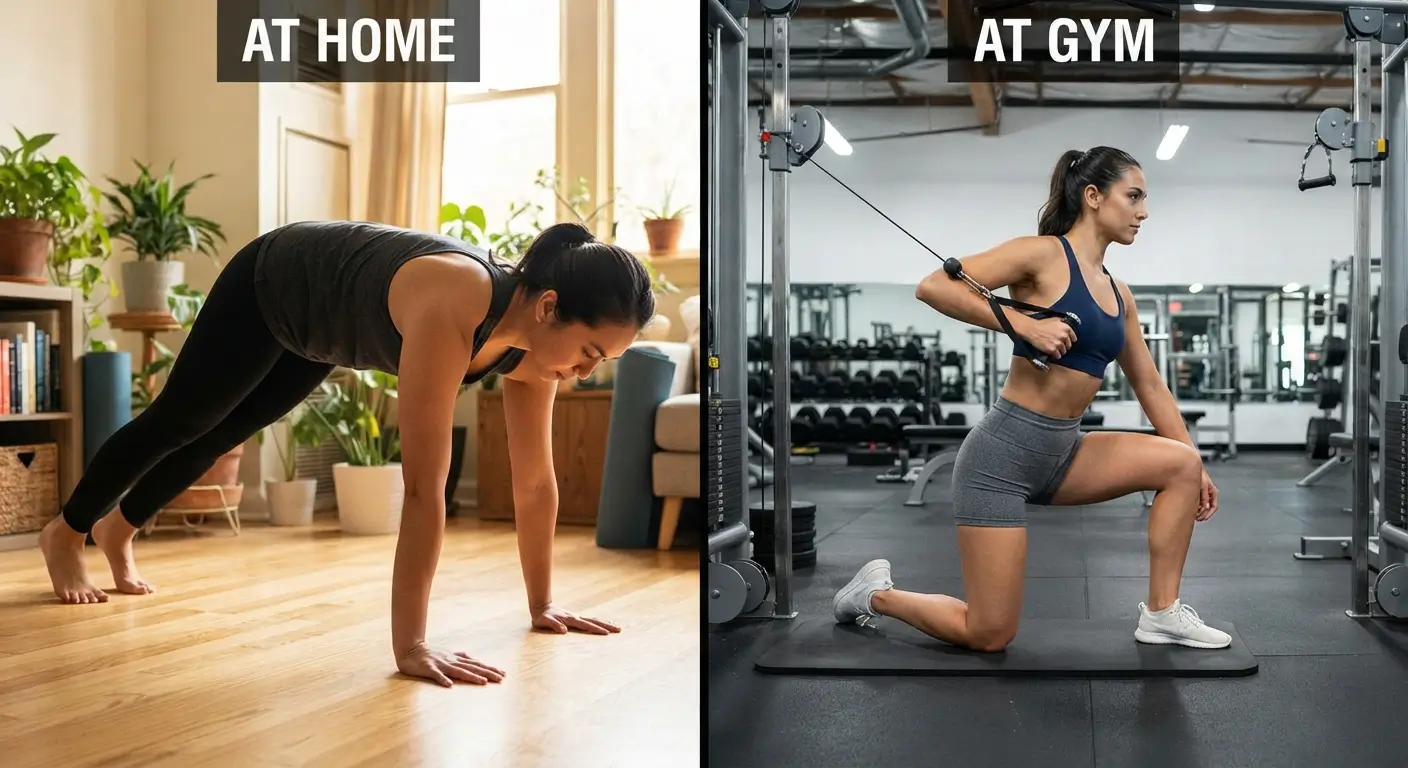
The Arnold press is a great shoulder builder, but it is not right for everyone. Maybe the rotation bothers your shoulders, you only own light dumbbells, or you train at a cable station and want the same deltoid burn. Therefore, this guide gives you practical Arnold press alternatives you can do with no equipment, with dumbbells, and with cables.
In addition, you will get form cues, sets, reps, rest times, easier and harder versions, and a full sample workout. Overall, every swap keeps the same goal: strong, stable, well-rounded shoulders.
Quick Answer: The best Arnold press alternatives are the pike push-up (no equipment), the seated or neutral-grip dumbbell shoulder press (dumbbell), and the single-arm cable shoulder press (cable). All three train the shoulders in a similar pressing pattern without the rotation. Start with the option that feels pain-free and lets you control every rep.
Why You Might Want an Arnold Press Alternative
The Arnold press starts with your palms facing you and rotates them forward as you press overhead. Because of that rotation, the move demands more coordination and can feel awkward with heavier dumbbells. If you are still deciding between the two lifts, read our breakdown of Arnold press vs shoulder press.
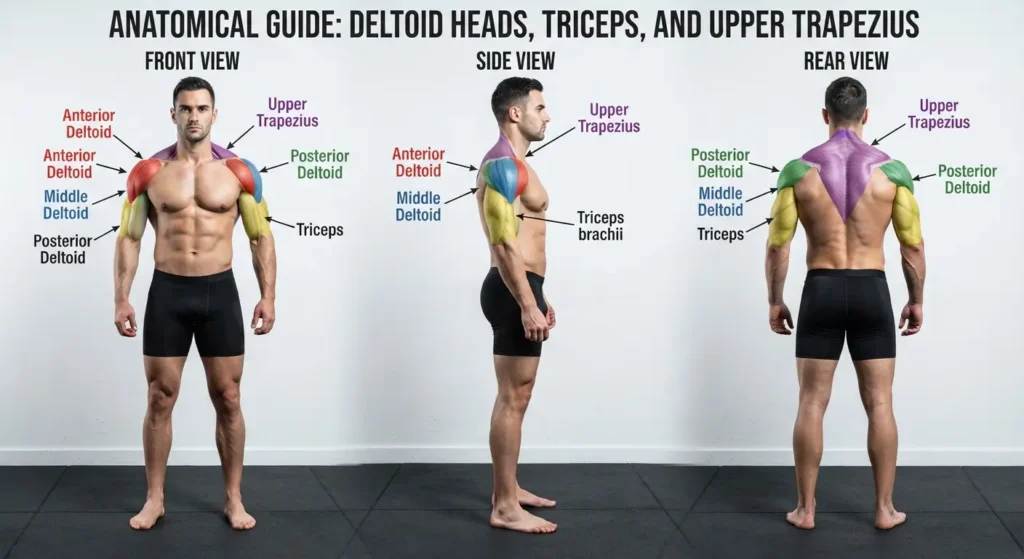
Common reasons to swap include shoulder discomfort during the twist, limited equipment, and a need for easier progression. Another reason is simple variety. Also, your deltoids have three heads, and one exercise cannot train them all equally.
In fact, a University of Wisconsin electromyography study of the deltoid found that the dumbbell shoulder press activated the anterior deltoid most. However, the middle and rear heads responded better to raises and rows, so the authors concluded that a variety of exercises is needed.
Muscles Worked by the Arnold Press and Its Alternatives
First, understanding what you are replacing makes it easier to choose a good swap. Specifically, the Arnold press mainly trains the front and side parts of your shoulder, with help from your arms and upper back.
Primary muscles
- Anterior deltoid (front of the shoulder)
- Lateral, or medial, deltoid (side of the shoulder)
Secondary muscles
- Triceps brachii (back of the upper arm)
- Upper trapezius and serratus anterior (shoulder blade movers)
- Rotator cuff muscles (small stabilizers that keep the joint centered)
- Upper chest, mostly at the start of the press
Therefore, a good Arnold press alternative should keep the deltoids and triceps working while letting you control the shoulder blade. Pressing movements also overlap with chest work, as explained in our guide on whether bench press works your shoulders.
Benefits of Overhead Pressing (and Why Alternatives Still Work)
For example, overhead pressing builds shoulder strength you use for lifting a box onto a shelf, loading a suitcase, or playing sports. It also trains your core to stay braced while your arms work above your head.
Adults should do muscle-strengthening activity on at least two days per week, according to the CDC’s adult activity guidelines. In addition, the same page suggests 8-12 repetitions per set, with one set as a minimum and two or three sets for added benefit.
Importantly, you do not need the Arnold press specifically. A meta-analysis in the Journal of Strength and Conditioning Research found that muscle growth can be similar across a wide range of loads, while heavier loads produced larger gains in maximal strength. As a result, any of these Arnold press alternatives can work if you train hard and progress over time.
How to Do the Arnold Press (The Baseline Movement)
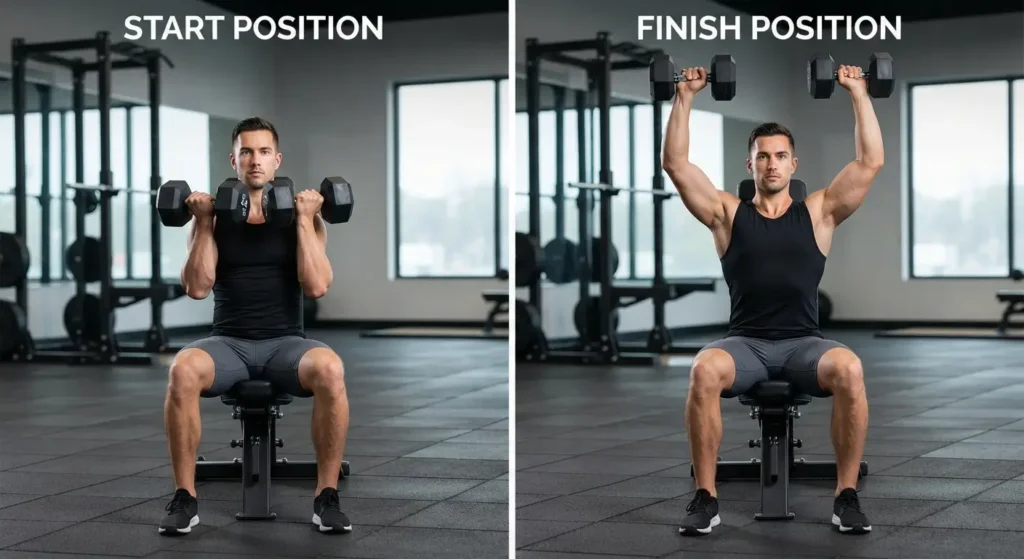
Before swapping, know the movement you are replacing, and use light dumbbells at first.
- First, sit on a bench with the back set to about 80-85 degrees, feet flat. Hold the dumbbells at chest height with palms facing you and elbows in front of your ribs.
- Next, brace your abs and keep your ribs down. Your lower back should stay in a natural position, not arched.
- Then press the dumbbells up while rotating your palms to face forward.
- As you reach the top, finish with your arms nearly straight, wrists stacked over elbows, and shoulders away from your ears.
- Afterward, reverse the rotation as you lower for about three seconds.
- Finally, pause briefly at the bottom without resting the weights on your shoulders.
Coach’s Tip: Think “open a door” as you rotate. Keep your elbows slightly in front of your body, not flared straight out to the sides. If the rotation feels sharp or pinchy, stop and switch to one of the Arnold press alternatives below.
Sets, Reps, and Weight by Goal
First, pick the row that matches your goal. Keep in mind that rest times are practical starting points, not strict rules.
| Goal | Sets | Reps | Rest | Effort |
|---|---|---|---|---|
| Strength | 3-5 | 4-6 | 2-3 min | Leave 1-2 reps in reserve |
| Muscle size | 3-4 | 8-12 | 60-90 sec | Leave 1-3 reps in reserve |
| Endurance | 2-3 | 15-20 | 45-60 sec | Stop 2-3 reps short of failure |
For weight, beginners often start with 8-15 lb (4-7 kg) per hand on a dumbbell press. Meanwhile, intermediate lifters commonly use 15-30 lb (7-14 kg) per hand. Many people need lighter dumbbells for the Arnold press than for a plain press, so do not copy your usual weight.
A network meta-analysis in Medicine & Science in Sports & Exercise found that muscle growth looked similar across low, moderate, and high loads when sets were taken near failure. Strength improved more with high and moderate loads than with low loads. Therefore, choose a load that lets you finish all reps with clean form.
Common Mistakes and How to Fix Them
Common Mistake: Leaning back and arching your lower back to push the weights up. This turns the press into a chest-and-back move and can irritate your spine. Instead, lower the weight, squeeze your glutes, and keep your ribs stacked over your hips.
- Flared elbows: Elbows pointed straight out make the press feel cramped. Instead, bring them slightly forward, in the scapular plane (about 30-45 degrees from straight out to the side).
- Shrugging: If your shoulders climb toward your ears, the upper traps take over. Instead, think “long neck” and press away from the ceiling.
- Rushing the rotation: Fast twisting uses momentum. Use a slow three-second lowering phase instead.
- Going too heavy: Heavy weights make the form fall apart, so choose a weight you can control for every rep.
- Skipping the warm-up: Cold shoulders feel stiff, so do arm circles, band pull-aparts, and two light sets first.
Arnold Press Alternatives With No Equipment
You do not need a gym to train your shoulders. These no-equipment Arnold press alternatives also work well in a small space. For a wider menu, browse our bodyweight exercises list.
1. Pike Push-Up: The Best No-Equipment Arnold Press Alternative
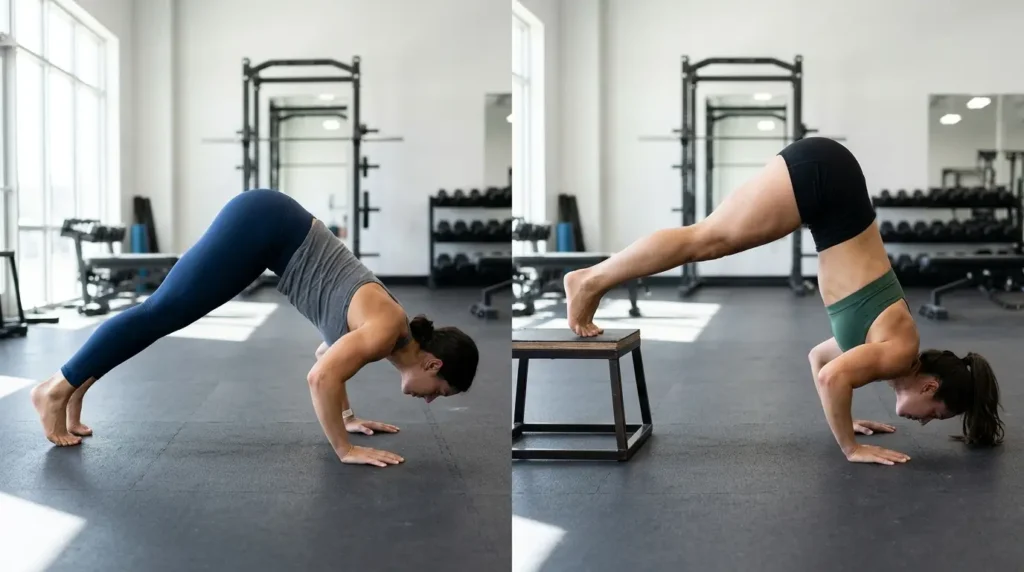
The pike push-up is the closest no-equipment match because it presses your body weight up and down in a vertical path.
How to do it:
- First, start in a downward-dog shape with hands shoulder-width apart and hips high.
- Next, walk your feet about 12-18 inches (30-45 cm) closer to your hands so your torso is more upright.
- Then bend your elbows and lower the top of your head toward the floor between your hands.
- Finally, press back up until your arms are straight.
Sets and reps: 3 sets of 6-12 reps; rest 60-90 seconds. For tempo, lower for three seconds and then press up in one second.
Easier: Place your hands on a bench or sturdy counter about 24-30 inches (60-75 cm) high and press in an incline.
Harder: Use the elevated-feet version below.
2. Elevated-Feet Pike Push-Up: A Harder Arnold Press Alternative
Put your feet on a step or couch cushion about 12-18 inches (30-45 cm) high. This shifts more body weight onto your arms, so the press feels heavier. Also, keep your hips high and your neck relaxed.
Sets and reps: 3 sets of 5-10 reps; rest 90 seconds.
Easier: Return to the floor-level pike.
Harder: Add a slower lowering phase or a pause at the bottom for one second.
3. Backpack Overhead Press: A Household Arnold Press Alternative
Load a backpack with books or water bottles and hold it with both hands in front of your chest. Then press it overhead like a barbell. Also, you can adjust the load by adding or removing items.
Sets and reps: 3 sets of 10-15 reps; rest 60 seconds. Start with about 8-12 lb (4-5 kg).
Easier: Use a lighter bag or a single water bottle in each hand.
Harder: Slow the lowering phase to four seconds.
Hand position also matters in bodyweight work. One Journal of Athletic Training study notes that hand position can change muscle activity during push-up variations. Therefore, keep your hand width consistent while you track progress, and use our 12-week calisthenics program if you want a longer plan.
Dumbbell Arnold Press Alternatives
These dumbbell Arnold press alternatives are the most direct replacement. In addition, they let each arm work on its own and are easy to load gradually. If you are still buying, compare adjustable vs. fixed dumbbells first.
1. Seated Dumbbell Shoulder Press: The Simplest Arnold Press Alternative
This is the simplest swap. First, sit with your back supported and hold the dumbbells at shoulder height with palms forward. Then press straight up.
Sets and reps: 3-4 sets of 8-12 reps; rest 60-90 seconds.
Easier: Use lighter dumbbells or a machine press.
Harder: Stand up to press, which adds stability demand.
A study of barbell and dumbbell presses in 15 men found that standing dumbbell pressing produced the highest deltoid muscle activity, even though it allowed the lowest maximal lift. In other words, a more demanding setup makes the shoulders work harder with lighter weights.
2. Neutral-Grip Dumbbell Press: A Shoulder-Friendly Arnold Press Alternative
Hold the dumbbells with palms facing each other, as if you were holding a pair of hammers. Then press up with your elbows slightly forward.
This grip often feels kinder on the shoulder joint because it avoids the twist. For that reason, it is a smart choice when the rotation of the Arnold press feels uncomfortable.
Sets and reps: 3 sets of 8-12 reps, rest 60-90 seconds.
Easier: Use a neutral-grip press with a slightly inclined bench (about 70 degrees).
Harder: Add a one-second pause at the bottom.
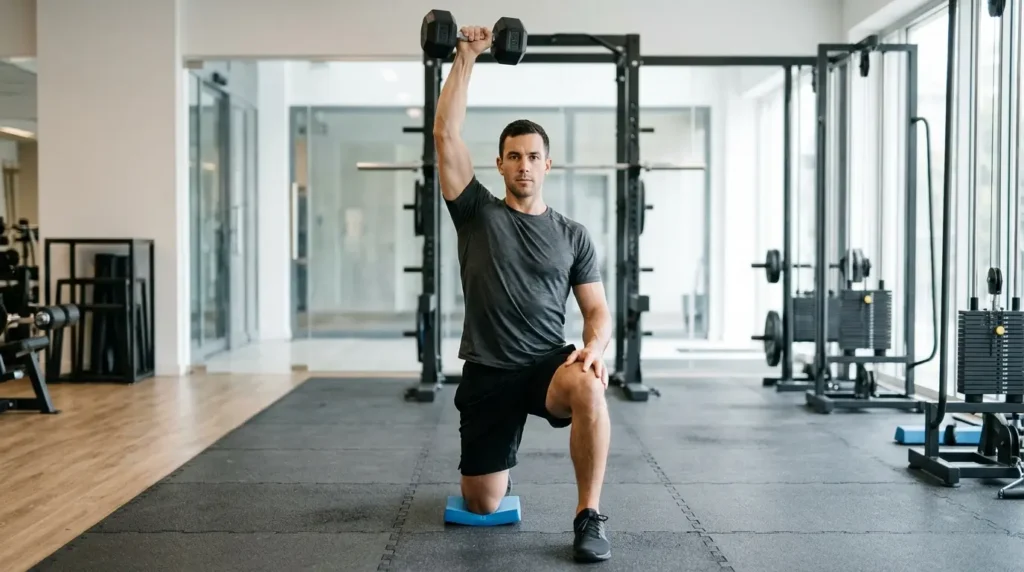
3. Half-Kneeling Single-Arm Dumbbell Press
Kneel on one knee with the opposite foot forward. Hold one dumbbell at shoulder height and press it overhead while squeezing the glute on the kneeling side.
This version trains your core and helps even out side-to-side differences, because most people find one arm is weaker.
Sets and reps: 3 sets of 8-10 reps per arm; rest 60 seconds.
Easier: Sit on a bench.
Harder: Use a heavier dumbbell or lower for four seconds.
4. Dumbbell Lateral Raise (Complementary Move)
Lateral raises are not a press, but they target the side deltoid directly. Raise your arms out to the sides to shoulder height with a soft bend at the elbow, then lower slowly.
Sets and reps: 3 sets of 12-15 reps with 5-10 lb (2-5 kg) per hand; rest 45-60 seconds.
Easier: Raise your arms only to hip height or use a band.
Harder: Pause for two seconds at the top.
In addition, add a rear-delt exercise. Our seated rear delt raise guide covers a simple setup.
Cable Arnold Press Alternatives
Cable Arnold press alternatives give smooth, steady tension from start to finish. They also let you change direction easily, which suits shoulders that dislike heavy dumbbells. If you are limited by dumbbell weight, a cable stack may help.
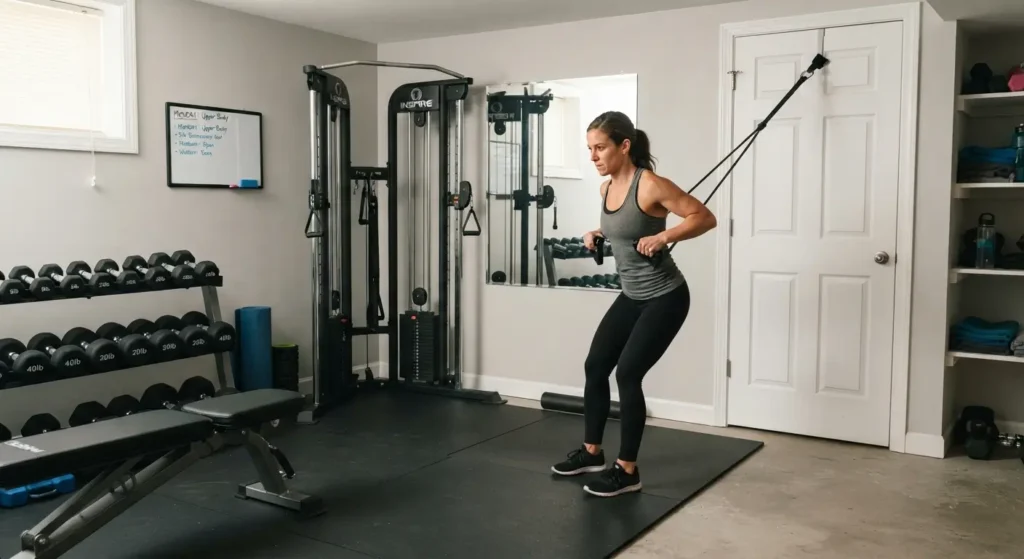
1. Single-Arm Standing Cable Press: A Smooth Arnold Press Alternative
Set the pulley low, about 6-12 inches (15-30 cm) off the floor. Hold the handle at shoulder height and step away until the cable is taut. Next, stagger your feet and press the handle straight up.
Sets and reps: 3 sets of 8-12 reps per arm; rest 60 seconds.
Easier: Use the half-kneeling position below.
Harder: Stand on one leg or use a heavier stack setting.
2. Half-Kneeling Cable Press
Kneel on the knee farthest from the cable stack. Keep your ribs down and press the handle diagonally up and slightly across your body. Because the kneeling position limits swaying, it also teaches you to brace.
Sets and reps: 3 sets of 10 reps per arm; rest 60 seconds.
Easier: Use a lighter plate on the stack and a short range.
Harder: Slow the lowering phase to four seconds.
3. Cable Face Pull
Face pulls strengthen the rear delts and upper back, which help balance all that pressing. Set the rope at forehead height, pull toward your face with elbows high, then separate the rope ends.
Sets and reps: 3 sets of 12-15 reps, rest 45-60 seconds.
Coach’s Tip: On any cable press, keep your wrist straight and your forearm stacked over the cable line. If the cable pulls your shoulder forward, move your feet a half step farther from the stack.
Machine and Band Arnold Press Alternatives
Machines and bands are useful when you want simple setups or less balance demand.
Machine shoulder press: The seat holds your back, and the handles guide the path. As a result, it is a good first step for beginners. Next, set the seat so the handles start around shoulder height and aim for 3 sets of 8-12 reps. Because the machine stabilizes the weight, expect deltoid muscle activity to be lower than with free weights, as shown in the standing-versus-seated findings above.
Resistance band overhead press: Stand on the middle of a band and press the handles overhead. Bands also travel well and cost little, which makes them handy Arnold press alternatives for travel. A systematic review in SAGE Open Medicine found that elastic resistance training can produce similar strength gains to conventional training. Conversely, an electromyography study in the European Journal of Sport Science found that conventional equipment, such as barbells and cables, produced higher prime-mover activation than bands in four multi-joint exercises. To make them harder, use thicker bands or double up.
Bands also suit people who need to set up quickly. See apartment workout equipment for compact gear ideas.
Progression Ladder for Arnold Press Alternatives: Easier to Harder
Use this ladder for any of the Arnold press alternatives above, and move up when you can finish every set with good form. However, if you are stuck on a step, stay there for another week.
| Level | No equipment | Dumbbell | Cable |
|---|---|---|---|
| Easiest | Incline pike push-up (hands on a bench) | Seated neutral-grip press, light | Half-kneeling press, short range |
| Medium | Floor-level pike push-up | Seated dumbbell shoulder press | Standing single-arm press |
| Harder | Elevated-feet pike push-up | Standing dumbbell press | Single-leg standing cable press |
| Hardest | Pause-rep pike push-ups | Half-kneeling single-arm press, heavy | Tempo cable press with 4-second lowering |
To progress, first add 1-2 reps per set, and then add weight. Once you hit the top of your rep range on every set, increase the load by about 5 lb (2 kg) per hand or one cable stack step.
Who Should Be Careful
Overhead pressing is safe for many people, but some should check with a doctor or physical therapist first. That includes anyone with shoulder pain, a past rotator cuff injury, recent surgery, or a medical condition that affects exercise.
According to the Cleveland Clinic, overhead motions that twist the shoulder with the arm raised can cause shoulder impingement. The clinic also notes that people should not ignore pain or difficulty moving the shoulder.
A range of motion tip may help. One small Journal of Strength and Conditioning Research study of the sitting military press found that a shorter range of motion reduced trapezius involvement without lowering medial deltoid activity, but only with heavy loads. That is not a reason to cut every rep short. Still, it shows that small setup changes can alter which muscles do the work.
Stop any exercise that causes sharp, pinching, or lingering shoulder pain. In addition, pain that does not settle should be checked by a professional.
Sample Shoulder Workout Using Arnold Press Alternatives
First, pick one option from each block. Then train shoulders twice a week with at least 48 hours between sessions. If you want to pair shoulders with legs, try our leg and shoulder workout.
Warm-up (5 minutes): Arm circles, band pull-aparts, scapular wall slides, and two light sets of the first exercise.
| Block | Gym version | Home version | Sets x Reps | Rest |
|---|---|---|---|---|
| 1. Main press | Seated neutral-grip dumbbell press | Pike push-up | 4 x 8-10 | 90 sec |
| 2. Second press | Half-kneeling cable press | Backpack overhead press | 3 x 10 per arm / 3 x 12 | 60 sec |
| 3. Side delts | Dumbbell lateral raise | Band lateral raise | 3 x 12-15 | 45-60 sec |
| 4. Rear delts and upper back | Cable face pull | Band pull-apart | 3 x 15 | 45 sec |
Cool-down (3-5 minutes): Cross-body shoulder stretch and doorway chest stretch, 30 seconds each side. Finally, keep stretches gentle.
Besides these Arnold press alternatives, you can also try these bench press alternatives for more pressing variety.
FAQ
What Can I Do Instead of the Arnold Press?
Good Arnold press alternatives include the seated dumbbell shoulder press, the neutral-grip dumbbell press, the single-arm cable press, and the pike push-up. Each uses a similar overhead pressing path without the twist. Therefore, pick the version that feels comfortable and lets you add weight or reps over time.
Is the Arnold Press Necessary for Big Shoulders?
No. Research suggests muscle growth can occur across a wide range of loads when sets are taken near failure. Therefore, a mix of presses, lateral raises, and rear-delt work can cover all three deltoid heads. Consistent training and gradual progression matter more than any single exercise.
What Is a Good Arnold Press Alternative Without Dumbbells?
The pike push-up is the best option. It uses your body weight and follows a vertical pressing path. Moreover, you can make it easier by raising your hands on a bench, or harder by elevating your feet. A loaded backpack press is another simple choice.
Can I Do the Arnold Press on a Cable Machine?
You can approximate it with a single-arm cable press and a gentle wrist turn, but cables do not copy the dumbbell path exactly. Instead, a half-kneeling cable press is usually easier to control. If the rotation bothers your shoulder, skip the twist and press in a straight line.
What Is the Best Arnold Press Alternative for Shoulder Discomfort?
A neutral-grip dumbbell press or a cable press in the scapular plane often feels more comfortable because there is no rotation. However, shoulder pain needs individual advice. See a doctor or physical therapist before training through pain. Then choose the pain-free option that you can control.
How Many Sets of Shoulder Presses Should I Do?
For most beginners, 3 to 4 sets of 8-12 reps, done two days per week, is a solid start. For example, the CDC suggests at least one set of 8-12 reps, with two or three sets offering extra benefit. Add sets gradually as you recover.
Conclusion: Choosing the Right Arnold Press Alternatives
The best Arnold press alternatives give you the same strong, controlled overhead pressing without the rotation. Use pike push-ups when you have no equipment, a neutral-grip or seated dumbbell press when you have weights, and a half-kneeling cable press when you have a cable stack. Add lateral raises and face pulls so every part of the shoulder gets attention.
Start light, move slowly, and progress one small step at a time. With steady training and good form, your shoulders will get stronger no matter which Arnold press alternative you choose.
This article is for general information and is not a substitute for advice from a doctor or physical therapist.
