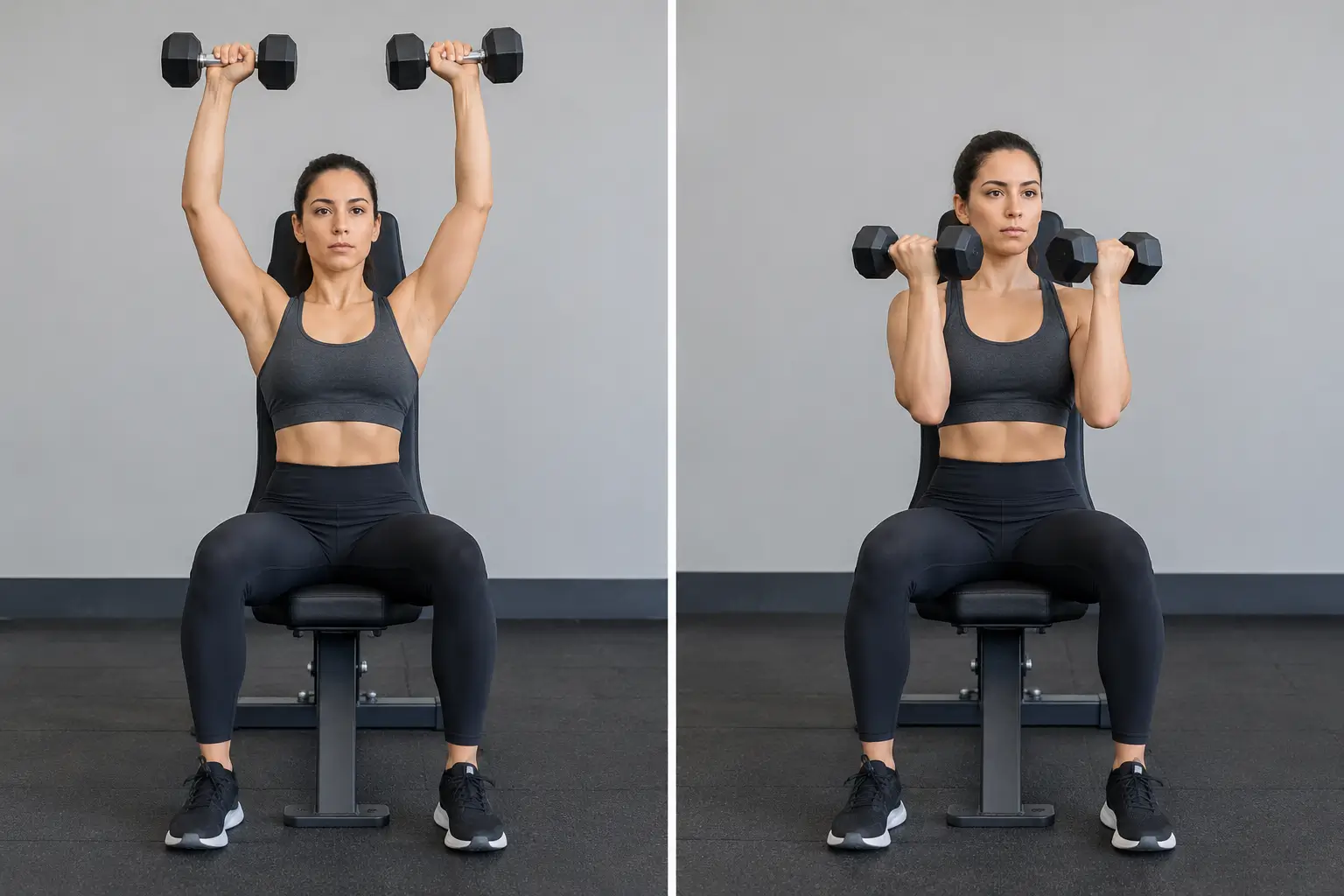
Arnold press vs shoulder press: Which is better? Both build strong shoulders, but they do different jobs. The standard shoulder press is simple and easy to load heavy. The Arnold press adds a rotation that changes how your shoulders work.
This guide compares the two side by side, so you can pick the right one for your goals. Along the way, you will get form steps, sets and reps, a cost comparison, and a sample workout. By the end, you will know which press should be your main lift and when the other one earns a spot.
Quick Answer
In the Arnold press vs shoulder press matchup, the standard press is the better main lift for most people because it is easier to learn and load. The Arnold press is a strong second choice that adds rotation and may boost front and side deltoid activity, based on one small study. Add it for variety.
Arnold Press vs Shoulder Press: Side-by-Side Comparison
Use this table for a quick snapshot. The details come in the sections below.
| Factor | Dumbbell shoulder press | Arnold press |
|---|---|---|
| Hand position | Palms forward or slightly angled | Palms start facing you, then rotate to face forward |
| Main muscles | Front and side deltoids, triceps | Front and side deltoids, triceps |
| Rotation | None | Yes, about 90 degrees |
| Typical load | Heavier | Lighter (often 20-30% less) |
| Learning curve | Easy | Moderate |
| Best role in a workout | Main lift | Second exercise or variety |
| Best for | Beginners, strength goals, tracking progress | Intermediate lifters, lighter-weight shoulder work |
| Main drawback | Fixed hand position can bother some shoulders | Rotation under load can be harder on irritated shoulders |
What Is the Standard Shoulder Press?
The standard dumbbell shoulder press is the classic overhead press. You start with the dumbbells at shoulder height, then press them overhead until your arms are almost straight. Because the movement is simple, it is easy to track and load over time.
It mainly trains the anterior (front) deltoid and lateral (side) deltoid, with the triceps finishing the lockout. Meanwhile, the upper trapezius and serratus anterior help move and stabilize your shoulder blades.
Form steps for the standard version
- Set up. Sit on a bench with back support, feet flat on the floor, and a dumbbell on each thigh.
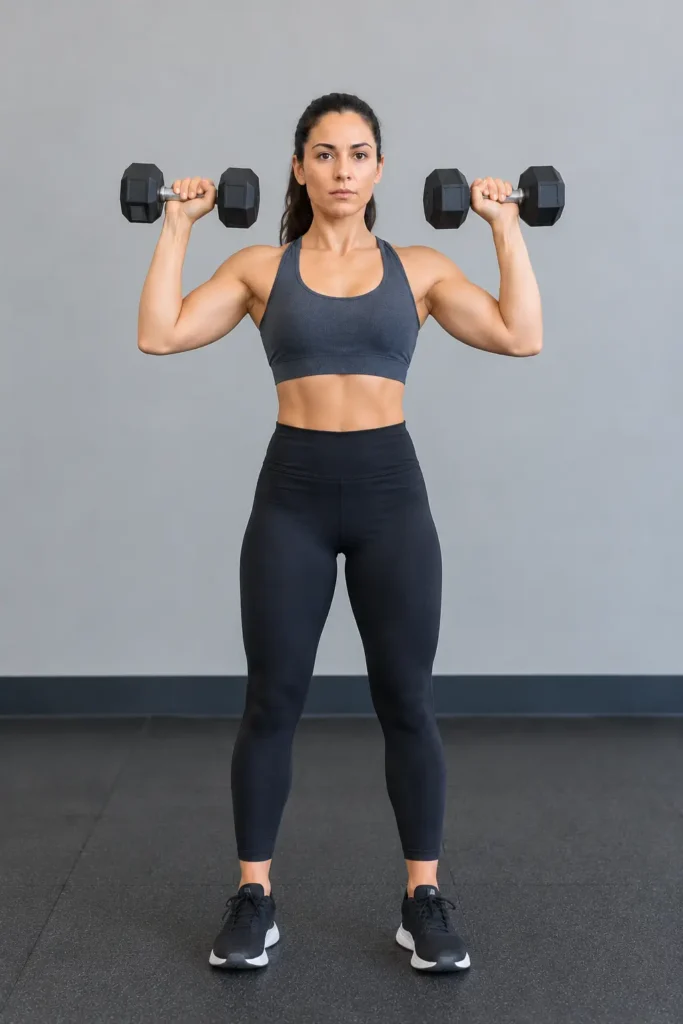
- Bring the weights up. Kick them to shoulder height one at a time, with elbows slightly in front of your torso.
- Brace. Next, take a breath, tighten your core, and keep your ribs down.
- Press up. Drive the dumbbells overhead in a slight arc until your arms are almost straight.
- Lower with control. Then take 2-3 seconds to bring the weights back to shoulder level.
- Repeat. Keep your wrists stacked over your elbows throughout.
The movement should feel like tension across the front and top of your shoulders, with your triceps working near the top. It should not feel like a pinch at the top of your shoulder.
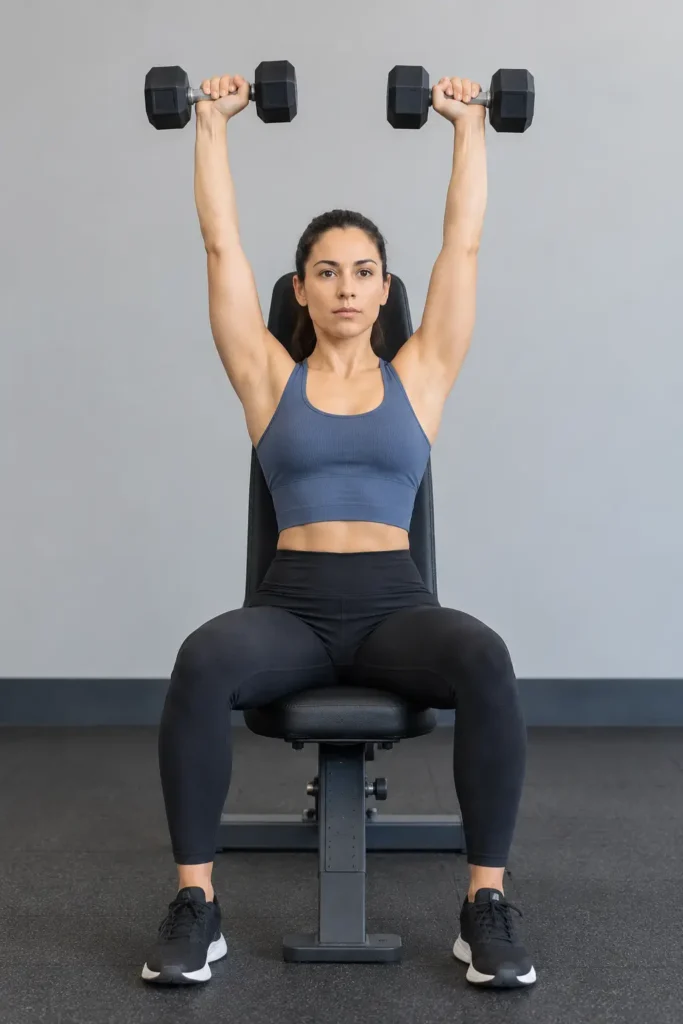
Starting weight (coaching guideline): Many beginners do well with 8-15 lb (3.6-6.8 kg) per hand for women and 15-30 lb (6.8-13.6 kg) per hand for men. Choose a weight that lets you finish 8-12 reps with 1-3 reps left in reserve.
Easier version (regression): Use a lighter pair, press with a neutral grip (palms facing each other), or try a single-arm press.
Harder version (progression): Press standing, slow the lowering phase to 3-4 seconds, or move up to a barbell.
What Is the Arnold Press?
The Arnold press is a dumbbell press with a built-in twist. It is named after Arnold Schwarzenegger, and it starts with your palms facing you. As you press up, you rotate your hands so your palms face forward at the top.
Because the rotation lengthens the path of the dumbbells, the movement feels smoother but more demanding. It trains the same main muscles as the standard press, yet the load is lighter, and the control demands are higher.
Form steps for the rotation version
- Start position. Sit on a bench with back support. Hold the dumbbells in front of your chest with palms facing you and elbows pointing down.
- Begin the press. Next, start lifting the dumbbells while your elbows swing out to the sides.
- Rotate. As the weights pass your face, turn your palms outward.
- Finish overhead. At the top, your palms face forward, and your arms are almost straight.
- Reverse the motion. Then lower slowly while rotating your palms back toward you.
- Keep it smooth. Move through the rotation without jerking.
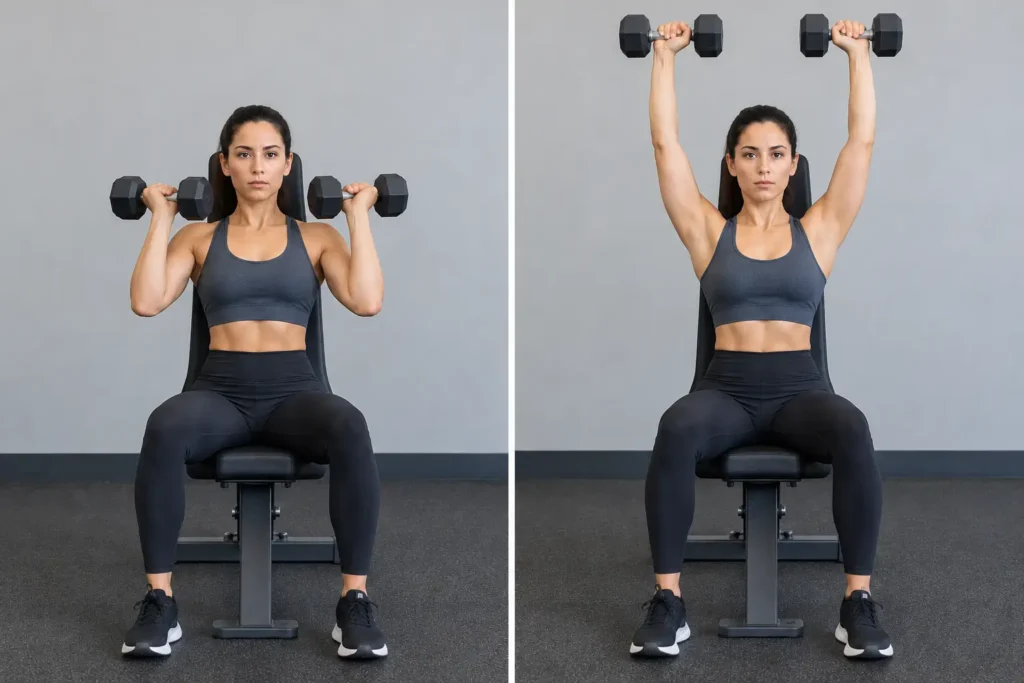
Coach’s Tip: Make the rotation slow and even. If you speed through the twist, momentum takes over and your shoulders do less of the work.
Starting weight (coaching guideline): Use roughly 20-30% less than your standard press weight. For example, if you press 25 lb (11.3 kg) per hand, start the Arnold press with 15-20 lb (6.8-9.1 kg).
Easier version (regression): Skip the rotation and start with a neutral grip, then add a small turn as the movement feels comfortable.
Harder version (progression): Pause for one second at the bottom, slow each rep to 4 seconds, or perform the movement standing.
Common Mistake: Going too heavy too soon. Many lifters grab their regular shoulder press dumbbells for Arnold presses. As a result, the rotation turns sloppy, and the elbows flare or the lower back arches. Fix: Drop the weight by about a quarter, and make every rep slow and clean.
Key Differences: Arnold Press vs Shoulder Press
Muscles worked and what the research says
In the Arnold press vs shoulder press comparison, both train the front and side deltoids. However, research comparing them directly is very limited. The best-known comparison is a small EMG study of ten healthy young men, which found that the Arnold press produced higher electrical activity in the anterior and medial deltoid than the overhead dumbbell press. Front deltoid activity was higher than side deltoid activity in both exercises.
That result is interesting, but it has limits. The study was small, tested only five reps per exercise, and measured electrical activity rather than muscle growth. Therefore, it is a reason to try the Arnold press, not proof that it builds bigger shoulders. [VERIFY: confirm journal details and indexing before publishing]
It also matters that neither press hits the rear deltoid much. For that reason, pair your presses with a rear delt move such as the seated bent-over rear delt raise.
Range of motion and rotation
The Arnold press moves your hands through a larger path. Naturally, that makes many lifters think it must build more muscle. Yet the research is not that detailed.
A systematic review of range of motion and muscle growth found a benefit for full range of motion in the lower body, while evidence for the upper limbs was limited and conflicting. So a longer path does not guarantee better shoulder growth. In practice, the best range is the one you can control with good form.
Strength and loading
The standard shoulder press wins for heavy loading. Because your hands stay in one position, you can add weight in small, steady steps. Moreover, tracking progress is easy: more weight or more reps means you improved.
Seated versus standing also matters. In a study of 15 healthy men, the standing dumbbell press max was about 10% lower than the seated dumbbell press max. The same research group found that standing and one-arm presses increased core muscle activity compared with seated versions. In other words, sitting helps you lift more, while standing asks more from your trunk.
For progression, the ACSM position stand recommends starting novices around 8-12 repetitions and raising the load by about 2-10% once you can beat your target reps by one or two. That approach fits the standard press well. It also works for the Arnold press, though the weight jumps should be smaller.
Joint safety and mobility
Overhead pressing of any kind can bother a sensitive shoulder. According to the Cleveland Clinic, shoulder impingement is painful pinching inside the shoulder, and it is almost always an overuse injury.
Because the Arnold press adds rotation under load, it may feel worse than a neutral-grip press if your shoulder is already irritated. On the other hand, some lifters find it more comfortable because the rotation lets the shoulder move naturally. Either way, pain is your signal to stop. Check with a doctor or physical therapist if pain persists.
If you also struggle with a hunched posture, our guide to rounded shoulders and posture correctors may help you decide whether a corrector is worth trying alongside your training.
Difficulty and learning curve
The standard version takes about one session to learn. The rotation version needs a few sessions because the twist, elbow path, and tempo must all line up. As a result, beginners usually do better starting with the simpler press.
When to Choose the Shoulder Press
Pick the standard shoulder press if any of these fit you:
- New to lifting. It is simple and easy to learn.
- Chasing strength. Heavier loads and easy tracking make progress clear.
- Training at home with limited time. One exercise gives you a lot of value.
- Needing a main lift. Its steady loading pattern makes it easy to build workouts around.
It also leaves room for variations. For example, you can switch between seated, standing, neutral-grip, and barbell versions as your shoulders adapt. If you plan to move to a barbell, compare an Olympic versus standard barbell first.
When to Choose the Arnold Press
Choose the Arnold press when these points sound like you:
- A base of pressing strength. Because it is more technical, it suits lifters with a few weeks of consistent training.
- A need for variety. A new movement can keep training fresh without adding heavy loads.
- A preference for lighter weights. It works well with lighter dumbbells, which can suit lifters who want less joint load.
- A liking for smooth, long movements. Many lifters find the rotation more natural than a fixed grip.
Of course, it is not a replacement for the standard press. Instead, think of it as a useful second option.
Cost Comparison: Which Costs More?
In the Arnold press vs shoulder press cost comparison, the money side is simple because both use the same equipment. You need a pair of dumbbells and, ideally, a bench with back support. The Arnold press needs lighter weights, so a smaller dumbbell range usually covers it.
| Cost factor | Shoulder press | Arnold press |
|---|---|---|
| Equipment | Dumbbells and bench | Dumbbells and bench |
| Weight range needed | Wider (heavier) | Narrower (lighter) |
| Extra gear | None required | None required |
| Time to learn | Short | Longer |
| Gym access needed | No | No |
If you are building a home setup, compare hex or round dumbbells before you buy. Adjustable dumbbells can cover both presses with one purchase. For small spaces, our list of apartment workout equipment can help. Current prices vary by brand and region, so check them yourself. [VERIFY: add price ranges only after checking current retail listings]
How to Combine Both in One Workout
You do not have to pick a winner in the Arnold press vs shoulder press debate. In fact, many lifters get the best of both by using the standard press as the main lift and the Arnold press as a lighter follow-up.
Sample workout
| Exercise | Sets | Reps | Rest |
|---|---|---|---|
| Seated dumbbell shoulder press | 3 | 6-10 | 90-120 sec |
| Seated Arnold press | 2-3 | 10-12 | 60-90 sec |
| Lateral raise | 3 | 12-15 | 60 sec |
| Seated bent-over rear delt raise | 3 | 12-15 | 60 sec |
| Dumbbell shrug | 2 | 10-15 | 60 sec |
For more shoulder ideas, see our leg and shoulder workout and our comparison of dumbbell versus barbell shrugs. If you have no equipment, the calisthenics exercises list includes pressing options for home.
How often to train
The CDC recommends muscle-strengthening activity on at least two days a week for all major muscle groups. In addition, a 2016 meta-analysis suggests training each major muscle group at least twice a week may support muscle growth. For shoulders, that could mean one heavier day with the standard press and one lighter day featuring Arnold presses.
A simple progression plan
- Weeks 1-2: Perform 3 sets of 10 reps with a light weight. Focus on clean form.
- Weeks 3-4: Add one rep per set, aiming for 12 reps.
- Week 5: Once you hit 12 reps on every set, add 2.5-5 lb (1.1-2.3 kg) per hand and drop back to 8-10 reps.
- Repeat. Rest on the days between shoulder sessions.
Warm up before pressing. Start with arm circles, band pull-aparts, and one or two light sets of 12-15 reps.
FAQ: Your Top Questions
Is the Arnold press better than the shoulder press?
Not necessarily. One small EMG study found higher front and side deltoid activity with the Arnold press, but that does not prove better growth. The standard shoulder press is easier to load and track, so most lifters should treat it as the main lift and use the Arnold press as a variation.
Can beginners try the rotation version?
Yes, with light weights and patience. However, the rotation takes practice, so many beginners learn the standard press first. Once you can press with steady form for a few weeks, try Arnold presses with a weight about 20-30% lighter than your usual press.
Is the Arnold press safe for your shoulders?
It can be, if you use light weights and control the rotation. Still, any overhead press may irritate a sensitive shoulder. If you feel pinching or sharp pain, stop and check with a doctor or physical therapist. The Cleveland Clinic notes that impingement is typically an overuse problem.
How much weight should I use?
For Arnold presses, start with about 20-30% less than your standard dumbbell press. For example, if you press 25 lb (11.3 kg) per hand, try 15-20 lb (6.8-9.1 kg). Choose a weight that lets you finish 10-12 slow, controlled reps with a couple in reserve.
Should I sit or stand?
Seated is best for most people because the back support helps you focus on pressing. Standing demands more from your core and balance, and research shows standing presses lower your max load. Begin seated, then try standing once your form is steady.
Do either of these hit the rear delts?
Only a little. Both presses mainly train the front and side deltoids, with the triceps helping. For balanced shoulders, add a rear delt exercise such as a bent-over raise or a band pull-apart on the same day.
Conclusion: Arnold Press vs Shoulder Press, Which Is Better?
So, in the Arnold press vs shoulder press debate, which is better? For most lifters, the standard shoulder press is the better main exercise because it is simple, easy to load, and easy to track. The Arnold press is a smart add-on that brings variety and a different feel, and one small study suggests it may boost front and side deltoid activity.
Therefore, start with the standard press as your base. After a few weeks of steady training, add 2-3 sets of Arnold presses with lighter dumbbells. In the end, the best press is the one you can perform with clean form, without pain, week after week.
Check with a doctor or physical therapist before starting if you have shoulder pain, an injury, or a medical condition.
