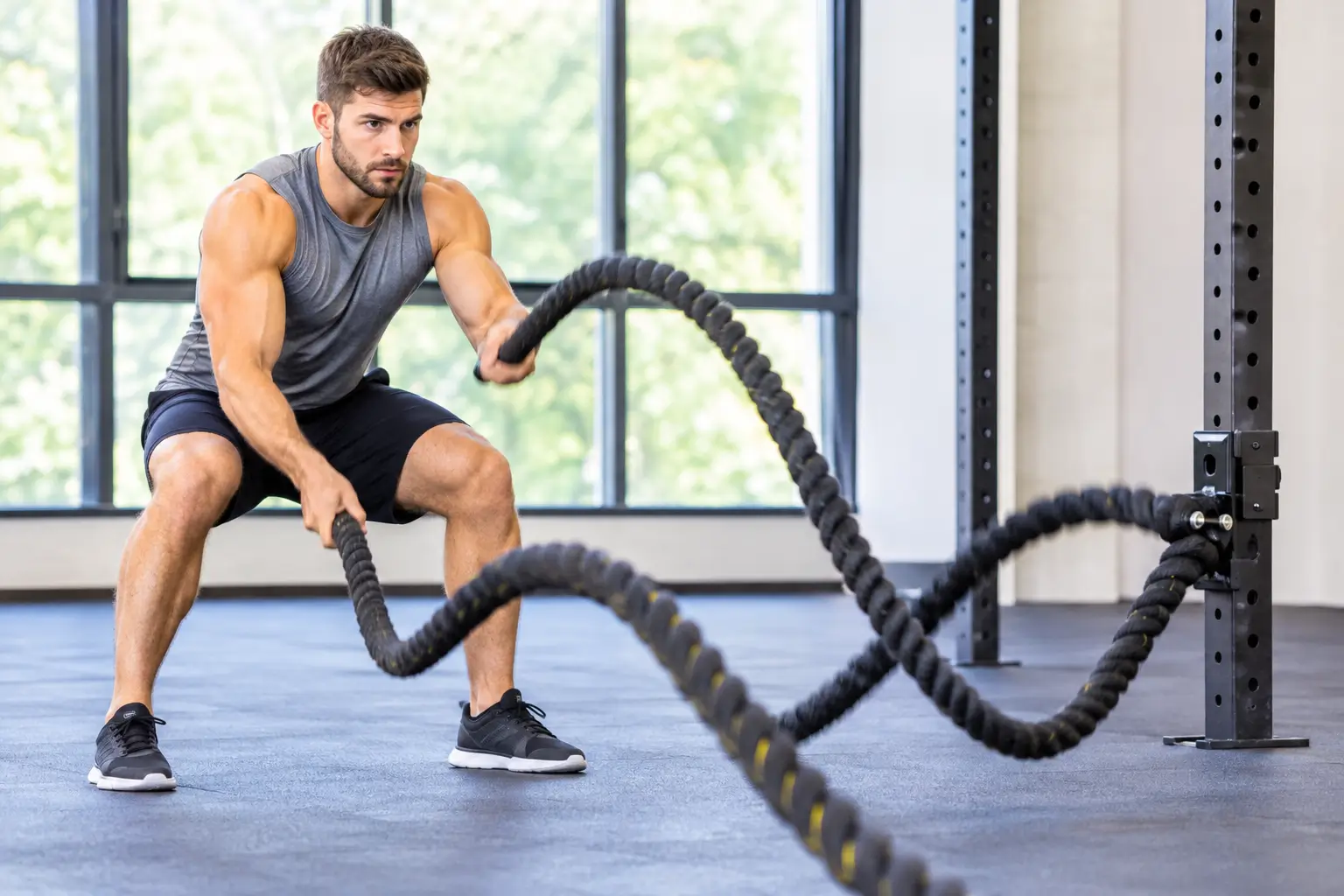
Battle ropes look intense, and they are. You grab two heavy ropes, whip them into waves, and your heart rate climbs within seconds. But do the battle rope benefits match the hype?
This guide covers battle rope benefits: what it actually does, based on lab studies and practical coaching. You will learn what research says about heart health, muscle, and calories. You will also see where ropes fall short. Finally, you will get form cues, sample workouts, and easier and harder options.
Quick Answer: Battle rope benefits include a high heart rate, strong upper-body and core muscle activity, and a high calorie burn in short, low-impact intervals. Studies suggest ropes raise cardio fitness and upper-body power. They do not build maximal strength like heavy lifting, and fat-loss evidence is limited. Use them 1–3 times weekly as conditioning.
Battle Rope Benefits for Your Heart: What It Actually Does for Cardio Fitness
Ropes are best known as a cardio tool, so start there. In a 10-minute rope study, participants did 15 seconds of waves followed by 45 seconds of rest, ten times. Their average heart rate was 163 beats per minute, and peak effort reached about 10 METs. The authors described it as vigorous-intensity work that meets thresholds known to improve cardiorespiratory fitness.
An ACE-sponsored study found a similar pattern with a seven-exercise interval circuit. Participants averaged 148 beats per minute, about 79% of their maximum heart rate, and worked at roughly 51% of their VO2 max. The researchers classified the session as vigorous. Double-arm power slams were the hardest move in the circuit.
Oxygen use tells the same story. A study that compared three training styles found that battle rope and burpee protocols produced the highest oxygen consumption of the protocols tested. In other words, ropes can match many classic conditioning drills.
Acute numbers are useful, but training results matter more. In an eight-week randomized trial of collegiate basketball players, the rope group improved aerobic capacity by 17.6%, compared with 12.0% in the comparison group. Because these athletes were young and active, beginners may see different results.
For context, the CDC lists 75 minutes of vigorous activity per week as one way adults can meet aerobic guidelines. A good rule is the talk test: if you can say only a few words between breaths, you are in the vigorous zone.
Battle Rope Benefits for Muscle: What It Actually Does for Strength and Power
Next, consider the muscles. A muscle-activity study recorded 21 volunteers doing alternating and double waves. The anterior deltoid, external obliques, and lower-back muscles worked at about 51–73% of maximum voluntary contraction. That is moderate to high effort for your shoulders and trunk.
The two wave styles also differed slightly. Alternating waves produced more oblique activity, while double waves produced more lower-back activity. Therefore, mixing both styles gives your core a fuller workout.
Lower-body numbers were different. The gluteus medius worked at only 14–18% of maximum during these waves. As a result, ropes should not replace squats or hip hinges when you want strong legs.
Power may improve too. In the basketball trial, the rope group raised upper-body mean power by 7.3% and chest-pass speed by 4.8%. However, that study used trained athletes and a structured eight-week plan, so treat the percentages as examples, not promises.
Now the limits. Ropes make it hard to add load in small steps. You cannot easily add 5 lb (2.3 kg) the way you can on a barbell, so maximal strength usually grows better with heavy lifting. From a coaching view, ropes work best as conditioning that complements your lifts.
Here is what the movement should feel like: first a burn in the shoulders and forearms, then a deep effort in your abs and breathing. If you feel it mostly in your lower back, shorten the interval and fix your stance.
Battle Rope Benefits for Calories and Fat Loss: What the Evidence Shows
Calorie burn is where marketing gets loud, so stay realistic. In the 10-minute rope study, the estimated energy cost of the session, including recovery oxygen use, was about 467 kilojoules, or roughly 112 calories. Keep in mind that this was a small group of active adults, and your number will vary with body size and effort.
That is a decent return for 10 minutes. However, calories burned do not automatically equal fat lost. A five-week trial of kettlebell and battle rope intervals in 13 college students found no significant change in body composition. The sample was small and the period short, so more research is needed.
Therefore, treat ropes as one tool inside a larger plan that includes strength training, regular movement, sleep, and food habits. To compare another cardio option, see our guide on whether treadmills burn belly fat. Anyone starting a weight loss program should talk with a doctor first.
Seated and Low-Impact Battle Rope Benefits
Battle ropes need no jumping, so they may suit people who want cardio without landing impact. A 2018 study compared standing and seated rope work with treadmill or cycle tests. The authors suggested ropes may be a low-cost way to build cardio endurance for people who cannot move their legs rhythmically for aerobic exercise.
If you have shoulder, back, or joint problems, ask a doctor or physical therapist before you start.
Battle Rope Benefits at a Glance: Evidence Scorecard
| Benefit | What studies found | Evidence strength |
|---|---|---|
| Cardio fitness | Vigorous heart rates in short intervals; aerobic capacity rose in an eight-week trial of athletes (source) | Moderate, small studies |
| Shoulder and core work | About 51–73% of maximum muscle activity (source) | Moderate |
| Upper-body power | 7.3% higher mean power in basketball players (source) | Limited, one trial |
| Glute and leg work | Low glute activity, 14–18% of maximum (source) | Limited |
| Fat loss | No significant body-composition change in five weeks (source) | Limited |
| Seated option | Seated and standing rope work tested (source) | Limited |
Overall, ropes are a strong conditioning tool. Beyond that, the proven claims get thinner.
How to Do Battle Rope Waves: Step-by-Step Form
Good form makes ropes safer and more effective. Most gym ropes are 30–50 ft (9–15 m) long and 1.5–2 in (3.8–5 cm) thick [VERIFY]. A thinner, shorter rope is easier to grip and control. If you train at home, check your space first, and see our guide to apartment workout equipment for ideas on fitting gear into small rooms.
- Anchor the rope. Loop the center of the rope around a sturdy post, rack, or rated anchor strap. Test it with a firm pull before you start.
- Set your distance. Stand 10–15 ft (3–4.5 m) from the anchor. More slack makes waves easier, while less slack makes them harder.
- Build your stance. Place your feet shoulder-width apart, sink into a quarter squat, and brace your core. Keep your chest up and your back flat.
- Grip the ends. Use an overhand grip with your thumbs wrapped and your elbows slightly bent.
- Make alternating waves. Raise one hand to about chest height, snap it down, and switch. Keep a steady rhythm, and let small hip dips drive the movement.
- Check the wave. Aim for waves that travel all the way to the anchor. Breathe steadily, and stop the set when your form slips.
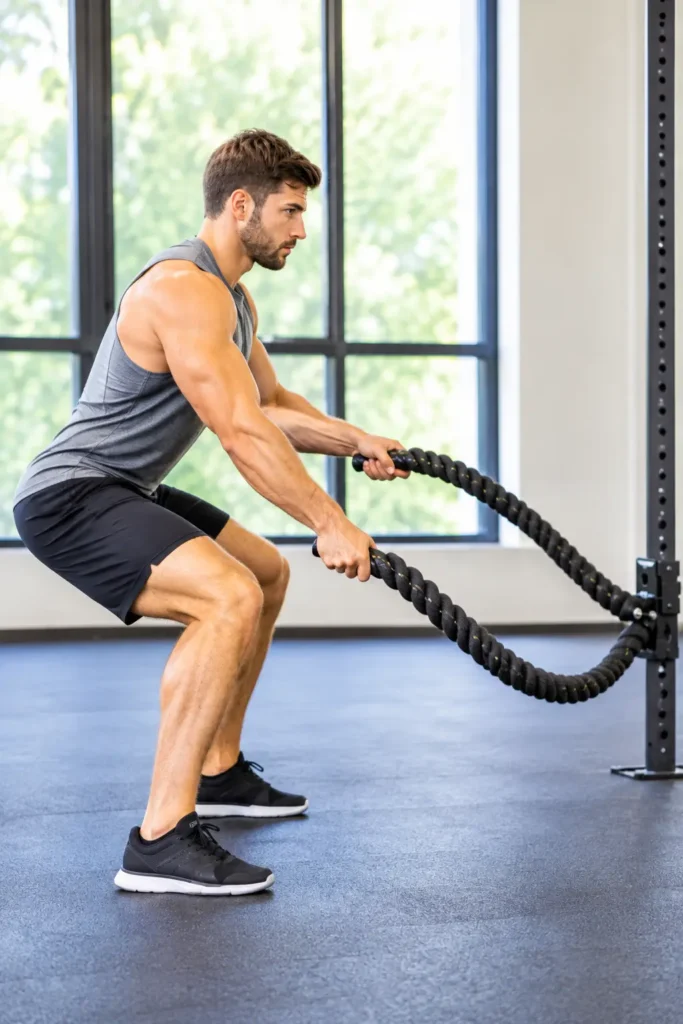
Coach’s Tip: Think hips and knees first, arms second. Small, rhythmic dips from your hips and knees drive the waves, so your shoulders do not carry the whole load. This also helps you last longer in each interval.
Common Mistake: Standing tall with locked knees, rounding your back, and using only your arms. Fix it: Sink into a quarter squat, keep your ribs down, and shorten the interval until every wave looks the same.
Rope weight matters too. Heavier ropes make every wave harder, so choose a lighter rope first and check the manufacturer’s listed weight [VERIFY].
Battle Rope Exercises: Easier and Harder Versions
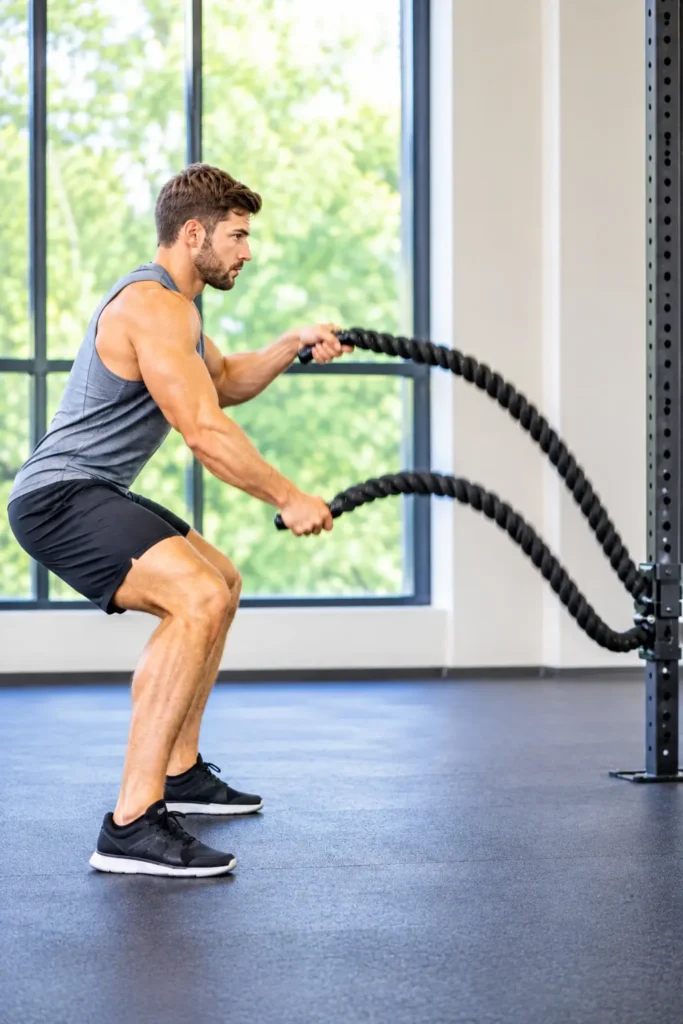
The moves below match the styles used in research. Start with the easier version, then step up when you can finish every interval with steady form.
| Exercise | Easier version | Harder version |
|---|---|---|
| Alternating waves | 10–15 sec with extra slack | 30–40 sec with less slack, or in a deeper squat |
| Double waves | 10–15 sec, small waves | 30 sec, big waves with a squat on every wave |
| Power slams | 8–10 slams, half height | 15–20 slams from overhead, with a hip hinge |
| Outward circles | 10 sec, small circles | 20–30 sec, large circles |
| In-and-out waves | 10 sec, slow tempo | 20–30 sec, fast tempo with a lunge stance |
| Seated waves | 10 sec on a bench, small waves | 20–30 sec on a bench, big waves |
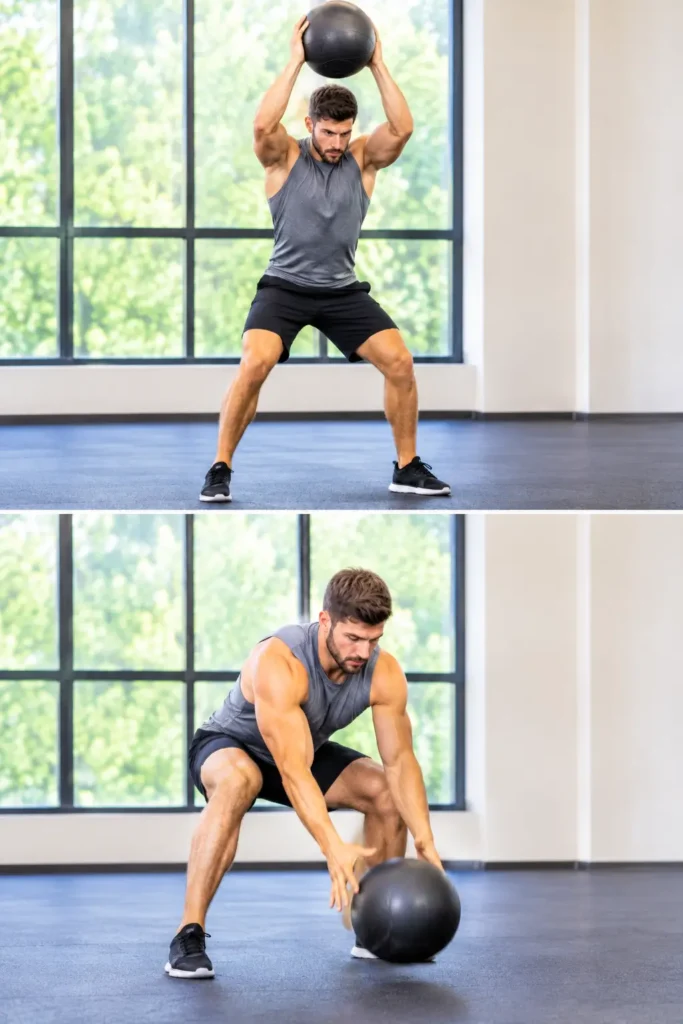
Use the table below to set your intervals by goal. Rest long enough that you can repeat the same quality each round.
| Goal | Work | Rest | Rounds |
|---|---|---|---|
| Cardio conditioning | 15–30 sec | 30–60 sec | 6–10 |
| Power | 5–10 sec all-out | 60–90 sec | 6–8 |
| Muscular endurance | 30–45 sec | 30 sec | 4–6 |
Sample Battle Rope Workouts by Level
Start every session with five minutes of marching, arm circles, and bodyweight hip hinges. Then do two practice rounds of 10-second waves. Afterward, cool down with a five-minute walk and gentle shoulder stretches.
| Level | Format | Moves | Total time |
|---|---|---|---|
| Beginner | 15 sec work, 45 sec rest, 10 rounds | Alternating waves only | 10 min |
| Intermediate | 20 sec work, 40 sec rest, 2 rounds | Alternating waves, double waves, power slams, outward circles, in-and-out waves, squat waves | 12 min |
| Advanced | 30 sec work, 30 sec rest, 3 rounds, 90 sec rest between rounds | Power slams, alternating waves, double waves, outward circles, in-and-out waves | About 18 min |
The beginner format matches the 10-minute rope study described earlier. For the week, beginners can train one or two days, intermediates two days, and advanced lifters up to three days. Always leave a rest day between hard rope sessions.

Safety: Who Should Be Careful With Battle Ropes
Ropes are simple, but they are demanding. Shoulders, wrists, and the lower back take most of the stress. Therefore, build up slowly.
- Start with short intervals and long rests.
- Keep a flat back and a braced core, and stay clear of walls and people by at least 6 ft (1.8 m).
- Stop if you feel sharp pain in your shoulders, elbows, wrists, or back.
- Check your anchor every session for wear.
Some lifters like elbow sleeves for lifting for warmth and comfort, although sleeves do not fix poor form. Talk with a doctor or physical therapist before you start if you have a heart condition, high blood pressure, shoulder or back pain, a past injury, or are pregnant or postpartum. Older adults with health conditions should also get clearance first.
Tips to Get More From Battle Ropes
First, pair ropes with strength training. The CDC advises muscle-strengthening activity on at least two days a week, so use ropes as a conditioning finisher. For shoulder balance, add pulling work such as seated bent-over rear delt raises. Bodyweight options also fit well; browse our calisthenics exercises list.
Next, rotate your cardio. If you want a lower-body option, compare a rowing machine vs. an elliptical, or read our Concept2 rower review. Another full-body choice is covered in our Maxi Climber vs VersaClimber comparison.
Finally, remember that interval training is not only about ropes. Our article on whether kettlebell swings work abs shows another conditioning tool that challenges your core.
FAQ: Battle Rope Benefits
What muscles do battle ropes work?
Battle ropes mainly work the shoulders, obliques, and lower back, with the forearms, upper back, and legs helping. A muscle-activity study found 51–73% maximum activation in the anterior deltoid, obliques, and lumbar muscles. Glute activity was lower, so add squats or hip hinges for your lower body.
Are battle ropes good for weight loss?
They can help you burn calories in short intervals, since one study estimated about 112 calories for a 10-minute session. However, a small five-week trial found no significant body composition change. Weight loss depends on your overall activity and eating habits, so use ropes as one part of a plan, and check with a doctor first.
How long should a battle rope workout be?
Ten minutes is a solid start. Research used a 10-minute session of 15 seconds of work and 45 seconds of rest and found vigorous-intensity effort. As you improve, build to 12–20 minutes of intervals, plus a separate warm-up. Train two to three times weekly with a rest day between hard sessions.
Are battle ropes better than running or cycling?
Neither is better for everyone. Ropes train the upper body and core at once, while running and cycling mainly load the legs. One study found rope work produced higher oxygen use than some free-weight and body-weight circuits. Choose based on your goals, joints, and what you will actually do consistently.
Can beginners use battle ropes?
Yes, if you start small. Use short intervals of 10–15 seconds, a lighter or shorter rope, extra slack, and long rests of 45–60 seconds. Stand in a quarter squat with a braced core and stop when form slips. Beginners with joint pain, heart conditions, or high blood pressure should check with a doctor first.
How often should I use battle ropes?
Most people do well with one to three sessions per week. The CDC suggests adults add muscle-strengthening on at least two days, so schedule ropes around lifting rather than replacing it. Leave at least one rest day between hard rope sessions, since shoulders and forearms tire quickly.
Final Thoughts on Battle Rope Benefits: What It Actually Does
Battle rope benefits: what it actually does comes down to three things. Ropes raise your heart rate quickly, challenge your shoulders and core, and fit into short, low-impact intervals. They are not a magic fat burner, and they do not replace heavy lifting or leg training.
Start with 10 minutes, use good form, and add time or intensity slowly. Combine ropes with strength work, and let results guide your next step. If pain or health concerns show up, back off and ask a professional.
