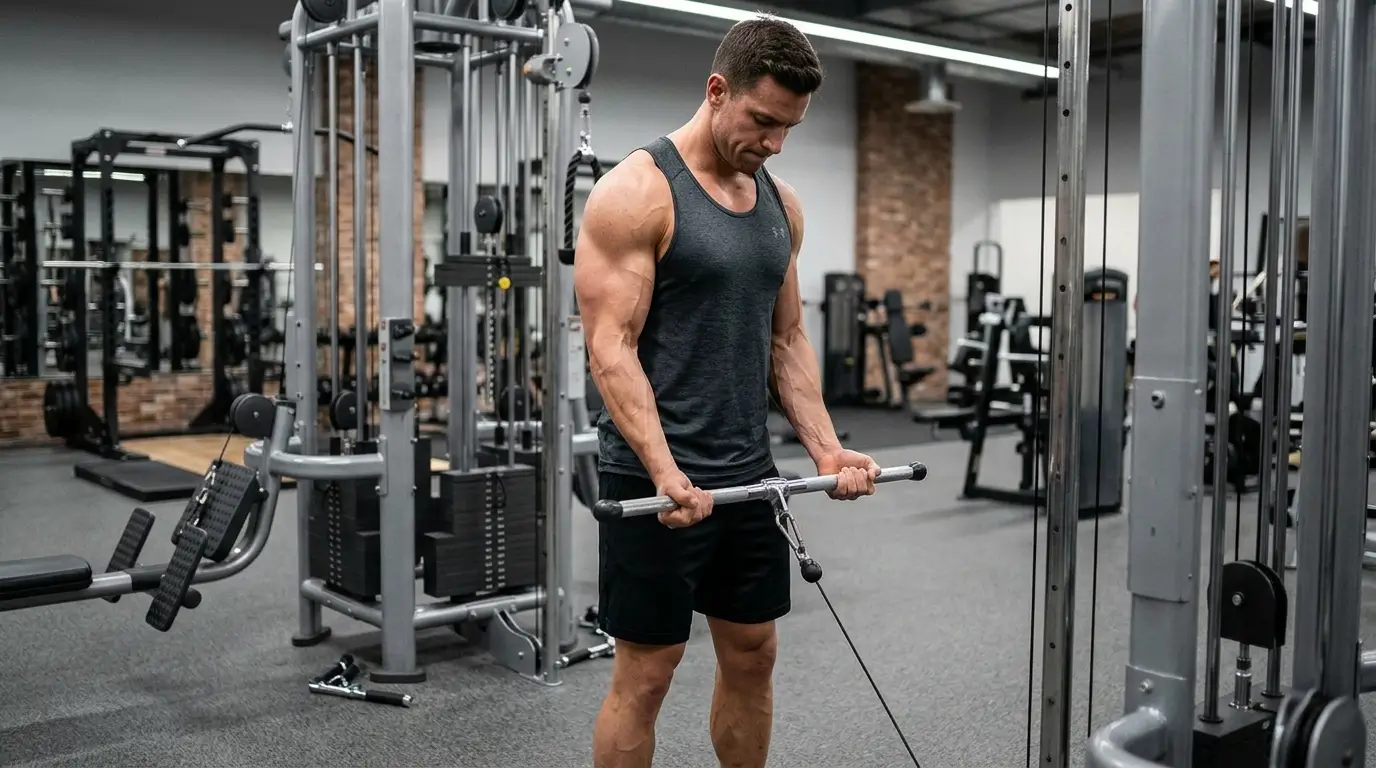
Best Bicep Cable Exercises: 10 Moves, Form Cues, and a Sample Workout
The best bicep cable exercises give your arms steady resistance from the bottom of the curl to the top. That is different from a dumbbell, which feels lighter when your arm is straight and at the very top. A cable station also lets you change angles quickly, so you can hit the biceps from several positions in one session.
This guide covers 10 bicep cable exercises with form cues, sets, reps, and easier and harder versions. You will also get a sample cable arm workout and a simple plan for adding weight over time.
Quick Answer: The best bicep cable exercises are the standing low-pulley curl, Bayesian curl, cable hammer curl, high cable curl, and cable preacher curl. Together they train the biceps brachii and brachialis through stretched, mid-range, and peak positions. Do 2–4 sets of 8–15 controlled reps per exercise, two or three days a week.
Muscles Worked by Bicep Cable Exercises
The biceps brachii sits on the front of your upper arm and has two parts: a long head and a short head. Its two main jobs are bending the elbow and turning the palm up (supination).
Other muscles help, too. The brachialis lies under the biceps and bends the elbow in almost any grip. The brachioradialis runs along the forearm and helps most when your palms face in or down. Your anterior deltoid and forearm flexors also assist, especially if you swing or grip hard.
Pulling exercises train these same muscles. If you want the full picture, see our guide to pull-up muscles worked. Cable curls simply let you isolate the arms with more control.
Why the Best Bicep Cable Exercises Work
A cable keeps the load pulling against your arm in a steady line. With a dumbbell, gravity pulls straight down, so the curl feels easiest at the bottom and hardest at mid-range. With a low pulley, the bottom of the curl stays loaded, which is why many lifters feel the stretch more.
Cables also make setup easy. You can move the pulley up or down, switch handles in seconds, and train one arm at a time. That makes bicep cable exercises handy for fixing strength gaps between sides. If you want a head-to-head breakdown, read our barbell curl vs cable curl comparison.
Still, cables are not magic. One small 2025 study of 11 volunteers found that a standard dumbbell curl produced higher biceps muscle activity than a Bayesian cable curl at 80% of one-rep max. The authors called it exploratory, and muscle activity is not the same as muscle growth. So think of cables as one strong tool, not a replacement for free weights.
Coach’s Tip: Use cables for what they do best: smooth tension, easy angle changes, and strict single-arm work. Keep a dumbbell or barbell curl in your plan, too.
How to Choose Your Weight, Reps, and Rest
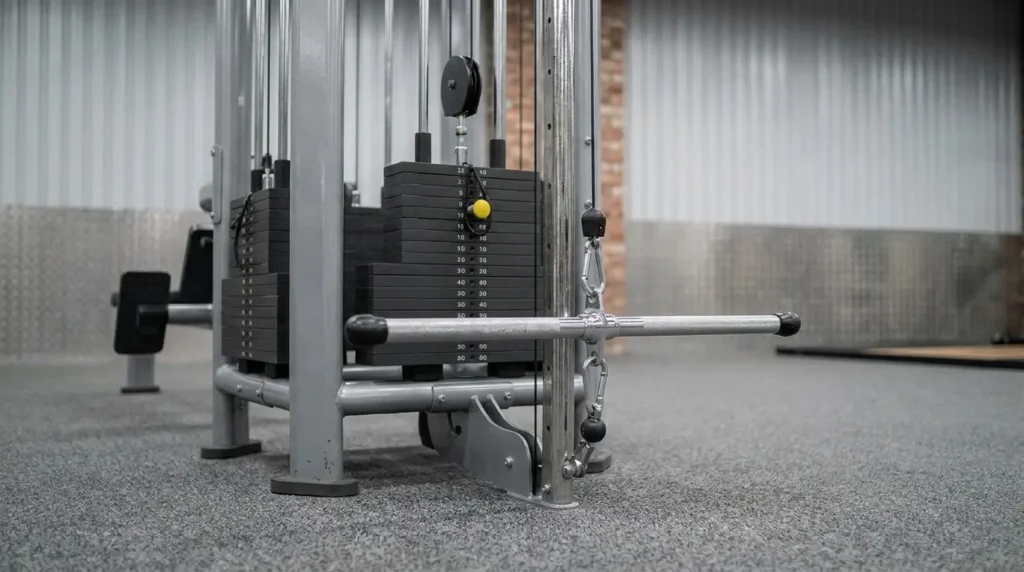
Pick a weight you can lift with strict form for the target reps, finishing each set with one or two clean reps in the tank. The weight stack on cable machines varies by brand, so start light. Many beginners do well with about 15–30 lb (7–14 kg) on a bar or rope and 10–20 lb (4.5–9 kg) per arm on single-arm moves.
The HHS Physical Activity Guidelines tell adults to do muscle-strengthening activity on at least two days a week. The ACSM position stand suggests that new lifters use loads in the 8–12 repetition range and train major muscles two to three days a week. It also lists 1–2 minute rests for hypertrophy-focused work.
Here is how the numbers change with your goal:
| Goal | Sets | Reps | Rest | Effort |
|---|---|---|---|---|
| Strength | 3–5 | 5–8 | 2–3 min | Heavy, strict form |
| Muscle size | 2–4 | 8–15 | 1–2 min | Finish 1–2 reps shy of failure |
| Endurance | 2–3 | 15–25 | 30–60 sec | Light, steady tempo |
Research on loading is encouraging for cable work. A meta-analysis by Schoenfeld and colleagues found that heavier loads built more maximal strength, while muscle size gains were similar across a wide range of loads when sets were taken close to failure. A separate analysis of muscle fiber growth found no significant difference between low-load and high-load training. In plain terms, you have flexibility in your rep range, and effort and consistency matter most.
The 10 Best Bicep Cable Exercises
1. Standing Low-Pulley Cable Curl (Straight or EZ Bar)
This is the foundation of most cable biceps workouts. It trains both heads of the biceps with steady tension.
How to do it:
- Attach a straight bar or EZ bar to the low pulley and stand 12–18 inches (30–46 cm) back from the stack.
- Grip the bar palms up, about shoulder-width apart, with your elbows pinned to your sides.
- Curl the bar toward your collarbone, squeezing your biceps at the top.
- Lower over three seconds until your arms are straight.
Sets and reps: 3 sets of 8–12 reps, resting 90 seconds.
Why it works: The bar keeps your palms supinated, which suits the biceps. A 2018 study of 12 lifters found that straight-bar and EZ-bar curls produced higher biceps activity than dumbbell curls at 65% of one-rep max. That study used free weights, not cables, but the grip lesson carries over. The EZ bar also raised forearm (brachioradialis) activity, and you can compare attachments in our EZ curl bar differences guide.
Easier: Use a rope or single D-handle and lighter weight.
Harder: Add a 1-second pause at the top and slow the lowering phase to four seconds.
Common Mistake: Swinging your torso to start the rep. If your hips move, the weight is too heavy. Lower it by one plate and keep your ribs stacked over your hips.
2. Bayesian Cable Curl
The Bayesian curl is a single-arm curl done facing away from the stack. Your arm starts behind your body, which keeps the biceps stretched under load.
How to do it:
- Set the pulley low and attach a D-handle.
- Face away from the machine and hold the handle with your arm behind you.
- Take a short staggered stance and lean forward slightly.
- Curl the handle forward without letting your elbow drift in front of your torso.
Sets and reps: 3 sets of 10–15 reps per arm, resting 60–90 seconds.
Why it works: The stretched start position loads the long head of the biceps. As noted above, early research is mixed on how it compares with a dumbbell curl, so treat it as a useful variation rather than a must-do.
Easier: Stand tall instead of leaning, and use less weight.
Harder: Pause for two seconds at the bottom of each rep.
3. Cable Rope Hammer Curl
Hammer curls use a neutral grip, with palms facing each other. They shift more work to the brachialis and forearm, which add thickness to the upper arm.
How to do it:
- Attach a rope to the low pulley.
- Hold the ends with your palms facing in and your elbows at your sides.
- Curl up until your thumbs are near your shoulders, then spread the rope slightly.
- Lower slowly without letting the stack touch.
Sets and reps: 3 sets of 10–15 reps, resting 60–90 seconds.
Why it works: The neutral grip is easier on many wrists. For a deeper look at how the grip changes things, see our hammer curl vs. bicep curl article.
Easier: Use one arm at a time to focus on form.
Harder: Slow each rep to a four-second lowering phase.
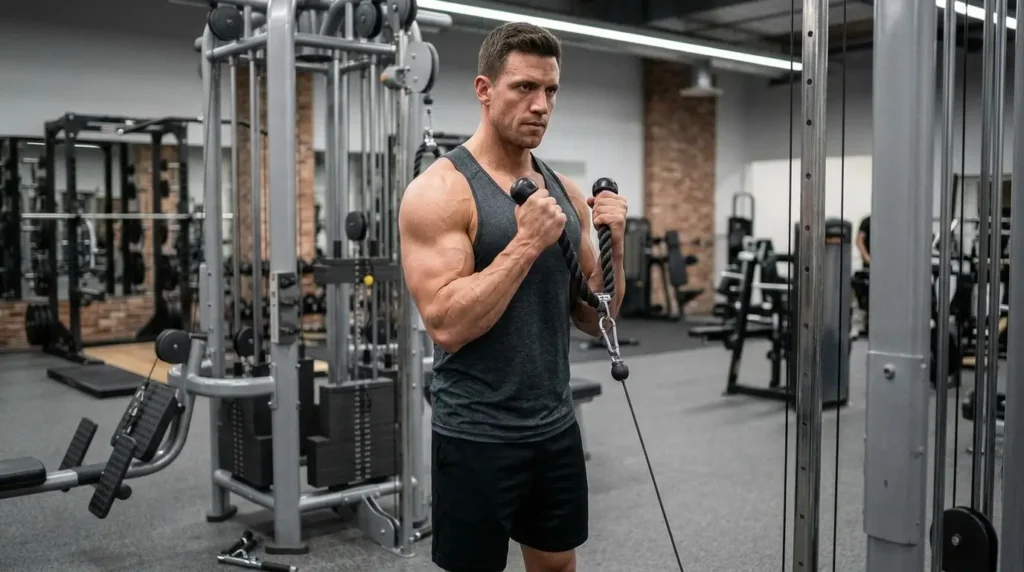
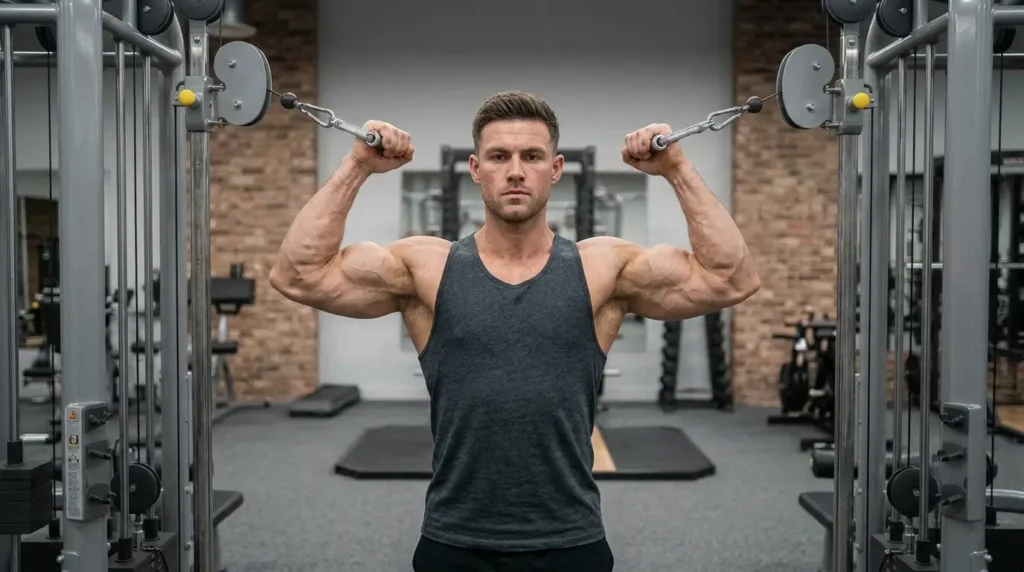
4. High Cable Curl (Double-Biceps Curl)
You stand between two high pulleys and curl toward your head, as in a double-biceps pose. It is a great finisher because the tension stays high at the top of the rep.
How to do it:
- Set both pulleys at about shoulder height, or slightly above.
- Stand in the middle with your arms out to the sides, palms up.
- Curl the handles toward your ears, keeping your upper arms level.
- Squeeze for one second, then return under control.
Sets and reps: 2–3 sets of 12–15 reps, resting 60 seconds.
Why it works: The peak squeeze is strong here, and the setup limits cheating. Use lighter weights than you think you need.
Easier: Do one arm at a time while holding a stable cable column with your free hand.
Harder: Hold the top position for three seconds on the final rep of each set.
Coach’s Tip: If your shoulders feel it more than your biceps, lower the pulleys a few inches and keep your elbows slightly in front of your torso.
5. Cable Preacher Curl
Resting your arms on a pad removes momentum and forces strict reps. Place a preacher bench in front of a low pulley.
How to do it:
- Adjust the seat so your armpits rest comfortably at the top of the pad.
- Hold a straight or EZ bar with an underhand grip.
- Curl to about chin height without lifting your elbows off the pad.
- Lower slowly, stopping just short of fully locking out.
Sets and reps: 3 sets of 8–12 reps, resting 90 seconds.
Why it works: The pad keeps your upper arms still, so the biceps do the work. It is also one of the best bicep cable exercises for teaching a smooth, controlled rep.
Easier: Use a single arm and a light handle.
Harder: Add a two-second pause at the top.
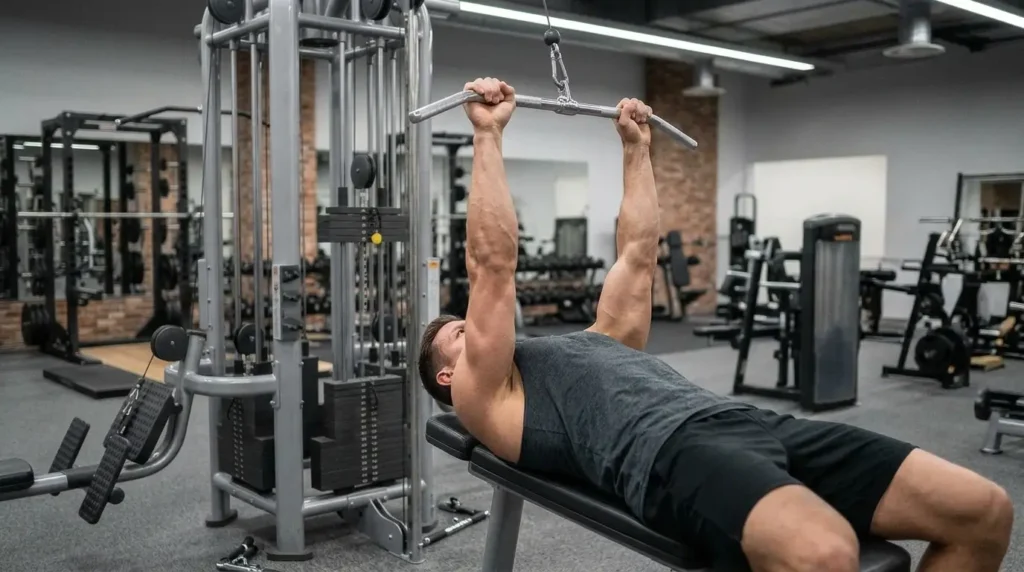
6. Lying Cable Curl
Lie on a flat bench or the floor with your head near the stack and a low pulley behind you. Your arms stay in front of your body, which changes the line of pull.
How to do it:
- Lie on your back with your head close to the machine.
- Hold a bar or rope with your arms extended overhead and slightly angled.
- Curl the handle toward your forehead, keeping your upper arms still.
- Lower under control.
Sets and reps: 3 sets of 10–12 reps, resting 90 seconds.
Why it works: Your position removes body English and puts the biceps in a lengthened position. Keep the weight light until you find your groove.
Easier: Use a rope and lighter load.
Harder: Slow the lowering phase to four seconds.
7. Cable Spider Curl
Lie chest-down on an incline bench, set at about 45 degrees, facing the stack. Your arms hang straight down, which makes it hard to cheat.
How to do it:
- Place the bench a few inches (about 10 cm) from the low pulley, facing it.
- Rest your chest on the bench and let your arms hang with the handle in front of you.
- Curl up, squeeze, and lower under control.
Sets and reps: 3 sets of 10–15 reps, resting 60–90 seconds.
Why it works: Gravity and the bench help keep the elbows still, so the biceps stay under tension through the full curl.
Easier: Do alternating single-arm movements
Harder: Pause for one second at the top of each rep.
8. Cable Concentration Curl
Sit on a bench with a low pulley next to your leg. Rest your elbow on your inner thigh and curl a D-handle toward your shoulder.
How to do it:
- Sit with your feet wide and your working arm hanging between your knees.
- Brace your elbow against your inner thigh.
- Curl up, squeezing hard at the top.
- Lower slowly until your arm is nearly straight.
Sets and reps: 2–3 sets of 10–15 reps per arm, resting 60 seconds.
Why it works: It is perfect for building the mind-muscle connection. Focus on the squeeze rather than the load.
Easier: Rest your free hand on your knee for support.
Harder: Add a two-second squeeze at the top.
9. Reverse-Grip Cable Curl
An overhand grip moves more of the load to the brachioradialis and forearm. Pair it with other curls to train your arms from several angles.
How to do it:
- Attach a straight or EZ bar to a low pulley.
- Grip the bar with your palms facing down, hands about shoulder-width apart.
- Keep your wrists straight and curl the bar toward your chest.
- Lower under control.
Sets and reps: 2–3 sets of 10–15 reps, resting 60–90 seconds.
Why it works: The overhand grip challenges grip and forearm strength, which can help with pulling exercises. Use less weight than a regular curl, since your forearms tire first.
Easier: Use a lighter bar or switch to a neutral grip.
Harder: Slow the lowering phase to four seconds.
10. Cable 21s
This one is a finisher, not a main lift. You do seven reps in the bottom half, seven in the top half, and seven full reps without resting.
How to do it:
- Set up as in the standing low-pulley curl.
- Curl from straight arms to halfway up for seven reps.
- Curl from halfway to the top for seven reps.
- Finish with seven full-range reps.
Sets and reps: 1–2 sets of 21 reps, resting 2 minutes.
Why it works: It trains the stretched, middle, and peak positions in a single set. It also builds muscular endurance, so go light.
Easier: Do 5-5-5 reps instead.
Harder: Add a one-second pause at the top of each phase.
How to Put the Best Bicep Cable Exercises Into a Workout
You do not need all 10 moves in one day. Pick three or four that cover different positions: one stretched (Bayesian or lying curl), one standard (low-pulley bar), one neutral grip (rope hammer), and one peak (high cable or concentration curl).
Here is a sample cable arm workout:
| Exercise | Sets | Reps | Rest |
|---|---|---|---|
| Standing low-pulley EZ-bar curl | 3 | 8–12 | 90 sec |
| Bayesian cable curl | 3 | 10–15 per arm | 60–90 sec |
| Cable rope hammer curl | 3 | 10–15 | 60–90 sec |
| High cable curl | 2 | 12–15 | 60 sec |
Warm up first with 5 minutes of easy cardio and one light set of curls (about 40–50% of your working weight). Cable arm days pair well with pulling work, so try adding some back cable exercises or a dumbbell-only back day in the same week.
How often should you train them? Two or three sessions a week works for most people. If you wonder about curling every day, that guide explains the trade-offs.
How to progress: Use double progression. Stay at the same weight until you hit the top of the rep range on every set with clean form, then add the smallest plate on the stack and start again at the bottom of the range.
Easier and Harder Options
If cables are not available, you can swap in a few moves. Resistance bands mimic the steady pull of a cable at home. Dumbbell curls and incline curls are good free-weight options. For no-equipment training, push-ups for biceps show how to shift load toward the arms.
To make any cable curl harder, slow the lowering phase, add a pause, or do single-arm sets. To make it easier, lower the weight, reduce the range, or use two hands on a rope.
Safety Tips and Who Should Be Careful
Keep your wrists straight, your elbows near your sides, and your shoulders relaxed. Do not jerk the stack, and stop a set when your form breaks down.
Some people should take extra care. If you have elbow, wrist, or shoulder pain, or you have had a biceps tendon injury, check with a doctor or physical therapist before adding new curls. Some lifters like elbow sleeves for lifting for warmth and comfort, but they do not fix poor form. Sharp or lasting pain is a signal to stop and get checked.
Frequently Asked Questions
Are cable curls good for biceps?
Yes. Cable curls train the biceps brachii and brachialis through a full range of motion with steady tension. They are not the only good option, but they are easy to adjust, simple to track, and handy for single-arm work and strict form.
Are cable curls better than dumbbell curls?
Neither is clearly better for everyone. Cables offer smoother resistance, while dumbbells offer a natural wrist path. One small study found higher biceps activity with a dumbbell curl than a cable curl, so using both is a smart plan.
How many sets and reps should I do for cable biceps?
Most lifters do well with 2–4 sets of 8–15 reps per exercise, taking sets close to failure with good form. Use 5–8 reps if you want to emphasize strength, and 15–25 reps if you want to train endurance.
What is the best cable attachment for biceps?
A straight bar or EZ bar suits most people for the main curl. A rope works well for hammer curls, and a single D-handle is best for one-arm moves. Pick the grip that feels strong and pain-free in your wrists.
Can you build big biceps with cables only?
Yes, if you train hard, progress the weight, eat enough protein and calories, and recover. Research shows muscle size can grow across many loading ranges. Many lifters still mix cables with dumbbells or barbells for variety.
Why do my forearms take over during cable curls?
Your grip may be too tight, your wrists may be bent, or the weight may be too heavy. Loosen your hands, keep your wrists straight, and lower the load. Try a thicker grip or a rope if it helps.
Final Thoughts on the Best Bicep Cable Exercises
The best bicep cable exercises are the ones you can perform with strict form and progress over time. Start with the standing low-pulley curl, add a Bayesian or lying curl for the stretch, a rope hammer curl for the brachialis, and a high cable curl for the squeeze.
Train two or three days a week, use a rep range that feels challenging, and increase the weight gradually. Pair cables with free weights if you can, since the research suggests both have a place.
