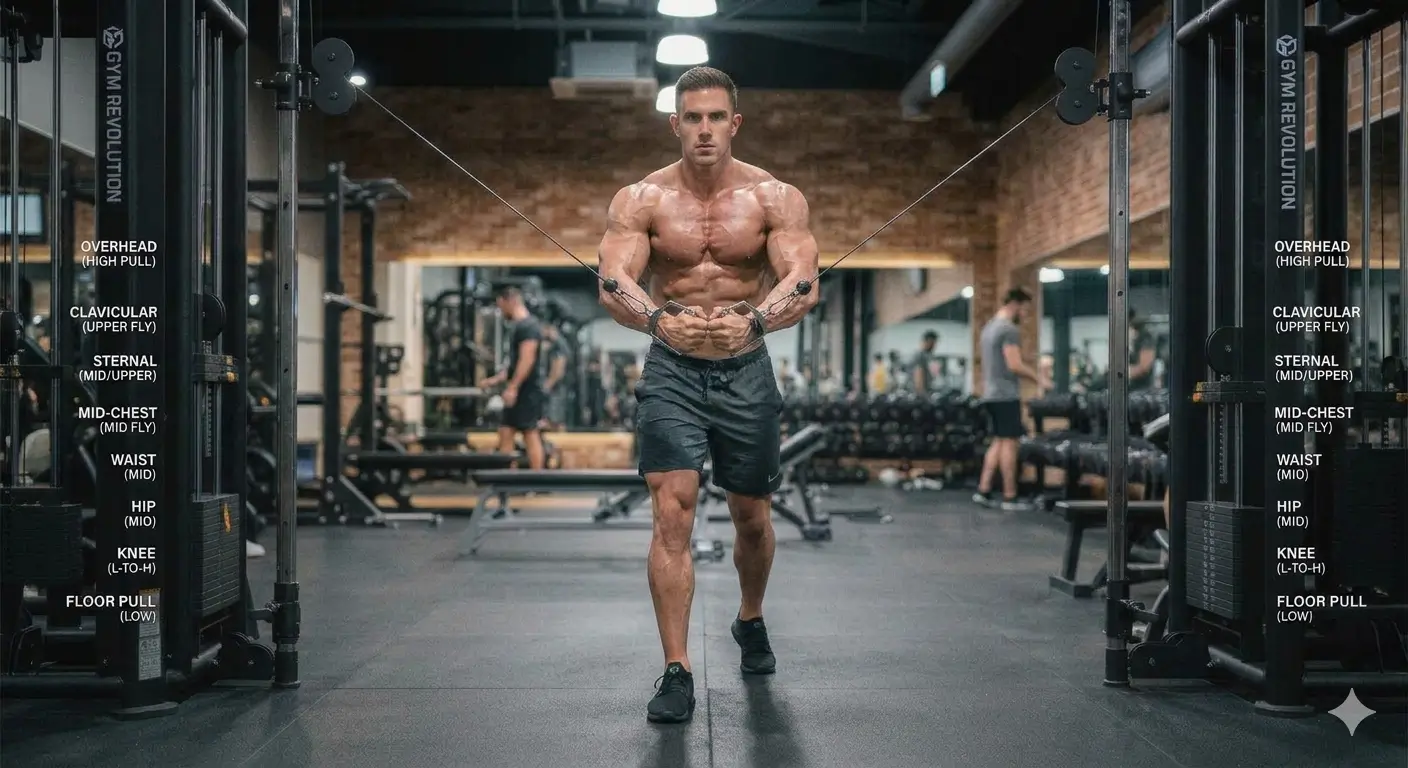
The best chest cable exercises give your pecs something barbells and dumbbells cannot: smooth, steady tension from the first inch of the rep to the last. Gravity pulls dumbbells straight down, so the tension on your chest changes as you move. A cable keeps pulling along the same line, which is why a good chest cable workout feels so different.
Cables are also friendly to beginners. You can change the weight in seconds, set the pulleys at any height, and train one side at a time. In this guide, you will learn 10 cable chest exercises with form cues, sets, reps, easier and harder versions, and a sample routine you can start this week. For a wider chest-building plan, see our guide to the best exercises to get a bigger chest.
Quick Answer: The best chest cable exercises are the standing cable fly, high-to-low fly, low-to-high fly, incline cable fly, and standing cable chest press. Together they train the whole pec with constant tension. Start with 3 sets of 10–15 reps, rest 60–90 seconds, and pick a weight that leaves 1–2 reps in reserve.
Why Cables Belong in Your Chest Workout
Cables are not a replacement for heavy pressing, but they fill a gap that pressing leaves open. In an ACE-sponsored study of 14 young men using 80% of their one-rep max, the bent-forward cable crossover produced about 93% of the pectoral muscle activity of the barbell bench press. The researchers concluded that the bench press, pec deck, and cable crossover could be used interchangeably for chest activation. That is a small study, so treat it as a useful clue, not a final answer.
Other research points the same way: a 2023 systematic review and meta-analysis found that the flat bench press usually produced greater pectoralis major activity than most variants at the same relative load. In other words, cables work best beside your presses, not instead of them. If you want to strengthen your main lift, our tips to increase your bench press pair well with this plan.
Load matters less than you might think for muscle size. A meta-analysis in the Journal of Strength and Conditioning Research found that muscle growth was similar across light and heavy loads, while maximal strength gains favored heavier loads. Cables let you train with lighter weights and controlled form, which is a smart fit for flys and for lifters who want to protect their shoulders.
Quick Cable Setup Checklist
- Handles: Use D-handles for flys and presses. Rope or bar attachments are not needed here.
- Stance: Use a split stance (one foot forward) so you do not rock backward.
- Elbows: Keep a soft bend, about 10–20 degrees, and hold that angle for the whole rep.
- Tempo: Move out in 2 seconds, squeeze for 1 second, and return in 2–3 seconds.
- Effort: Stop each set with 1–2 reps left in the tank until you have practiced the form.
The 10 Best Chest Cable Exercises
1. Standing Mid Cable Fly (Cable Crossover)
This is the classic move people picture first, and it earns its spot among the best chest cable exercises. It trains the middle of the chest through a wide, smooth arc.
How to do it:
- Set both pulleys at about shoulder height and attach D-handles.
- Hold a handle in each hand, step forward about 24 inches (60 cm), and lean slightly from the hips.
- With soft elbows, sweep the handles in a wide arc until your hands meet in front of your sternum.
- Squeeze for one second, then return slowly until you feel a comfortable chest stretch.
- Sets and reps: 3 sets of 10–15 reps; rest 60–90 seconds
- Starting weight: 10–15 lb (4.5–7 kg) per side
- Easier version: Shorten the range of motion and use 5–10 lb (2–4.5 kg) per side
- Harder version: Pause for 2 seconds at the squeeze, or finish with a drop set
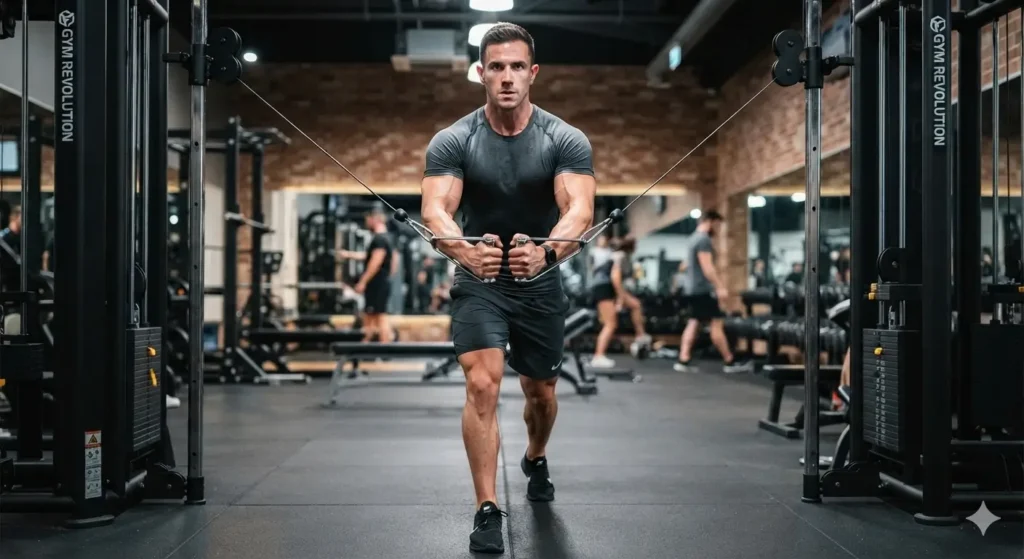
Coach’s Tip: Imagine hugging a large barrel. Your elbows should stay almost still while your upper arms sweep forward. If your hands start leading the movement, the weight is probably too heavy.
2. High-to-Low Cable Fly
Set the pulleys high and pull down and in. This version is often used as a lower chest cable exercise because the handles travel toward your hips.
How to do it:
- Set both pulleys at the top position.
- Step forward into a split stance and lean forward slightly.
- Sweep the handles down and together until they meet near your belt line.
- Squeeze, then return slowly to chest height.
- Sets and reps: 3 sets of 10–15 reps; rest 60–90 seconds
- Starting weight: 10 lb (4.5 kg) per side
- Easier version: Use one arm at a time with a lighter weight
- Harder version: Slow the return to 4 seconds
This move works well early in your session while your shoulders are fresh. Moreover, it trains the same arm path many athletes use when throwing or swinging.
3. Low-to-High Cable Fly
Set the pulleys low and scoop the handles up and in. Coaches often choose this as one of the top upper chest cable exercises because the pulling line favors the upper fibers of the pec.
How to do it:
- Set both pulleys at the lowest position.
- Stand tall with a split stance and your ribs down.
- Lift the handles in an arc until they meet at about eye level.
- Pause briefly, then lower with control.
- Sets and reps: 3 sets of 12–15 reps; rest 60 seconds
- Starting weight: 5–10 lb (2–4.5 kg) per side
- Easier version: Stop the handles at chin height
- Harder version: Add a 2-second pause at the top
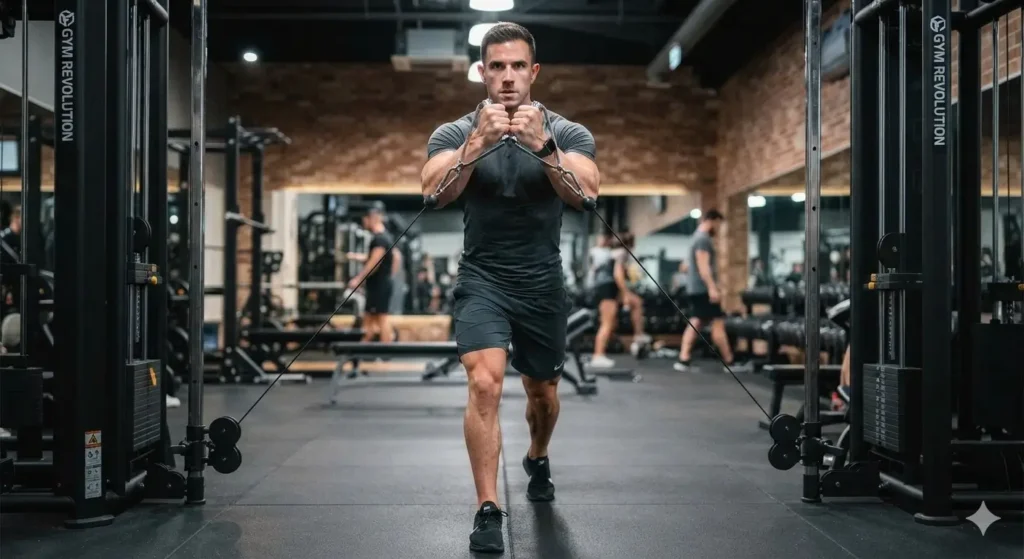
Common Mistake: Shrugging the shoulders up toward your ears. This shifts work to the upper traps and can irritate the shoulder. Keep your shoulders down and back, and think “chest up, shoulders away from ears.”
4. Flat Bench Cable Fly
Placing a bench between the cable stacks removes standing balance from the equation. You can focus entirely on your chest, which makes this a good choice for beginners.
How to do it:
- Place a flat bench in the center of the station with pulleys at the lowest setting.
- Lie back with a handle in each hand and arms extended over your chest.
- Lower your arms out to the sides until you feel a stretch, keeping your elbows slightly bent.
- Bring your hands back together over your chest and squeeze.
- Sets and reps: 3 sets of 10–15 reps; rest 60–90 seconds
- Starting weight: 10 lb (4.5 kg) per side
- Easier version: Limit the stretch so your hands stop level with your shoulders
- Harder version: Use a 3-second lowering phase
5. Incline Cable Fly
Set an adjustable bench to a low incline, about 30 degrees, and you get a strong upper-chest stretch with steady tension.
How to do it:
- Set the bench to about 30 degrees and the pulleys at the lowest position.
- Sit back, pull your shoulder blades down and together, and hold a handle in each hand.
- Open your arms until you feel a stretch across the upper chest.
- Bring the handles together above your upper chest and squeeze.
- Sets and reps: 3 sets of 10–15 reps; rest 60–90 seconds
- Starting weight: 5–10 lb (2–4.5 kg) per side
- Easier version: Use a 15-degree incline with less weight
- Harder version: Pause for 2 seconds at the stretch
A steep incline (above about 45 degrees) turns the move into a front-shoulder exercise, so keep the angle modest.
6. Standing Cable Chest Press
This press trains your pecs, front shoulders, and triceps together, and it also asks your core to stay braced. Researchers who compared the standing cable press with the bench press noted that the pectoralis major, front deltoid, and serratus anterior are highly active in more stable pushing positions, while the abs, triceps, and upper traps work harder as stability drops. That is why a staggered, steady stance matters here.
How to do it:
- Set both pulleys at chest height.
- Face away from the machine in a split stance, handles at chest level, elbows bent.
- Press forward until your arms are nearly straight, then bring your hands together.
- Return slowly until you feel a light stretch in your chest.
- Sets and reps: 3 sets of 8–12 reps; rest 90–120 seconds
- Starting weight: 20–30 lb (9–14 kg) per side
- Easier version: Use a wall push-up or a lighter weight; see our calisthenics exercises list for more bodyweight options
- Harder version: Move to a single-leg stance or add a 2-second pause
It is also a handy option when you need bench press alternatives because of a crowded gym or a sore shoulder.
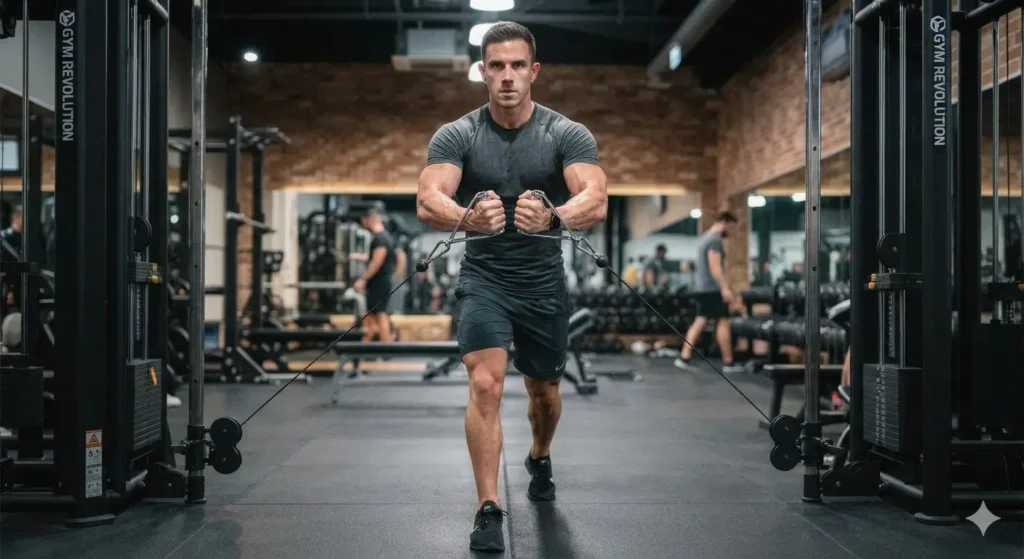
7. Seated Cable Chest Press
A seat with back support lets you push harder without worrying about balance. If you like machines, it feels similar to a Hammer Strength chest press, but with free-moving handles.
How to do it:
- Set the pulleys at chest height behind a bench with a back pad.
- Sit tall, back pressed to the pad, with a handle in each hand.
- Press out until your arms are nearly straight without locking the elbows.
- Bring the handles back slowly to the starting point.
- Sets and reps: 3 sets of 8–12 reps, rest 90–120 seconds
- Starting weight: 25–35 lb (11–16 kg) per side
- Easier version: Use lighter weight and a shorter range of motion
- Harder version: Add a 1-second squeeze at full extension
8. Incline Cable Press
Sitting on an incline bench of about 30 degrees and pressing the handles up and forward shifts more work toward the upper chest.
How to do it:
- Set an incline bench to about 30 degrees and the pulleys at the lowest position.
- Sit back with your feet flat and bring the handles to the sides of your chest.
- Press up and slightly together until your arms are nearly straight.
- Lower the handles slowly to chest level.
- Sets and reps: 3 sets of 8–12 reps; rest 90–120 seconds
- Starting weight: 15–25 lb (7–11 kg) per side
- Easier version: Press one arm at a time
- Harder version: Use a 3-second lowering phase
9. Single-Arm Cable Press (Split Stance)
Training one side at a time shows you any strength gap between your left and right chest. It also challenges your core to resist twisting.
How to do it:
- Set the pulley at chest height and hold one handle at the side of your chest.
- Stand in a split stance with your back to the machine.
- Press the handle straight forward without rotating your torso.
- Return slowly and finish all reps before switching sides.
- Sets and reps: 3 sets of 8–12 reps per side; rest 60–90 seconds
- Starting weight: 10–20 lb (4.5–9 kg)
- Easier version: Brace your free hand on a rack or wall
- Harder version: Pause for 2 seconds at full extension
10. Single-Arm Cable Fly
This finisher lets you reach across your body a little farther than a two-arm fly, which gives each pec a strong squeeze.
How to do it:
- Set the pulley at chest height and take one handle with the same-side hand.
- Stand sideways to the machine in a split stance, arm out to the side with a soft elbow.
- Sweep the handle across your body until it reaches your midline.
- Return slowly and switch sides after your set.
- Sets and reps: 2–3 sets of 12–15 reps per side; rest 45–60 seconds
- Starting weight: 5–10 lb (2–4.5 kg)
- Easier version: Use a shorter arc
- Harder version: Slow the return to 4 seconds
How to Put the Best Chest Cable Exercises Into a Workout
A good plan mixes one or two presses with two or three flys. Presses build strength and handle heavier loads, while flys add stretch and constant tension. The CDC says adults should do muscle-strengthening activity on at least two days each week, so two chest sessions fit nicely inside that guideline.
Weekly volume matters too. A meta-analysis on weekly training volume found that more weekly sets were linked to more muscle growth, and a later systematic review described favorable results above nine weekly sets per muscle group. For most lifters, starting with 10–14 hard sets for the chest each week is a sensible range.
Sample Workout A: Beginner Chest Cable Workout (2 Days per Week)
| Exercise | Sets | Reps | Rest |
|---|---|---|---|
| Seated cable chest press | 3 | 8–12 | 90–120 sec |
| Standing mid cable fly | 3 | 10–15 | 60–90 sec |
| Low-to-high cable fly | 2 | 12–15 | 60 sec |
Sample Workout B: Intermediate Chest Cable Workout
| Exercise | Sets | Reps | Rest |
|---|---|---|---|
| Incline cable press | 4 | 8–12 | 90–120 sec |
| Flat bench cable fly | 3 | 10–15 | 60–90 sec |
| High-to-low cable fly | 3 | 10–15 | 60–90 sec |
| Single-arm cable fly | 2 | 12–15 per side | 45–60 sec |
Sets, Reps, and Weight by Goal
| Goal | Reps per set | Effort | Rest |
|---|---|---|---|
| Strength (presses) | 4–8 | 1–2 reps in reserve | 2–3 min |
| Muscle growth | 8–15 | 0–2 reps in reserve | 60–120 sec |
| Muscular endurance | 15–20 | 1–2 reps in reserve | 45–60 sec |
To progress, use double progression. Stay at the same weight until you hit the top of the rep range on every set, then raise the weight by one plate (about 5–10 lb, or 2–4.5 kg) and start at the bottom of the range again. Research summarized in a network meta-analysis suggests muscle size improvements seem to be load-independent, while strength gains are superior with higher loads, so you can mix heavier press days with lighter, controlled fly days.
Pairing chest with back training also keeps your shoulders balanced. For that, our best back cable exercises make an excellent partner to this routine. If you want to swap in other presses on some days, the bench press variations for every level are a good next read.
![best chest cable exercises - Cable station with a bench and labeled pulley heights for the chest workout]](https://www.xbodyshape.org/wp-content/uploads/2026/11/Cable-Pulley-Exercise-Guide-1-1024x936.webp)
Safety Tips for Chest Cable Exercises
Cable training is joint-friendly, yet your shoulders still do a lot of work. Therefore, a few simple habits go a long way.
- Warm up first. Do 5 minutes of light cardio, then 1–2 light sets of the first exercise.
- Respect your stretch. Stop when your hands reach shoulder level, not when you feel a deep pull in the front of the shoulder.
- Keep the shoulders down. Pull your shoulder blades gently back and down before every set.
- Skip pain, not effort. A burning chest is normal. Sharp or pinching shoulder pain is not, so stop and reassess.
- Know your shoulder load. Pressing moves also load the front delts, as explained in our look at how the bench press works your shoulders.
If you have shoulder pain, a past shoulder injury, or a medical condition, check with a doctor or physical therapist before starting a new chest routine.
FAQ: Best Chest Cable Exercises
Are cable flys better than dumbbell flys?
Neither wins outright. Cables keep tension on your chest through the whole arc, while dumbbells lose tension near the top of the fly. Choose cables for smooth tension and quick weight changes, and dumbbells when no cable station is free. Many lifters use both across the week.
How do I hit my upper chest with cables?
Use low-to-high cable flys and incline cable presses with the bench at about 30 degrees. Keep your shoulders down and aim your hands toward eye level. Avoid steep inclines above 45 degrees, which shift work to the front shoulders. Pair one upper-chest move with one mid-chest move per session.
How many sets of cable flys per week?
Most lifters do well with 6–9 sets of flys across two sessions, plus 4–6 sets of presses. Weekly volume research links more weekly sets to more muscle growth, up to a point. Add sets slowly, and cut back if your shoulders feel sore.
How heavy should cable flys be?
Choose a weight that lets you finish 10–15 clean reps with 1–2 reps left in reserve. Beginners often start at 5–15 lb (2–7 kg) per side. If your elbows bend more or your shoulders roll forward, the weight is too heavy. Add 5 lb (2 kg) only after you reach the top of your rep range.
Can cable exercises replace the bench press?
Sometimes, but not fully. A 2023 meta-analysis found the bench press usually produced more pec activity than other variants at the same relative load. Cable presses make good substitutes on crowded gym days, yet heavy pressing still builds the most strength.
Why do I feel cable flys in my shoulders?
Common causes are too much weight, elbows that bend and straighten during the rep, a stretch that goes too deep, or shoulders that roll forward. Lower the weight, lock in a slight elbow bend, and stop your hands in line with your shoulders. If pain continues, check with a doctor or physical therapist.
Conclusion: Build Your Chest With the Best Chest Cable Exercises
The best chest cable exercises give you steady tension, easy weight changes, and plenty of ways to train every part of the pec. Start with a seated or standing cable press, add a mid fly and a low-to-high fly, and keep 1–2 reps in reserve. Then, track your weights and add small amounts over time.
Aim for two chest sessions per week, keep your shoulders down, and move with control. With consistent effort, this chest cable workout can become a reliable part of your routine.
