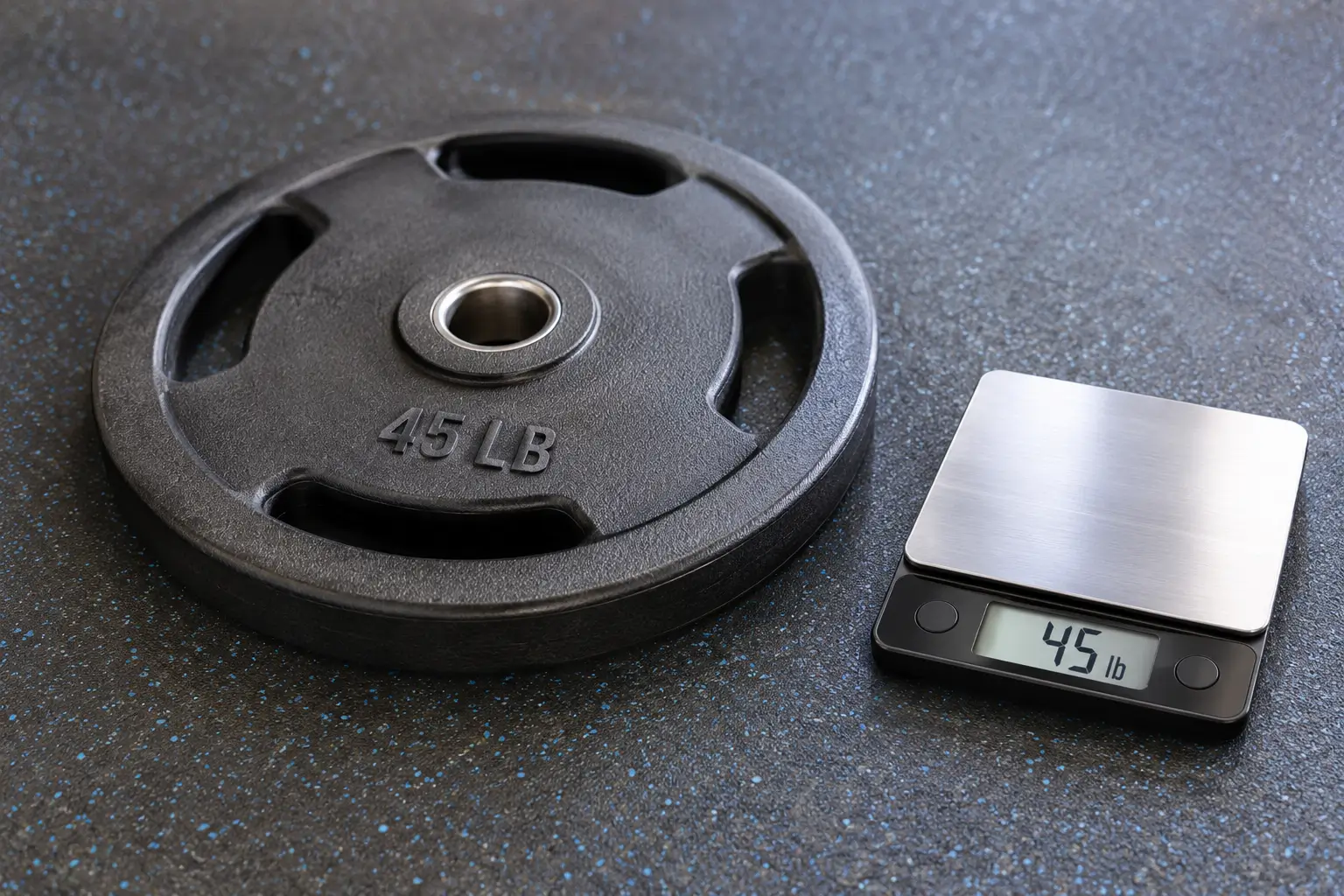
If you have ever stood in front of a plate tree and wondered how much does a 45 lb plate weigh, the short answer is simple: 45 pounds, or about 20.4 kilograms. The longer answer matters too. Real plates are not always exact, and plates marked in kilograms are not the same thing.
This guide gives you the numbers in pounds and kilograms. It also shows how much a pair weighs, how much a loaded bar weighs, and how far off a plate can be. Finally, it gives you a simple way to use 45 lb plates in your training.
Quick Answer: A 45 lb plate weighs 45 pounds (20.4 kg). A pair weighs 90 lb (40.8 kg). Real plates can be off by 1–3% depending on quality, so one may weigh about 43.7–46.4 lb. A 20 kg plate is lighter at 44.1 lb. An empty 45 lb bar plus one 45 on each side equals 135 lb.
How Much Does a 45 Lb Plate Weigh in Real Life?
On paper, the number is easy. In the gym, it depends on who made the plate and how tightly they control the weight.
The “45 lb” on a plate is a target. Manufacturers aim for it, but no plate comes out exactly right. The allowed error is called weight tolerance, and it varies a lot between plate types.
Rogue Fitness publishes tolerances for its own plates, so we can use them as clear examples:
- Standard cast iron: Rogue lists a tolerance of plus or minus 3% for its Olympic plates.
- Machined iron: Its machined Olympic plates are listed at plus 2% and minus 0% on the 25–45 lb sizes, so they never weigh less than the label.
- Training bumpers: The Echo bumper plate guide lists a weight within 1% of the target.
- Crumb rubber bumpers: Rogue’s Hi-Temp bumper guide says plates are guaranteed within 0.5 lb of the stated weight.
- Calibrated steel: Its calibrated steel plates are machine calibrated to within 10 grams.
What That Means in Pounds and Kilograms
Here is how those tolerances translate for a single 45 lb plate. These figures come from the manufacturer numbers above, plus simple math.
| Plate type (Rogue example) | Stated tolerance | Real weight range (lb) | Real weight range (kg) |
|---|---|---|---|
| Calibrated steel | ±10 grams | About 45.00 lb | About 20.41 kg |
| Echo bumper | ±1% | 44.55–45.45 lb | 20.2–20.6 kg |
| Hi-Temp bumper | ±0.5 lb | 44.5–45.5 lb | 20.2–20.6 kg |
| Machined iron | +2% / −0% | 45.0–45.9 lb | 20.4–20.8 kg |
| Standard iron | ±3% | 43.65–46.35 lb | 19.8–21.0 kg |
Other brands may list different numbers, so check your own plates’ product page [VERIFY for any brand you own].
Coach’s Tip: If you keep a training log, load the same plates for the same lift every time. Two “45s” from different brands can differ by a pound or more. Using the same pair keeps your numbers honest.
How Much Does a 45 Lb Plate Weigh in Kilograms?
Math first: one pound equals about 0.4536 kg. So 45 lb works out to 20.41 kg. Gyms often round this to 20 kg when talking casually, but the two are not the same plate.
A plate stamped “20 kg” weighs 44.09 lb. That is almost a pound lighter than a 45 lb plate. For a beginner, it hardly matters. For someone tracking a bench press or deadlift record, it adds up fast.
Common Plate Conversions
| Plate | Pounds | Kilograms |
|---|---|---|
| 45 lb plate | 45 lb | 20.4 kg |
| 35 lb plate | 35 lb | 15.9 kg |
| 25 lb plate | 25 lb | 11.3 kg |
| 10 lb plate | 10 lb | 4.5 kg |
| 5 lb plate | 5 lb | 2.3 kg |
| 2.5 lb plate | 2.5 lb | 1.1 kg |
| 20 kg plate | 44.1 lb | 20 kg |
| 25 kg plate | 55.1 lb | 25 kg |
Because of this gap, a barbell loaded with kilogram plates will not match the pound math on the wall chart. If you train with both, write the unit next to every number.
How Much Does a Pair of 45 Lb Plates Weigh?
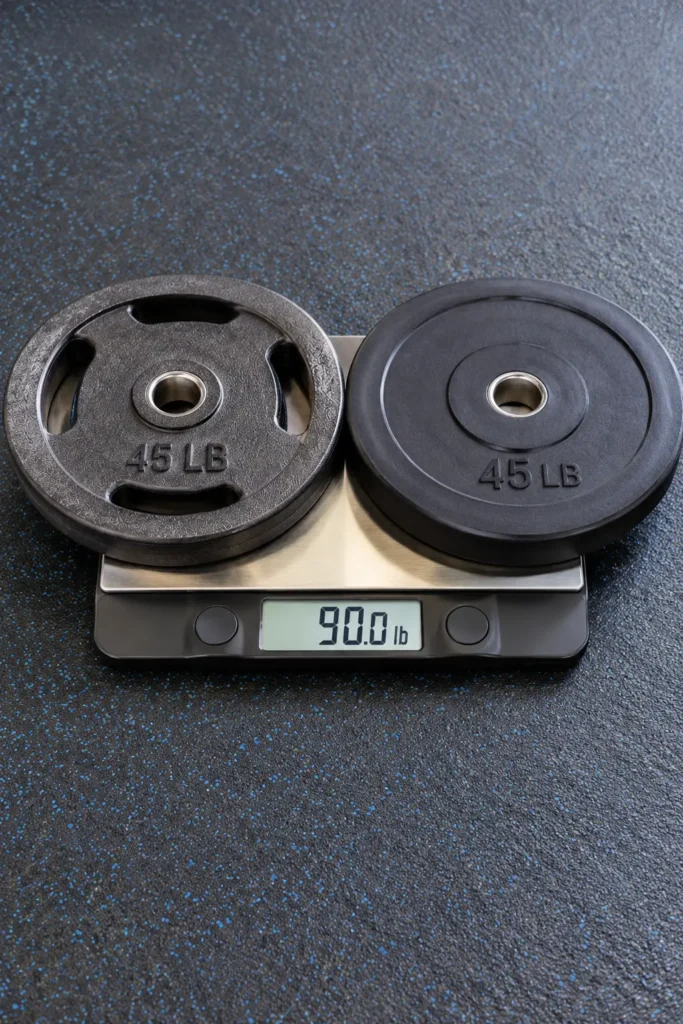
Plates usually come in pairs, because a barbell needs one on each side. Many lifters search “how much does a 45 lb plate weigh” and then need the pair number next. A pair of 45 lb plates weighs 90 lb (40.8 kg). Four plates weigh 180 lb (81.6 kg).
This matters when you shop. Many sellers list a “45 lb pair” at one price, and that means two plates, not one. Always check whether a listing says “each,” “single,” or “pair.”
How Much Does a Barbell Loaded With 45 Lb Plates Weigh?
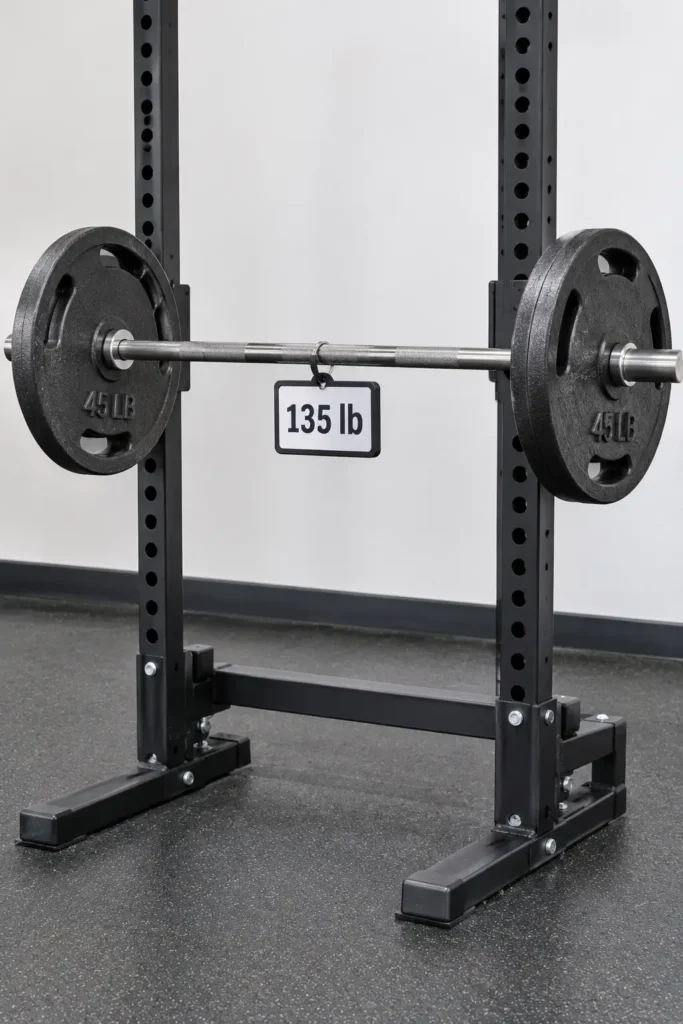
A standard men’s Olympic barbell weighs 45 lb (20 kg) [VERIFY with your bar’s manufacturer page, since some bars weigh slightly more or less]. Add plates evenly to both sides, and the total is easy to calculate.
| 45 lb plates per side | Math | Total weight (lb) | Total weight (kg) |
|---|---|---|---|
| 0 (empty bar) | 45 | 45 lb | 20.4 kg |
| 1 | 45 + 90 | 135 lb | 61.2 kg |
| 2 | 45 + 180 | 225 lb | 102.1 kg |
| 3 | 45 + 270 | 315 lb | 142.9 kg |
| 4 | 45 + 360 | 405 lb | 183.7 kg |
| 5 | 45 + 450 | 495 lb | 224.5 kg |
Collars add a small amount on top of these totals. Gym lifters call 135, 225, 315, and 405 “one plate, two plates, three plates, and four plates.” Now you know the secret code.
To see how the bar itself differs from other bars, read our guide to the Olympic barbell vs. standard barbell. If you use a specialty bar, check the trap bar weight guide and the curl bar weight guide before you do your math.
Size and Fit: Will a 45 Lb Plate Fit Your Bar?
Size is the other half of the question. Most 45 lb plates are about 17.7 inches (45 cm) across. That matches the international weightlifting standard of 450 mm for bumper plates, and Rogue lists the Echo bumper at 450 mm (17.72 in). Some budget bumpers run slightly smaller. Rogue’s Hi-Temp plates, for example, are 445 mm (about 17.5 in).
Olympic plates have a center hole of about 2 inches (50 mm). They fit Olympic bars and will not fit a thin 1-inch standard bar. Rogue lists its Echo collar opening at 50.6 mm, or roughly 2 in.
Width varies a great deal. Iron plates are thin, while rubber bumpers are thicker. This changes how many plates you can load. A bar with five 45 lb plates per side may not fit if you use wide bumpers [VERIFY sleeve length for your own bar].
Common Mistake: Putting 1-inch standard plates on an Olympic bar, or the reverse. The hole size must match the sleeve. A loose fit can slide, and a plate that slides off mid-lift is dangerous. Always use collars.
Is a 45 Lb Plate Heavy for a Beginner?
The answer to “how much does a 45 lb plate weigh?” is easy. Whether it is too heavy for you depends on your experience and the lift. For a single plate held in your hands, 45 lb is a real challenge for most beginners. On a barbell, it is a different story. The bar spreads the load, and a first plate on each side gives you 135 lb total.
For most new lifters, that is more than they need on day one. The American College of Sports Medicine position stand recommends that novice lifters train with loads in the 8–12 repetition maximum range. It also recommends training the major muscles two to three days per week. In plain terms, pick a weight that makes the last two or three reps hard but clean.
For general health, the CDC advises adults to do muscle-strengthening activity at least two days a week. You do not need 45 lb plates to meet that guideline. Dumbbells, bands, and body weight all count.
Starting Points by Goal
These ranges follow the ACSM guidance for novices. Treat the weight as a guide, because your starting load depends on your own strength.
| Goal | Reps per set | Sets | Rest | Plate guidance |
|---|---|---|---|---|
| General strength (novice) | 8–12 | 2–3 | 1.5–2 min | Use the lightest plates that make the last reps hard |
| Muscle size | 8–12 | 3–4 | 1–2 min | Add small plates before jumping to a 45 |
| Endurance | 12–15 | 2–3 | 30–60 sec | Light plates, controlled tempo |
If 45 lb plates feel like a giant leap, you are right. Use change plates in between. A 10 lb or 25 lb plate lets you move up in smaller steps. Our guide on how to increase your bench press shows how to add weight without stalling.
How to Use a 45 Lb Plate in a Simple Workout
You can also train with a plate in your hands, not only on a bar. Here is a short, beginner-friendly routine. Do it twice a week with a day of rest between sessions.
| Exercise | Sets | Reps | Rest | Plate to start with |
|---|---|---|---|---|
| Goblet-style plate squat | 3 | 10 | 90 sec | 10–25 lb |
| Plate hip bridge (plate on hips) | 3 | 12 | 60 sec | 25–45 lb |
| Plate pinch carry (30 seconds) | 3 | 1 walk | 60 sec | 10–25 lb |
| Plate overhead hold (short) | 2 | 20 sec | 60 sec | 10 lb |
How to Do the Plate Squat
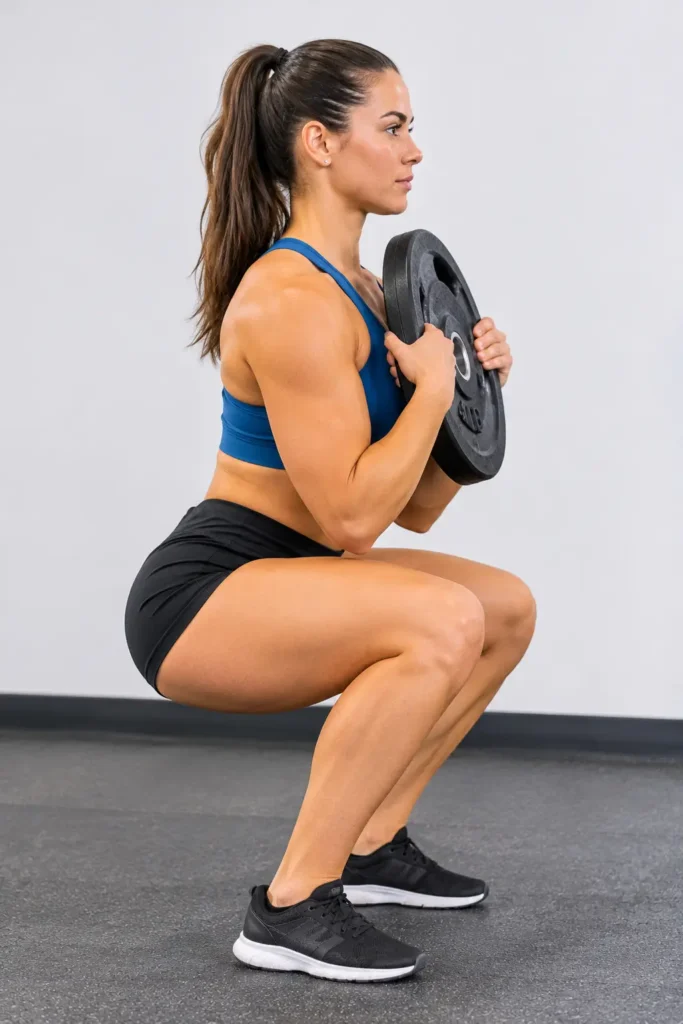
- Hold the plate flat against your chest with both hands, elbows pointing down.
- Stand with your feet about shoulder width apart.
- Lower slowly for three counts, and keep your chest tall.
- Pause for one count at the bottom, then stand up with control.
It should feel like your thighs and glutes are doing the work. Your arms should stay relaxed enough to hold the plate, but not tense.
Easier and Harder Versions
- Easier (regression): Use a 10 lb plate, or sit back to a box. Shorten the range of motion until your form is solid.
- Harder (progression): Move to a 35 lb or 45 lb plate. Or slow the lowering phase to four or five seconds.
Coach’s Tip: Grip the edge of the plate with your fingertips under the rim, not the whole palm. It builds grip strength and keeps the plate from sliding down your chest.
Safety Notes for Lifting and Carrying 45 Lb Plates
Even a single plate can strain your back if you lift it badly. Follow these basics:
- Bend your hips and knees to pick a plate up from the floor. Do not round your back.
- Slide the plate close to your body before you stand.
- Load both sides of the bar evenly. Uneven loading can tip the bar.
- Use collars on every working set.
- Keep your fingers away from the gap between stacked plates.
- Store plates on a tree or in a rack, not leaning on a wall where they could slide.
If you have back pain, a past injury, or a health condition, check with your doctor or a physical therapist before you start heavy lifting.
Related Tips for Home Gym Owners
Buying plates is a real investment, so a few habits save time and money.
- Weigh a sample. A cheap bathroom scale can show whether a plate is far off its label. A difference of a pound or two is normal for iron plates.
- Buy a mix. Pairs of 45s, 25s, and 10s cover most routines. Add 5 lb and 2.5 lb change plates for small jumps.
- Think about floor space. Plates and barbells take space, so plan the room first. Our list of the best apartment workout equipment shows smaller options.
- Match plates to your rack. If you squat or press at home, a sturdy rack matters as much as the plates. See our best squat rack with pull-up bar reviews.
- Know your machine loads. Plate-loaded machines may multiply the weight, so a 45 lb plate can feel very different there. Our leg press machine weight guide explains why.
Frequently Asked Questions
Is a 45 lb plate always exactly 45 lb?
No. Most plates are close but not perfect. Manufacturers allow a weight tolerance, which can be as tight as a few grams on calibrated steel or as wide as plus or minus 3% on standard iron. That means one plate might weigh 43.7–46.4 lb, depending on the type.
How much does a 45 lb plate weigh in kg?
A 45 lb plate weighs about 20.4 kg. The math is 45 times 0.4536. Many people round it to 20 kg in conversation, but a plate stamped 20 kg weighs 44.1 lb, so the two are not interchangeable if you track your lifts closely.
How many 45 lb plates make 225?
Two 45 lb plates on each side of a standard 45 lb barbell make 225 lb. The math is 45 for the bar plus four plates at 45 each, which is 180. That is why lifters call it “two plates” on a bench press.
Do 45 lb plates fit a standard barbell?
They fit Olympic barbells, which have 2-inch (50 mm) sleeves. They do not fit thin 1-inch standard bars, which need plates with a smaller hole. Check the hole size on the plate and the sleeve diameter on the bar before you buy or load.
Is a 45 lb bumper plate the same weight as an iron plate?
The label is the same, but the real weight can differ. Bumpers and iron plates have different tolerances. Bumper plates are also thicker than iron plates for the same weight, so fewer fit on a bar sleeve. Both are still labeled 45 lb.
Is a 45 lb plate heavy for a beginner?
Holding one plate can be hard for a beginner, while a loaded bar at 135 lb is a bigger jump. Beginners usually do better starting lighter. Use a weight that lets you complete 8–12 clean reps, then add small plates as you get stronger.
Conclusion
So, how much does a 45 lb plate weigh? Exactly 45 pounds on the label, about 20.4 kg, and a pair comes to 90 lb. In the real world, expect a spread of roughly 1% to 3% depending on how the plate was made. Remember too that a 20 kg plate is 44.1 lb, which is a quiet trap for anyone switching between systems.
Use the loading chart to plan your barbell work, add small plates when a full jump is too big, and always secure the bar with collars. If you are just starting, build your form first. The plates will still be there when you are ready for them.
