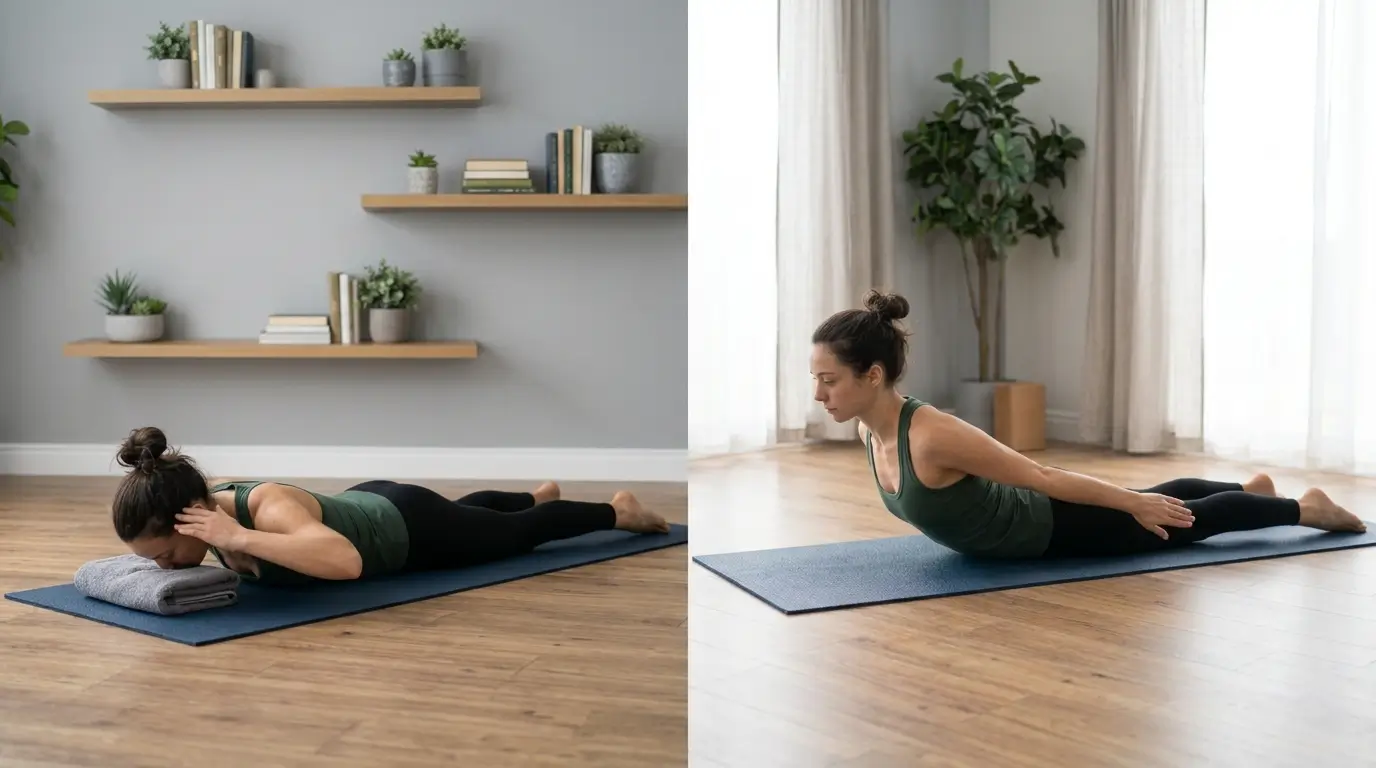
Learning how to do back extensions at home (no machine needed) takes a mat, a few square feet of floor, and about ten minutes. First, the good news: you don’t need a Roman chair, a 45-degree bench, or a gym membership. Instead, your body weight and clean form are enough to train your lower back, glutes, and hamstrings.
The CDC says adults need muscle-strengthening activity on two or more days a week that works all major muscle groups, and it lists the back among them. Floor back extensions meet that goal with zero equipment. Also, they build a stronger base before you move on to hinges, rows, or deadlifts.
Below, you’ll find step-by-step form, sets and reps, common mistakes, easier and harder versions, and a sample workout. In addition, if you enjoy equipment-free training, our calisthenics exercises list makes a good companion.
Quick Answer: Here’s how to do back extensions at home (no machine needed): lie face down, hands at your temples. Squeeze your glutes, lift your chest a few inches, hold two seconds, then lower slowly. Do 2-3 sets of 8-12 reps, two to three days a week. Stop if pain is sharp.
Muscles Worked by Back Extensions at Home (No Machine Needed)
A back extension means raising your torso (or legs) against gravity while you lie face down. Before you learn how to do back extensions at home (no machine needed), it helps to know what is working. As you will see, several muscles share the load.
Primary and secondary muscles
| Muscle | Job during the lift | Role |
|---|---|---|
| Erector spinae (spinalis, longissimus, iliocostalis) | Extends and straightens the spine | Primary |
| Multifidus | Small deep muscles that stabilize each spinal segment | Primary |
| Gluteus maximus | Extends the hip and steadies the pelvis | Primary |
| Hamstrings | Assist hip extension when the legs lift | Primary |
| Lower and middle trapezius, rhomboids | Pull the shoulder blades back and down | Secondary |
| Quadratus lumborum | Stabilizes the side of the lower spine and pelvis | Secondary |
| Transverse abdominis (deep core) | Braces the trunk so the ribs and pelvis stay controlled | Stabilizer |
What the research shows
Researchers have measured this directly. For example, in a 2013 EMG study of healthy adults, the posterior chain muscles worked harder during trunk extension (about 57% of maximum) than during leg extension (about 47%). Likewise, lumbar muscle activity followed the same pattern, at roughly 71% versus 62%.
A separate muscle MRI study of 14 healthy people pointed the same way. Lumbar extensor activity was higher with trunk extension than with leg extension, and higher again when the position was held at the top. As a result, this guide asks for a short pause on every rep.
Do you need a machine to get this effect? Not necessarily. For instance, a 2021 study of resistance-trained women compared the Roman chair, the Romanian deadlift, and a seated back extension machine. Erector spinae activation was similar across all three, while the seated machine produced the lowest glute and hamstring activation. However, keep in mind that EMG studies use small groups, so they show trends rather than guarantees.
Benefits of Back Extensions Without a Machine
When done consistently, floor back extensions may offer several practical benefits. However, expectations should stay realistic, so here are the main ones.
- Stronger spinal muscles. Your erector spinae and multifidus help you stand tall, bend, and carry things. Therefore, training them directly builds the strength those tasks rely on.
- Better hip support. Because the glutes and hamstrings assist, this movement also helps with walking, stair climbing, and lifting.
- Possible back-pain support. For example, the Mayo Clinic notes that exercise often helps ease back pain and prevent further discomfort. However, pain has many causes, so read the safety section before you start.
- Posture support. Strong back muscles help you hold a tall position longer. Meanwhile, some people try posture corrector options as a reminder, but strength work builds the muscles behind good posture.
- Bone-health relevance. Mayo Clinic researchers report that improving back strength is linked to a lower risk of vertebral fractures, back pain, and kyphotic posture in people with osteoporosis. Still, anyone with bone loss should get medical guidance first.
- Low cost, easy scaling. A mat is enough. Then you adjust difficulty with pauses, arm position, and added load.
How to Do Back Extensions at Home (No Machine Needed): Step-by-Step Form
What you need
You need an exercise mat or carpeted floor, a folded towel about 1 inch (2.5 cm) thick for your forehead, and roughly 3 by 7 feet (0.9 by 2.1 m) of space. In addition, if you are building a small-space setup, our apartment workout equipment guide has compact ideas.
Step-by-step form
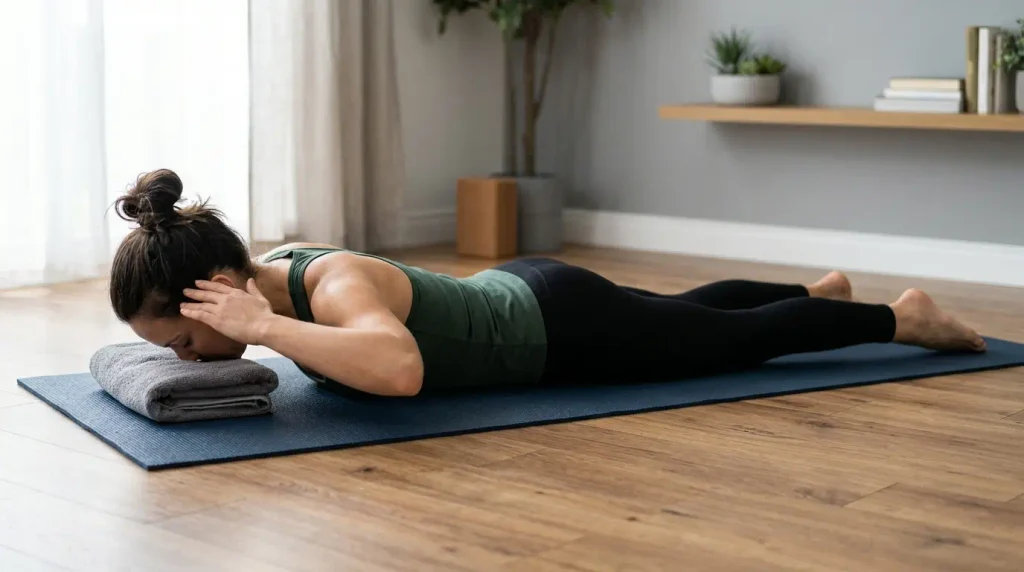
- Set up. First, lie face down with your legs straight and about hip-width apart. Then rest your forehead on the towel and place your hands lightly beside your temples, elbows wide.
- Find neutral. Next, look at the floor with a slight chin tuck. As a result, your neck stays in line with your spine for the whole set.
- Brace. Gently squeeze your glutes and draw your lower belly slightly away from the floor. Think 20% effort, not a hard clench.
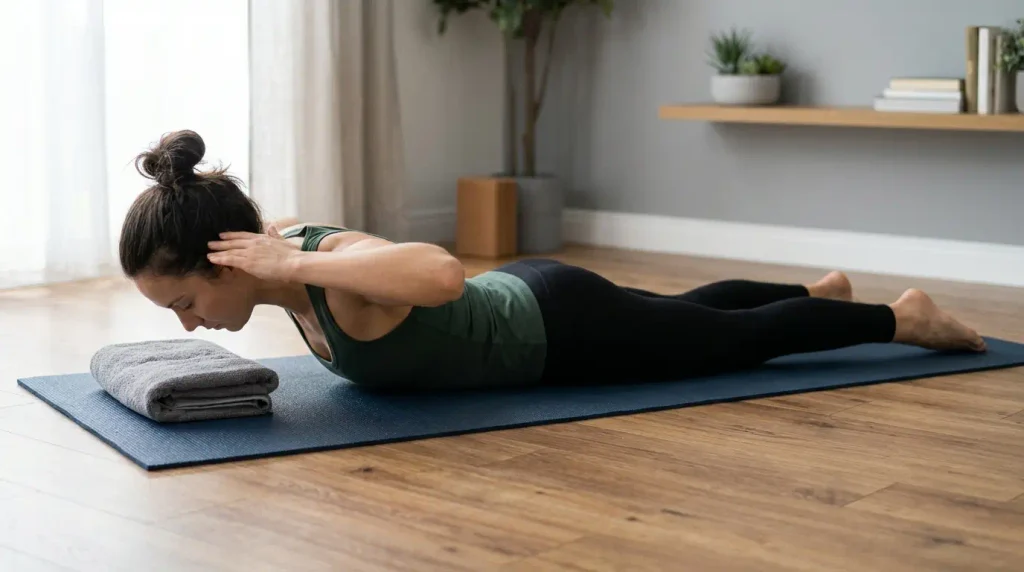
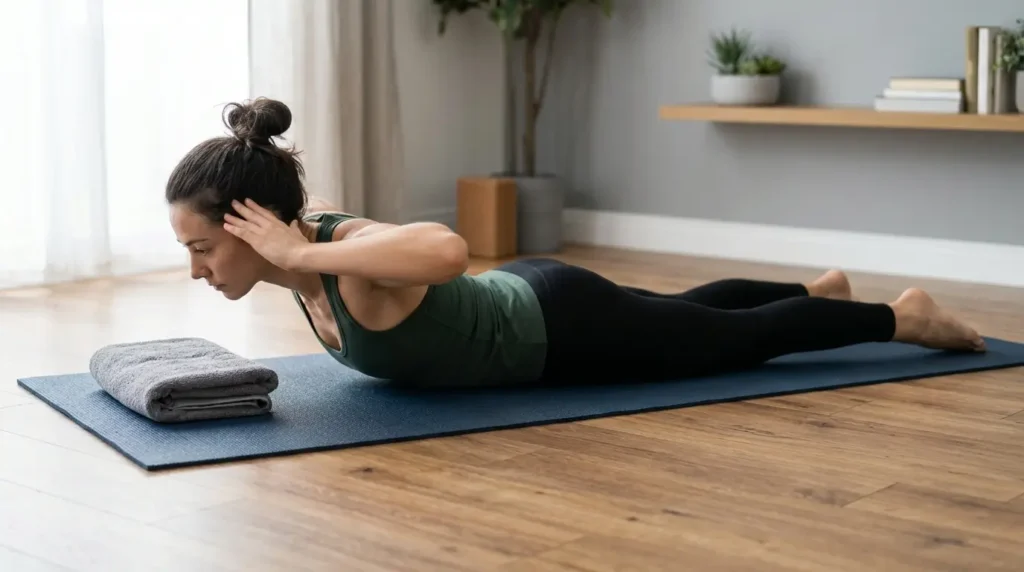
- Lift. After that, raise your head, chest, and ribs 3-6 inches (8-15 cm) by squeezing the muscles beside your spine. Meanwhile, keep your legs on the floor for the basic version.
- Pause. Hold for one to two seconds. Your ribs, not your chin, should lead the movement.
- Lower. Finally, return slowly over about three seconds until your chest touches down.
- Repeat. Breathe out as you rise and in as you lower. Above all, don’t hold your breath.
Aim for a 2-1-3 tempo: two seconds up, one second hold, three seconds down. Because this pace is slow, it keeps momentum out of the movement.
What it should feel like
Expect a warm, working sensation in the muscles beside your spine and in your glutes. However, you should not feel pinching, sharp pain, or tingling in your lower back.
Coach’s Tip: Think “lengthen,” not “lift.” Imagine pulling the crown of your head away from your feet as you rise. This cue stops you from cranking your neck or jamming your lower spine. As a result, even a 3-inch (8 cm) lift feels surprisingly hard.
Sets, Reps, and Rest for Back Extensions at Home (No Machine Needed)
The right dose depends on your goal, and it is a key part of how to do back extensions at home (no machine needed). For context, the ACSM position stand on progression recommends 2 to 3 training days per week for novices, with loads in an 8-12 repetition range. It also suggests raising load by about 2-10% once you can beat your target reps by one or two. In contrast, for muscular endurance, it points to lighter loads, higher reps, and short rests.
| Goal | Sets | Reps or hold | Rest | Days per week |
|---|---|---|---|---|
| Learn the form (beginner) | 2 | 6-8 reps, 2-second pause | 60 sec | 2 |
| Muscle (size) | 3 | 8-12 reps, 3-second lowering | 60-90 sec | 2-3 |
| Strength | 3-4 | 5-8 reps holding a 10-20 lb (4.5-9 kg) backpack at chest | 90-120 sec | 2 |
| Endurance | 2-3 | 15-20 reps or 20-30 sec holds | 30-60 sec | 2-3 |
Progress one variable at a time. First add reps, then pauses, then a longer lever (arm position), and only then load. Also leave at least one rest day between sessions. Similarly, the recovery logic in our guide on whether you can do squats every day applies here.
Common Mistakes When Doing Back Extensions at Home (No Machine Needed)
Most form problems come from trying to go too high, too fast. Therefore, to master how to do back extensions at home (no machine needed), fix these six first.
- Craning the neck. Looking forward shortens the back of your neck. Fix: keep your eyes on the floor and your chin slightly tucked.
- Lifting too high. Past about 6 inches (15 cm), you mostly crank the lower spine instead of using your muscles. Fix: stop when your ribs are clear of the floor, then hold there.
- Using momentum. Swinging up and dropping down removes the work from the muscles. Fix: use the 2-1-3 tempo.
- Holding your breath. This raises tension and cuts your reps short. Fix: exhale as you rise.
- Doing too much, too soon. For example, three sets of 20 on day one often brings next-day soreness. Fix: start with two sets of 6-8 reps.
- Letting the legs splay. Wide, rotated legs shut off your glutes. Fix: keep legs straight, hip-width apart, and squeeze your glutes lightly.
Common Mistake: Treating a bigger arch as a better rep. A back extension is not a backbend. Instead, move from a flat torso to a neutral, straight line, then lower with control. In fact, more range does not mean more muscle work.
Back Extension Variations: Easier to Harder
Use the version that lets you finish every rep with good form. Then, when a level feels easy for all sets, move up one step.
| Level | Variation | Dose |
|---|---|---|
| Easier | Sphinx hold: lie on your forearms, elbows under shoulders | 3 x 20-30 sec |
| Easier | Mini lift: arms by your sides, lift only 2-3 inches (5-8 cm) | 2 x 8 |
| Standard | Hands at temples, chest lift | 2-3 x 8-12 |
| Harder | Hands behind head, slower tempo | 3 x 10 |
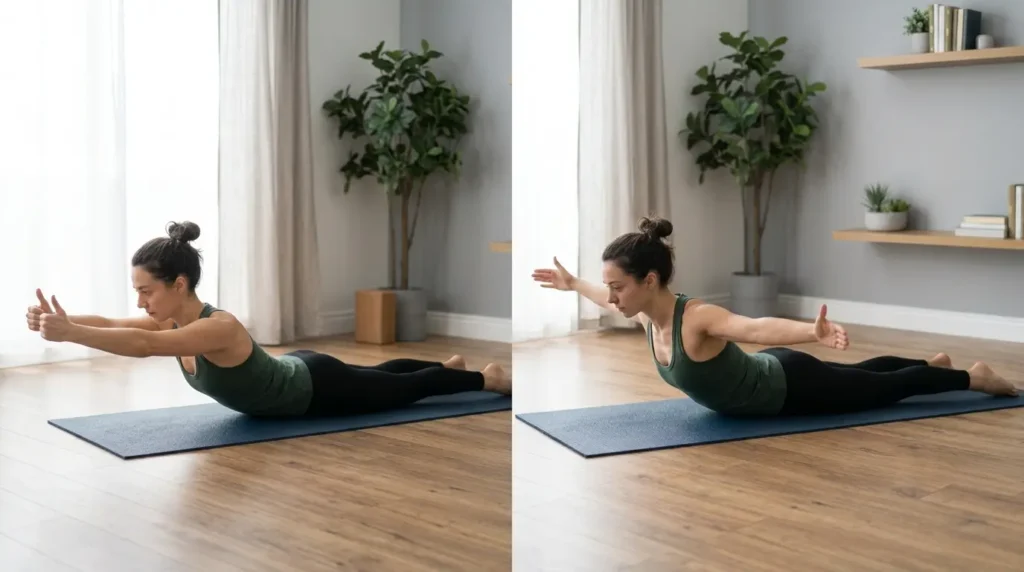
| Harder | “Y” position: arms overhead in a long lever | 3 x 8 |
| Harder | Top-position hold (a Sorensen-style hold) | 3 x 20-30 sec |
| Harder | Weighted: backpack or book at chest, 5-10 lb (2.3-4.5 kg) | 3 x 8 |
| Hardest | Full superman: lift arms and legs together | 3 x 8-10 |
Easier versions
The sphinx hold is the best starting point if you feel stiff or unsure. It keeps your spine in gentle extension with very little load. After that, progress to the mini lift to learn the glute squeeze.
Harder versions
Moving your arms overhead lengthens the lever, so the same movement feels much heavier. In addition, a two-second pause at the top raises the challenge. Similarly, a loaded backpack is a simple way to apply the ACSM idea of progressive overload.
Bed-edge back extension (advanced)
Once the floor versions feel easy, you can place your hips on the edge of a firm bed or sturdy bench about 18-20 inches (45-50 cm) high, with your feet anchored by a partner. Then lower slowly and rise only until your body forms a straight line. Never swing past that line. However, if you can’t anchor your feet safely, skip this version.
Alternatives to Back Extensions (No Equipment, Dumbbell, Band, Machine)
Variety keeps training fun and loads your back from other angles. For example, the bridge adds more hip work. In fact, a 2015 EMG study in the Journal of Physical Therapy Science noted that bridging combines hip extension with back extensor work, while the Sorensen hold suits thoracic extension.
No-equipment, dumbbell, and band options
| Type | Exercise | Best for | Starter dose |
|---|---|---|---|
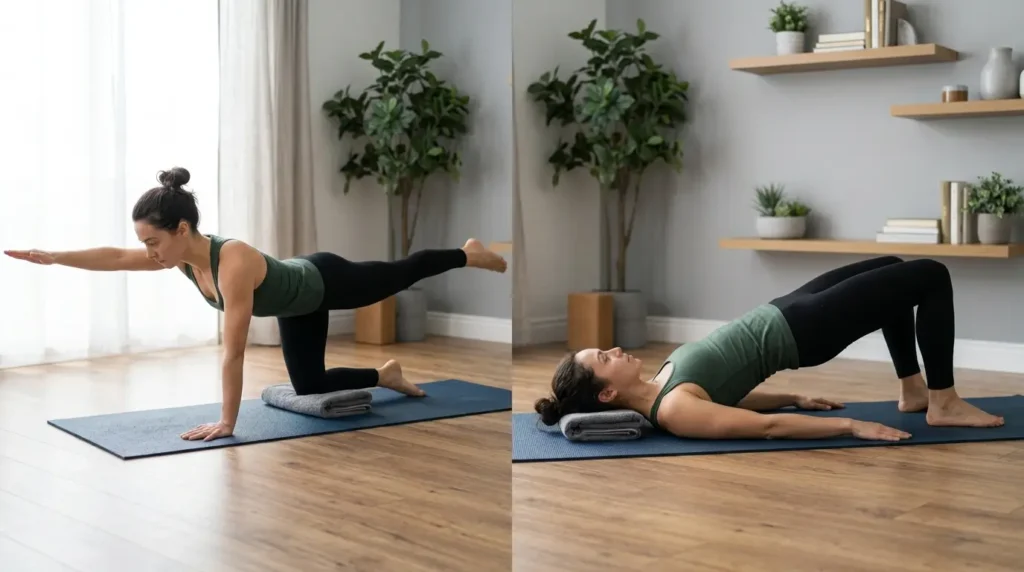
| No equipment | Bird dog | Spine stability, coordination | 2 x 6-8 per side |
| No equipment | Glute bridge | Glutes and hamstrings | 3 x 10-12 |
| No equipment | Prone “T” and “Y” raises | Upper back and shoulder blades | 2 x 8-10 |
| Dumbbell | Romanian deadlift | Hip hinge, hamstrings, glutes | 3 x 8-10 with 10-25 lb (4.5-11 kg) |
| Dumbbell | Good morning (light) | Hip hinge and spinal control | 2 x 10 with 5-10 lb (2.3-4.5 kg) |
| Band (cable swap) | Band pull-through | Glutes and hips | 3 x 10-12 |
| Band | Band good morning | Hip hinge with a light load | 2 x 12 |
| Machine/gym | Roman chair (45-degree) | Heavier, longer-range loading | 3 x 8-12 |
| Machine/gym | Reverse hyper | Glutes and low back | 3 x 10-12 |
Hip-hinge and hold options
If you own a kettlebell, you can also train the same posterior chain through swings. Our article on whether kettlebell swings work abs explains how the hinge pattern loads the trunk. In addition, quiet holds work well for the legs, so see our list of isometric leg exercises for ideas.
Gym machines
If you later join a gym, the Roman chair is a natural next step. For instance, in the 2021 study of resistance-trained women mentioned earlier, the Roman chair produced higher glute and hamstring activation than the seated machine. That said, you can build a solid base at home first.
Who Should Be Careful With Back Extensions
Back extensions suit many healthy adults. However, they are not right for everyone, so check with a doctor or physical therapist first if you have any of the following:
- Current or recent back pain, a past disc problem, or a diagnosed spine condition
- Pain, numbness, or tingling that travels into a leg
- Osteoporosis or low bone density
- Pregnancy or recent childbirth (lying face down is often uncomfortable, so ask your provider about alternatives)
- A recent surgery or injury
- Age 65 or older with any medical condition
For example, the Mayo Clinic advises that if you are starting exercise because of ongoing back pain or after a back injury, you should talk to a physical therapist or another member of your healthcare team. The same advice applies here.
Osteoporosis deserves a special note. Mayo Clinic researchers have studied progressive back-strengthening programs in postmenopausal women, but those programs were carefully dosed and supervised. Therefore, don’t copy a protocol from the internet. Instead, ask your doctor what intensity is safe for you.
Stop the exercise if you feel sharp pain, pinching, numbness, tingling, or pain that spreads into your buttock or leg. Muscle soreness is normal, but nerve-like or sharp pain is not.
Sample Workout: Back Extensions at Home (No Machine Needed)
This 25-30 minute session puts how to do back extensions at home (no machine needed) into practice and also works your core. Therefore, do it two or three non-consecutive days a week.
Warm-up
Spend five minutes on cat-cow x 8, glute bridge x 10, bird dog x 6 per side, and 30 seconds of easy walking in place. Afterward, you will be ready for the main work.
The workout
| Exercise | Sets | Reps | Rest |
|---|---|---|---|
| Floor back extension (standard) | 3 | 8-10, 2-sec pause | 60 sec |
| Bird dog | 2 | 6-8 per side, 2-sec hold | 45 sec |
| Glute bridge | 3 | 10-12 | 45-60 sec |
| Prone “Y” raise | 2 | 8-10 | 45 sec |
| Dead bug (core balance) | 2 | 6-8 per side | 45 sec |
Back work should not stand alone. For example, to keep the front and back of your trunk balanced, add some ab training tips. Likewise, on other days, include pulling moves, since it helps to know what muscles pull-ups work so you can cover your upper back as well.
Cool-down
Finish with child’s pose for 30 seconds, then a gentle knee-to-chest stretch for 20-30 seconds per side. Meanwhile, breathe slowly.
Four-week plan
| Week | Back extension dose | Change |
|---|---|---|
| 1 | 2 x 6 | Learn the 2-1-3 tempo |
| 2 | 2 x 8 | Add a 2-second pause |
| 3 | 3 x 8 | Move hands behind head |
| 4 | 3 x 10 | Try the “Y” arm position or a light backpack |
If any week feels too hard, repeat it. After all, progress works best when it is steady, not rushed.
FAQ
Can you do back extensions without a machine?
Yes. Floor-based versions train your spinal extensors, glutes, and hamstrings with body weight alone. Then you can raise difficulty with pauses, longer levers, or a loaded backpack. For best results, start with two sets of six to eight slow reps and add volume gradually each week.
How many back extensions should I do?
Most beginners do well with two sets of six to eight controlled reps, two or three non-consecutive days per week. ACSM suggests 2 to 3 training days weekly for novices. Then add reps or sets slowly. However, if your lower back feels sore the next day, repeat the same workload before progressing, and stop if pain is sharp.
Are back extensions good for lower back pain?
They may help some people, but pain varies by cause. For example, the Mayo Clinic says exercise often helps ease back pain, yet it advises talking with a physical therapist or healthcare provider first if you have ongoing pain or a past injury. Therefore, stop immediately if the movement causes sharp pain, numbness, or leg symptoms.
Are floor back extensions as good as a Roman chair?
They are different tools. A Roman chair allows a longer range of motion and easier loading, while floor versions are simpler to learn. For instance, in a study of resistance-trained women, the Roman chair produced higher glute and hamstring activation than a seated machine. Still, for most home exercisers, floor work plus progressions is a smart starting point.
What can I use instead of a back extension machine?
Try prone floor extensions, the bird dog, glute bridges, band good mornings, or dumbbell Romanian deadlifts. Each trains the posterior chain without a machine. Next, choose one extension-style move and one hip-hinge move per session. Finally, use a loaded backpack, resistance band, or household dumbbells to add challenge as you improve.
Is it okay to do back extensions every day?
Light, pain-free sets may be fine for some people, but daily training leaves little recovery time for your spinal muscles. Therefore, most programs do better with two or three sessions weekly, with rest days in between. If you want daily movement, alternate with walking or gentle mobility work, and ask a clinician if you have back problems.
Conclusion: How to Do Back Extensions at Home (No Machine Needed)
Now you know how to do back extensions at home (no machine needed). First, start on the floor, keep your neck long, lift only until your ribs clear the mat, and lower slowly. Then begin with two sets of six to eight reps, and progress through pauses, arm positions, and light load.
Consistency beats intensity here. Therefore, two or three short sessions a week, paired with core and pulling work, will cover the muscles that keep your spine strong and stable. However, if you have pain, bone loss, or a medical condition, check in with a professional before you start.
