Can you build muscle after 50? Yes, you can, and the research is encouraging. A meta-analysis of adults 50 and older found that resistance exercise improves muscular strength, especially when the training is hard enough to challenge you. Other research suggests that even a small amount of training may improve lean mass and muscle size in healthy older adults.
Still, the rules change a little with age. Muscle responds more slowly, joints need more care, and recovery takes longer. That does not mean you should avoid the weight room. It means you should train smarter.
This guide explains what happens to muscle as you age, what results are realistic, and how to set up a safe weekly plan. You will also get a sample workout, protein and supplement basics, and clear answers to common questions.
Quick Answer: Yes, you can build muscle after 50. Research suggests resistance training improves strength and may add lean mass at any age. Train two to three full-body days a week, use weights that make the last few reps hard, add load slowly, eat enough protein, and rest a day or two between sessions for the same muscles.
Can You Build Muscle After 50? What the Science Says
What Happens to Muscle as You Age
Muscle mass peaks in young adulthood, at about age 30. After that, muscle loss is steady, roughly 5% per decade in men and usually somewhat less in women, according to a review of long-term studies.
A separate review reports that relative muscle mass falls by 30–50% by age 80. The same review says muscle power drops about 10–15% per decade until age 70, then may fall 25–40% per decade. This age-related loss is called sarcopenia.
Notice the word “may.” These figures are averages, and they depend on genetics, health, and activity. However, the National Strength and Conditioning Association (NSCA) points out that countering muscle disuse with resistance training is a powerful way to fight this loss.
Why Older Muscle Still Responds to Training
The good news is that older muscle still adapts. In the meta-analysis of adults 50 and older, higher-intensity training gave the best strength gains. In addition, the NSCA position statement describes resistance training as helpful for mobility, independence, and quality of life.
Training volume matters too. A network meta-analysis of 151 trials in adults 60 and older found that a low volume of training can improve physical function, lean mass, and muscle size. However, a higher volume seemed necessary for bigger strength gains.
Strength training may also help your bones. Mayo Clinic notes that it may help protect against age-related loss of bone strength. As a result, lifting is about more than looking muscular.
In plain terms, you do not need marathon gym sessions. You need consistent, well-planned work that gets harder over time.
What Building Muscle Looks Like After 50
Expect results to show up in three ways. First, you will probably get stronger. Second, daily tasks such as climbing stairs or carrying groceries may feel easier. Third, with steady training and good nutrition, your muscles may grow a little.
Progress is rarely a straight line, so give any new plan 8 to 12 weeks before you judge it. Track strength and function, not just the mirror. Useful markers include:
- The weight you can use for 10 clean reps on a goblet squat
- How many times you can stand up from a chair in 30 seconds
- How long you can carry a bag in each hand
- How you feel climbing one flight of stairs
Training Guidelines to Build Muscle After 50 at a Glance
The NSCA position statement outlines ranges such as 8–10 exercises per session, up to three sets of 8–12 reps, and three sessions per week, with loads that move from light to heavy over time [VERIFY exact figures against the full text]. The CDC recommends muscle-strengthening on at least 2 days a week, taken to the point where another rep is hard to do without help.
Here is how a coach would turn those ranges into a simple plan:
| Variable | Beginner (first 8–12 weeks) | Experienced (6+ months) |
|---|---|---|
| Days per week | 2 | 3 |
| Exercises per session | 6–8 | 8–10 |
| Sets per exercise | 1–2 | 2–3 |
| Reps per set | 10–15 | 6–12 |
| Effort | Stop 3 reps before failure | Stop 1–2 reps before failure |
| Rest between sets | 60–90 seconds | 90–120 seconds |
| Progression | Add reps first | Add 2.5–5 lb (1–2.5 kg) when you hit the top reps |
How to Build Muscle After 50: A Simple Weekly Plan
Set Your Training Frequency
Start with two full-body days per week, such as Monday and Thursday. After four to six weeks, add a third day if you recover well. Full-body sessions work well because each muscle gets trained several times a week.
Leave at least one rest day between sessions. For example, a Monday, Wednesday, Friday schedule gives every muscle group a day or two to recover.
Build Each Session Around Compound Exercises
Compound lifts train several joints and muscles at once, so they give you the most return for your time. Aim to cover five movement patterns each week:
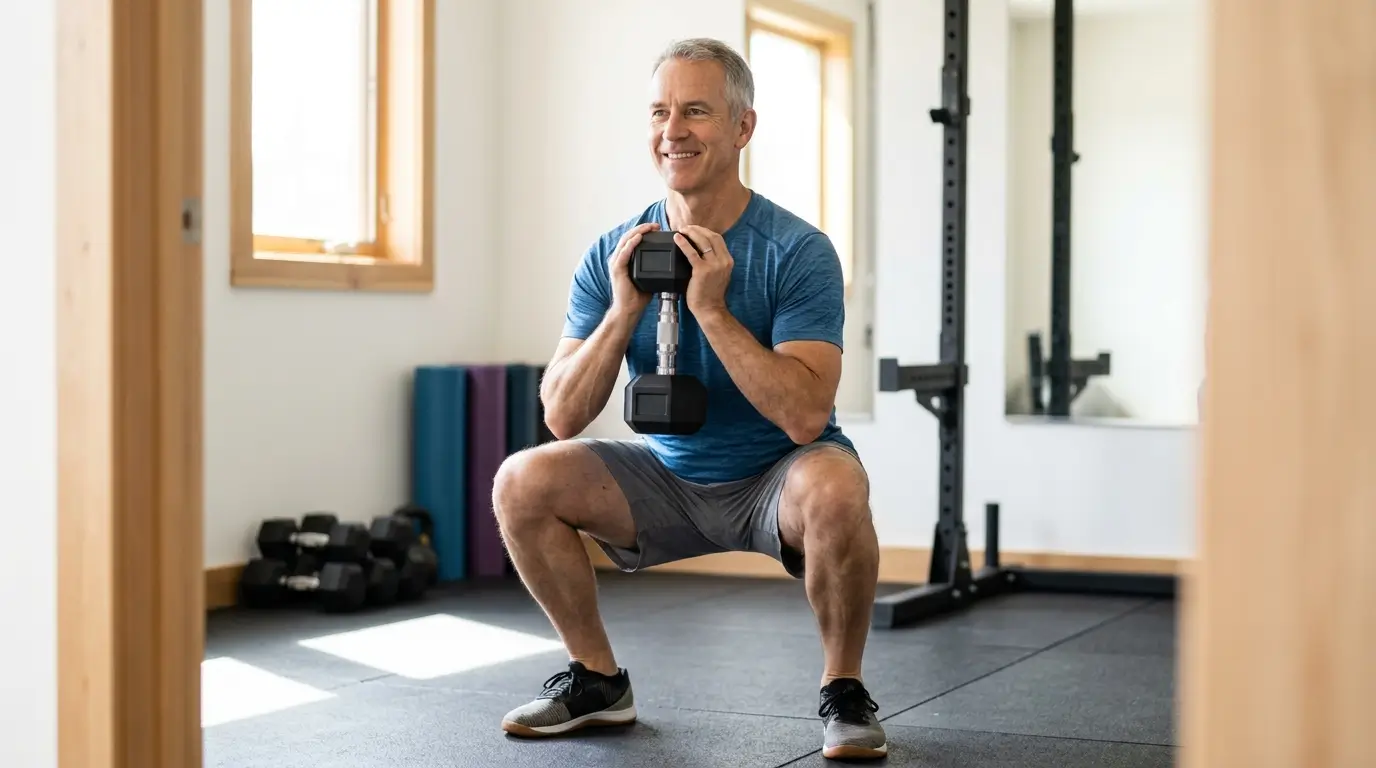
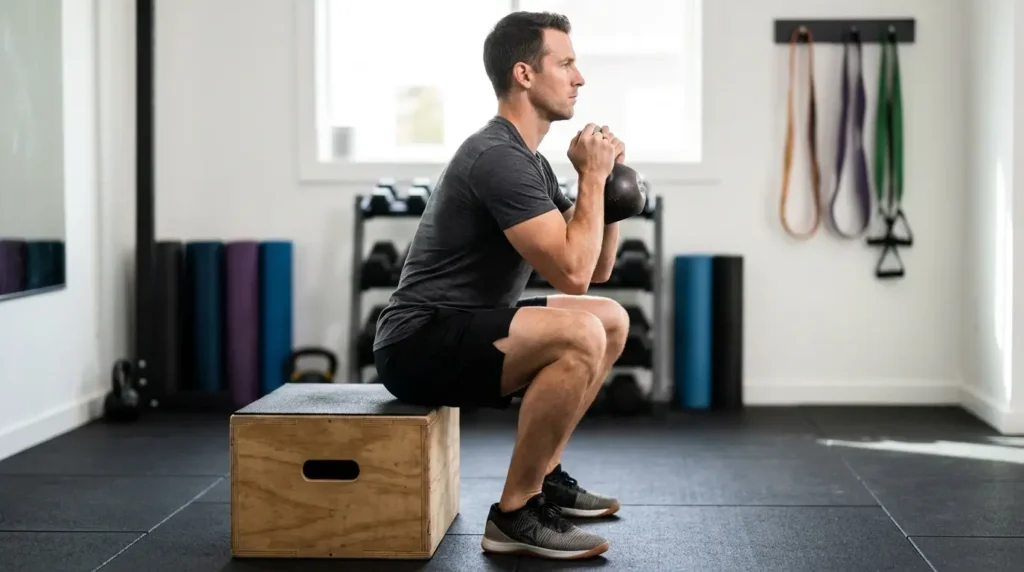
- Squat: goblet squat, sit-to-stand, or leg press
- Hinge: Romanian deadlift or glute bridge
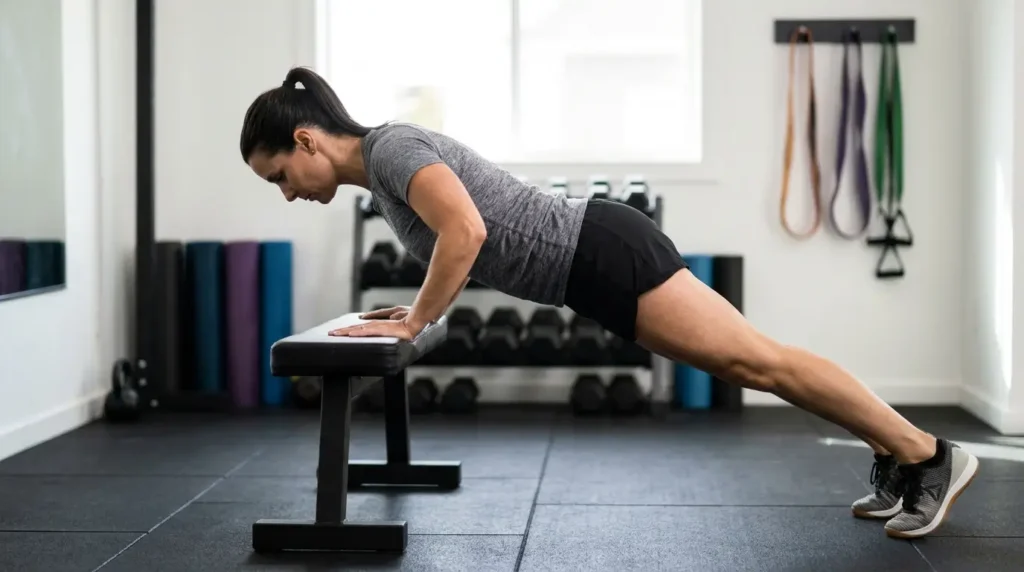
- Push: incline push-up, dumbbell chest press, or overhead press
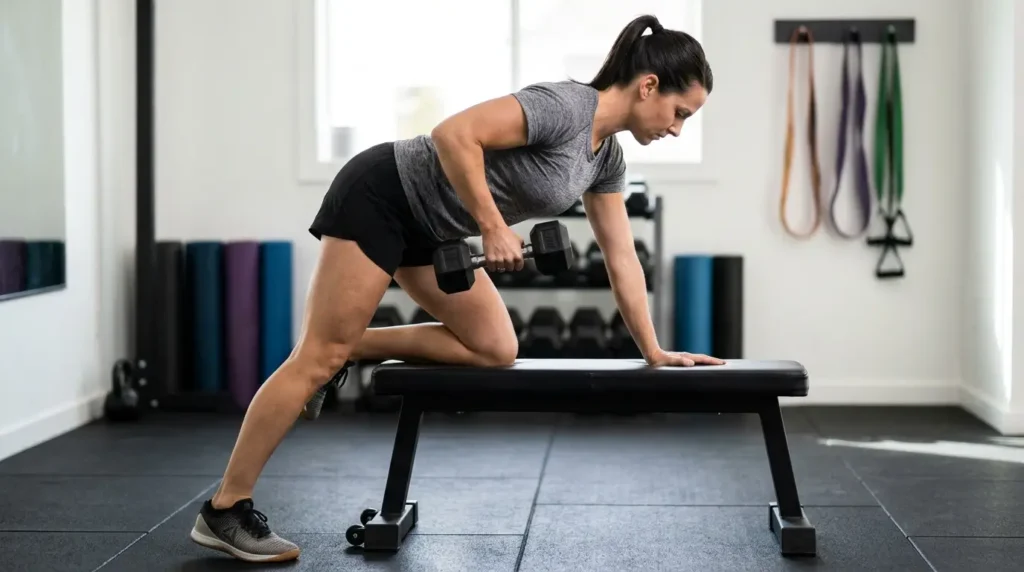
- Pull: one-arm row, band row, or lat pulldown
- Carry and core: farmer’s carry and plank
If you wonder how often to squat, our guide on doing squats every day explains why rest still matters. For pulling strength, try this dumbbell-only back day. For pressing, see these exercises for a bigger chest.
Choose Reps, Effort, Tempo, and Rest
Use a weight that lets you finish every rep with good form but makes the last two or three reps hard. Coaches call this “reps in reserve.” You should feel like you could do two or three more reps, but not many more. The NSCA statement is summarized as saying that training to failure has not been shown to add extra benefit in older adults [VERIFY].
Tempo also matters. Lift the weight in about two seconds, pause for one, and lower it in about three. Slow lowering keeps tension on the muscle and protects your joints from sudden jerks.
Finally, rest 60–90 seconds between lighter sets and up to two minutes between heavy sets. Use the extra time to breathe and reset your posture.
Use Progressive Overload
Muscle grows when the work gets slightly harder over time. This idea is called progressive overload. Use this simple rule: when you can complete all sets at the top of your rep range with good form, add weight next session.
For most dumbbell exercises, that means adding 2.5–5 lb (1–2.5 kg) per hand. If the jump feels too big, add one rep per set instead. If you train at home, adjustable dumbbells make these small jumps easy.
Coach’s Tip: Write down every workout. Record the exercise, weight, sets, and reps. Next session, your goal is simple: beat one number by a small amount. A log keeps you honest and shows progress that the mirror may not.
Common Mistake: Jumping to heavy weights in the first month. Tendons and joints adapt more slowly than muscles, so too much load too soon can cause elbow, shoulder, or knee pain. Fix it by starting with weights that feel easy for the first two weeks, then building up.
Sample 3-Day Workout
Alternate Workout A and Workout B. In week one, do A, B, A. In week two, do B, A, B. Warm up first with 5–10 minutes of brisk walking or easy cycling and a few light sets of your first exercise.
Workout A
| Exercise | Sets | Reps | Rest | Starting weight |
|---|---|---|---|---|
| Goblet squat | 3 | 8–12 | 90 sec | 10–20 lb (4.5–9 kg) |
| Dumbbell Romanian deadlift | 3 | 10 | 90 sec | 10–25 lb (4.5–11 kg) each hand |
| Incline push-up | 3 | 8–12 | 60 sec | Body weight |
| One-arm dumbbell row | 3 | 10 each side | 60 sec | 10–20 lb (4.5–9 kg) |
| Seated dumbbell overhead press | 2 | 10 | 60 sec | 5–15 lb (2.3–6.8 kg) each hand |
| Plank | 2 | 20–40 sec | 45 sec | Body weight |
Workout B
| Exercise | Sets | Reps | Rest | Starting weight |
|---|---|---|---|---|
| Leg press or step-up | 3 | 10–12 | 90 sec | Light; add weight slowly |
| Glute bridge or hip thrust | 3 | 10–12 | 60 sec | Body weight or 10–25 lb (4.5–11 kg) |
| Dumbbell chest press | 3 | 8–12 | 90 sec | 10–20 lb (4.5–9 kg) each hand |
| Lat pulldown or band row | 3 | 10–12 | 60 sec | Light to moderate |
| Standing calf raise | 2 | 12–15 | 45 sec | Body weight |
| Farmer’s carry | 3 | 30–40 sec | 60 sec | 15–25 lb (6.8–11 kg) each hand |
These starting weights are examples only. Choose a load that fits the effort rules above. If you use machines, our review of the best leg press machines can help you pick one.
Easier and Harder Versions
| Exercise | Easier (regression) | Harder (progression) |
|---|---|---|
| Goblet squat | Sit-to-stand from a chair, no weight | Heavier dumbbell or 3-second lowering |
| Romanian deadlift | Hip hinge with a broomstick | Heavier dumbbells or single-leg version |
| Incline push-up | Hands on a counter, about 36 inches (91 cm) high | Hands on a bench, about 16–18 inches (41–46 cm) high, then floor |
| One-arm row | Seated band row | Heavier dumbbell with a 1-second pause at the top |
| Overhead press | Lighter weight or band press | Standing press with heavier dumbbells |
| Plank | Hands on a counter | Longer holds or shoulder taps |
If calisthenics appeal to you, this 12-week calisthenics program offers more bodyweight options.
Form Cues for Three Key Lifts
Goblet squat
- Hold one dumbbell against your chest with both hands, elbows pointing down.
- Stand with feet slightly wider than shoulder width, toes turned out a little.
- Sit down and back, keeping your chest tall, until your thighs are near parallel to the floor or as deep as feels comfortable.
- Push through your whole foot to stand. You should feel it in your thighs and glutes.
One-arm dumbbell row
- Place one hand and the same-side knee on a bench. Keep your back flat.
- Let the dumbbell hang with your arm straight.
- Pull your elbow toward your hip, as if starting a lawn mower.
- Pause briefly, then lower for three seconds. You should feel your upper back and the side of your torso working.
Incline push-up
- Place your hands on a sturdy counter or bench, slightly wider than your shoulders.
- Make a straight line from head to heels.
- Lower your chest toward the surface with elbows at about a 45-degree angle.
- Press back up without letting your hips sag.
Protein, Food, and Supplements for Muscle After 50
Food supports training, but the research on protein is mixed. A meta-analysis found that protein supplements enhanced strength and size gains from resistance training in healthy adults. However, a review of nonfrail older adults found no extra gains from protein supplementation compared with control conditions.
So what should you do? Put a protein food, such as fish, eggs, yogurt, beans, or chicken, in each meal before you buy a powder. A doctor or registered dietitian can set a target that fits your health, especially if you have kidney disease or take medicines.
Creatine gets a lot of attention. A meta-analysis in Medicine & Science in Sports & Exercise suggests that adding creatine to resistance training may increase muscle mass, strength, and function in older adults. The authors also said more research is needed. Talk to your doctor before taking any supplement.
Recovery, Soreness, and Rest Days
Some muscle soreness is normal when you start. It usually peaks a day or two after training and fades. Sharp joint pain, pain that lingers for days, or pain that changes how you move is different. Stop that exercise and ask a physical therapist or doctor about it.
Warm up before every session. Five to ten minutes of easy movement raises your body temperature and prepares your joints. In addition, give each muscle group at least a day of rest between hard sessions.
Meanwhile, keep moving on off days. Easy walking helps you feel looser and keeps your routine consistent.
Who Should Be Careful
Check with your doctor or physical therapist before you start, especially if you have heart disease, high blood pressure, osteoporosis, joint replacements, balance problems, recent surgery, or ongoing pain. Women going through menopause should also ask about any symptoms that affect training.
Breathe steadily while you lift. Exhale as you push or pull, and inhale as you lower. Holding your breath can raise blood pressure and make you dizzy.
Stop and seek medical help if you feel chest pain, severe shortness of breath, dizziness, or sudden sharp pain. Learn the exercises with light weights first, and consider a few sessions with a qualified trainer or physical therapist.
Cardio, Balance, and Gear That Support Muscle Gains
Muscle is only one part of fitness. The CDC says adults 65 and older need aerobic, muscle-strengthening, and balance activities each week. Aim for the aerobic target of 150 minutes of moderate activity, which is about the effort of brisk walking.
A brisk 30-minute walk covers roughly 1.5 to 2 miles (2.4 to 3.2 km). Our summary of the 10,000 steps research can help you set a daily target. If your knees prefer low impact, see these stationary bikes for older adults.
For balance work, begin with heel-to-toe walking or standing from a chair. Then you can explore tools like the BOSU ball, but only after you feel steady on the floor.
At home, you need very little: a pair of dumbbells or an adjustable set, a few resistance bands, a sturdy chair, and a bench or counter. Skip the gadgets until your routine is a habit.
Frequently Asked Questions
Is it too late to build muscle at 50?
No. Research on adults 50 and older shows that resistance exercise improves strength, and the NSCA calls resistance training a powerful tool against age-related muscle loss. Start light, learn good form, and build up slowly. Ask your doctor first if you have health conditions.
How many days a week should I lift weights after 50?
The CDC recommends muscle-strengthening at least two days a week for older adults, and many programs use two to three full-body sessions. Beginners can start with two, then add a third if recovery feels good. Leave at least one rest day between sessions.
How much protein do I need to build muscle after 50?
Research is mixed. Protein supplements helped healthy adults gain more from lifting, yet a review of nonfrail older adults found no extra benefit. A practical approach is to include a protein food at every meal. Ask your doctor or dietitian for a personal target.
Can you build muscle after 60 or 70?
It is possible. A review of 151 trials in adults 60 and older found that resistance training improved physical function, lean mass, and muscle size. Progress may be slower, so start gently, focus on form, and increase the load gradually. Check with your doctor first.
Do I need heavy weights to build muscle after 50?
Not at first. Start with loads you can lift for 10–15 clean reps. Over time, higher-intensity training gave bigger strength gains in a meta-analysis of adults 50 and older, so heavier loads help later. Increase weight slowly and keep your form strict.
Does creatine help adults over 50?
It may. A meta-analysis of older adults found that creatine plus resistance training may improve muscle mass, strength, and function more than training alone, but the authors called for more research. Ask your doctor before using it, especially if you have kidney concerns.
Conclusion: Can You Build Muscle After 50?
So, can you build muscle after 50? Yes, and the research supports it. Age slows the process, but it does not close the door. Strength, function, and often muscle size can all improve when you train with a plan.
To get started, remember three steps. First, lift two to three days a week with compound exercises. Second, make each session slightly harder over time. Third, support your training with protein foods, easy cardio, and rest.
Be patient, keep a log, and stay consistent for at least 8 to 12 weeks. Ask your doctor or physical therapist before you begin, then take the first step this week. Your future self will thank you.