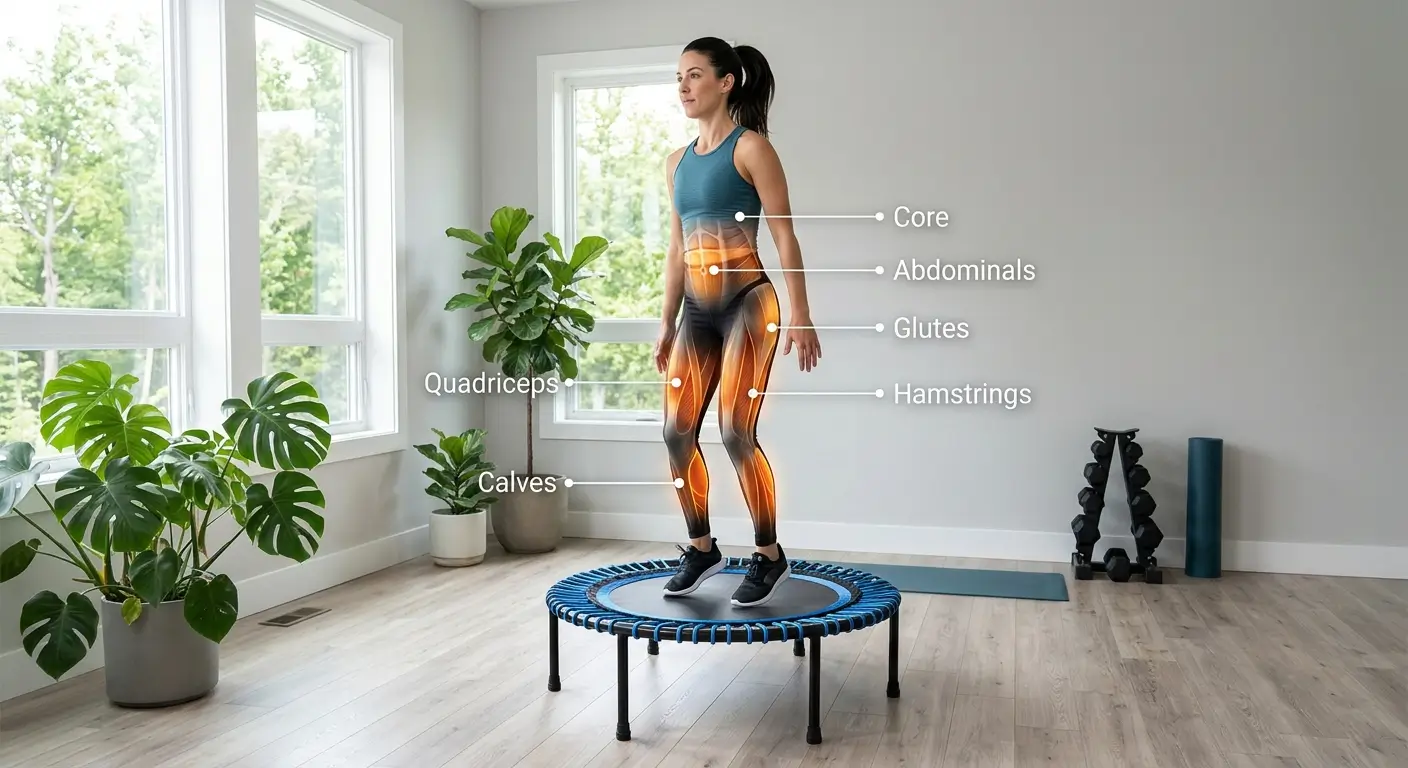
What muscles does a rebounder work? Far more than most people expect. A rebounder looks like a toy, but step on it and bounce for five minutes, and your legs, core, and breathing tell a different story. The soft, springy mat moves under your feet on every bounce, so your body reacts each time, and dozens of muscles switch on to keep you upright.
The answer is more than “legs.” The soft, springy mat moves under your feet on every bounce. Your body has to react each time, so dozens of muscles switch on to keep you upright. This guide breaks down exactly what muscles a rebounder works, how to train them, and how to build a safe routine.
Quick Answer: What Muscles Does a Rebounder Work?
A rebounder works your quads, glutes, hamstrings, and calves most. Your core muscles and the small stabilizers in your feet, hips, and back work hard to keep you balanced on the moving mat. Your arms and shoulders join in when you add arm swings or light hand weights.
What Muscles Does a Rebounder Work? Primary Movers
So, what muscles does a rebounder work hardest? The lower body comes first.” Then keep the existing text. When people ask what muscles a rebounder works, the lower body comes first. Every bounce is a small jump and landing, so your legs do the pushing and the absorbing.
Quadriceps
Your quads sit on the front of your thigh. They straighten your knee when you push off the mat. They also lower you gently when you land, which is a controlled, “braking” action. This landing job is why your thighs often feel warm after a short session.
Glutes
Your glutes extend your hips and help you stay tall as you bounce. They work hardest when you jog, run in place, or add squat-style bounces. A rebounder also lets you move your legs wide for side-to-side jumps, which brings in the outer glutes too.
Hamstrings
The hamstrings run down the back of your thigh. They help control your knees and hips when the mat pushes back up. They are busiest in jogging and high-knee patterns, where your legs move through a bigger range.
Calves and Ankle Muscles
Your calves push your heels toward the floor and help launch each bounce. The shin muscle (tibialis anterior) and the tiny muscles around your ankles also work overtime. Because the mat is soft and uneven under your weight, your feet make hundreds of small corrections. That is a different job from walking on a firm floor.

What Muscles Does a Rebounder Work Besides the Legs?
The rebounder is more than a leg trainer. These muscles work in a supporting role, but they matter a lot.
Core Muscles
Your deep abdominal muscle (transverse abdominis), your obliques, and your lower back muscles (erector spinae) keep your trunk steady. Without a firm core, you would wobble with every landing. This is the main reason a rebounder core workout feels different from crunches. You are not holding a pose. You are reacting to movement.
If you want to train your abs more directly, pair your bounce sessions with the tips in our guide on how to flex your abs.
Hip Stabilizers and Pelvic Floor
The small muscles around your hips keep your pelvis level as the mat shifts. Your pelvic floor also responds to impact and to changes in pressure inside your belly. Some people find this helpful, while others find it uncomfortable. If you have pelvic floor concerns, start gently and check with a doctor or pelvic health physical therapist first.
Upper Body
Your shoulders, chest, and arms are not the main target. They do work, though, when you swing your arms, hold light weights, or add moves like jumping jacks. If you like that kind of full-body cardio, you may also enjoy our breakdown of 100 jumping jacks calories.
Does a Rebounder Build Muscle?
A fair, honest answer: it depends on your starting point and how you train. A rebounder is mainly a cardio and endurance tool. It does not load your muscles as heavily as a barbell squat does.
One small study from California State University, San Bernardino, tested 21 recreationally trained adults. Researchers measured leg muscle activity during vertical jumps after short mini-trampoline use and found no significant difference compared with a control group. The authors suggested the bouncing time may have been too short to change muscle activation. That is one small student-journal study, so treat it as a reminder rather than a verdict.
For most beginners, the practical takeaway is simple. Rebounding builds muscular endurance and balance well. If your goal is to add serious size or maximal strength, combine it with resistance training. We cover that approach in our calisthenics exercises list.
Benefits of the Muscles a Rebounder Works
Once you know what muscles a rebounder works, the next question is what that muscle work does for you. Here is what that muscle work may do for you.
- Moderate-to-vigorous cardio that feels easier. An American Council on Exercise (ACE) study by University of Wisconsin–La Crosse researchers found a mini-trampoline routine met American College of Sports Medicine guidelines for improving cardiorespiratory fitness. Participants also felt the work was less strenuous than it actually was.
- Calorie burn. In the same ACE research, women averaged about 9.4 calories per minute and men about 12.4. Your numbers will vary with body size and effort.
- Better balance. Cleveland Clinic notes that one study found 14 weeks of mini-trampoline exercise improved older adults’ ability to regain their balance by about 35%.
- Gentler landings. The springy mat takes some of the shock that hard floors send into your joints. Many people find it more comfortable than running, although it is not risk-free.
- Fun that keeps you coming back. The best workout is the one you actually repeat.
For comparison with other easy-on-the-body cardio, see our post on slow jogging vs fast walking.
How to Bounce on a Rebounder: Step-by-Step Form
Good form decides which muscles do the work. A rebounder is forgiving, but sloppy posture can strain your back or knees. Follow these steps for the basic “health bounce.”
- Set up your space. Place the rebounder on a flat surface with 6 feet (1.8 m) of clear room on every side. Keep it away from walls and furniture.
- Stand in the center. Place your feet about hip-width apart. A typical adult rebounder is about 36-40 inches (91-102 cm) across [VERIFY with your model’s manufacturer page].
- Soften your knees. Keep a slight bend, like you are about to sit on a high stool. Locked knees send shock straight into your joints.
- Stand tall. Lift your chest, keep your eyes forward, and gently brace your core, as if someone might tap your stomach.
- Start with a heel-lift bounce. Keep your feet on the mat and just push through your legs. Your toes should barely leave the surface.
- Add a small jump. Once you feel steady, let your feet lift 1-2 inches (2.5-5 cm). Land softly on the whole foot.
- Swing your arms. Move your arms gently in rhythm with your legs for balance.
- Breathe steadily. Never hold your breath. Aim for a pace where you could still say a short sentence.
Coach’s Tip: Think “quiet landings.” If the mat sounds loud or your head bobs a lot, you are bouncing too high. Lower your bounce and the work moves from your joints into your muscles, where you want it.

Sets, Reps, and Time by Goal
The right dose depends on what you want from the rebounder. These are starting points for healthy adults, not rules. Adjust by how you feel.
| Goal | Bounce Style | Work Time | Rest | Rounds | Frequency |
|---|---|---|---|---|---|
| Muscular endurance | Health bounce, jogging in place | 45-60 sec | 15-30 sec | 6-8 | 3 days/week |
| Lower-body strength support | Squat bounces, wide-stance bounces | 30-40 sec | 45-60 sec | 4-6 | 2-3 days/week |
| Cardio fitness | Jog, high knees, jumping jacks | 30-60 sec | 30 sec | 8-10 | 3-4 days/week |
| Balance and stability | Slow bounce, single-leg stance | 20-30 sec per side | 30 sec | 3-4 | 2-3 days/week |
For a cardio base, the CDC says adults need at least 150 minutes of moderate activity a week plus two days of muscle-strengthening work. A rebounder can cover part of the aerobic side. Add real resistance training to cover the strength side.
Common Mistakes and How to Fix Them
Common Mistake: Bouncing too high. Big jumps feel exciting, but they raise landing forces and turn a joint-friendly workout into a jarring one. Keep your feet within a few inches of the mat, especially in your first month.
Here are more errors I see again and again, along with simple fixes.
- Locked knees. Keep a soft bend at every landing.
- Leaning forward. This pulls the load into your lower back. Stack your ribs over your hips instead.
- Holding your breath. Count your bounces out loud if you need a reminder to breathe.
- Staring at your feet. Look at a point at eye level. It helps balance and posture.
- Doing too much, too soon. Calves and shins can feel sore if you jump straight into 30 minutes. Start with 5-10 minutes and add 2-3 minutes each week.
- Skipping shoes or grip when needed. Cleveland Clinic suggests jumping barefoot or in grippy socks if you worry about slipping. Choose what feels stable for you.
Rebounder Exercise Variations: Easier to Harder
Variations let you hit different muscles and keep progress moving.
Easier Versions (Regressions)
- Heel-lift bounce: Feet stay on the mat. Great for week one.
- Handlebar-assisted bounce: If your rebounder has a stability bar, hold it lightly. This is helpful for balance concerns.
- Seated bounce: Sit on a sturdy chair on the mat and gently bounce with your legs and core. Only do this if the rebounder is rated for it [VERIFY manufacturer guidance].
Harder Versions (Progressions)
- Jogging and high knees: More hip flexor, hamstring, and core work.
- Squat bounces: Sink into a quarter squat and push through your heels. This brings in more quad and glute work.
- Single-leg bounces: Bounce lightly on one foot, 15-20 seconds per side. It challenges your ankle and hip stabilizers.
- Twists: Rotate your hips side to side as you bounce to hit your obliques.
- Light hand weights: Use 1-3 lb (0.5-1.4 kg) weights for arm drives. Keep them light, because balance comes first.
For leg-loaded progressions off the mat, try a dumbbell Bulgarian split squat on solid ground. Rebounder bounces and heavy single-leg work make a great pair.
Alternatives to Rebounding
Don’t have a rebounder? Here are options that train similar muscles.
- No equipment: Jumping jacks, high knees, jog in place, and standing balance holds. Our isometric leg exercises also build leg endurance without any gear.
- Dumbbell: Goblet squats, step-ups, and walking lunges for the quads, glutes, and hamstrings.
- Cable: Cable pull-throughs and cable squats train the glutes and hamstrings with steady tension.
- Machine: Leg press, hamstring curl, and elliptical or stair machine sessions for lower-body endurance.
- Other balance tools: A balance disc or half-dome trainer can also challenge your stabilizers. See the BOSU ball benefits for how that compares.
Who Should Be Careful
A rebounder is gentle for many people, but it is still an impact exercise. Talk to a doctor or physical therapist before starting if you:
- Have knee, ankle, hip, or back pain.
- Are pregnant or postpartum.
- Have pelvic floor symptoms, such as leaking.
- Have osteoporosis, osteopenia, or a history of fractures.
- Are managing heart, blood pressure, or inner-ear balance conditions.
- Are an older adult who feels unsteady.
Research does look at supervised mini-trampoline programs for older adults. One randomized study tested a 12-week program of balance, strength, and jumping exercises on a mini-trampoline in older women with osteopenia. Those programs were tailored and guided, so they are not the same as jumping on your own. For general guidance, the CDC advises older adults to include aerobic, muscle-strengthening, and balance activities. A stability handle is a smart safety feature in this group.
Equipment safety also matters. Check springs or bands for wear, keep pets and kids off the mat during your session, and never exceed the weight limit. Rebounder weight limits vary, so confirm yours on the manufacturer page [VERIFY].
Sample 20-Minute Rebounder Workout
Use this routine to feel what muscles a rebounder works, in a smart order. Do it 2-3 days a week.
| Block | Exercise | Time | Main Muscles |
|---|---|---|---|
| Warm-up | Heel-lift bounce | 3 min | Calves, core, ankles |
| Round 1 | Health bounce | 45 sec | Quads, glutes, core |
| Rest (walk in place) | 15 sec | ||
| Round 2 | Jog in place | 45 sec | Hamstrings, hip flexors |
| Rest | 15 sec | ||
| Round 3 | Squat bounce | 40 sec | Quads, glutes |
| Rest | 20 sec | ||
| Round 4 | Jumping jacks | 40 sec | Full body, shoulders |
| Rest | 20 sec | ||
| Round 5 | Twist bounce | 40 sec | Obliques, hips |
| Rest | 20 sec | ||
| Round 6 | Single-leg balance bounce | 20 sec per side | Ankle and hip stabilizers |
| Repeat | Rounds 1-6 once more | about 8 min | |
| Cool-down | Slow bounce, calf and quad stretch | 3 min | Legs, core |
For beginners, do the circuit once and cut each work block to 30 seconds. For a bigger challenge, add light hand weights during the heel bounce and jog rounds. To fit this into a larger home setup, see our picks for apartment workout equipment.

How to Progress Over Eight Weeks
A simple plan helps you improve without burning out.
- Weeks 1-2: 10 minutes, three days a week. Focus on soft knees and quiet landings.
- Weeks 3-4: 15 minutes, three days a week. Add jogging and jumping jacks.
- Weeks 5-6: 20 minutes, three days a week. Add squat bounces and twists.
- Weeks 7-8: 20-25 minutes. Add single-leg work or light hand weights.
Add two non-rebounder strength days each week, using squats, rows, and pushes. If you wonder how often to train legs, our guide on whether you can do squats every day covers recovery in more detail.
FAQ
Does a rebounder tone your legs?
Yes, it can help. Rebounding trains your quads, glutes, hamstrings, and calves through hundreds of small bounces, which builds muscular endurance. For visible shape changes, pair it with resistance training and balanced nutrition. Results vary from person to person, and no exercise can target fat loss in one body area.
Does rebounding work your abs?
Yes, indirectly. Your deep core muscles and obliques fire on every bounce to keep your trunk steady on the moving mat. This is stability work rather than crunch-style training. Add twists, single-leg bounces, or a few direct ab exercises if your goal is a stronger midsection.
What muscles does a rebounder work for beginners?
Mostly lower body and core, with some upper-body help. Arm swings, jumping jacks, and light hand weights bring in your shoulders and arms. It is a strong cardio workout but not a complete strength program. Combine it with pulling and pushing exercises for balanced training.
How long should I rebound each day?
Beginners can start with 5-10 minutes and build toward 20 minutes, three to four days a week. Listen to your calves, knees, and back. Add time slowly, about 2-3 minutes each week. Rest days matter, so do not feel pressure to bounce every single day.
Is rebounding safe for knees?
Many people find a rebounder more comfortable than running because the mat absorbs some impact. It is still impact exercise, so form matters. Keep your bounces low, avoid locked knees, and stop if you feel sharp pain. See a doctor or physical therapist if you have knee problems.
Can rebounding replace running?
For cardio, it may be a good alternative. ACE research found a mini-trampoline routine met guidelines for cardiorespiratory fitness. Running trains different skills, such as forward propulsion and bone loading from firm ground. Many people mix both, using the rebounder on lighter or recovery days.
Conclusion: What Muscles Does a Rebounder Work?
So, what muscles does a rebounder work? Your quads, glutes, hamstrings, and calves lead the way, while your core, hips, and ankle stabilizers work nonstop to keep you balanced. Your arms and shoulders join in when you add arm drives or light weights. It is a low-impact, fun way to build endurance and balance.
Remember that a rebounder is not a replacement for strength training. Use it as one tool alongside squats, rows, and pushes. Start with short sessions, keep your bounces low, and build slowly. If you ever feel pain, dizziness, or pelvic symptoms, stop and talk to a healthcare provider.
