
This guide to apple body shape: traits and how to train for it starts with one simple idea. An apple body shape means you store more fat around your midsection, while your hips, legs, and arms stay leaner. If that sounds like you, you are not doing anything wrong. Where your body stores fat depends partly on genetics, age, and hormones.
Below, you will learn the main traits of this shape and what they mean for your health. Then you will get a complete training plan with strength sessions, cardio, walking, and a four-week progression. The plan suits most healthy adults who are new to training or returning after a break.
Quick Answer
Apple body shape: traits and how to train for it come down to this. You store fat mostly around the midsection. The best plan combines full-body strength work two to three days a week, cardio or intervals two days a week, and daily walking. Crunches alone will not trim belly fat.
Apple Body Shape: Traits and How to Train for It, Explained
An apple body shape describes a pattern of fat storage. People with this shape carry more weight around the waist and abdomen. As a result, their legs and hips often look slimmer by comparison.
Common Traits of an Apple Body Shape
Here are the traits you will see most often:
- A waist as wide as, or wider than, the hips. Many people with this shape carry their weight “up top.”
- Leaner legs and arms. Thighs and calves often look slim next to the torso.
- A rounder or firmer belly. Some of that is soft fat under the skin, while some sits deeper around the organs.
- A broader upper back, shoulders, or bust. This can make the midsection look larger by contrast.
- Weight gain that shows up in the belly first. Many people notice this after age 40 or after menopause.
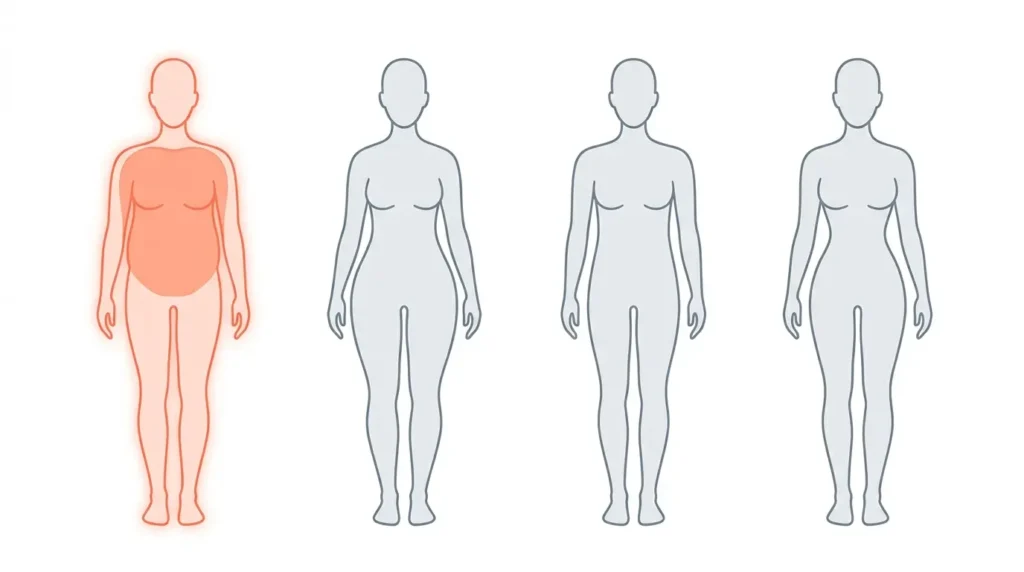
Keep in mind that these are descriptions, not diagnoses. Body shape labels are only a rough guide, and many people fall between categories. Even so, the apple pattern deserves attention because of where the fat sits.
Apple vs Pear Body Shape
The pear shape is the opposite pattern, with more fat stored on the hips and thighs. According to Harvard Health, people with a pear shape tend to have lower waist-to-hip ratios. They are also less prone to heart disease than people with abdominal obesity.
However, that does not make an apple shape a sentence. Instead, it means your waistline is a useful number to watch and a good target to train for.
Why an Apple Body Shape Matters for Health
First, it helps to know that belly fat comes in two types. Subcutaneous fat sits under the skin, and you can pinch it. Visceral fat sits deeper in the abdomen and wraps around internal organs. Mayo Clinic lists high blood pressure, heart disease, high blood sugar, and fatty liver among the risks linked to a large amount of belly fat.
Fat Location Matters
In addition, fat location appears to matter, not only total body fat. A Harvard Health blog post on a BMJ study found that measures of central fat were linked to a higher risk of death. Larger hip and thigh size, on the other hand, was linked to a lower risk. Still, these are associations, not guarantees, and many other factors shape your personal risk.
Why Do Some People Store Fat in the Belly?
Several factors play a part:
- Genetics. The same Harvard Health post says how your body stores fat is largely determined by genetics.
- Age and muscle loss. Mayo Clinic notes that people lose muscle as they age, which can slow how quickly the body uses calories.
- Hormones. Mayo Clinic also reports that lower estrogen after menopause likely changes where fat is stored.
- Habits. Eating and drinking more calories than you burn leads to weight gain. Moreover, Mayo Clinic says alcohol and smoking can add to belly fat.
If you are postmenopausal, managing a medical condition, or unsure whether to start training, check with your doctor first.
How to Measure Your Apple Body Shape
You do not need fancy tools, because a soft tape measure is enough. Follow these steps:
- Stand relaxed and place the tape around your bare midsection, just above your hip bones.
- Keep the tape level and snug, but do not press into the skin.
- Breathe out normally, then read the number. Do not suck in your stomach, as Mayo Clinic advises.
A common benchmark comes from U.S. guidelines. NIH’s NICHD cites a healthy waist limit of 35 inches (89 cm) for women and 40 inches (102 cm) for men. Cutoffs differ by ethnicity and sex, as the Harvard Health blog points out. Therefore, treat these numbers as a starting point for a conversation with your doctor, not as a verdict.
Coach’s Tip: Measure once every two to four weeks, at the same time of day. Daily measuring mostly tracks water and digestion. In contrast, your waist trend over months tells you far more than any single reading.
What the Research Says About Training an Apple Body Shape
Before the plan, here is what research says about apple body shape: traits and how to train for it. This section will save you from spending months on the wrong exercises.
You Cannot Spot-Reduce Belly Fat
In a randomized trial in the Journal of Strength and Conditioning Research, 24 healthy adults did abdominal exercise training. It had no significant effect on body weight, body fat percentage, or abdominal circumference. On the other hand, the group did gain muscular endurance, so ab work is not useless. It simply will not melt the fat covering your abs.
Likewise, Mayo Clinic says crunches can strengthen and tone the abdominal muscles, but they will not get rid of belly fat on their own.
Common Mistake: Doing 100 crunches a day and calling it an apple body shape workout. Core work belongs in your plan. However, it should take about 10 minutes of a session, not the whole session. Fat comes off your whole body based on your overall training and eating habits, not on which muscle you work.
Cardio and Intervals Show the Strongest Effect on Visceral Fat
First, a meta-analysis in PLoS One found that aerobic training of moderate or high intensity had the highest potential to reduce visceral fat in adults with a higher body weight. Second, a network meta-analysis of 84 randomized controlled trials ranked vigorous aerobic exercise and HIIT as the best options for visceral fat. Resistance training ranked lowest for that one outcome. [VERIFY journal name and year for the 84-trial review before publishing.]
Exercise also compares well with medication. A Mayo Clinic Proceedings analysis of 3,602 participants found larger visceral fat reductions per pound of body weight lost with exercise than with medication.
Strength Training Still Belongs in Your Plan
Many articles get this part wrong. Strength training is not the top tool for visceral fat. Nevertheless, it does other jobs that matter for an apple body shape:
- It helps you keep and build muscle as you age, which Mayo Clinic links to maintaining a healthy weight.
- It changes how you look and move, because added muscle on your glutes, back, and shoulders shifts your proportions.
- It meets the national guideline. The CDC says adults need at least two days of muscle-strengthening activity each week, plus 150 minutes of moderate activity or 75 minutes of vigorous activity.
In short, combine both approaches instead of choosing one.
Apple Body Shape: Traits and How to Train for It With This Workout Plan
This plan uses three strength days, two cardio days, and daily walking. The ACSM position stand recommends two to three strength days per week for novices, with loads in the 8 to 12 repetition range. Accordingly, the sessions below follow that guidance.
Equipment Needed
- A pair of adjustable or fixed dumbbells (see our guide to adjustable vs fixed dumbbells)
- A bench or sturdy chair
- A cardio option, such as a treadmill, bike, rower, or safe hill
- Optional: a resistance band
Warm-Up (6 to 8 Minutes)
- Walk or cycle easily for 3 minutes.
- Next, do 8 bodyweight squats, 8 hip hinges (push your hips back with soft knees), and 8 arm circles each direction.
- Then do 6 slow cat-cow movements on hands and knees.
- Finally, do 1 light warm-up set of your first exercise.
Weekly Schedule
| Day | Session | Time |
|---|---|---|
| Monday | Strength A | 40 minutes |
| Tuesday | Intervals (HIIT) | 20 to 25 minutes |
| Wednesday | Easy walk + mobility | 30 to 45 minutes |
| Thursday | Strength B | 40 minutes |
| Friday | Steady cardio | 30 to 40 minutes |
| Saturday | Strength A (repeat) | 40 minutes |
| Sunday | Rest or gentle walk | Optional |
Next week, start with Strength B on Monday, then A, then B. Alternating this way keeps every muscle group on a steady rhythm.
Strength A and B
| Exercise | Sets | Reps | Rest |
|---|---|---|---|
| A1. Goblet squat | 3 | 10 | 90 sec |
| A2. Dumbbell Romanian deadlift | 3 | 10 | 90 sec |
| A3. Push-up (incline if needed) | 3 | 8 to 12 | 60 to 90 sec |
| A4. One-arm dumbbell row | 3 | 10 per side | 60 sec |
| A5. Dead bug | 2 | 8 per side | 45 sec |
| B1. Dumbbell split squat | 3 | 8 per leg | 90 sec |
| B2. Standing dumbbell overhead press | 3 | 8 to 10 | 90 sec |
| B3. Hip thrust (bench or floor) | 3 | 10 to 12 | 90 sec |
| B4. Band or cable lat pulldown | 3 | 10 to 12 | 60 sec |
| B5. Pallof press | 2 | 10 per side | 45 sec |
How to Do Each Exercise
Lower-Body Exercises
Goblet squat. First, hold one dumbbell against your chest with your feet shoulder-width apart. Then brace your abs and sit down between your hips, keeping your chest tall. Stand by pushing the floor away. It should feel like effort in your thighs and glutes, not your lower back.
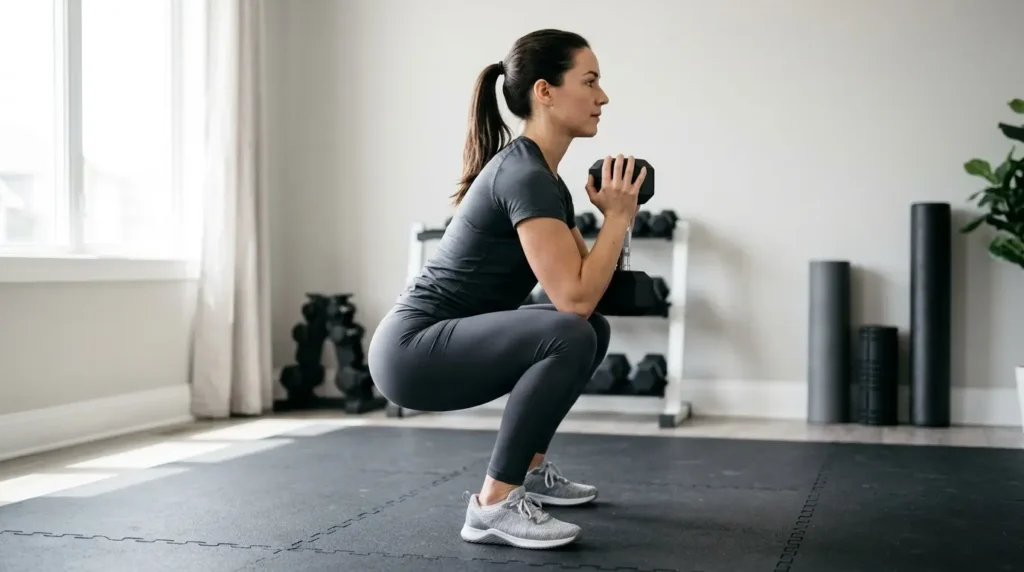
Dumbbell Romanian deadlift. Hold dumbbells in front of your thighs. Next, push your hips straight back with soft knees, sliding the weights down your legs until you feel a stretch behind your thighs. Squeeze your glutes to stand, and stop lowering as soon as your back starts to round.
Dumbbell split squat. Take a long step back and keep your torso upright. After that, lower your back knee toward the floor. For more detail, see our dumbbell Bulgarian split squat guide.
Hip thrust. Rest your upper back on a bench. Then drive your hips up until your torso is level and squeeze your glutes at the top. Lower with control.
Upper-Body Exercises
Push-up. Place your hands slightly wider than your shoulders and keep your body in one line from head to heels. Lower your chest toward the floor, then press away. If this is too hard, put your hands on a bench or counter.
One-arm dumbbell row. Support yourself on a bench with one hand and one knee. Pull the dumbbell toward your hip, not your shoulder, and pause for one second at the top. Then lower slowly.
Standing overhead press. Hold the dumbbells at shoulder height with your ribs down. Press up until your arms are straight, without leaning back.
Lat pulldown (band or cable). Pull your elbows down toward your ribs. Think “elbows to pockets,” not “hands to chest.”
Core Exercises
Dead bug. Lie on your back with your arms up and knees bent at 90 degrees. Lower one arm and the opposite leg toward the floor while keeping your lower back gently pressed down. Then return and switch sides, moving slowly.
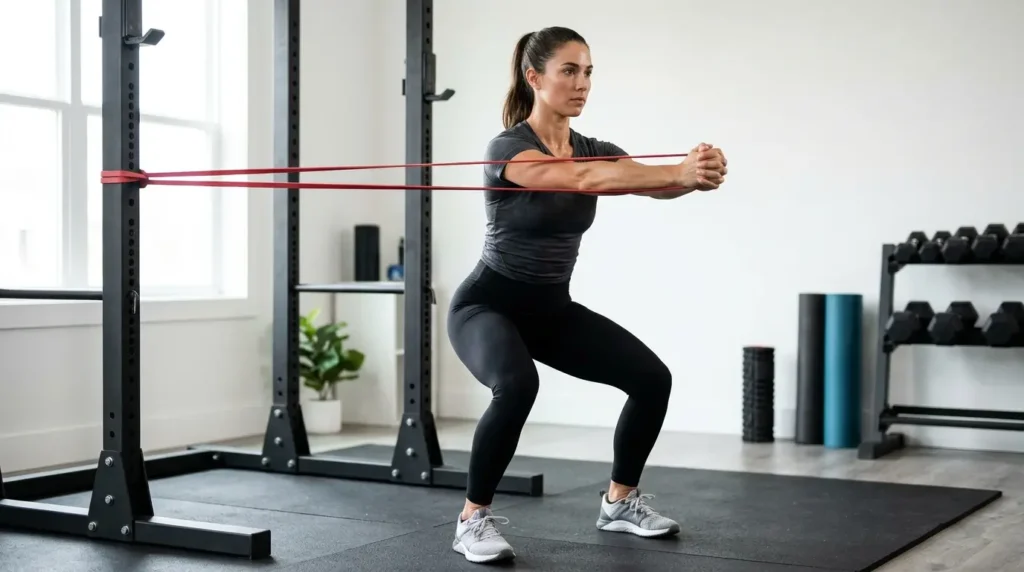
Pallof press. Stand sideways to a band anchored at chest height. Hold the band at your chest and press your hands straight out. Because the band tries to twist you, your job is to resist it. This builds core stability.
Coach’s Tip: For most exercises, pick a weight that makes the last two reps challenging but not sloppy. As rough starting points, many adult beginners start goblet squats around 15 to 30 lb (7 to 14 kg). Rows often start around 10 to 25 lb (5 to 11 kg) per hand. Adjust to your own level.
Easier and Harder Versions
| Exercise | Easier version | Harder version |
|---|---|---|
| Goblet squat | Box squat to a chair | Tempo squat (3 seconds down) or heavier weight |
| Romanian deadlift | Hinge with bodyweight only | Single-leg RDL |
| Push-up | Hands on a counter | Feet elevated on a bench |
| One-arm row | Band row | Heavier weight, 2-second pause |
| Dead bug | Heels tap, arms still | Add a light dumbbell or band |
| Split squat | Hold a support | Rear foot elevated (Bulgarian) |
| Overhead press | Seated press | Single-arm press |
| Hip thrust | Glute bridge | Single-leg hip thrust |
| Pallof press | Shorter hold | Add a pause and step wider |
Sets, Reps, and Weight by Goal
| Goal | Reps | Intensity | Rest |
|---|---|---|---|
| General strength (beginner) | 8 to 12 | Last 2 reps hard | 60 to 120 sec |
| Muscle building | 8 to 12 | 1 to 3 reps left in the tank | 60 to 120 sec |
| Muscular endurance | 15+ | Light to moderate | Under 90 sec |
The 8 to 12 repetition range for novices comes from the ACSM position stand. So does the guidance of more than 15 reps with short rests for local muscular endurance.
Cardio for an Apple Body Shape
As the research above shows, cardio does the heavy lifting for visceral fat. Your weekly plan includes two kinds.
Intervals (Tuesday)
Pick a bike, rower, incline treadmill, or hill. Then follow this pattern:
- Warm up for 5 minutes.
- Do 6 to 8 rounds of 30 seconds hard, then 90 seconds easy. “Hard” means about 8 out of 10 effort, where you can say a few words but not a full sentence.
- Cool down for 5 minutes.
If you like rowing, try our 30-minute rowing workout for a structured option.
Easier: Do 20 seconds hard and 100 seconds easy for 5 rounds.
Harder: Add rounds, shorten rest to 60 seconds, or raise the intensity.
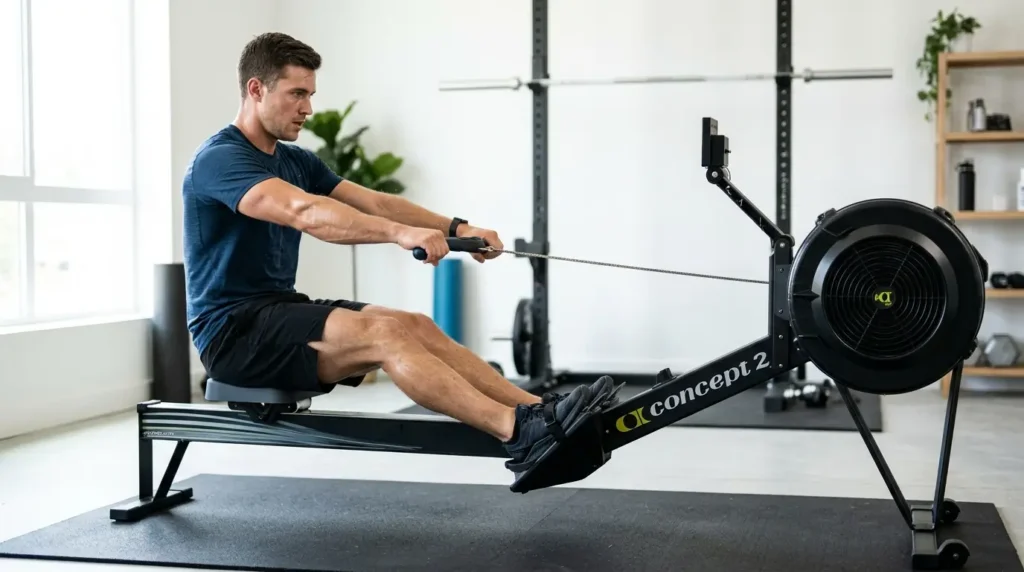
Safety note: High-intensity work is not right for everyone. If you have heart disease, high blood pressure, chest pain, or other medical concerns, talk with your doctor before starting intervals.
Steady Cardio (Friday)
Walk briskly, bike, swim, or use the elliptical for 30 to 40 minutes. Choose a pace where you can talk in short sentences. Meanwhile, if you wonder how machines compare, see our articles on whether the treadmill burns belly fat and whether the elliptical burns belly fat.
Daily Walking
Easy walking adds up without taxing your recovery. Our breakdown of 10,000 steps and what research says explains how to set a realistic daily target. For example, start with your current average and add about 1,000 steps every week or two. A 1-mile (1.6 km) walk is roughly 2,000 steps for many people.
Core Training for an Apple Body Shape
Your core still matters. A strong core supports your back and helps you lift with better control. Therefore, keep it short and smart:
- Anti-extension: dead bug, plank
- Anti-rotation: Pallof press
- Carries: farmer carry (hold a dumbbell in each hand and walk for 30 to 45 seconds)
For form details on visible ab work, see our guide on how to flex your abs. Remember, though, that visible abs depend mostly on overall body fat, not on how many crunches you do.
Common Mistake: Holding your breath and bracing so hard you cannot breathe. Instead, exhale during the effort. Your core should feel firm, not frozen.
Four-Week Progression Plan
Progress slowly. The ACSM position stand suggests raising the load by 2 to 10 percent once you can complete one to two extra reps beyond your target. Here is one way to apply that idea.
| Week | Strength focus | Cardio focus |
|---|---|---|
| 1 | Learn form. 2 sets of each exercise, stop 3 reps before failure. | Intervals: 20 sec hard, 100 sec easy, 5 rounds |
| 2 | Add the third set. | Intervals: 30 sec hard, 90 sec easy, 6 rounds |
| 3 | Add reps until you reach 12, then add weight. | Intervals: add 1 round |
| 4 | Add weight where reps hit the top of the range. | Steady cardio: add 5 minutes |
After week 4, repeat the cycle with slightly heavier weights, or switch exercises to keep it fresh. Once the basics feel easy, the 12-week calisthenics program is a good next step if you want to train with bodyweight only. In short, apple body shape: traits and how to train for it is a long game, so build slowly.
Beginner and Advanced Versions
Beginner: Train strength two days a week, do one interval session, and walk daily. Use the easier versions from the table above.
Advanced: Add a fourth strength day with a lower-body or upper-body split. Use heavier loads in the 6 to 10 rep range. If recovery allows, add a second interval session.
Cool-Down (5 Minutes)
- Walk slowly for 2 minutes until your breathing settles.
- Hold a gentle hamstring stretch for 30 seconds each side.
- Hold a chest stretch in a doorway for 30 seconds.
- Finally, take 5 slow breaths, inhaling through your nose and exhaling long.
Nutrition and Lifestyle Support
Training alone rarely changes your waistline. For this reason, Mayo Clinic recommends a healthy diet built on plant-based foods, lean protein, and sensible portions. It also suggests swapping sugary drinks for water and aiming for slow, steady weight loss rather than quick fixes.
Alcohol deserves a look, too. Mayo Clinic’s belly fat guidance for men notes that drinking too much alcohol of any kind can raise belly fat risk. If you drink, keep it moderate. Likewise, if you plan to change how much you eat, or you have a medical condition, work with your doctor or a registered dietitian.
Tips for Better Results
- Track a trend, not a day. Use waist measurements, how your clothes fit, and your strength numbers.
- Prioritize sleep. Poor sleep makes it harder to stay consistent. [VERIFY: add an NIH or CDC sleep source if you want to make a specific claim here.]
- Train legs and glutes hard. They are your biggest muscles, so they also balance your proportions.
- Log your workouts. Write down weights and reps so you can add a little each week.
- Be patient. Meaningful body changes take months, not days.
Who Should Be Careful
Check with a doctor or physical therapist before starting if you have pain, an injury, a heart or blood pressure condition, or diabetes. The same goes if you are pregnant or postpartum. Likewise, check in if you are postmenopausal and new to strength training. Stop any exercise that causes sharp pain, dizziness, or chest discomfort.
FAQ
What is an apple body shape?
An apple body shape is a pattern where fat collects around the waist and abdomen while the hips, legs, and arms stay leaner. The waist is often as wide as or wider than the hips. It describes fat distribution, not fitness level, and it can occur at many body weights.
Is an apple body shape unhealthy?
Not automatically. However, carrying a lot of fat around the middle is linked to higher health risks, according to Harvard Health. Your risk also depends on waist size, habits, genetics, and medical history. A doctor can check your numbers and explain what they mean for you.
What is the best workout for an apple body shape?
Combine full-body strength training two to three days a week with cardio or intervals, plus daily walking. Research suggests vigorous aerobic exercise and HIIT work best for visceral fat. Meanwhile, strength training builds and protects muscle, so use both together.
Can you change an apple body shape?
You can change your waist size and body composition through training, nutrition, sleep, and time. However, you cannot change your underlying frame, and genetics influence where you store fat. Many people shrink their waist and build muscle without turning into another “shape.”
Do crunches help an apple body shape?
Crunches can strengthen your abs. Still, a randomized trial found six weeks of abdominal training did not significantly change abdominal circumference or fat. Therefore, use core exercises for strength and stability, and use full-body training, cardio, and nutrition to change your waistline.
How often should an apple body shape lift weights?
Two to three days a week is a solid start for beginners, based on ACSM guidance. Also, give each major muscle group at least one rest day between hard sessions. Advanced lifters can train three to four days a week once recovery is good.
Conclusion: Train the Whole Body, Not Just the Belly
The apple body shape is a fat-storage pattern, not a flaw. Now you know the traits, the health context, and the plan. Strength training builds muscle and shape, cardio and intervals target visceral fat, and walking ties it all together.
To begin, follow the four-week plan, measure your waist every few weeks, and add a little weight or time as you get stronger. Apple body shape: traits and how to train for it come down to one idea. Train the whole body, stay consistent, and let the results build.
