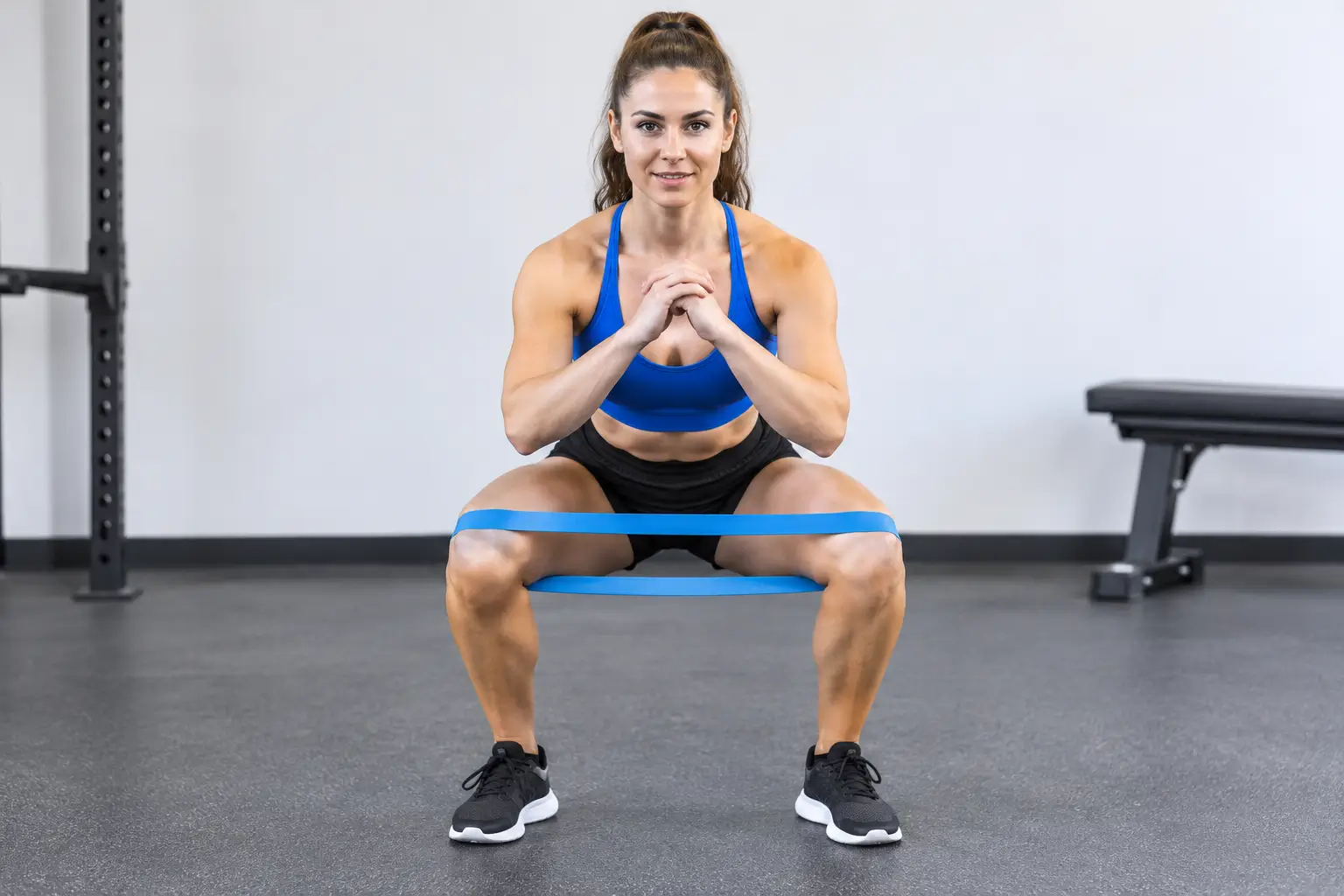
How to Do Banded Squat: Form, Tips and Common Mistakes
Learning how to do banded squat the right way takes about ten minutes. Yet most people rush it, let the band pull their knees inward, and wonder why their hips feel nothing. Fortunately, this guide fixes that.
You will learn where to place the band, how to set your feet, and what the movement should feel like. You will also get sets, reps, an easier version, a harder version, and a full sample workout. Along the way, we will look at what research says about squatting with a band, because the evidence is more mixed than most gym posts admit.
Quick Answer
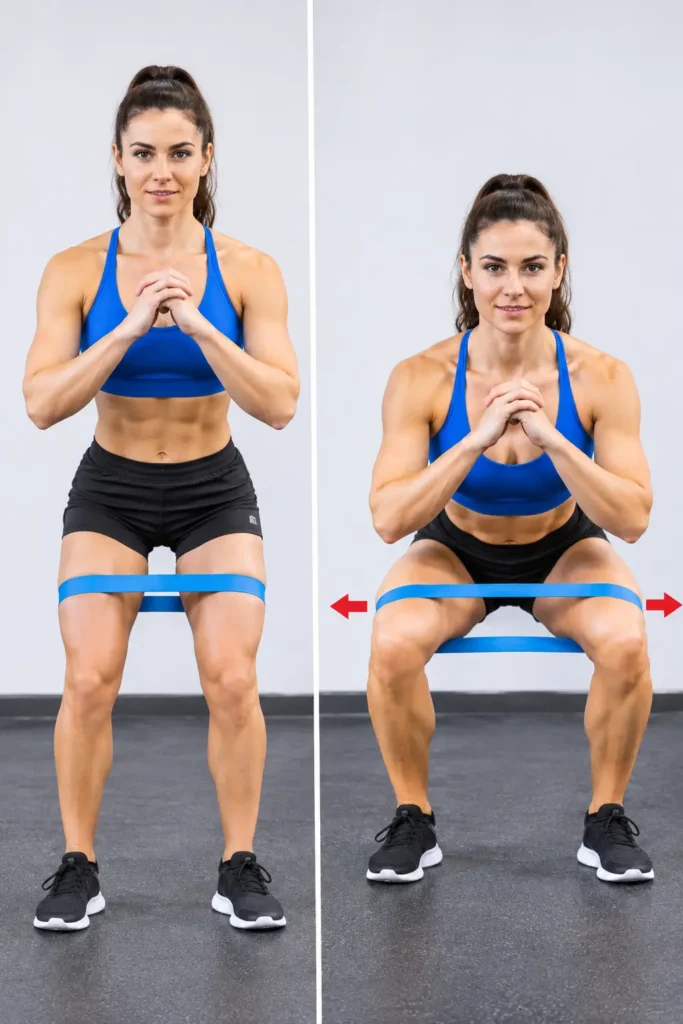
To do a banded squat, put a loop band just above your knees and stand with feet slightly wider than shoulder-width. Sit your hips back and down while pushing your knees gently outward against the band. Keep your chest up and heels flat, then stand tall. Start with a light band for 2–3 sets of 10–15 reps.
Banded Squat Muscles Worked
A banded squat uses the same main muscles as a regular squat. However, the band adds extra work for the muscles on the outside of your hips.
Primary muscles
- Gluteus maximus: the big buttock muscle that straightens your hips as you stand up.
- Gluteus medius: a smaller hip muscle on the side of the pelvis. It helps move the thigh outward and rotate it, which is exactly what you do when you push against the band (Alizadeh et al., 2023).
- Quadriceps: the front-of-thigh muscles that straighten your knees.
Secondary muscles
- Hamstrings and adductors: they help control the descent and assist the glutes.
- Erector spinae and abdominals: they keep your spine steady.
- Calves: they stabilize your ankles.
Mayo Clinic notes that a squat done with resistance tubing works the quadriceps, hamstrings, and gluteal muscles, so the band does not change the basic muscle map (Mayo Clinic). What changes is how much effort your hip rotators and abductors put in, since they push outward against the band all the way down and up.
Benefits of the Banded Squat (and What Research Does and Does Not Show)
The banded squat is popular for good reasons. It is cheap, portable, and easy to learn. In addition, a loop band costs far less than a rack, and it fits in a gym bag or a drawer.
Practical benefits
- Teaches “knees out” cues. The band gives your legs something to push against, which makes the cue easy to feel.
- Warms up the hips. Many lifters use a few light reps before heavy squats to wake up the glutes.
- Works almost anywhere. If you are building a small home setup, a band is a smart first purchase. Our list of apartment workout equipment shows other space-saving picks.
- Counts toward your weekly strength work. Adults should do muscle-strengthening activity at least two days a week, according to the CDC adult activity guidelines.
What the research says
Here is the honest part. Studies on bands around the thighs show mixed results, so we should not oversell them.
- A study of 26 healthy adults found that looped bands increased gluteus maximus activity during the barbell back squat. The same study found larger knee valgus angles (knees moving inward) and more shin rotation when bands were used (Reece et al., 2020).
- A narrative review in the International Journal of Sports Physical Therapy found conflicting results across studies. It noted that some findings show bands may increase knee valgus instead of fixing it (Forman et al., 2023).
- Another study compared bands of different stiffness. The stiffest band raised gluteus medius activity, but it also reduced vastus medialis activity compared with no band (Alizadeh et al., 2023).
- Earlier work by Foley and colleagues also looked at a band loop during the barbell squat, in both trained and untrained people (Foley et al., 2017).
So what does this mean for you? Research suggests a band may increase glute effort, but it does not reliably fix knees that cave in. Therefore, treat the band as a cue and a warm-up tool, not as a cure. Ultimately, the best defense against knee cave is still good technique, a sensible load, and steady practice.
Finally, elastic bands can build real strength. A systematic review and meta-analysis found similar strength gains from elastic resistance and from conventional training with weights or machines (Lopes et al., 2019). That makes a banded squat a reasonable choice when you have no barbell.
How to Do Banded Squat Step by Step
Follow these steps for a bodyweight or goblet banded squat. Also, take your time with the first few sets and focus on feel, not speed.
What you need
- One loop band (also called a mini band). Most loop bands are roughly 12 in (30 cm) long when laid flat, but sizes vary by brand [VERIFY].
- Flat shoes or bare feet on a non-slip surface.
- Optional: a dumbbell or kettlebell, or a chair or box about 16–18 in (41–46 cm) high for depth control.
The steps
- Place the band. Slide the loop up your legs and sit it just above your knees, on the lower thigh. Make sure it lies flat and does not roll.
- Set your stance. Stand with feet slightly wider than shoulder-width. Mayo Clinic describes a stance a little wider than the shoulders with toes pointing ahead (Mayo Clinic). Some people feel better with toes turned out a few degrees. Pick the angle that keeps your knees comfortable.
- Find your tripod foot. Spread your weight across the heel, the base of the big toe, and the base of the little toe. Your arch should stay lifted, not collapsed.
- Brace. Next, take a breath into your belly, tighten your midsection as if someone might tap it, and lift your chest.
- Push the knees out. Before you descend, press your knees outward until you feel the band tighten. Hold that gentle tension the whole set.
- Sit back and down. Push your hips back, then bend your knees. Imagine sitting into a chair behind you. Keep your heels flat.
- Stop at a good depth. Lower until your thighs are about parallel to the floor, or as low as you can go with good form. Mayo Clinic says to go as low as you can if you cannot reach a 90-degree knee bend, while keeping the knees centered over the feet and not rolling in or out (Mayo Clinic).
- Stand up. Then, drive through your whole foot and keep your knees pressing out. Finally, squeeze your glutes at the top without leaning back.
- Breathe and reset. Inhale on the way down and exhale as you stand. Then repeat for your planned reps.
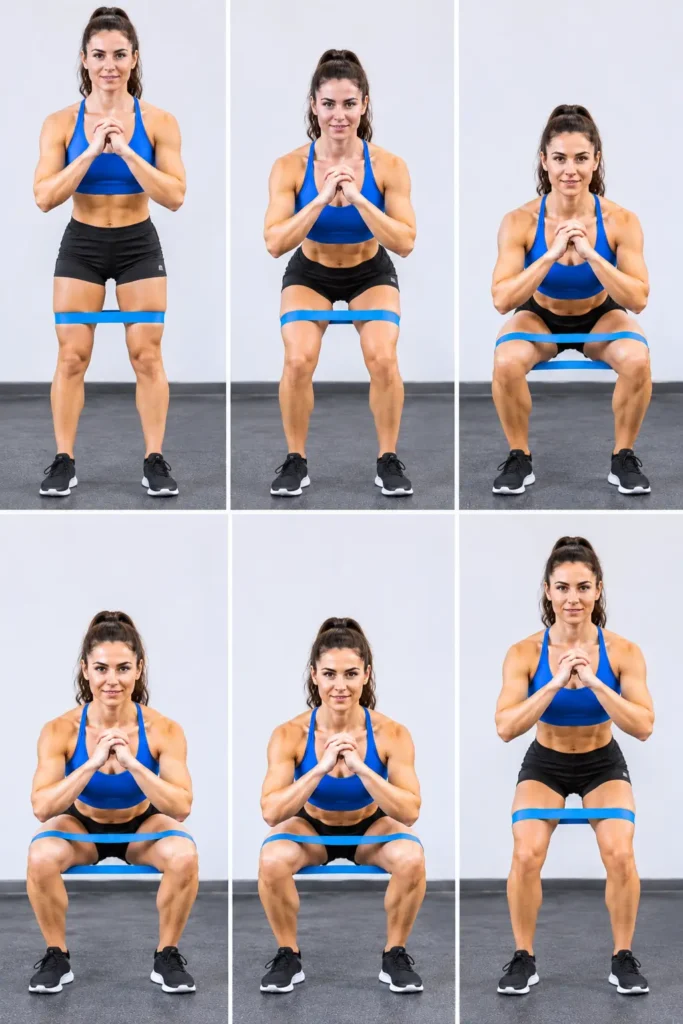
Coach’s Tip: Think “spread the floor” instead of “shove the knees out.” That cue keeps your whole foot active and stops you from rolling onto the outside edges of your feet. Also, use a mirror or record a short side-and-front clip on your phone so you can check your knees.
What it should feel like
You should feel warmth and effort on the outside of your hips and in your glutes. Your quadriceps will work too, but you should not feel sharp pain in the knee. If you do, stop and lower the band tension or the depth.
Banded Squat Sets, Reps and Weight by Goal
Your goal decides your sets, reps, and rest. The table below uses ranges based on the ACSM position stand on progression models in resistance training, adapted for a banded squat. The ACSM recommends 2–3 training days per week for novices and says multiple-set programs suit muscle growth [VERIFY exact wording before publishing].
| Goal | Sets | Reps | Rest | Tempo | Load idea |
|---|---|---|---|---|---|
| Warm-up / activation | 1–2 | 8–12 | 30–45 sec | 2 sec down, 1 sec up | Bodyweight with a light band |
| Endurance | 2–3 | 15–20 | 30–60 sec | Smooth and steady | Bodyweight or light goblet, light-to-medium band |
| Muscle (hypertrophy) | 3–4 | 8–12 | 60–90 sec | 3 sec down, 1 sec up | Goblet squat with a 15–35 lb (7–16 kg) dumbbell, medium band |
| Strength (basic) | 3–5 | 5–8 | 2–3 min | Controlled down, strong up | Heavier dumbbells or barbell, with a light band only |
A few notes on this table:
- Band strength: Resistance bands vary by brand. A light band might offer around 10–25 lb (4.5–11 kg) of tension when stretched, but check the maker’s chart [VERIFY]. Start light.
- Weight: For a heavy barbell squat, many coaches therefore skip bands or use a very light one, because of the knee findings above.
- Frequency: Two to three lower-body days a week works well for most beginners. If you are curious about daily practice, read our guide on whether you can squat every day.
- Progress slowly: Add reps first. Then, add a little weight or a slightly thicker band.
Banded Squat Common Mistakes and Fixes
In fact, most problems come from two things: too much band and too little attention. Here are the errors I would watch for when teaching this move.
Common Mistake: Letting the band pull your knees inward as you stand up. The knees drift together, the arches collapse, and the band wins. Fix it by using a lighter band, slowing the tempo, and pressing the knees out before you start each rep.
- Using a band that is too strong. For example, a thick band can drag your knees inward. Studies link stiffer bands with larger knee-in movement in some cases (Reece et al., 2020). Fix: drop to a lighter band and earn the thicker one.
- Heels lifting off the floor. This shifts weight to the toes and, as a result, strains the knees. Fix: widen the stance a little, turn the toes out slightly, or place a thin plate under the heels if your ankles are tight.
- Rounding the lower back at the bottom. This often happens because you go deeper than your hips allow. Fix: stop a bit higher, brace harder, and work on hip and ankle mobility.
- Putting the band at the wrong place. If the band sits on the knee joint or slips toward the shins, it feels odd and slides. Fix: place it on the lower thigh, just above the kneecap.
- Rushing the reps. Fast reps let momentum do the job, so the hips never work. Fix: use a 3-second lowering phase.
- Leaning too far forward. Otherwise, you end up doing a half-good morning. Fix: hold a light dumbbell at your chest as a counterweight (a goblet hold).
- Cutting depth. Finally, tiny squats waste the band. Fix: use a chair or box as a depth guide, and sit down lightly, not drop.
Mayo Clinic also points out that wobbling knees can signal weak hips or glutes, and that good-form practice helps correct it (Mayo Clinic Care Network). After all, that is the real goal here: better control, not a gimmick.
Banded Squat Variations: Easier to Harder
Next, use this ladder to find your level. Move up only once the current step feels easy and clean for all sets.
Easier versions (regressions)
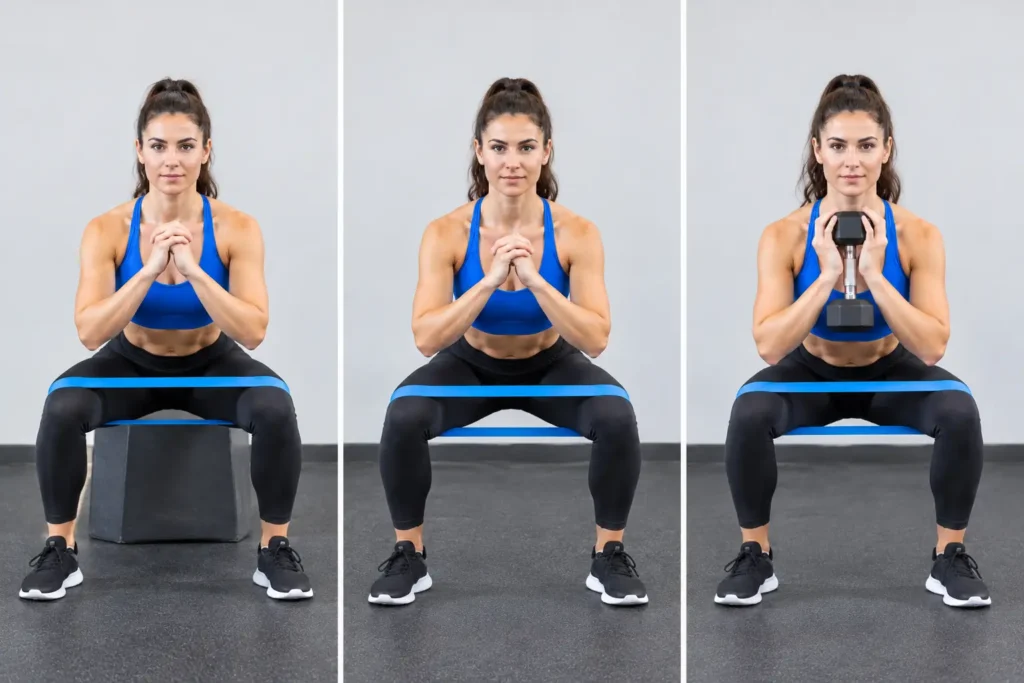
- Box or chair banded squat: Sit back to a chair, tap lightly, and stand. This limits depth and also builds confidence.
- Half-depth banded squat: Squat to a comfortable partial depth with a very light band.
- Wall-supported banded squat: Lean your back against a wall (or hold a doorframe) for balance.
- No-band bodyweight squat: Practice the “spread the floor” cue first, then add the band.
Standard version
- Bodyweight banded squat: 2–3 sets of 10–15 reps with a light band. This is the starting point for most people.
Harder versions (progressions)
- Banded goblet squat: Hold a dumbbell or kettlebell at your chest. This is also the most beginner-friendly way to add load. If you plan to buy weights, see our comparison of adjustable dumbbells vs fixed dumbbells.
- Tempo banded squat: Lower for 3–4 seconds, pause for 1–2 seconds at the bottom, then stand up.
- Banded squat with pause: A 2–3 second hold in the bottom position, similar to the holds in our isometric leg exercises.
- Banded jump squat: Only for experienced, pain-free lifters. Land softly and keep the knees pressing out.
- Single-leg progression: Move toward a split-stance exercise such as the dumbbell Bulgarian split squat, using a band only if it helps your form.
Alternatives to the Banded Squat
If you do not have a band or the exercise does not suit you, these options train similar muscles.
- No equipment: Bodyweight squats, sumo squats, glute bridges, and wall sits. Our calisthenics exercises list has more ideas.
- Dumbbell: Goblet squats, dumbbell Romanian deadlifts, and reverse lunges.
- Cable: Cable pull-throughs and cable squats to the chair.
- Machine: The hack squat and leg press let you load the legs while the machine supports your back. See our hack squat alternatives and the guide to leg press machines.
- Band-only options: Lateral band walks, clamshells, and banded glute bridges, which target the side-hip muscles without a squat pattern.
Who Should Be Careful With Banded Squats
Most healthy adults can try a light banded squat. Still, a few groups should slow down.
- Anyone with knee pain, a past ACL or meniscus injury, or kneecap pain. Because some studies link bands with more knee-in movement, ask a doctor or physical therapist before you use one.
- People with hip or low-back pain. Instead, reduce depth and keep the load light.
- Pregnant or postpartum exercisers. Check with your healthcare provider first.
- Older adults or people with balance problems. Use a chair, a wall, or a counter for support.
- Heavy barbell lifters. Research on bands in loaded squats raises questions, so keep bands light or skip them during heavy sets (Reece et al., 2020).
Stop the exercise if you feel sharp, pinching, or sudden joint pain. Muscle burn is normal, but joint pain is not.
Sample Workout Using the Banded Squat
This 25–30 minute lower-body session suits beginners and home gym owners. Do it two days a week with at least one rest day between. If you want a bigger plan, pair it with the leg and shoulder workout.
Warm-up (5 minutes): March in place, 10 hip circles per side, 10 bodyweight squats.
| Exercise | Sets | Reps | Rest |
|---|---|---|---|
| Banded squat (light band) | 3 | 12 | 60–90 sec |
| Dumbbell Romanian deadlift (15–30 lb / 7–14 kg) | 3 | 10 | 60–90 sec |
| Reverse lunge | 3 | 8 per leg | 60 sec |
| Banded glute bridge | 3 | 15 | 45–60 sec |
| Lateral band walk | 2 | 10 steps each way | 45 sec |
| Standing calf raise | 3 | 15 | 45 sec |
Cool-down (3–5 minutes): Hold a quad stretch and a hamstring stretch for 30 seconds each side, then breathe slowly.
Progression plan: In weeks 1–2, aim for clean form. By weeks 3–4, add 2 reps per set. Then, in week 5, switch to a goblet banded squat. Finally, in week 6, raise the dumbbell weight by 5 lb (2.3 kg) or move to a slightly stronger band.
FAQ: Banded Squat Questions
Do banded squats work glutes?
Yes, they can. Research shows looped bands may raise glute activity during squats, though results vary by band strength and study. The band adds outward tension, so your glutes work harder to hold your knees in line. Still, depth, tempo, and good form matter more than the band.
Are banded squats good for knees?
It depends. Some studies found bands can increase knee-in movement, especially with stiffer bands, so they are not a guaranteed knee fix. Use a light band, press your knees out, and keep reps controlled. If you have knee pain or injury, talk to a doctor or physical therapist first.
Where should the band go for a banded squat?
Place the loop just above your knees, on the lower thigh. Some people use it around the ankles or feet for lateral walks, but for squats above the knees is standard. The band should lie flat and stay put. If it rolls down, shift it slightly higher.
What resistance band is best for squats?
Start with a light loop band, since it lets you learn the pattern without dragging your knees inward. Choose a fabric or latex loop that stays flat on your thighs. Move to a stronger band only when your knees stay steady all the way up. Check the maker’s resistance chart [VERIFY].
How many banded squats should I do?
For most beginners, 2–3 sets of 10–15 reps works well, two or three days a week. For muscle growth, try 3–4 sets of 8–12 reps with a dumbbell. Stop each set when your form starts to slip, not when you are completely exhausted.
Can beginners do banded squats?
Yes, beginners can do them with a light band and a box or chair for depth control. First, start with bodyweight, then practice the knee-out cue, and keep sets short. If your knees cave in or you feel pain, remove the band and work on basic squat form first.
Conclusion
Now you know how to do banded squat the safe, simple way. Place a light loop band above your knees, set a tripod foot, press your knees gently outward, sit back and down, and stand tall with control. Above all, keep the reps slow and the band light.
Remember that the research is mixed. A band may raise glute effort, but it does not replace strong hips, good coaching cues, and steady practice. Use it as a warm-up and awareness tool, then progress to goblet squats and single-leg work as you improve. For general strength, aim to train your legs on at least two days per week, as the CDC suggests (CDC).
