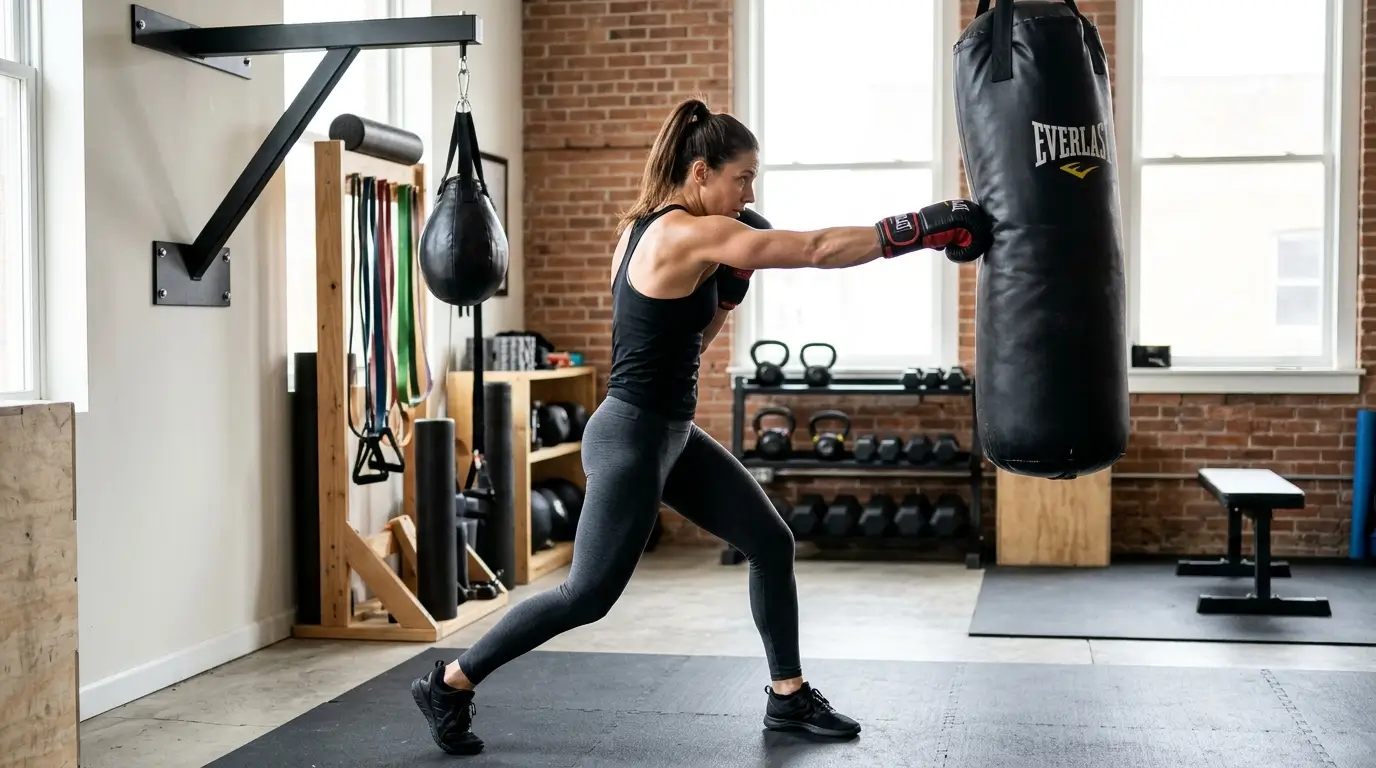
Boxing Workout Benefits: What Boxing Does for Your Body and Mind
Boxing workout benefits go well beyond a sweaty session on a heavy bag. A good round raises your heart rate, trains your shoulders, core, and legs together, and asks your brain to coordinate it all. You do not need to fight anyone to get these gains. Shadowboxing, bag work, and fitness boxing classes are non-contact ways to train.
This guide explains what boxing can and cannot do, using research from the CDC, PubMed, and peer-reviewed journals. You will also get a beginner routine, a 4-week progression, form cues, and safety notes, so you can start with confidence.
Quick Answer: What Are the Boxing Workout Benefits?
Quick Answer: Boxing workout benefits include better cardio fitness, full-body muscular endurance, a solid calorie burn, and sharper coordination. Research on interval training, which boxing rounds resemble, also links this style of exercise to better mood and less stress. Most adults can start with two or three non-contact sessions a week and build up slowly.
Boxing Workout Benefits: What the Research Says
Start with the big picture. The CDC physical activity guidelines say adults need 150 minutes of moderate activity a week, or 75 minutes of vigorous activity, plus muscle-strengthening work on at least two days. Boxing can help you hit both targets. The pace of your rounds sets the intensity, and punching, pivoting, and bracing all load your muscles.
How hard is boxing, really? One lab study from the University of New Mexico measured people punching a boxing device in two-minute rounds. They worked at about 61% to 72% of their maximum oxygen uptake and 84% to 92% of their maximum heart rate. Faster punching tempos raised oxygen use and heart rate even more. Keep in mind that those participants already had boxing experience, so beginners may reach this level more slowly. [VERIFY: author and exact title of this page]
Boxing rounds also look a lot like interval training: short bursts of hard work, then short rests. A meta-review of 33 systematic reviews found that high-intensity interval training (HIIT) improved cardiorespiratory fitness compared with active controls. That review also reported improvements in anxiety and depression compared with before training. Note that this research studied HIIT in general, not boxing alone.
Now for the honest part. A 2024 meta-analysis of randomized trials concluded that HIIT did not clearly improve depression or anxiety symptoms in healthy people, and it rated that evidence as very low certainty. So the research suggests possible mood benefits, but it does not promise them. Treat boxing as one good tool, not a cure-all.
Boxing Workout Benefits at a Glance
| Benefit | What it means for you | How strong is the evidence? |
|---|---|---|
| Cardio fitness | Stronger heart and lungs for daily life | Supported by punching-intensity data and HIIT reviews |
| Muscular endurance | Shoulders, core, and legs tire less quickly | Practical effect of repeated rounds; limited boxing-specific data [VERIFY] |
| Calorie burn | Energy use depends on pace and body weight | Varies; see the Harvard chart below |
| Mood and stress | Possible lift in well-being | Moderate for HIIT in general; low certainty in healthy adults |
| Balance and coordination | Better footwork and body control | Mixed; strongest research is in Parkinson’s disease |
| Convenience | Short sessions, low-cost gear | Practical advantage |
Main Benefits of a Boxing Workout, Explained
1. Better Cardio Fitness
Cardio is one of the most dependable boxing workout benefits for beginners. Throwing punches for two or three minutes straight is real aerobic work. Your heart rate climbs fast, then drops during rest. That pattern, repeated for six or eight rounds, trains both your aerobic system and your ability to recover between hard efforts.
As a coach, I like boxing rounds for beginners because the timer does the pacing for you. You work hard when the bell rings and rest when it stops. There is less guessing than with open-ended cardio.
2. Full-Body Muscular Endurance
A punch is not an arm movement. Force starts at the floor, travels through the legs and hips, and finishes at the fist. That is why boxing workout benefits reach so many muscles at once.
- Primary muscles: shoulders (deltoids), chest (pectorals), triceps, and the core muscles, including the obliques and rectus abdominis.
- Secondary muscles: lats, upper back, glutes, quads, and calves, which drive your stance and pivots.
- Stabilizers: forearms and grip muscles, especially during bag work with wraps and gloves.
Notice the word “endurance.” Boxing trains your muscles to keep working for many reps and rounds. It does not replace heavy lifting if your main goal is maximum strength or muscle size. For that, pair it with strength days, such as a calisthenics routine or weights.
3. Calorie Burn and Weight Management
One of the most asked-about boxing workout benefits is calorie burn, and it depends on your body weight, your pace, and how much rest you take. A heavier person doing fast rounds will burn more than a lighter person at an easy pace. The Harvard Health calorie chart lists many activities at three body weights, so you can compare gym options. [VERIFY: check whether the chart lists a boxing or bag-work row before quoting any number.]
For perspective, other quick, high-effort moves also add up. Our breakdown of 100 jumping jacks and calories shows how a simple warm-up move compares.
One caution: boxing cannot “spot reduce” belly fat. Weight changes come from your overall energy balance over time. Boxing may help by burning energy and being fun enough that you keep showing up. If weight loss is your main goal, talk with a doctor or registered dietitian first.
4. Mood and Stress Relief
Mood support is one of the more talked-about boxing workout benefits, and the interval format may help. A 2022 meta-analysis in the British Journal of Sports Medicine found that HIIT led to moderate improvements in mental well-being, depression severity, and perceived stress compared with non-active control groups.
Again, this is HIIT research, and later reviews show the picture is not settled for healthy adults. A fair summary is this: boxing may support your mood, especially when it replaces inactivity, but it is not a treatment for anxiety or depression. If you are struggling, please talk with a doctor or mental health professional.
5. Coordination, Balance, and Footwork
Boxing asks you to move your feet, turn your hips, and throw hands in a set order. That mix trains timing and body control. Simple drills, like a jab-cross combo while shifting your weight, are a good start.
The best research on balance comes from people with Parkinson’s disease. A community-based boxing program study linked participation to better balance. A small pilot trial of 29 people found balance improved after 10 weeks of boxing classes, with no adverse events. However, a 2025 meta-analysis concluded that boxing did not significantly improve balance, fitness, or quality of life in older people with Parkinson’s. The evidence is mixed, so anyone with Parkinson’s should work with a physical therapist.
If balance is your focus, pair boxing with simple stability work. A BOSU ball routine is one option once you are comfortable on flat ground.
6. Time-Efficient and Low-Cost
Short sessions make boxing workout benefits easy to fit into a busy week. You can get a solid session in 20 to 30 minutes. The gear is simple: gloves, wraps, a timer, and a bag if you have space. If you live in a small place, our list of the best apartment workout equipment can help you plan around tight space.
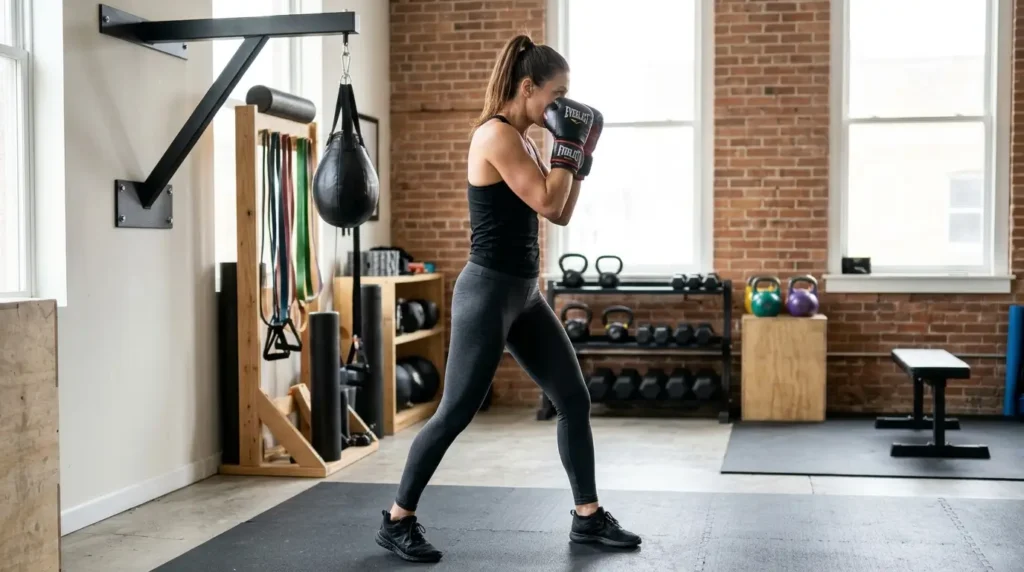
How to Get Boxing Workout Benefits: A Beginner Routine
You do not need a gym membership to enjoy boxing workout benefits. Follow this plan for non-contact bag work or shadowboxing.
Equipment Checklist
- Gloves: 12 to 16 oz (340 to 450 g) is a common range for bag work. Heavier gloves protect your hands better. [VERIFY: confirm glove-size guidance by body weight with a manufacturer chart]
- Hand wraps: 120 to 180 in (305 to 457 cm) of cloth wrap to support your wrists and knuckles.
- Heavy bag: Weight matters for safety and feel. See our guide on how much a punching bag weighs.
- Timer: A phone app that rings every two or three minutes works fine.
- Optional: Jump rope and a speed bag. If you want a speed bag, check our speed bag platform reviews.
Warm-Up (5 Minutes)
- Jog or march in place for 60 seconds.
- Do 10 arm circles forward and 10 backward.
- Rotate your torso 10 times to each side with arms relaxed.
- Do 10 bodyweight squats at an easy pace.
- Shadowbox lightly for 60 seconds, throwing slow jabs and crosses.
Basic Stance and Punches
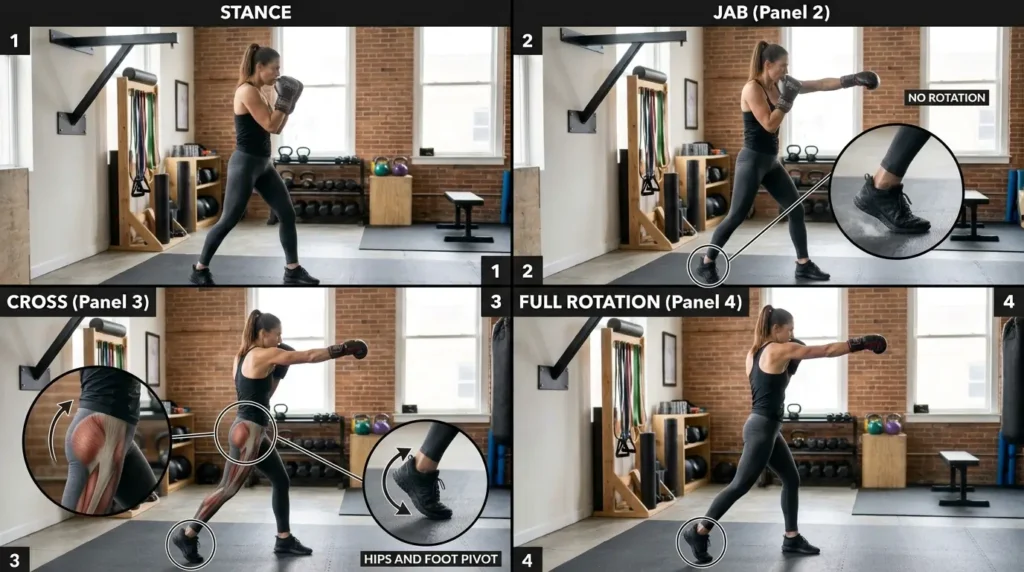
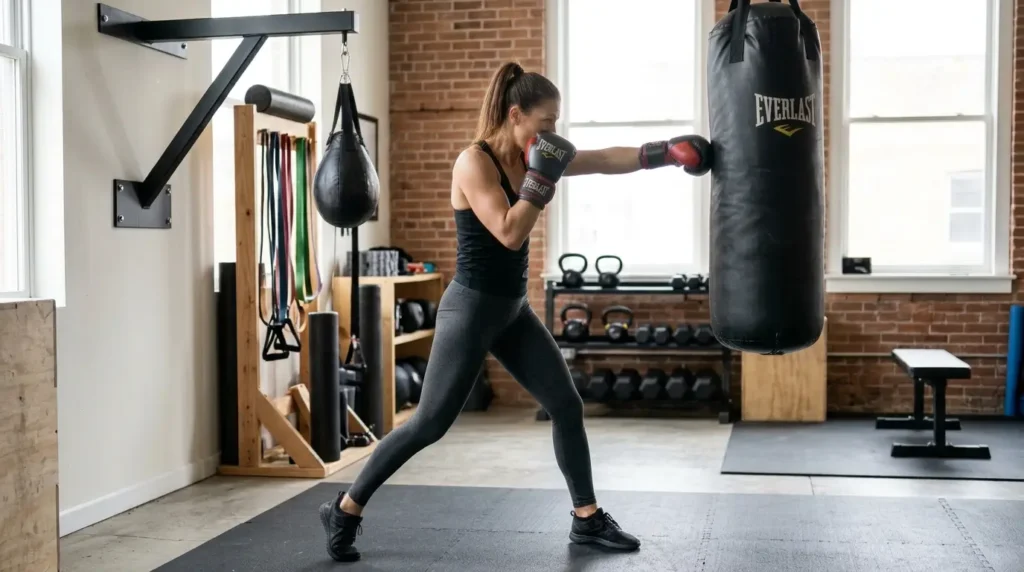
- Set your stance. Stand with feet a little wider than shoulder width. If you are right-handed, step your left foot forward about half a stride. Bend your knees slightly.
- Raise your guard. Keep both fists near your cheeks and elbows close to your ribs. Tuck your chin.
- Throw the jab (punch 1). Extend your lead hand straight out, rotate the fist so the palm faces down at the end, and snap it back.
- Throw the cross (punch 2). Push off your back foot, rotate your hips and shoulders, and send your rear hand straight forward.
- Add the lead hook (punch 3). Keep your elbow bent at about 90 degrees and turn your hips to swing the lead hand in an arc.
- Reset every time. Return your hands to your guard after each punch.
Coach’s Tip: Breathe out sharply with each punch, as if saying “tss.” Holding your breath makes you tire fast and raises your tension. Also, stand about an arm’s length from the heavy bag (roughly 25 to 30 in, or 64 to 76 cm), so your punches land with a slightly bent elbow.
Common Mistake: Punching with only your arms and locking out your elbow. This tires your shoulders fast and puts stress on the joint. Fix: Start each punch from your feet and hips, and stop just before your elbow fully straightens.
Sample 30-Minute Boxing Workout
| Block | Time | Rest | Focus |
|---|---|---|---|
| Warm-up | 5 min | none | Mobility and light shadowboxing |
| Rounds 1-2: Shadowboxing | 2 min each | 45 sec | Jab and cross only, slow and clean |
| Rounds 3-4: Shadowboxing or bag | 2 min each | 45 sec | Add the lead hook (1-2-3 combo) |
| Rounds 5-6: Bag work | 2 min each | 60 sec | Repeat 1-2-3-2, steady pace |
| Core finisher | 3 sets of 30 sec plank | 30 sec | Brace your abs, keep hips level |
| Cool-down | 5 min | none | Walk, then stretch shoulders, chest, hips |
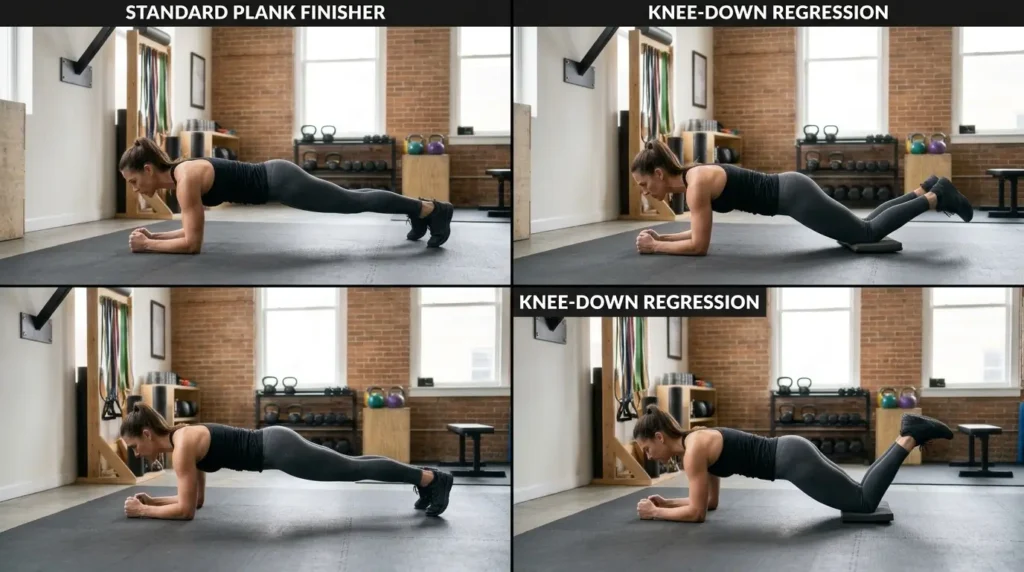
Easier Version (Regression)
- Shadowbox only, with no bag.
- Use 1-minute rounds and 60 to 90 seconds of rest.
- Throw only jabs and crosses.
- Replace the plank with a knee plank.
- Skip jumping in the warm-up and march instead.
Harder Version (Progression)
- Move to 3-minute rounds, which is the standard round length in boxing.
- Add footwork: step forward, back, and side to side between combos.
- Add uppercuts and body hooks to your combinations.
- Hold light dumbbells of 1 to 3 lb (0.5 to 1.4 kg) while shadowboxing, but only if your shoulders feel healthy.
- Cut your rest time down to 30 seconds.
4-Week Progression Plan
| Week | Rounds | Round length | Rest | Sessions per week |
|---|---|---|---|---|
| 1 | 4 | 2 min | 60 sec | 2 |
| 2 | 5 | 2 min | 45 sec | 2-3 |
| 3 | 6 | 2 min | 45 sec | 3 |
| 4 | 6 | 3 min | 60 sec | 3 |
Tracking your rounds is the simplest way to see boxing workout benefits build over time. Space sessions at least one day apart. On other days, do strength work. The CDC recommends muscle-strengthening on two or more days a week, so adding that keeps your plan balanced. A walking habit can fill the gaps too; see our 10,000 steps research review for ideas.
Boxing Workout Benefits vs. Other Cardio Choices
Boxing is not the only way to get a hard, time-efficient workout, though boxing workout benefits are hard to match for variety. If you prefer low-impact cardio, a 30-minute rowing workout is a great alternative. If you like group energy, our comparison of Barry’s vs Orangetheory shows how two popular interval classes differ.
Choose the one you will actually do three times a week, whether or not it offers every one of the boxing workout benefits above. Consistency matters more than the perfect program.
Boxing Workout Benefits by Goal
Different people want different things from boxing. The table below shows how to shape your sessions around your main goal. It uses the same beginner format from above, so you can adjust rounds and rest without learning a new program.
| Your goal | How boxing can help | Simple setup | Pair it with |
|---|---|---|---|
| Heart and lung fitness | Rounds raise your heart rate, then let it recover | 6 rounds of 2 to 3 min, 45 sec rest | Walking or rowing on off days |
| Muscular endurance | Repeated punching and pivoting tires shoulders, core, and legs | 3 bag or shadowboxing sessions a week | Two strength days a week |
| Mood and stress | A timer and a clear task can give your mind a break | Shadowboxing to a steady beat | Good sleep and, if needed, professional support |
| Weight management | Adds to your weekly energy use | 3 sessions plus daily walking | Balanced eating habits |
| Coordination | Combos and footwork train timing | 5 min of footwork drills before rounds | Light balance work |
Notice that no goal depends on boxing alone. The best boxing workout benefits show up when the sessions fit into a full week of movement, rest, and food that supports your training. Start with the row that matches your main goal, then add one new element every two weeks.
Tips to Get the Most Boxing Workout Benefits
These coaching habits help you turn boxing workout benefits into steady progress without overdoing it.
- Learn form before speed. Slow, clean punches teach your body the pattern. Add pace only when your stance stays balanced.
- Stay loose until contact. Keep your shoulders and hands relaxed, then tighten your fist and core at the moment of impact. Constant tension makes you tire early.
- Keep a simple log. Write down the number of rounds, round length, and how hard it felt on a 1 to 10 scale. Over a few weeks, you will see clear progress.
- Use a round timer. Fixed work and rest periods keep you honest and make sessions repeatable.
- Protect your joints. Wrap your hands every time, and do a few wrist and shoulder circles before you start. Replace worn wraps and gloves.
- Schedule recovery. Sleep, an easy walk, and gentle shoulder and hip mobility on rest days help you feel ready for the next session.
- Change one variable at a time. Add rounds, shorten rest, or add a new punch, but not all three in the same week.
If you follow these tips, the boxing workout benefits described in this guide become easier to reach, and you are less likely to deal with sore wrists or shoulders.
Who Should Be Careful with a Boxing Workout
Boxing workout benefits are open to most beginners, and the sessions are generally approachable, but some people need extra care. Check with a doctor or physical therapist first if you have:
- Heart, blood pressure, or lung conditions.
- Wrist, elbow, or shoulder pain, or a recent injury.
- Balance problems or a history of falls.
- Pregnancy or postpartum recovery.
- Osteoporosis or other bone concerns.
- A neurological condition such as Parkinson’s disease.
Beginners should also follow these safety rules:
- Always wrap your hands and use properly fitted gloves on a bag.
- Skip sparring. Hits to the head carry real risks. Stay with non-contact bag work or classes.
- Stop if you feel dizzy, have chest pain, or feel sharp joint pain.
- Build volume slowly. Adding too many rounds too fast is a common cause of sore shoulders and wrists.
- Hydrate and rest. Take at least one full recovery day between hard sessions.
Older adults can enjoy boxing workout benefits through boxing-style training, but they should use a slower pace, a stable surface, and a nearby chair for support. This article is not a medical plan, so personal limits come first.
Frequently Asked Questions
What are the main benefits of a boxing workout? A boxing workout may improve cardio fitness, build muscular endurance in your shoulders, core, and legs, and burn energy during the session. It also trains coordination and footwork. Research suggests interval-style exercise may support mood too, though results vary from person to person.
Is boxing a good workout for beginners? Yes, when you keep it non-contact. Begin with shadowboxing and short rounds, learn a safe stance, and add bag work as your form improves. Start with two sessions a week, and increase gradually. Wrap your hands and use gloves that fit.
How often should I do a boxing workout? Most beginners do well with two or three sessions a week, spaced at least a day apart. The CDC also recommends muscle-strengthening on two or more days weekly, so fill your off days with strength work or walking. Adjust based on soreness and recovery.
Does boxing help with weight loss? Boxing can burn energy, but weight change depends on your overall energy balance over time. It cannot target belly fat specifically. Pair regular sessions with sensible eating and sleep. Talk with a doctor or registered dietitian before starting a weight loss plan.
Does boxing build muscle? Boxing mainly builds muscular endurance, not large muscle size. Your shoulders, core, and legs work hard for many reps. If building muscle is your goal, add resistance training with weights or progressive calisthenics, and use boxing as a cardio and conditioning tool.
Can boxing help with stress? It may. Studies on high-intensity interval training link it to better well-being and lower perceived stress, though a 2024 review found the evidence unclear in healthy adults. Boxing is not a medical treatment. If stress or low mood feels heavy, please talk with a healthcare professional.
Conclusion
The best boxing workout benefits come from steady, smart practice: stronger cardio fitness, better muscular endurance, a solid energy burn, and sharper coordination. The research on interval training is encouraging, but it also shows we should avoid big promises. Start with a simple stance, short rounds, and wrapped hands.
Follow the 4-week plan, add strength work on other days, and listen to your body. If you are ready to turn boxing workout benefits into a habit, schedule your first two sessions today and keep them short and clean.
