Barre Workout Benefits: What the Research Shows (and a 30-Minute Routine to Try)
Barre workout benefits come mostly from one thing: long, controlled work for your legs, glutes, core, and arms at a light load. As a result, the workout feels hard without heavy weights or impact. At the same time, barre has clear strengths and clear limits.
I’ll be straight with you about the science. Barre has far less research behind it than running, lifting, or Pilates. Therefore, this guide shows which studies exist, what they can and cannot prove, and how to build a session that works. Think of it as a coach’s honest briefing, not a sales pitch.
Quick Answer
Barre workout benefits include better muscular endurance in the legs and core, improved posture and balance, and more flexibility in a joint-friendly format. However, early studies are small, so results look promising rather than proven. Barre does not build maximal strength or bone density well, so pair it with other training.
What Is a Barre Workout?
A barre class borrows from ballet, Pilates, and strength training. First, you hold a ballet barre, or a sturdy chair or counter, for support. Then you do small, precise movements for many repetitions, often finishing with long isometric holds.
Most classes run 45 to 60 minutes. For example, a session may move from arms with light weights, to thighs and glutes at the barre, to a core section on the mat, and finally to a stretch. In addition, the shaking you feel is simply muscle fatigue, so it does not mean something is wrong.
Muscles Barre Works
- Primary: quadriceps, glutes, hamstrings, inner thighs, calves
- Secondary: transverse abdominis, obliques, rectus abdominis, shoulders, upper back, and the deep postural muscles along the spine
What Does the Research on Barre Workout Benefits Say?
Here is the honest picture. Only a handful of small studies have tested barre itself. Meanwhile, several others tested ballet, which is related but not identical.
Studies on Barre Workout Benefits
- A randomized study in the Journal of Sports Science and Health placed 30 sedentary female office workers (ages 30 to 45) into a barre group or a control group. The barre group trained three times a week for eight weeks, and the authors reported better lower-limb and core muscle endurance and strength than controls. Because the comparison group did nothing, the study shows barre beats staying inactive. It does not show barre beats other workouts.
- A 2023 study of 35 women aged 21 to 35 compared barre fitness with dance fitness. According to the report, the barre group showed statistically significant gains in several fitness measures, whereas the dance group’s changes were not significant. Still, the groups were small, so treat this as an early signal.
- A 2023 observational study in Urogynecology followed women new to barre and tracked urinary incontinence symptoms. Since it had no control group, it cannot separate the effect of barre from the effect of time or attention. [VERIFY exact findings against the full text before publishing]
Related Evidence From Ballet
- A systematic review of 23 classical ballet studies found that ballet training may improve balance in novices and may help people stay active across the lifespan. However, the studies varied a lot.
- A single-arm study of women over 50 reported positive effects on strength and balance, along with high attendance. Even so, without a control group it cannot prove ballet caused the gains.
- In a randomized trial of 44 older women, virtual ballet and virtual wellness classes both improved select gait and balance measures. Notably, the authors pointed to social interaction as a possible key factor.
Bottom line: the research suggests barre is a reasonable, low-impact way to build muscular endurance, and it may help balance. Nevertheless, it does not show that barre beats Pilates, yoga, or strength training. As far as I could find, nobody has tested that head-to-head.
The Main Barre Workout Benefits, Explained
Barre Workout Benefits for Strength and Endurance
1. Better muscular endurance. Muscular endurance is how long a muscle can keep working at a light load. Barre trains it directly through high reps and long holds. In daily life, that helps with standing up from a chair, climbing stairs, and carrying groceries. Moreover, this is where the research is most consistent, since the office-worker trial reported greater endurance and strength gains in the legs and core. If you like the hold-based work, our guide to isometric leg exercises goes deeper.
2. A stronger core and better posture. Many barre moves cue you to tuck your pelvis, lift your ribs, and keep your shoulders down. Consequently, you train the deep core muscles that hold you upright. Barre may help good posture feel easier to hold, although no large trial has measured this directly. In particular, if you sit all day, the glute and core work is a good match. For a related issue, see our guide to anterior pelvic tilt exercises.
Barre Workout Benefits for Balance and Mobility
3. Improved balance. Holding the barre with one hand, lifting one leg, and rising onto your toes all challenge balance. This matters at every age, and especially as you get older. Still, the ballet research above comes from ballet classes, not barre classes. Therefore, treat the balance link as plausible, not proven.
4. More flexibility and mobility. Most classes end with stretches for the hips, hamstrings, and back. Over time, regular stretching can help you move through a fuller range. Your hips may feel looser after a few weeks, but results vary from person to person.
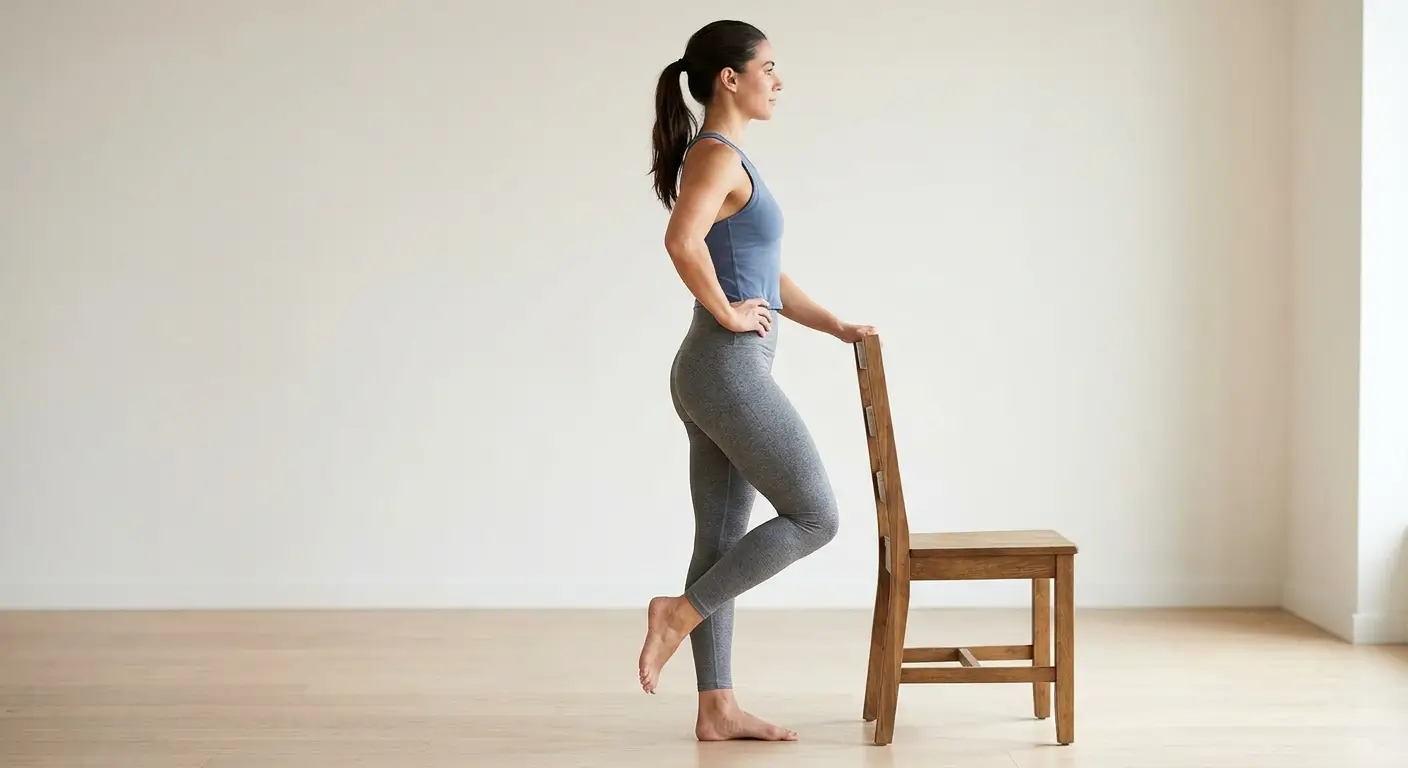
5. A joint-friendly workout. Barre has no jumping or pounding, and your feet stay mostly planted. In addition, you can adjust the range of motion, which makes the workout comfortable for people who find running or HIIT rough on the knees, hips, or feet. That said, low impact is not the same as no risk. Deep knee bends and long holds can still bother sore joints.
Everyday Health Benefits of Barre
6. Pelvic floor awareness. Many instructors cue a gentle pelvic floor lift during inner-thigh and core moves. That awareness may be useful. However, barre is not pelvic floor therapy. A Cochrane review found that women with stress incontinence who did targeted pelvic floor muscle training were far more likely to report being cured than untreated women. For this reason, if you leak urine when you cough, jump, or lift, talk to a doctor or pelvic floor physical therapist instead of relying on classes alone.
7. A workout you will keep doing. Consistency beats perfection. Barre is music-driven, easy to scale, and friendly to beginners. Likewise, the older-women studies reported high attendance in ballet-based programs, which hints that people enjoy this style of class. A plan you enjoy is a plan you repeat.
8. Support for weekly activity goals. The CDC says adults need at least 150 minutes of moderate aerobic activity a week plus muscle-strengthening activity on two or more days [VERIFY: this is the 2008 CDC fact sheet; swap in the current CDC adult-activity page]. Barre can count toward the strengthening side if the class works your major muscle groups. On the other hand, it will not cover your aerobic minutes unless the class is fast-paced.
Barre Workout Benefits at a Glance
| Benefit | What evidence exists | Confidence |
|---|---|---|
| Leg and core muscular endurance | One small randomized study vs. inactive controls | Moderate-low |
| Overall fitness vs. dance fitness | One small study in young women | Low |
| Balance | Ballet studies, not barre-specific | Low-moderate |
| Posture | Practical cues, no strong trials | Low |
| Flexibility | Class design, limited direct data | Low |
| Pelvic floor symptoms | Observational study, no control group | Very low |
| Max strength and bone density | Not shown; light loads limit these | Not supported |
What Barre Does Not Do Well
Good coaching means naming the limits too.
- Maximal strength and muscle size. Light weights and body weight limit the load your muscles feel. Once you pass the beginner stage, heavier lifting builds more strength. Fortunately, a well-built barbell workout for women pairs nicely with barre.
- Bone density. Bone responds to higher strain, such as heavy lifting or impact, and a standard barre class has neither. Because no study I found measured bone density after barre, this is a reasoned limit, not a tested result.
- Fat loss. Barre burns energy, yet class intensity varies a lot. Also, no research I found shows barre alone changes body fat, so be wary of anyone who promises a number.
- “Toning.” Muscles do not tone into a different shape. Instead, they get stronger and fitter, and what you see depends on body fat and genetics.
How to Get the Most From Barre Workout Benefits
How Often Should You Do Barre?
For most beginners, two to three sessions a week works well, with at least one rest day between them. In addition, add a walking habit on the other days, such as the routine in our guide to 10,000 steps benefits. Walking covers the aerobic side that barre often under-delivers.
| Goal | Barre sessions per week | Pair it with |
|---|---|---|
| Build a habit | 2 | 2 walks of 20-30 minutes |
| Improve endurance and balance | 3 | 1-2 strength sessions |
| Add strength | 1-2 | 2 weight sessions with heavier loads |
A 30-Minute Routine to Get Barre Workout Benefits at Home
You do not need a studio. A sturdy chair or kitchen counter works as your barre. Ideally, the surface sits around hip height, roughly 36 to 42 inches (91 to 107 cm) for a standing counter, and it must not slide or tip.
Next, gather a mat, a pair of 1 to 3 lb (0.5 to 1.4 kg) dumbbells (water bottles work too), and a small cushion or soft ball for the inner-thigh squeeze. If you plan to progress the weights, see our comparison of adjustable vs. fixed dumbbells.
Warm-up (5 minutes): march in place, do shoulder rolls, make gentle hip circles, and finish with bodyweight squats to a chair.
| Exercise | Sets | Reps / Time | Rest |
|---|---|---|---|
| Plié squats (wide stance) | 2 | 12-15 reps + 20 sec hold | 30 sec |
| Relevé (heel raises) | 2 | 15 reps, slow tempo | 30 sec |
| Standing side leg lift | 2 | 10-12 per leg | 30 sec |
| Chair glute kickback | 2 | 10-12 per leg | 30 sec |
| Light-weight arm series (curls, rows, overhead press) | 2 | 12-15 reps | 30 sec |
| Inner-thigh ball squeeze | 2 | 15 reps + 10 sec hold | 30 sec |
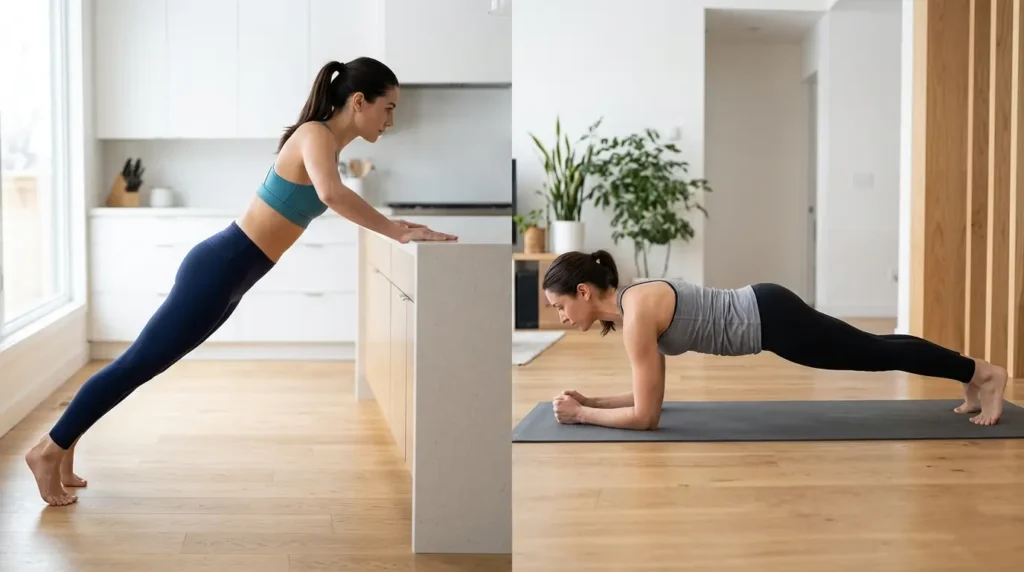
| Plank or incline plank | 2 | 20-30 sec | 30 sec |
Cool-down (3-5 minutes): hip flexor stretch, hamstring stretch, and child’s pose.
How to Do the Key Moves
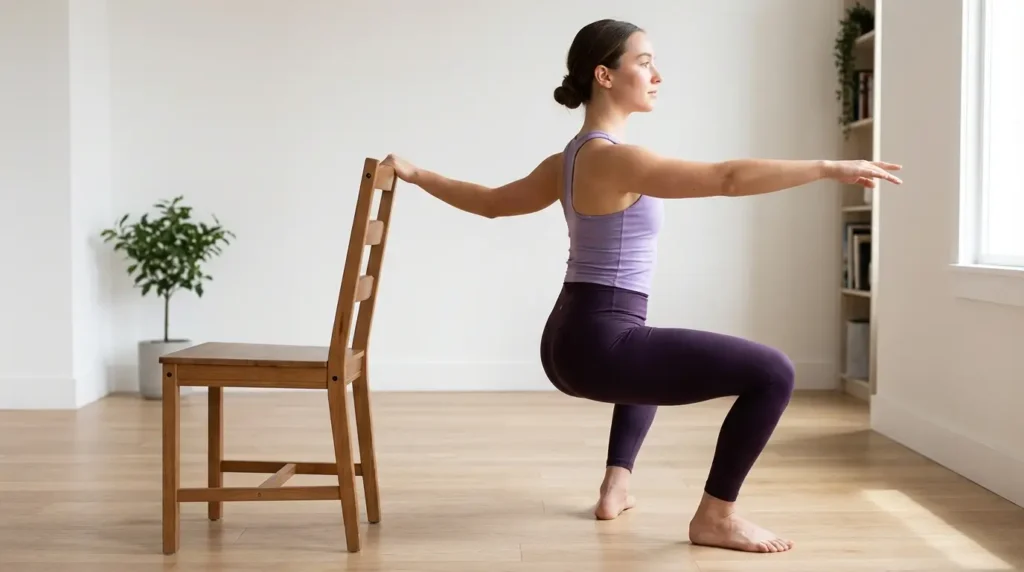
Plié squat
- Stand with your feet wider than your hips and toes turned out about 30 to 45 degrees.
- Rest one hand lightly on the barre or chair.
- Bend your knees straight over your toes, then lower until your thighs are close to parallel, or only as far as feels comfortable.
- Keep your ribs stacked over your hips and your tailbone pointing down.
- Press through your heels to stand, and squeeze your glutes at the top.
- Tempo: about 2 seconds down, 1 second up. Our guide on doing squats every day covers how often to repeat them.
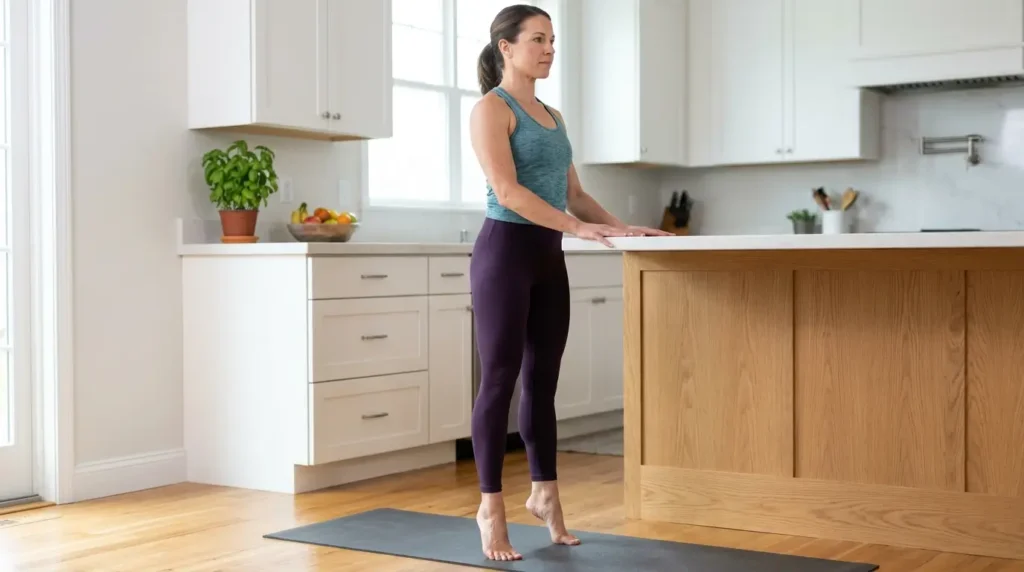
Relevé (heel raise)
- Stand with your feet parallel, hip-width apart, hands on the barre.
- Lift your heels slowly, rising as high as you can without your ankles rolling outward.
- Pause for a second at the top, then lower for 3 seconds.
- Cue: imagine a string pulling the crown of your head to the ceiling.
Standing side leg lift
- Stand tall with one hand on the barre and feet together.
- Lift your outside leg to the side about 12 to 18 inches (30 to 45 cm), toes facing forward.
- Keep your hips level, and do not lean toward the opposite side.
- Lower slowly, then repeat.
Coach’s Tip: Move smaller and slower than you think you should. Barre works through control, not range. For instance, if your leg swings or your back arches, shrink the movement until you feel the target muscle and nothing else. You should feel a deep, burning fatigue in the muscle, not sharp pain in a joint.
Common Mistake: Gripping the barre too tightly and leaning on it. The barre is for balance, not for holding you up. To fix this, rest just your fingertips on it. If you cannot balance that way, lower the difficulty instead of clamping on.
Easier and Harder Versions
| Regression (easier) | Progression (harder) | |
|---|---|---|
| Plié squat | Shallower depth, both hands on the counter | Hold a 3-5 lb (1.4-2.3 kg) dumbbell at your chest, or add a slow pulse at the bottom |
| Relevé | Both hands on the counter | Lift on one foot, or add a 3-second hold at the top |
| Side leg lift | Slide the toe out along the floor | Add a light ankle weight or a band (see ankle weights benefits) |
| Plank | Incline plank with hands on the counter | Full plank with 40-60 second holds |
Who Should Be Careful With Barre?
Check with your doctor or physical therapist first if you:
- Have knee, hip, or back pain, or a recent injury
- Are pregnant or postpartum (ask your provider which moves are safe, especially core work and deep holds)
- Have osteoporosis or low bone density
- Have balance problems or a history of falls
- Manage a medical condition, or have been inactive for a long time
- Notice urine leakage during exercise, or a heavy or bulging feeling in the pelvis
Above all, stop any move that causes sharp, pinching, or radiating pain. Slight muscle burn and shaking are normal. Joint pain, however, is not.
Barre vs. Other Low-Impact Workouts
Barre overlaps with Pilates and yoga, but the emphasis differs. Specifically, barre leans on standing leg endurance and holds, while Pilates focuses more on core control and spinal movement. If you like the mat side, try our Pilates criss-cross guide or the Pilates chair workout for beginners.
Later, once flat-ground moves feel easy, a BOSU ball can make single-leg barre moves harder.
FAQ
What are the main barre workout benefits?
Barre may improve leg and core muscular endurance, posture awareness, balance, and flexibility in a low-impact format. Early studies are small, though. Barre is a useful addition to a routine, but it is not a complete program, since it does not train maximal strength or aerobic fitness well.
Is barre good for weight loss?
Barre burns energy, but no strong evidence shows barre alone drives weight or fat loss. Results depend on class intensity, nutrition, sleep, and total weekly activity. Therefore, combine barre with walking and strength training, and see your doctor before starting a weight-loss plan.
Does a barre workout build muscle?
Barre can build muscle endurance, especially in beginners. For significant muscle size or maximal strength, however, heavier resistance training works better. Many people use barre two days a week alongside lifting for a balanced plan.
Is barre better than Pilates?
No research I found compares them directly. Barre emphasizes standing leg endurance and holds, while Pilates emphasizes core control and spinal movement. Consequently, choose the one you enjoy and will keep doing, or mix both across the week.
How often should you do barre workout sessions?
Two to three sessions a week with a rest day between them suits most beginners. Meanwhile, add walking or other aerobic activity on other days. Increase length or intensity gradually, and reduce the load if joints feel sore.
Can you do barre at home without a barre?
Yes. A sturdy chair back or kitchen counter at about hip height works well. Wear grippy socks or go barefoot, clear the floor, and use light weights or water bottles. Then follow a beginner video or the routine above.
Are the Barre Workout Benefits Worth It?
The barre workout benefits that research supports best are muscular endurance in the legs and core. In addition, balance, posture awareness, and flexibility gains are plausible, all in a low-impact, joint-friendly format. Still, the evidence is early, so keep your expectations realistic.
Use barre as one part of a bigger plan. For example, two or three sessions a week, plus walking and some heavier strength work, covers the gaps. Finally, start small, move with control, and build from there.
